Infographic
Published October 22, 2022
CommercialBy following this simple 8- step process you can get started with monthly Reporting to Experian. Reward and protect your borrowers and businesses throughout their financial journey by revealing a more complete credit history.
Download the infographic
View now Report
Q1 2026 Main Street Report
U.S. small businesses entered Q1 2026 navigating a more complex and constrained operating environment shaped by slowing economic growth, rising energy costs, and tightening credit conditions. The Experian Small Business Index™ declined 5.5 points in February to 48.8, reflecting near-term softening, but remains above year-ago levels and within its historical range, signaling underlying stability.
Macroeconomic conditions are creating some headwinds. GDP growth rebounded to 2.0% in Q1 after the Q4 government shutdown but was below market expectations. Inflation re-accelerated to 3.3% in March, driven in part by rising energy prices following geopolitical disruptions in global oil markets. The closure of the Strait of Hormuz contributed to a sharp increase in oil prices, raising transportation and input costs across industries. At the same time, consumer confidence declined to a historic low of 49.8, indicating growing caution among households and increasing risk for consumer-facing businesses.
Credit conditions reflect a widening divergence between supply and demand. According to the Federal Reserve's Senior Loan Officer Opinion Survey, lenders continue to tighten underwriting standards even as demand for commercial credit is expected to increase. This dynamic is likely to constrain access to capital, particularly for smaller or higher-risk borrowers.
Despite these headwinds, small business formation remains strong, with new business applications exceeding historical averages. However, sentiment has weakened. Expectations for improved business conditions declined sharply, and capital investment activity has slowed, reflecting elevated uncertainty and cautious planning.
Report
Q4 2025 Main Street Report
The U.S. economy continued to expand in Q4 2025, though the pace of growth slowed and underlying indicators presented increasingly mixed signals. Real GDP rose at a 1.4% annualized rate, reflecting continued expansion but marking a deceleration from earlier in the year. In January 2026[GS1.1][SM1.2], inflation moderated to 2.4% year-over-year, providing relief to businesses and consumers alike. Meanwhile, the unemployment rate remained relatively low at 4.3%, underscoring ongoing labor market resilience.
However, beneath these stable headline indicators, signs of cooling emerged. Consumer spending and retail sales slowed during the quarter, suggesting households are becoming more selective amid elevated borrowing costs and slower wage growth. While consumer sentiment edged slightly higher in December, spending momentum weakened. Wage growth continued to moderate, and labor market churn declined, with lower quits and softer hiring activity signaling a gradual normalization rather than contraction.
According to the Experian Small Business Index™, business credit conditions remained within the typical 40-60 range. Lending availability showed slight tightening during the fourth quarter, while APRs remained elevated but stable. Entrepreneurial momentum remained strong. New business formations averaged approximately 509,000 per month, with acceleration most pronounced in the South and West.
Despite these pressures, optimism improved modestly among both consumers and small business owners. The NFIB Small Business Optimism Index and University of Michigan Consumer Sentiment Index both recorded gains in December, suggesting confidence has stabilized even as economic momentum slows. As 2025 closesclosed, small businesses remained fundamentally stable but increasingly cautious, navigating a higher-cost credit environment and moderating demand.
 Report
Q3 2025 Main Street Report
The holidays are here, and Black Friday sparks a surge in consumer spending. U.S. small businesses are proving remarkably resilient despite persistent economic challenges. Inflation held at 3.0% in September, and interest rates remain elevated, yet entrepreneurs are capitalizing on seasonal demand through digital innovation and disciplined financial strategies.
August saw 428,937 new business applications, a 10% year-over-year increase driven by minority and younger founders, while the Experian Small Business Index™ rose to 41.1, signaling improved credit health. With average credit card APRs exceeding 21.5%, small firms are shifting toward installment loans to finance inventory and holiday promotions, ensuring structured repayment and sustainable growth.
This adaptability positions local retailers to turn economic headwinds into opportunities, leveraging festive shopping momentum to strengthen their foothold in a competitive market.
 Video
Video
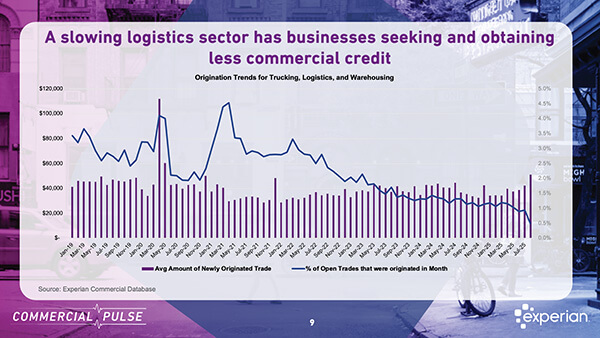
Rising Delinquencies Signal Growing Risk in Transportation & Warehousing
As the U.S. economy continues to recalibrate post-pandemic, the transportation and warehousing segments of the logistics sector are signaling caution. While the broader logistics industry has remained in expansion mode, Experian’s latest Commercial Pulse Report reveals that delinquencies are rising—an early warning of growing risk in two of the economy’s most critical subsectors.
Check out the full report to see how these trends could impact your strategy!