Report
Economy Solid as Mixed Signals Persist
Published February 24, 2026
Commercial Commercial Insights Credit & Economic Trends Economic & Market Insights
The U.S. economy continued to expand in Q4 2025, though the pace of growth slowed and underlying indicators presented increasingly mixed signals. Real GDP rose at a 1.4% annualized rate, reflecting continued expansion but marking a deceleration from earlier in the year. In January 2026[GS1.1][SM1.2], inflation moderated to 2.4% year-over-year, providing relief to businesses and consumers alike. Meanwhile, the unemployment rate remained relatively low at 4.3%, underscoring ongoing labor market resilience.
However, beneath these stable headline indicators, signs of cooling emerged. Consumer spending and retail sales slowed during the quarter, suggesting households are becoming more selective amid elevated borrowing costs and slower wage growth. While consumer sentiment edged slightly higher in December, spending momentum weakened. Wage growth continued to moderate, and labor market churn declined, with lower quits and softer hiring activity signaling a gradual normalization rather than contraction.
According to the Experian Small Business Index™, business credit conditions remained within the typical 40-60 range. Lending availability showed slight tightening during the fourth quarter, while APRs remained elevated but stable. Entrepreneurial momentum remained strong. New business formations averaged approximately 509,000 per month, with acceleration most pronounced in the South and West.
Despite these pressures, optimism improved modestly among both consumers and small business owners. The NFIB Small Business Optimism Index and University of Michigan Consumer Sentiment Index both recorded gains in December, suggesting confidence has stabilized even as economic momentum slows. As 2025 closesclosed, small businesses remained fundamentally stable but increasingly cautious, navigating a higher-cost credit environment and moderating demand.
Download Report
This site is protected by reCAPTCHA and the Google Privacy Policy and Terms of Service apply.
Thank you
Your report should open up in a new window.
 Webinar
Data Strategies for Smarter Tribal Lending Decisions
As Tribal lending evolves, understanding how consumer behavior, credit demand and portfolio performance are shifting is becoming increasingly important for effective risk strategy.
- Examine emerging credit and consumer trends across Tribal lending
- Understand where risk and growth opportunities are shifting
- Explore how more specialized data and analytics can improve risk differentiation
- Consider how purpose-built scoring can support more informed lending decisions
 Webinar
Modernizing mortgage underwriting with better data
See how evolving credit scores, alternative data, and verification tools could help lenders improve the mortgage process and expand access to homeownership.
In this HousingWire conversation, Allison LaForgia speaks with Michele Bodda, Group President of Experian Housing, Verification Solutions and Employer Services. Bodda discusses how lenders can put modern credit scoring and consumer data to work in underwriting today.
Watch the video to hear about:
• Using alternative credit data to better represent consumers with limited traditional credit histories
• Bringing the right information into the underwriting process at the right time
• How Power Profile Plus lets lenders request another score later in the process without repurchasing the underlying credit data
• Experian’s investment in income and employment verification, including its partnership with Workday
• Opportunities to improve efficiency and help more people pursue homeownership
 Report
Credit Card Market Growth Chartbook: Q2 2026
Explore credit card market trends through Q2 2026, including changes in originations, issuer performance and consumer segments.
- Track secured and unsecured credit card growth.
- Compare national banks, regional banks, credit unions, fintechs and subprime issuers.
- Examine origination trends by credit score and generation.
 Webinar
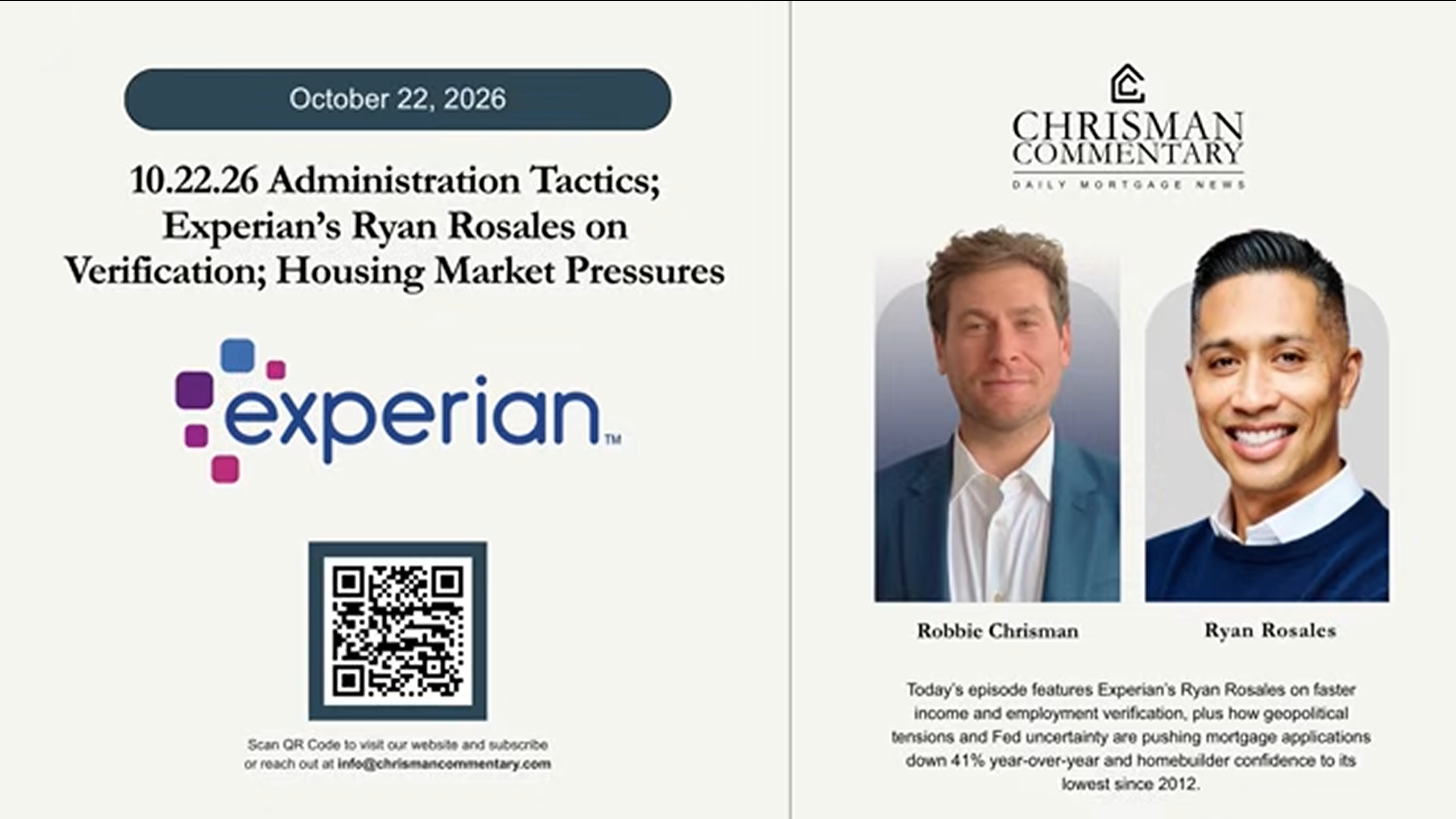
Experian’s Ryan Rosales on Improving Verification Speed and Borrower Experience
In this episode of the Chrisman Commentary, we explore why income and employment verification are reaching a turning point for mortgage lenders and borrowers alike. Ryan Rosales discusses how new data sources, including Experian Verify’s integration with Workday, are helping move the industry beyond the traditional choice between a few verification providers and cumbersome manual documentation. Tune in to hear how greater competition, expanded data coverage, real-time verification, and a more open ecosystem could reduce borrower friction, lower lender costs, and potentially reshape the future of mortgage origination.