


Business Information Blog

Credit Management

Credit Management

Reports & Scores

Business Credit Reports and Scores

Data & Analytics

Data and Analytics


The latest from our experts

Loading…
How Blended Credit Scores Improve Small Business Lending Decisions

How blended credit scores help SMB lenders improve risk assessment, expand automation, reduce false declines, and drive profitable growth.

Published: June 1, 2026 by Gary Stockton
The Rise of Sole Proprietors Is Reshaping Small Business Credit Risk

The U.S. small business landscape is undergoing a structural transformation — and commercial lenders may need to rethink what a “small business borrower” looks like. According to Experian’s May 26th, 2026 Commercial Pulse Report, new business formations remain at historically elevated levels, averaging approximately 450,000 per month since the pandemic. That pace represents a 54% increase compared to pre-pandemic averages from 2018 and 2019. Watch the Commercial Pulse Update According to Experian’s latest Commercial Pulse Report, new business formations remain at historically elevated levels, averaging approximately 450,000 per month since the pandemic. That pace represents a 54% increase compared to pre-pandemic averages from 2018 and 2019. But perhaps more importantly, the composition of those businesses has changed dramatically. In early 2026, approximately 93% of newly formed businesses were sole proprietorships, up from 85% in 2018. Many of these businesses have no employees, limited operating history, and different borrowing behaviors than the traditional small businesses lenders historically underwrote. That shift is creating a fundamentally different commercial credit environment. A Different Kind of Small Business Owner Historically, many small business lending models were designed around businesses with employees, established operations, recurring revenue streams, and longer credit histories. Today’s wave of new businesses often looks very different. Many newer firms are being launched by individuals pursuing consulting work, freelance opportunities, side businesses, creator-economy income streams, or post-retirement self-employment. These businesses may operate leaner, carry lower fixed costs, and rely more heavily on revolving credit products rather than traditional financing structures. In many cases, the business owner and the business itself are financially intertwined. That evolution matters because underwriting a sole proprietor is not the same as underwriting a mature operating company. The rise in sole proprietorships is being driven by several long-term labor force and demographic trends now reshaping the U.S. economy. Demographic Shifts Are Driving Entrepreneurship One of the most important forces behind the surge in sole proprietorships is the aging U.S. population. By 2050, individuals aged 55 and older are projected to represent nearly 40% of the total U.S. population. At the same time, Americans are increasingly working later in life. Labor force participation among older workers has steadily increased over the past two decades, while participation among younger workers has trended lower. Retirement itself is also evolving. Many retirees are no longer fully exiting the workforce. Instead, they are remaining economically active through part-time consulting, contract work, side businesses, and self-employment arrangements. According to research highlighted in Experian’s report, 59% of workers expect to continue working during retirement, while 61% of recent retirees express interest in continued employment. These trends are contributing to a growing segment of “microbusinesses” — businesses with few or no employees operating primarily around the skills, experience, or services of an individual owner. At the same time, broader workplace dynamics are also influencing entrepreneurial activity. Employee Engagement Is Falling According to Gallup, employee engagement in the U.S. and Canada declined to 31% in 2025, down from post-pandemic highs. Gallup estimates that low engagement costs the global economy nearly $10 trillion in lost productivity. Younger workers in particular appear increasingly affected by workplace stress, burnout, and changing expectations around flexibility and career mobility. As a result, more individuals may be pursuing alternative work arrangements, independent income streams, or self-employment opportunities. The side-hustle economy continues to expand as well. A recent PYMNTS study found that nearly 20% of workers engaged in regular side work during the previous six months. Collectively, these labor force dynamics are reshaping not only how Americans work, but also how small businesses are formed, financed, and evaluated from a credit perspective. Commercial Credit Usage Looks Different Experian data shows meaningful differences in how smaller and larger businesses use commercial credit. Smaller businesses and sole proprietors rely more heavily on commercial credit cards, while larger firms tend to utilize a broader mix of leases, lines of credit, and term loans. Businesses with four or fewer employees received average commercial card credit lines of roughly $8,900 in 2025. By comparison, businesses with more than 100 employees averaged approximately $29,500 in new commercial card credit lines. Even when loan origination rates appear similar across business sizes, loan amounts differ substantially. Businesses with fewer than four employees averaged approximately $119,000 in term loan originations, while larger businesses averaged closer to $268,000. Risk performance differs as well. Larger firms generally continue to demonstrate lower delinquency rates and stronger commercial credit scores, reflecting greater operational scale, more established financial histories, and broader access to capital. Why Risk Models May Need to Evolve For lenders, these shifts present both opportunity and complexity. The surge in new business formation creates potential growth opportunities across commercial credit markets. However, many of today’s borrowers may not fit historical underwriting assumptions. Traditional business risk models often relied heavily on factors associated with mature operating businesses — payroll size, years in business, trade depth, and established commercial borrowing history. Today’s newer firms may instead require a more blended view of risk that incorporates both commercial and consumer-level behaviors, cash flow dynamics, and alternative indicators of financial stability. As sole proprietors and microbusinesses continue to account for a growing share of the small business economy, lenders may need to remain agile in balancing portfolio growth with disciplined underwriting and risk management strategies. The definition of “small business” is evolving — and commercial risk models may need to evolve alongside it. Learn more ✔ Visit our Commercial Insights Hub for in-depth reports and expert analysis. ✔ Subscribe to our YouTube channel for regular updates on small business trends. ✔ Connect with your Experian account team to explore how data-driven insights can help your business grow. Download the Commercial Pulse Report Visit Commercial Insights Hub Related Posts

Published: May 26, 2026 by Gary Stockton
Experian Q1 2026 Main Street Report

The Experian Main Street for Q1 2026 highlights a landscape defined by mixed macro signals, tightening credit, and early signs of stress.

Published: May 11, 2026 by Gary Stockton
Small Business Stability Holds as Experian Small Business Index Edges Up in March

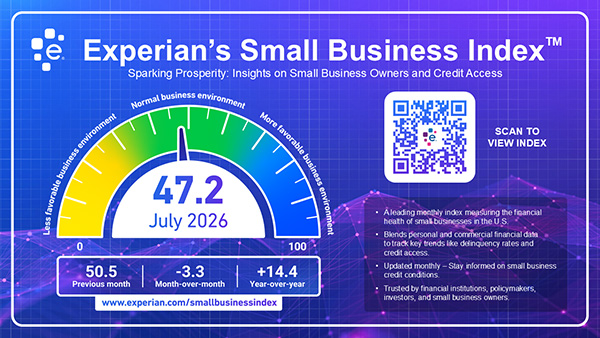
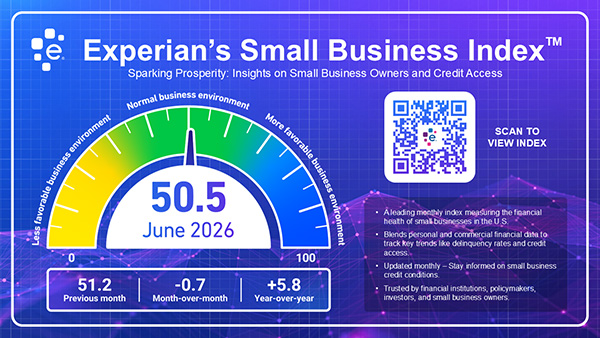
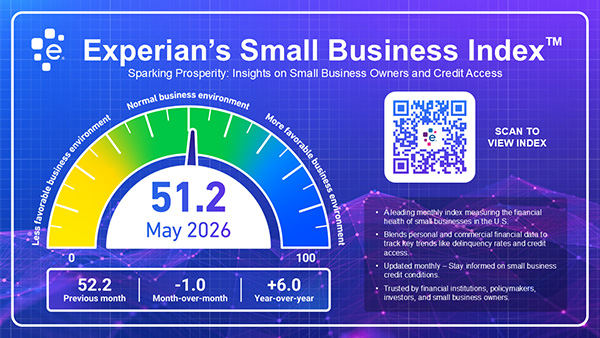
Incremental increase underscores steady operating environment even as inflation and sentiment present headwinds Mar 2026 Index Value (Mar): 49.2 Previous Month: 48.8 MoM: 0.4 YoY: 2.0 (Mar 2025 = 47.2) The Experian Small Business Index™ remained largely unchanged in March, increasing by 0.4 points to 49.2. This reflects a year-over-year increase of 2 points and indicates relative stability in small business conditions. The broader macroeconomic environment continues to present mixed signals, contributing to recent variability in the index. Conditions appeared more stable in March. The unemployment rate held steady at 4.3 percent, and wages continued to rise modestly. Gross domestic product increased by 2 percent in the first quarter and has been positive in most quarters over the past two years. Private employers added approximately 62,000 jobs in March. U.S. employers also reported 32,826 planned hires, which is an increase from 12,755 reported in February. Inflation increased to 3.3 percent in March, up from 2.4 percent in February, driven in part by higher fuel prices. Gasoline prices rose by approximately $1.00 from the end of February through the end of March, reaching an average of about $4.00 per gallon. This represents a month over month increase of 36 percent. Diesel prices rose by 46 percent compared to the prior month and are up 52 percent year over year. Consumer sentiment declined to 53.3 in March from 56.6 in February. The Small Business Optimism Index also decreased slightly to 98.8. Retail sales remained stable to slightly higher, suggesting that increased fuel costs and lower sentiment have not yet led to a significant reduction in consumer spending. New business formation remained strong, with approximately 492,000 new businesses established in March. Explore Experian Small Business Index Related Posts

Published: May 7, 2026 by Gary Stockton
Commercial Office Space: Strong Credit Performance in a Shifting Market

Commercial office space businesses show strong credit performance despite rising vacancies. Explore key trends shaping risk, demand, and resilience.

Published: May 4, 2026 by Gary Stockton
AI-Driven Energy Demand and the Emerging Impact on Credit Risk

AI-driven energy demand is reshaping credit risk. Learn how rising energy costs may impact small business performance and lending strategies.

Published: April 27, 2026 by Gary Stockton
Small Business Index Decreased 5.5 Points in February

The Experian Small Business Index declined in February on soft employment data. Check conditions in your State of Industry.

Published: April 15, 2026 by Gary Stockton
What Your Business Credit Score Is Really Telling the CRO

Learn how to use business credit scores to analyze portfolio risk, track migration, and make smarter commercial lending and risk decisions.

Published: April 7, 2026 by Gary Stockton
AI-Driven Businesses Are Pulling Ahead—And Credit Data Proves It

Experian Commercial Pulse explores how AI is changing credit risk with a fascinating study of high-impact AI industries.

Published: April 6, 2026 by Gary Stockton
Women-owned Small Businesses Growing Faster Than Male-owned

Understand the credit dynamics of women-owned small businesses and their critical role in the growth of the U.S. economy.

Published: March 23, 2026 by Gary Stockton
Banking Transformation: From Consolidation to AI: The New Risk Equation

Banking transformation is accelerating through consolidation, digital adoption, and AI innovation. What must CROs prepare for next?

Published: March 9, 2026 by Gary Stockton
Small Business Index Gains 8.5 Points in January

The Experian Small Business Index™ increased 8.5 points to 54.3 in January. This is 12.8 points higher than it was a year ago.

Published: February 27, 2026 by Gary Stockton
Commercial Insights Hub

Follow Us!

Subscribe to our blog

Enter your name and email for the latest updates.

This site is protected by reCAPTCHA and the Google Privacy Policy and Terms of Service apply.

About this blog

The latest insight, tips, and trends on all things related to commercial risk by the team at Experian Business Information Services. Please follow us on social media.

Stay informed by subscribing to this blog

Sign up for email notifications when new content has been published by Experian Business Information Services.
Sign Up