Latest Posts

Income and employment verification processes must be able to meet the demands of today's digital consumer. Learn how you can get it right.

People-based marketing connects businesses with real people, helping them understand who their customers are and how to engage them in more meaningful ways.

According to Experian’s Automotive Market Trends Report: Q1 2022, new vehicle registrations were down 19% from the prior year—declining to 3.4 million. Used registrations went from 11.4 million to 9.9 million year-over-year, decreasing 13.2%.

With the pandemic waning, now is the time for financial institutions to take action on financial inclusion. Read on to learn more!

Experian’s identity, verification, and fraud solutions can help government agencies of all sizes on their journey to digital modernization.

Whether a consumer has a brand-new or used vehicle, it’s inevitably going to need regular maintenance and require repairs. Fortunately for aftermarket professionals, the aftermarket “sweet spot” is continuously growing—a trend that should be watched closely. Vehicles in the sweet spot are typically between six- to 12-model-years-old and have aged out of general OEM manufacturer warranties for any repairs. Knowing the model year and type of vehicles that are in operation will be important for aftermarket professionals to determine what parts may be needed, and anticipate potential consumer needs. According to Experian’s Automotive Market Trends Report: Q1 2022, 35.8% of vehicles in operation (VIO) now fall within the aftermarket sweet spot, a 6.5% year-over-year increase. It is important to note that the aftermarket sweet spot max volume record of 104 million is expected to be broken over the next 12-18 months, considering the sweet spot volume was 100.3 million through Q1 2022 and the last time it exceeded that number was nine years ago. The increase will create more opportunities for aftermarket professionals as more vehicles will potentially need maintenance. Aftermarket “sweet spot” will continue to grow Right now, the aftermarket sweet spot consists of model years between 2011 and 2017. There were 10.5 million 2011 model year vehicles on the road through Q1 2022, this low volume will transition into the post-sweet spot next year. At the same time, there will be 16.5 million 2018 model year vehicles entering the sweet spot. Furthermore, an estimated 16.7 million vehicles in operation with a 2019 model year and almost 14.3 million vehicles in operation with a 2020 model year will be transitioning into the sweet spot in the next two years. When these model year vehicles enter the sweet spot, the current 12 million vehicles with a 2012 model year and an estimated 13.7 million 2013 model year vehicles will transition into the post-sweet spot, resulting in a notable increase. Watching this data closely will allow aftermarket professionals to continue assisting with maintenance and repairs for these vehicles that are currently on the road, as well as prepare for what’s to come to the aftermarket industry in approaching years. To learn more about other vehicle registration trends, watch the full Automotive Market Trends Report: Q1 2022 presentation on demand.

Online transactions face a higher chance of being declined because face-to-face transactions come with a higher degree of confidence. Businesses who fail to address this problem run the risk of losing the customer permanently, damaging their reputation and bottom line. What can e-commerce marketplace merchants do to increase the approval rate of online payments without making fraud worse? Here are three tips: 1. Broaden access to data beyond what’s in the authorization stream. Merchants use a variety of solutions to prevent fraud and verify identities, but typically use very limited data to approve a transaction through the authorization stream between a merchant and issuer. The issuing bank often only compares the purchase data to the address listed on the card owner’s account, which can create discrepancies when a customer is trying to send an order to an alternate address from their primary home. That’s why it’s important for merchants to augment their decisioning with additional data sources to help inform the true customer risk profile. 2. Leverage capabilities that can assess risk for both the transaction and the individual behind it. Today, merchants leverage limited data including email address data, device information and other technologies in silos to augment their address verification capabilities. The challenge with these tools is that each judge the risk of a specific component of the transaction or the individual. Where integration is lacking, false positives are amplified. 3. Collaborate and share expertise and data across merchants and issuers. How can Experian help? Leveraging our multidimensional data, technical expertise and advanced analytics capabilities, we can help businesses frictionlessly authenticate valid customers, thus increasing revenue by increased approval rates, without increasing fraud or operating expenses. Only Experian, through our frictionless account ownership verification solution, can connect a payment card to a provided identity at checkout beyond a name or address match. This solution combines Experian’s vast data assets – including over 500 million credit card account numbers on file in the U.S. across 250 million consumers – with our advanced analytics capabilities to match and assess the risk of the identity attributes presented to the merchant to the identity attributes contributed by the credit card’s issuer and to Experian’s network of credit and identity inquiries. The result: Experian's patent-pending REST API simply and frictionlessly improves a merchant’s customer experience and helps increase revenue while reducing their fraud and operating expenses. Get started with Experian's account ownership verification solution now.

Experian Link helps businesses remove unnecessary friction from card-not-present transactions by authentication consumer identities.

A false decline is a legitimate transaction that is not completed due to suspected fraud or the friction that occurs during verification. Read more.

Learn four best practices for improving consumer engagement while furthering your financial inclusion efforts. Read more!

“As an industry, fintech is known for creating compelling and personalized online journeys. But that experience can suffer if the fraud-prevention routines are perceived as burdensome by consumers,” said Kathleen Peters, Chief Innovation Officer for Experian’s Decision Analytics business, in a recent Q&A article with Finovate. With the proliferation of the digital world, managing digital identity and “getting it right” is crucial. However, as much as it is an opportunity, leveraging consumer identity data can also create a stumbling block for some organizations. Peters cited Experian’s annual Global Identity and Fraud Report, specifically, the consumer concern around online security and the need for industry players to find the right balance between security and a frictionless experience. “In short, we need the right fraud-prevention treatment for the right transaction; it is not a one-size-fits-all exercise,” Peters said. The interview also covered the importance of knowing a customer’s identity for compliance reasons and business use cases, dispelling the myth that banks’ efforts around personalization are considered “creepy” by consumers, and the best ways for banks and fintechs to build trust among their consumers. According to Experian’s Global Identity and Fraud Report, consumers are willing to give entities they trust more data, particularly if they feel they are receiving value. And it’s undeniable that data is at the heart of personalization and building better relationships. “It comes down to identifying and understanding consumers and their needs. The best way to do that is with a lot of data,” Peters said. To read the full article, visit Finovate’s website. Finovate: Experian CIO on Digital Identity, Personalization and Building Trust with Consumer Data Learn more about Experian Identity
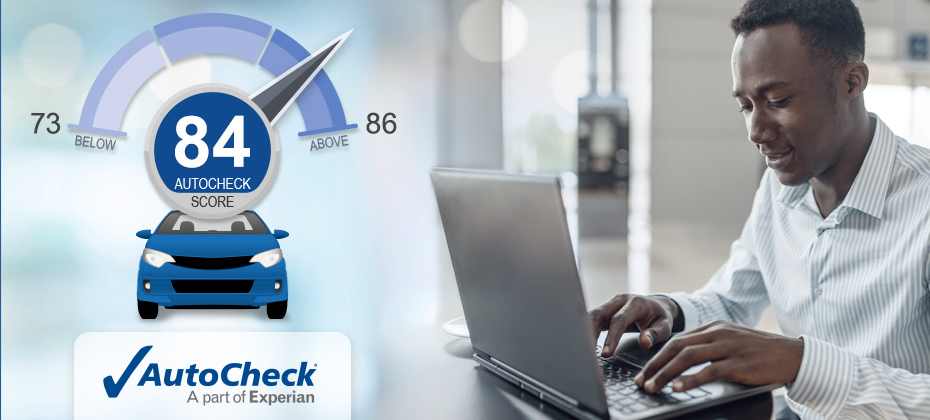
As competition for used vehicles remains fierce, dealers must make quick decisions on whether to acquire a potential vehicle—or someone else will. Whether you need to evaluate a trade-in or want to make a flat-out offer on a vehicle, quickly accessing the vehicle’s history is only the first step. What if you could determine the likelihood that a vehicle will be on the road in five years and compare it to other similar vehicles? Would this help in your decision-making? Use the AutoCheck Score to evaluate vehicles for your lot The patented AutoCheck ScoreSM was developed to help dealers determine the likelihood that a vehicle will be on the road in five years. The AutoCheck Score summarizes vehicle history data into an easy-to-understand “score” and provides an equivalent score range. Understanding the likelihood that a unit will still be on the road in five years gives dealers more perspective on a vehicle’s desirability and can help you accurately price it. Use the AutoCheck Score to more accurately merchandise vehicles The AutoCheck Score range will give you similarly aged and classed vehicles for comparison that you can use to help merchandise the vehicle for market and help manage consumer conversations regarding the vehicle’s price. How does the AutoCheck Score work? The AutoCheck Score analyzes various characteristics, including age, segment, mileage, number of owners, vehicle use, vehicle events, accidents, theft, and title brands. Essentially, this score summarizes the AutoCheck Vehicle History Report fields and delivers a “score range” that allows you to compare the actual vehicle (score) to other similarly aged and classed vehicles. The score is based on a scale of 1 to 100, but reading the score in conjunction with the score range is essential since looking at the score without knowing the range will reveal only half the story. Check out the example below. Car #1 has a lower score than Car #2. However, look at the score ranges (73-86). For Car #1, other comparable vehicles should fall into a range from 73 to 86, and this car scored an 84. That means the vehicle is within the AutoCheck Score range compared to other similar cars of the same age and class. Car #2 has a score of 89. Because this is higher than Car #1’s score, you might assume this car has a more favorable vehicle history, but that’s not entirely accurate. Comparable vehicles should score in a range from 90 to 95, and this car falls short. That means the car’s history is slightly less favorable compared to similar vehicles of the same age and class. In today’s competitive environment though, dealers may decide to take in both trades, and the AutoCheck Score can also help make decisions on how to price the vehicles for market. Become an AutoCheck member today As an AutoCheck subscriber, you’ll have access to the AutoCheck Score. Between the large graphic display and the simple number comparison, the AutoCheck Score can help you make decisions on vehicle acquisition much quicker and easier!

According to Experian's State of the Automotive Finance Market Report: Q1 2022, SUVs and CUVs made up 60.38% of total vehicle financing, an increase from 58.95% in Q1 2021.

With the right technology, it’s possible to implement a layered fraud solution that provides protection and enhances the consumer journey.

Discover the dos and don’ts when it comes to implementing a successful strategy for income and employment verification for mortgage. Read more!