
Are You Prepared for a Big Data Breach?

Updated: July 14, 2026 by Michael Bruemmer 3 min read February 14, 2022

Experian has been a sponsor of theAnnual Ponemon Data Breach Preparedness Studyfor nine years. During this time, I’ve seen companies change their operations to address the influx of increasing threats and evolve their infrastructure to prepare and react. Although I’ve had a front-row seat in this fast-changing situation, somehow, every year, the results of this study still surprise and intrigue me.

Speaking of Infrastructure, Let’s Talk Supply Chains

The 2022 report explores the value of Business Continuity Management (BCM) and Crisis Management plans to minimize a data breach’s consequences. This topic is similar to one highlighted in our2022 Data Breach Industry Forecast, which echoes that companies and organizations should expect these two areas to gain momentum, a finding based on predictions that natural disasters will continue to complicate supply chains. Also, the Forecast indicates that infrastructure cyberattacks will increase among the electrical grid and transportation networks.

This Year’s Surprise

Given all that we know and have gathered about data breaches over almost a decade, it was shocking to learn thatthis year’s Ponemon studyfound that only 56 percentof organizations have a BCM plan, and 53 percenthave a crisis management plan. I seriously thought those numbers would be significantly higher. It goes to show there’s much more opportunity, learning, and preparation to go around.
Cyber Threats and Third Parties

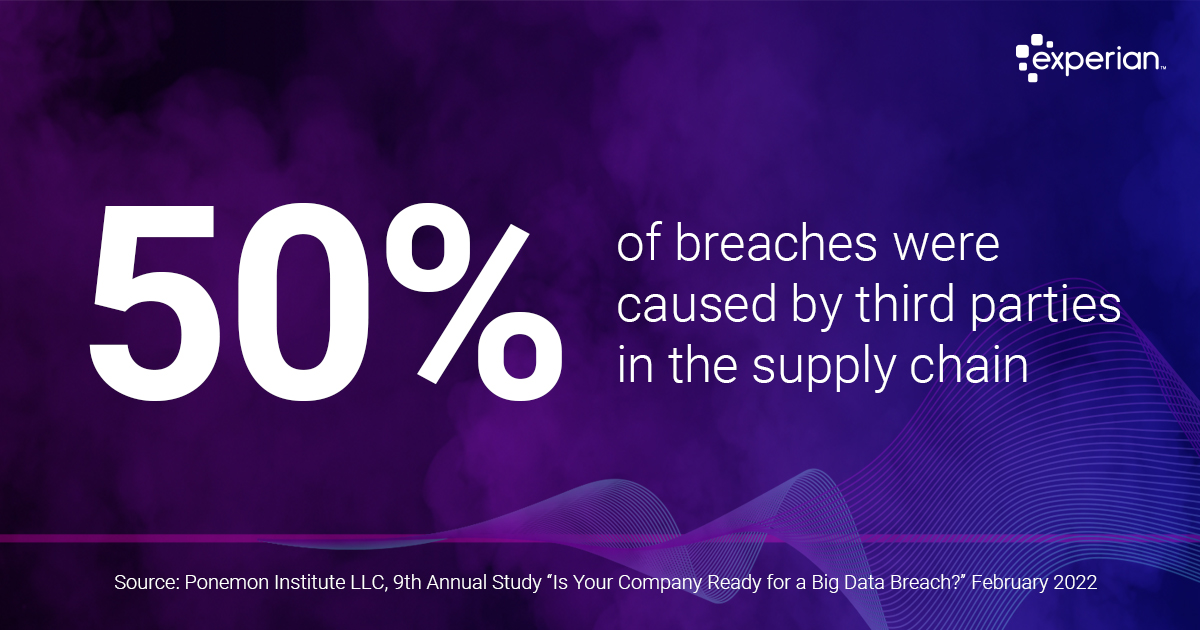
The 2022 report also demonstrated third parties’ role in data breaches. We saw that third parties in the supply chain were the cause of 50% of reported breaches, which increased to 53% when looking at only U.S.-based companies.

This data point is critical because as dependence on third-party vendors increases to improve customer experience, adapt to remote work, or improve operations, companies need to be more diligent in checking the cybersecurity protocols of their partners. If not, vulnerabilities to cyber threats can increase. Also, a lack of adherence to ever-changing government regulations could cause legal troubles.

I’ll close with one last point I found interesting: While 91% of organizations have data breach plans in place,only 56%require an audit of third parties, exposing them to a breach.

This information illuminates the point that companies need to consider all facets of their business when planning for a data breach – that’s one thing that shouldn’t come as a surprise.


Is your company ready for a data breach

Related Posts

How GenAI Fraud Bots Fly Under the Radar (and How to Ground Them Before It’s Too Late)

Today’s AI-powered fraud bots are exceptionally good at mimicking human behavior. Learn why a modern defense strategy is key.

November 18, 2026 by Laura Burrows
What Is Incident Response? Key Steps, Planning and Best Practices

Learn what incident response is, the key steps in the process and how to build and test an incident response plan for a data breach.

November 17, 2026 by Laura Burrows
Rethinking Charged-Off Portfolio Prioritization

Experian’s new Recovery Scores model turns portfolio intelligence into more focused recovery strategies, helping organizations improve returns, direct effort and accelerate speed to cash. The challenge isn’t simply working more accounts. Whether a debt buyer is evaluating an acquisition, an agency is deciding where to assign collector time or a lender is managing its own post-charge-off accounts, the question is similar: How can limited capacity be directed toward accounts with the greatest potential for recovery? Prioritizing accounts mainly by age, balance or when they were last worked may not show which ones are most likely to generate a recovery. With the new Recovery Scores model, organizations can rank charged-off accounts by expected collectability, providing a consistent signal to inform placement strategy and treatment decisions across the recovery lifecycle. Make collector capacity a strategic resource Working every account with the same level of attention isn’t always practical. The more useful question is: Where should teams focus first to protect speed to cash? Our model performance analysis found: 80% of recovered dollars come from the top 40% of accounts worked. The value isn’t simply a better ranking. It’s how organizations can use it for collections optimization. Score bands can inform different strategies for placement, outsourcing, auction and legal channel treatment rather than applying the same approach across an entire portfolio. For debt buyers: The scores can inform acquisition pricing and how a newly purchased portfolio is divided across internal collections, legal channels and resale. Expected collectability can shape debt portfolio analysis, including how a portfolio is valued and segmented before collection work begins. For agencies: Score bands can help teams focus collector resources on accounts with stronger recovery potential. For first-party lenders: Managing recovery internally, the scores provide another signal to help structure decisions about which accounts to work and in what order. Look beyond collectability alone Prioritization rarely comes down to a single variable. Consider two accounts that both rank highly for expected collectability, but one has a substantially larger balance. Their recovery likelihood may be similar, but the potential dollars recovered are not. The Recovery Scores model uses debt collections analytics by combining Experian’s bureau-based score with current balance information. This helps organizations consider both the likelihood of recovery and the potential dollars at stake, while sensitive balance information remains within the organization’s working environment. Monitor accounts as they change The first decision about an account is rarely the last. Teams continually make choices about treatment, placement and resource allocation as accounts move through the recovery process. Recovery Scores is also available as a trigger. When underlying information changes, teams can receive an update and reconsider an account’s placement without waiting for the next portfolio-wide re-score. An account that shows lower recovery potential today may have a different recovery outlook later. Turn recovery potential into a portfolio strategy When portfolios contain more accounts than teams can work at once, the question isn’t simply, “How many accounts can we work?” It is, “Where can our resources have the greatest impact?” The latest Recovery Scores model helps organizations sharpen placement and treatment decisions. It gives debt buyers a way to price and segment portfolios with greater confidence and gives lenders another tool to direct limited collector time across their own post-charge-off portfolios. Learn more about Experian Recovery Scores

November 10, 2026 by Zohreen Ismail

Subscribe to our Newsletter

Enter your name and email for the latest updates.

This site is protected by reCAPTCHA and the Google Privacy Policy and Terms of Service apply.

Subscribe to our Newsletter

Don't miss out on the latest industry trends and insights!
Subscribe