How GenAI Fraud Bots Fly Under the Radar (and How to Ground Them Before It’s Too Late)

by Laura Burrows 5 min read November 18, 2026

At A Glance

Today’s AI-powered fraud bots are exceptionally good at mimicking human behavior and slipping past the device and network checks that would’ve revealed earlier generations. Many record and replay real users’ mouse movements and keystrokes, rotate through thousands of IP addresses and adapt when they hit a control. For businesses that see high application volume every day, that’s a dangerous combination: a wave of fraudulent applicants can enter the ecosystem without causing a noticeable ripple in total volume.

Fraudsters have put generative AI (GenAI) to work in more ways than one. AI-generated deepfakes and fake documents get the most attention, and for good reason: they’re eerily convincing, built to fool both people and the checks designed to verify them. Experian’s2026 Future of Fraud Forecasteven warns of deepfake job candidates capable of passing interviews in real time.

But beneath the surface, AI is changing something more fundamental: how fraudsters launch attacks. Work that once took skilled teams and weeks of preparation, such as writing attack scripts, probing a target’s defenses and adjusting when a control blocks them, can now be automated and refined in minutes. That gives fraudsters the best of both worlds: the scale of a brute-force ambush with the sophistication of their most advanced, bespoke attacks.

Much of that shift runs through fraud bots. At the start of 2024, malicious bots made up 30% of the fraud attacks observed by Experian. By the end of the year, they made up 80%. The trend has only accelerated since: AI-enabled bot attacks grew 12.5x year over year in 2025, according to the2026 Thales Bad Bot Report.

One attack shows how easily these fraudsters slip through the cracks, especially at fast-growing digital businesses.

Fraudsters hiding in the shadows: A real-world example

Merchant onboarding companies face fraud every day. Many prioritize easy onboarding over fraud prevention; some expect up to 15% of applications to be fraudulent as a baseline, and a single attack can mean millions in losses.
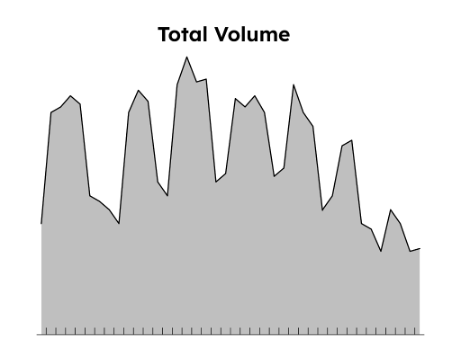
One merchant-onboarding fintech had grown accustomed to massive application volume and, with it, a steady stream of fraudulent applicants. Fraud typically held steady, while overall volume followed a peak-and-valley pattern as businesses applied during working hours.

Then came a week of record-high applications.On the surface, it was business as usual. Total volume followed its familiar pattern, in line with day-to-day trends. If the fintech had only watched for abnormalities in total volume, nothing would have looked out of place. In fact, the surge would have read as a welcome sign of growth, maybe even a reason to relax defenses further.
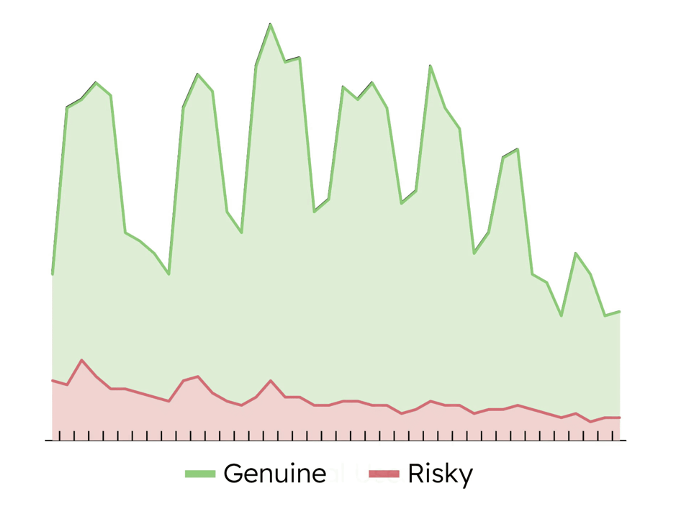
ButNeuroID,Experian’s behavioral analytics solution, revealed afraud ringhiding under the wave of applicants. With crowd-level visibility into user behavior, the fintech spotted a spike in its normally consistent fraud volume during the surge. It wasn’t dramatic- a jump of 13 percentage points in the share of risky applicants- but left undetected; the coordinated attack could have cost millions. Using NeuroID, the fintech found the gaps in its onboarding flow that fraudsters were exploiting and closed them without adding friction for genuine customers.

Not every bot is a bad bot

Spotting fraud botshidden in normal traffic is hard enough. But the emergence of consumer-ready AI agents presents a second challenge: not all automated traffic is fraud.

Consumer artificial intelligence (AI) platforms such as ChatGPT, Gemini and Claude now offer agents that browse websites, fill out forms and complete transactions on a real person’s behalf. Customers are using them to research products, shop, open accounts, and manage their finances. Those agents run on many of the same tools as fraud bots: automated browsers, machine-speed data entry, and none of the hesitation that marks a human session. And fraudsters can use the same consumer tools, or spoof a trusted agent’s identity, to blend in.

That changes the job.Blocking every botused to be the safe answer, because bots rarely had a legitimate reason to be on a sign-up or login page. Today, a blanket block can turn away customers and the revenue that comes with them. And as agent traffic grows, it becomes another surge for fraud bots to hide in, just like the record week at our merchant-onboarding fintech.

The question fraud teams need to answer has shifted from “Is this a bot?” to “Is this bot acting for a real customer, or committing fraud?” Most bot detection tools weren’t built to make that distinction.

Modern fraud bots need modern defenses

GenAI fraud is coming from every angle, and malicious tools like FraudGPT arewidely available. If you’re only stopping bots by looking for lightning-fast data entry or telltale device and network red flags, it’s time to rethink your approach. Even if your fraud stack is holding its own today, fraudsters will evolve to beat it.

Experian’s NeuroID helps you separate humans from bots, and good bots from bad, in real time:

Is this a human or a bot?

Behavior-first signals detect the subtle tells of even AI-powered, human-mimicking automation, including bots that device and network checks miss.

Where is the bot coming from?

For automated sessions, NeuroID returns the bot’s source, classification and verification status, distinguishing a verified agent from a major AI provider from one that’s unknown or spoofing an identity.

What is it trying to do?

Behavior, identity and linkage signals, such as one device tied to dozens of accounts, help reveal intent, so you can let trusted agents through and stop fraud bots at the top of the funnel.

And when agents are ready to transact,Experian Agent Trustverifies the person behind the payment, the legitimacy of the agent and the authorization of the payment.

Gain more insight into NeuroID’s ability to uncover large-scale attacks in real time and how it can assist with AI fraud detection to protect your business from fraud bots without shutting out the customers who send agents on their behalf.


Related Posts

Rethinking Charged-Off Portfolio Prioritization

Experian’s new Recovery Scores model turns portfolio intelligence into more focused recovery strategies, helping organizations improve returns, direct effort and accelerate speed to cash. The challenge isn’t simply working more accounts. Whether a debt buyer is evaluating an acquisition, an agency is deciding where to assign collector time or a lender is managing its own post-charge-off accounts, the question is similar: How can limited capacity be directed toward accounts with the greatest potential for recovery? Prioritizing accounts mainly by age, balance or when they were last worked may not show which ones are most likely to generate a recovery. With the new Recovery Scores model, organizations can rank charged-off accounts by expected collectability, providing a consistent signal to inform placement strategy and treatment decisions across the recovery lifecycle. Make collector capacity a strategic resource Working every account with the same level of attention isn’t always practical. The more useful question is: Where should teams focus first to protect speed to cash? Our model performance analysis found: 80% of recovered dollars come from the top 40% of accounts worked. The value isn’t simply a better ranking. It’s how organizations can use it for collections optimization. Score bands can inform different strategies for placement, outsourcing, auction and legal channel treatment rather than applying the same approach across an entire portfolio. For debt buyers: The scores can inform acquisition pricing and how a newly purchased portfolio is divided across internal collections, legal channels and resale. Expected collectability can shape debt portfolio analysis, including how a portfolio is valued and segmented before collection work begins. For agencies: Score bands can help teams focus collector resources on accounts with stronger recovery potential. For first-party lenders: Managing recovery internally, the scores provide another signal to help structure decisions about which accounts to work and in what order. Look beyond collectability alone Prioritization rarely comes down to a single variable. Consider two accounts that both rank highly for expected collectability, but one has a substantially larger balance. Their recovery likelihood may be similar, but the potential dollars recovered are not. The Recovery Scores model uses debt collections analytics by combining Experian’s bureau-based score with current balance information. This helps organizations consider both the likelihood of recovery and the potential dollars at stake, while sensitive balance information remains within the organization’s working environment. Monitor accounts as they change The first decision about an account is rarely the last. Teams continually make choices about treatment, placement and resource allocation as accounts move through the recovery process. Recovery Scores is also available as a trigger. When underlying information changes, teams can receive an update and reconsider an account’s placement without waiting for the next portfolio-wide re-score. An account that shows lower recovery potential today may have a different recovery outlook later. Turn recovery potential into a portfolio strategy When portfolios contain more accounts than teams can work at once, the question isn’t simply, “How many accounts can we work?” It is, “Where can our resources have the greatest impact?” The latest Recovery Scores model helps organizations sharpen placement and treatment decisions. It gives debt buyers a way to price and segment portfolios with greater confidence and gives lenders another tool to direct limited collector time across their own post-charge-off portfolios. Learn more about Experian Recovery Scores

November 10, 2026 by Zohreen Ismail
What Is a Third-Party Breach? How to Prepare for and Respond to Vendor Incidents

Learn what a third-party breach is and steps to prepare, contain risk, and support affected customers. Read more!

November 9, 2026 by Laura Burrows
Mortgage Underwriting Moves from Modernization Talk to Action 

Mortgage underwriting is entering a new phase. In a recent conversation with HousingWire’s Allison LaForgia, Michele Bodda, Group President of Experian Housing, Verification Solutions, and Employer Services, discussed how modern credit scores, alternative data and verification tools are changing how lenders evaluate borrowers.  Lenders can now judge modernization by its results, Bodda said. “Now we’re actually letting more modern scores get into underwriting to help price loans and go all the way through to securitization,” she told HousingWire. “We’re letting the scores and the data actually speak for itself instead of just talking about it.”  The Right Data at the Right Time  Modernizing underwriting means providing useful information at the right stage, rather than giving lenders everything at once. “You don’t need everything all at once. You don’t need everything on initial pull,” Bodda said.  Alternative data, such as rental payments and buy now, pay later activity, can help show how consumers manage obligations, especially those with thinner credit files. A thin credit file does not necessarily mean someone has a thin financial life.  “It’s our responsibility as one of the primary data providers to make sure we can make all of that available, so that we’re best representing the consumer,” Bodda said. A fuller view of data may help lenders identify creditworthy applicants who might otherwise be difficult to assess.  Simplifying Verification and Reducing Friction  Bodda also shared how Experian is making credit information more easily accessible and reducing unnecessary costs during the originations process, explaining that new enhancements to Experian’s Power Profile Plus allow lenders to pull credit data at the start of underwriting and request another score later without repurchasing the data.  “You can pull it later and not pay for the credit data again,” Bodda said.   Experian is also investing in income and employment verification, including through a new partnership with Workday. Bodda explained that Experian will continue to focus on process improvement, competition and innovation across the mortgage ecosystem.  A Broader Path to Homeownership  As consumer expectations and underwriting capabilities evolve, borrowers want a process that reflects their financial lives, while lenders seek greater efficiency. Modern scores, relevant data, and streamlined verification can help lenders assess applications with more context—and may help more people pursue homeownership.  “If we as an industry can open this up and bring more people into the process, then we’re going to thrive,” Bodda said in the interview.   Watch the interview and hear all of Michele’s insights, and more here.  

November 6, 2026 by Caroline Basile

Subscribe to our Newsletter

Enter your name and email for the latest updates.

This site is protected by reCAPTCHA and the Google Privacy Policy and Terms of Service apply.

Subscribe to our Newsletter

Don't miss out on the latest industry trends and insights!
Subscribe