Latest Posts

Industry-leading institutions apply a layered approach to solving fraud that starts with a fraud risk assessment. Learn more!

Electric vehicles (EVs) are the topic of conversation in the automotive industry, but we’re continuing to see another fuel type pick up speed. With consumer demand shifting and drivers exploring more fuel-efficient options, the automotive market is leaning back into hybrids. In fact, new retail hybrid registrations grew to 11.5% through Q3 2024, from 9.5% through Q3 2023, according to Experian’s Automotive Market Trends Report: Q3 2024. Meanwhile, EVs increased from 7.7% to 8.2% year-over-year and gasoline vehicles declined to 70.4% this year, from 72.7% last year. Despite EVs gaining notable attention over recent years, some consumers may be factoring in the benefits of opting for a hybrid, such as the convenience of driving a longer distance without facing challenges as charging stations remain limited. As more manufacturers adapt to consumer needs and roll out additional vehicles, data shows 9.1% of 2024 model year vehicles in operation were attributed to hybrids, while 6.2% of 2024 model years were EVs through Q3 2024. Having more models enter the market has shifted the hybrid and plug-in hybrid electric vehicle (PHEV) market share, with the Toyota Camry making up 12.5% of the market share this quarter, a notable increase from 2.4% last year. On the other hand, the Jeep Wrangler 4xe went from having 4.5% of market share last year to 2.4% through Q3 2024. With many consumers continuing to have some concerns around EVs such as range anxiety and charging times, they’re seeking a more practical solution for their daily driving needs. The balance of fuel options provides more convenience—making hybrids an appealing choice for those wanting an EV alternative. It’s important for manufacturers to stay ahead of the competitive market as it’s constantly evolving. Leveraging the most current data can provide solutions that address both feasibility and consumer preference. To learn more about vehicle market trends, view the full Automotive Market Trends Report: Q3 2024 presentation on demand.

Experian’s research reveals changes in the demographics of U.S. renters, now dominated by younger and lower average-income consumers.

Learn four capabilities to consider when building out an ID verification strategy and next steps to take. Read more!

Here are the top fraud trends and actionable resolutions to help risk managers stay ahead of fraud in 2025.

Attraction Towards Various Fuel Types For Pickup Trucks Reflects Evolving Consumer Preferences
Apply Automotive TagPickup trucks are a staple of the automotive industry. Their utility and versatility allow consumers to haul heavy loads or tow large trailers, making them ideal for blue-collar workers. At the same time, pickup trucks offer a sleek appearance that can be aesthetically appealing. And now, we’re seeing the next evolution of the pickup truck: EVs. According to Experian’s Automotive Consumer Trends Report: Q3 2024, of the 292.1 million vehicles in operation, more than 54 million were pickup trucks. Furthermore, 17.4% of new retail registrations this quarter were pickup trucks, while pickup trucks made up 19.2% of used retail registrations. Interestingly, we’re seeing more consumer demand for EV pickup trucks. Over the last 12 months, the Ford F-150 Lightening made up 42.2% of the EV pickup truck market share, closely followed by the Tesla Cybertruck at 37.9%. Rounding out the top five were the Rivian R1T (14.2%), GMC Hummer EV (4.8%) and Chevrolet Silverado EV (0.9%). Still room for the ICE pickup Although we’re beginning to see EV pickup trucks gain some prominence, the overwhelming majority of pickups on the road are gas-powered. In fact, over the last 12 months, 14.5% of new retail pickup truck registrations were attributed to the Chevrolet Silverado 1500, followed by the Ford-150 at 13.4% and the GMC Sierra 1500 (9.1%). Though, data found the preference flipped for the used side, with the Ford F-150 leading at 18.1% of retail pickup registrations and the Chevrolet Silverado 1500 at 13.9%, followed by the GMC Sierra 1500 (6.2%). With more consumers not only maintaining a keen interest in gasoline pickup trucks, but also moving into the EV space, the current data can be leveraged in more ways than one as professionals diversify their sales strategies while optimizing dealership inventory. To learn more about pickup truck insights, view the full Automotive Consumer Trends Report: Q3 2024 presentation or The Trade Desk Brochure.
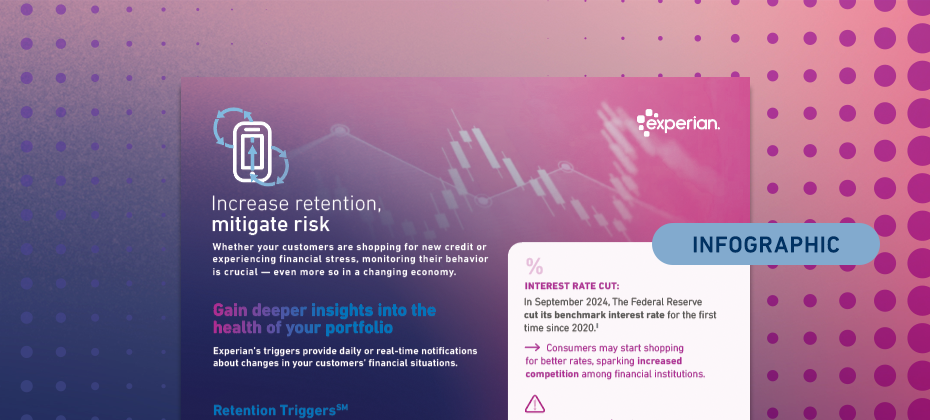
Whether consumers are shopping for new credit or experiencing financial stress, monitoring their behavior is crucial — even more so in an ever-changing economy. Our latest infographic explores economic trends impacting consumers’ financial behaviors and how Experian’s Risk and Retention TriggersSM enable lenders to detect early signs of risk or churn. Key highlights include: Credit card balances climbed to $1.17 trillion in Q3 2024. As prices of goods and services remain elevated, consumers may continue to experience financial stress, potentially leading to higher delinquency rates. Increasing customer retention rates by 5% can boost profits by 25% to 95%. View the infographic to learn how Risk and Retention Triggers can help you advance your portfolio management strategy. Access infographic

In 2024, the housing market defied recession fears, with mortgage and home equity growth driven by briefly lower interest rates, strong equity positions, generally positive economic indicators, and stock market appreciation. This performance is notable because, in 2023, economists’ favorite hobby was predicting a recession in 2024. Following a period of elevated inflation, driven largely by loose monetary policy, expansionary fiscal policy, and supply chain disruptions brought on by COVID, economists were certain that the US economy would shrink. However, the economy continued outperforming expectations, even as unemployment rose modestly (Figure 2) and inflation cooled (Figure 3). Source: FRED (Figure 1, Figure 2, Figure 3). So, a good economy is good for the mortgage and home equity markets, right? Generally speaking, this statement was true. As monitored by Experian’s credit database, mortgage originations increased by approximately thirty percent year over year as of November 2024 (Figure 4), and Q3 ’24 pre-tax profit for Independent Mortgage Banks (IMBs) averaged $701 per loan.1 So, business in home lending is good — certainly better than it was during the period when the Fed was raising rates, origination volumes shrank as opposed to grew, and IMB profit per loan turned negative. Source: Experian Ascend Insights Dashboard. What constituted this growth in mortgage lending? As we all know, the Fed has lowered interest rates by 100bps since they started reducing rates in September. The market had priced in the September cut weeks prior to the actual announcement (Figure 5), and the market enjoyed a spike in refinance volume as a result (Figure 6). However, in the lead-up to and following the US presidential election, interest rates spiked back up due to the market’s expectations around future economic activity, which will dampen pressure on refinance volumes even after the recent additional rate drop. The impact of further rate drops on mortgage rates is unclear, and refinance volume still constitutes only around three percent of overall origination volume. Source: Figure 5, Figure 6 (Experian Ascend Insights Dashboard). The shift to a purchase-driven housing market What does this all mean? Our view is that pockets of refinance volume (rate and term, VA, FHA, cashout) are available to those lenders with a sophisticated targeting strategy. However, the data also very clearly indicates that this market is still very much a purchase market in terms of opportunity for originations growth. This position should not surprise long-time mortgage lenders, given that purchase volume has always constituted a significant majority of origination volume. However, this market is a different purchase market than lenders may be used to. This purchase market is different because of unprecedented statistics about the housing market itself. The average age of a first-time homebuyer recently reached a record high of 38. The average age of overall homebuyers in November of this year similarly jumped to a new record high of 56, with homes being “wildly unaffordable for young people.” Twenty-six percent of home purchases are all-cash, another record high, and homeowners have an aggregate net equity position of $17.6 trillion, fueling those all-cash purchases. The market is expensive both from an interest rate perspective and a housing price-level perspective, and those trends are driving who is buying homes and how they are buying them.2 Opportunities for lenders in 2025 What do these housing market dynamics mean for lenders? To begin with, lenders should not spend money marketing mortgages to consumers in their 50s and 60s with large equity positions. These consumers are likely to be in the 26 percent all-cash buyer cohort, and that money will be wasted since mortgages are no longer so cheap that even cash-rich buyers would take them. Further, this equity-rich generation has children, and nearly 40% of those children borrow from the bank of mom and dad to purchase their first home. Since roughly a quarter (albeit a shrinking quarter) of homebuyers are first-time homebuyers, and since 40% of those rely on help from parents to facilitate that purchase, it may make sense for lenders to identify those consumers with 1) children and 2) significant equity positions and to offer products like cash-out refinances or home equity loans/lines to help facilitate those first-time purchases. Data is critical to executing these kinds of novel marketing strategies. It is one thing to develop these marketing and growth strategies in principle and another entirely to efficiently find the consumers that meet the criteria and give them a compelling offer. Consider home equity originations. As Figure 7 illustrates, HELOC originations are strong but have completely stalled from a growth rate perspective. As Figure 8 illustrates, this is despite the market's continued growth in direct mail marketing investment. Although HELOC origination volumes are a fraction of mortgage—around $27b per month for HELOC versus $182b per month for mortgage—there are significantly more home equity direct mail offers being sent per month (39 million) for home equity products as there are for mortgage (31 million) as of October ’24.3 This all means that although many lenders have wised up to the home equity opportunity to the point of saturating the market with offers, few have successfully leveraged targeting data and analytics to craft sufficiently compelling offers to those consumers to convert those marketing leads into booked loans. Source: Figure 7 (Experian Ascend Insights Dashboard), Figure 8 (Mintel). Adapting to a resilient housing market In summary, the housing market, comprised of mortgage and home equity products, has experienced persistent growth over the past year. Many who are reading this note will have benefitted from that growth. However, as we have identified, in many respects housing market growth has 1) been concentrated to some key borrower demographics and 2) many lenders are investing in marketing campaigns that are not efficiently reaching or convincing that key housing demographic to book loans, whether it be a home equity or mortgage product. As such, as we move into 2025, Experian advises our clients to focus on the following three themes to ensure they benefit from this trend of growth into the new year: Ensure you effectively differentiate your marketing targeting, collateral, and offers for the various demographics in the market. Ensure your origination experiences for mortgage and home equity products are modern and efficient. Lenders who force all borrowers through a painful, manual legacy process will waste marketing dollars and experience pipeline fallout. Although the market is growing, other lenders are coming for your current customers. They could be coming for purchase activity, refinance opportunities, or they may be using home equity products to encroach on your existing mortgage relationship. As such, capitalizing on growth in 2025 is not merely about gaining new customers; it is also about retaining your existing book of business using high-quality data and analytics. Learn more 1 Although December numbers are available for year-over-year comparison, we excluded them due to the holiday period's strong seasonality patterns. 2 The Case-Shiller index recently topped out at record levels. 3 Mintel/Comperemedia data.

Examine today’s renter population, current market trends, the state of housing development, and the market’s future.

Credential Stuffing Prevention: How Experian’s Behavioral Analytics Solutions Can Help
Apply CIS TagLearn how you can proactively fight credential stuffing attacks and protect your organization and customers.

Our new report provides a snapshot of the current credit card landscape and strategy considerations to inform your business decisions.

Bots have been a consistent thorn in fraud teams’ side for years. But since the advent of generative AI (genAI), what used to be just one more fraud type has become a fraud tsunami. This surge in fraud bot attacks has brought with it: A 108% year-over-year increase in credential stuffing to take over accounts1 A 134% year-over-year increase in carding attacks, where stolen cards are tested1 New account opening fraud at more than 25% of businesses in the first quarter of 2024 While fraud professionals rush to fight back the onslaught, they’re also reckoning with the ever-evolving threat of genAI. A large factor in fraud bots’ new scalability and strength, genAI was the #1 stress point identified by fraud teams in 2024, and 70% expect it to be a challenge moving forward, according to Experian’s U.S. Identity and Fraud Report. This fear is well-founded. Fraudsters are wasting no time incorporating genAI into their attack arsenal. GenAI has created a new generation of fraud bot tools that make bot development more accessible and sophisticated. These bots reverse-engineer fraud stacks, testing the limits of their targets’ defenses to find triggers for step-ups and checks, then adapt to avoid setting them off. How do bot detection solutions fare against this next generation of bots? The evolution of fraud bots The earliest fraud bots, which first appeared in the 1990s2 , were simple scripts with limited capabilities. Fraudsters soon began using these scripts to execute basic tasks on their behalf — mainly form spam and light data scraping. Fraud teams responded, implementing bot detection solutions that continued to evolve as the threats became more sophisticated. The evolution of fraud bots was steady — and mostly balanced against fraud-fighting tools — until genAI supercharged it. Today, fraudsters are leveraging genAI’s core ability (analyzing datasets and identifying patterns, then using those patterns to generate solutions) to create bots capable of large-scale attacks with unprecedented sophistication. These genAI-powered fraud bots can analyze onboarding flows to identify step-up triggers, automate attacks at high-volume times, and even conduct “behavior hijacking,” where bots record and replicate the behaviors of real users. How next-generation fraud bots beat fraud stacks For years, a tried-and-true tool for fraud bot detection was to look for the non-human giveaways: lightning-fast transition speeds, eerily consistent keystrokes, nonexistent mouse movements, and/or repeated device and network data were all tell-tale signs of a bot. Fraud teams could base their bot detection strategies off of these behavioral red flags. Stopping today’s next-generation fraud bots isn’t quite as straightforward. Because they were specifically built to mimic human behavior and cycle through device IDs and IP addresses, today’s bots often appear to be normal, human applicants and circumvent many of the barriers that blocked their predecessors. The data the bots are providing is better, too3, fraudsters are using genAI to streamline and scale the creation of synthetic identities.4 By equipping their human-like bots with a bank of high-quality synthetic identities, fraudsters have their most potent, advanced attack avenue to date. Skirting traditional bot detection with their human-like capabilities, next-generation fraud bots can bombard their targets with massive, often undetected, attacks. In one attack analyzed by NeuroID, a part of Experian, fraud bots made up 31% of a business's onboarding volume on a single day. That’s nearly one-third of the business’s volume comprised of bots attempting to commit fraud. If the business hadn’t had the right tools in place to separate these bots from genuine users, they wouldn’t have been able to stop the attack until it was too late. Beating fraud bots with behavioral analytics: The next-generation approach Next-generation fraud bots pose a unique threat to digital businesses: their data appears legitimate, and they look like a human when they’re interacting with a form. So how do fraud teams differentiate fraud bots from an actual human user? NeuroID’s product development teams discovered key nuances that separate next-generation bots from humans, and we’ve updated our industry-leading bot detection capabilities to account for them. A big one is mousing patterns: random, erratic cursor movements are part of what makes next-generation bots so eerily human-like, but their movements are still noticeably smoother than a real human’s. Other bot detection solutions (including our V1 signal) wouldn’t flag these advanced cursor movements as bot behavior, but our new signal is designed to identify even the most granular giveaways of a next-generation fraud bot. Fraud bots will continue to evolve. But so will we. For example, behavioral analytics can identify repeated actions — down to the pixel a cursor lands on — during a bot attack and block out users exhibiting those behaviors. Our behavior was built specifically to combat next-gen challenges with scalable, real-time solutions. This proactive protection against advanced bot behaviors is crucial to preventing larger attacks. For more on fraud bots’ evolution, download our Emerging Trends in Fraud: Understanding and Combating Next-Gen Bots report. Learn more Sources 1 HUMAN Enterprise Bot Fraud Benchmark Report 2 Abusix 3 NeuroID 4 Biometric Update

Scott Brown, Group President at Experian, recently presented at Reuters Next on the power of AI innovation in financial services.

Learn how background screeners can optimize pre-employment verification processes, reduce fraud risks, and ensure compliance.

This guide covers the various user authentication types and methods, focusing on helping financial institutions protect consumer information.