
With the rise of digital interactions, identity fraud has become an unassuming threat that impacts individuals, businesses, and institutions worldwide. According to the Federal Trade Commission (FTC), 5.4 million consumer reports regarding fraud and consumer protection were filed in 2023. Identity fraud, which is characterized as when an individual’s personal information is stolen and used without their consent for fraudulent purposes, has devastating consequences for consumers, including financial losses, damaged credit scores, legal issues, and emotional distress.
Financial institutions face damaging consequences beyond financial losses, including reputational damage, operational disruption, and regulatory scrutiny. As technology advances, so do fraudsters’ tactics, making it increasingly challenging to detect and prevent identity-related crimes. So, what are financial institutions to do? Industry-leading institutions apply a layered approach to solving fraud that starts with a fraud risk assessment.
What is a fraud risk assessment?
When opening a new account, banks typically conduct a fraud risk assessment to verify the identity of the individual or entity applying for the account and to assess the likelihood of fraudulent activity. Banks also assess the applicant’s credit history, financial background, and transaction patterns to identify red flags or suspicious activity. Advanced fraud detection tools and technologies are employed to monitor account opening activities in real-time and detect signs of fraudulent behavior. This assessment is crucial for ensuring compliance with regulatory requirements, mitigating the risk of financial loss, and safeguarding against identity theft.
Understanding the importance of fraud risk assessments
A fraud risk assessment is crucial for banks during account opening as it helps verify the identity of applicants and mitigate the risk of fraudulent activity. By assessing the likelihood and potential impact of identity fraud, banks can implement measures to protect customers’ assets and protect against losses in their portfolio. Additionally, conducting thorough risk assessments enables banks to comply with regulatory requirements, which mandate the verification of customer identities to prevent money laundering and terrorist financing. By adhering to these regulations and implementing effective fraud detection measures, banks can enhance trust and confidence among customers, regulators, and stakeholders, reinforcing the integrity and stability of the financial system.
10 tools to consider when building an effective fraud risk assessment
Several key factors should be carefully considered in an identity fraud risk assessment to ensure thorough evaluation and effective mitigation of identity fraud risks. Financial institutions should consider emerging threats and trends such as synthetic identity fraud, account takeover attacks, and social engineering scams when conducting a risk assessment. By staying abreast of evolving tactics used by fraudsters, organizations can proactively adapt their fraud prevention strategies and controls.
Here are 10 tools that can help catch red flags for fraud prevention:
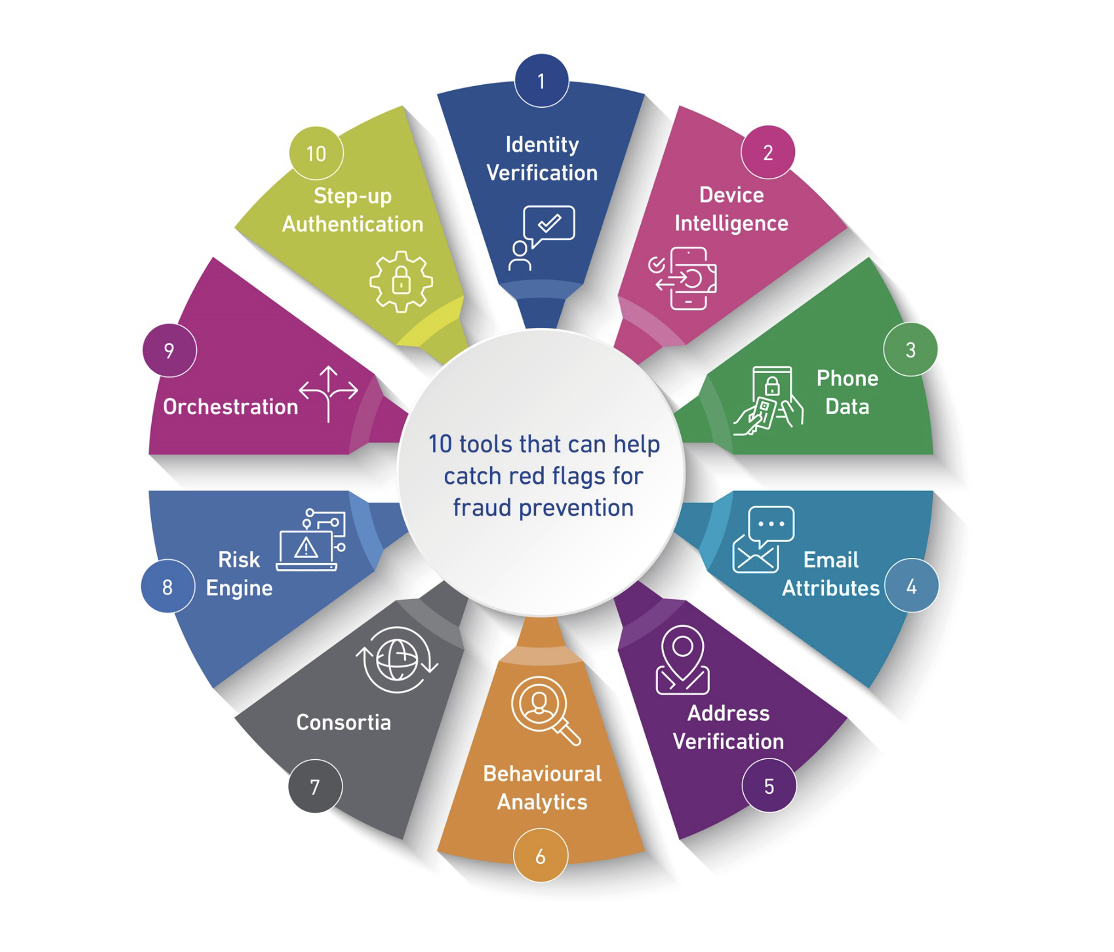
- Identity verification: Identity verification is the first line of defense against identity theft, account takeover, and other fraudulent activities. By verifying the identities of individuals before granting access to services or accounts, organizations can ensure that only legitimate users are granted access. Effective identity verification methods, such as biometric authentication, document verification, and knowledge-based authentication, help mitigate the risk of unauthorized access and fraudulent transactions. Implementing robust identity verification measures protects organizations from financial losses and reputational damage and enhances trust and confidence among customers and stakeholders.
- Device intelligence: Device intelligence provides insights into the devices used in online transactions, enabling organizations to identify and mitigate fraudulent activities. Organizations can detect suspicious behavior indicative of fraudulent activity by analyzing device-related data such as IP addresses, geolocation, device fingerprints, and behavioral patterns. Device intelligence allows organizations to differentiate between legitimate users and fraudsters, enabling them to implement appropriate security measures, such as device authentication or transaction monitoring.
- Phone data: Phone and Mobile Network Operator (MNO) data offers valuable insights into the mobile devices and phone numbers used in transactions. By analyzing MNO data such as subscriber information, call records, and location data, organizations can verify the authenticity of users and detect suspicious activities. MNO data enables organizations to confirm the legitimacy of phone numbers, detect SIM swapping or account takeover attempts, and identify fraudulent transactions. Leveraging MNO data allows organizations to strengthen their fraud prevention measures, enhance customer authentication processes, and effectively mitigate the risk of fraudulent activities in an increasingly mobile-driven environment.
- Email attributes: Email addresses serve as a primary identifier and communication channel for users in digital transactions. Organizations can authenticate user identities, confirm account ownership, and detect suspicious activities such as phishing attempts or identity theft by verifying email addresses. Analyzing email addresses enables organizations to identify patterns of fraudulent behavior, block unauthorized access attempts, and enhance security measures. Furthermore, email address validation helps prevent fraudulent transactions, safeguard sensitive information, and protect against financial losses and reputational damage. Leveraging email addresses as part of fraud prevention strategies enhances trustworthiness in digital interactions.
- Address verification: Address verification provides essential information for authenticating user identities and detecting suspicious activities. By verifying addresses, organizations can confirm the legitimacy of user accounts, prevent identity theft, and detect fraudulent transactions. Address validation enables organizations to ensure that the provided address matches the user’s identity and reduces the risk of fraudulent activities such as account takeover or shipping fraud.
- Behavioral analytics: Behavioral analytics enables organizations to detect anomalies and patterns indicative of fraudulent activity. By analyzing user behavior, such as transaction history, navigation patterns, and interaction frequency, organizations can identify deviations from normal behavior and flag suspicious activities for further investigation. Behavioral analytics allows organizations to create profiles of typical user behavior and detect deviations that may signal fraud, such as unusual login times or transaction amounts.
- Consortia: Consortia facilitate collaboration and information sharing among organizations to combat fraudulent activities collectively. By joining forces through consortia, organizations can leverage shared data, insights, and resources to more effectively identify emerging fraud trends, patterns, and threats. Consortia enables participating organizations to benefit from a broader and more comprehensive view of fraudulent activities, enhancing their ability to detect and prevent fraud.
- Risk engines: Risk engines enable real-time analysis of transaction data and user behavior to detect and mitigate fraudulent activities. By leveraging advanced algorithms and machine learning techniques, risk engines assess the risk associated with each transaction and user interaction, flagging suspicious activities for further investigation or intervention. Risk engines help organizations identify anomalies, patterns, and trends indicative of fraudulent behavior, allowing for timely detection and prevention of fraud. Additionally, risk engines can adapt and evolve over time to stay ahead of emerging threats, enhancing their effectiveness in mitigating fraud.
- Orchestration streamlines and coordinates the various components of a fraud detection and prevention strategy. By orchestrating different fraud prevention tools, technologies, and processes, organizations can optimize their efforts to combat fraud effectively. Orchestration allows for seamless integration and automation of workflows, enabling real-time data analysis and rapid response to emerging threats.
- Step-up authentication: Step-up authentication provides an additional layer of security to verify users’ identities during high-risk transactions or suspicious activities. By requiring users to provide additional credentials or undergo further authentication steps, such as biometric verification or one-time passcodes, organizations can mitigate the risk of unauthorized access and fraudulent transactions. Step-up authentication allows organizations to dynamically adjust security measures based on the perceived risk level, ensuring that stronger authentication methods are employed when necessary.
By layering these tools effectively businesses remove gaps that fraudsters would typically exploit.