
All posts by Julie Lee

For decades, credit data has given lenders a trusted foundation for assessing risk. Now, consumer-permissioned cash flow data is adding another layer of insight into consumers’ financial lives, including income, spending, liquidity and changing financial obligations. The opportunity is significant. Nearly one in five consumers lacks access to or has damaged credit. New Experian research also shows that 60% of consumers who have previously been denied credit or received less favorable terms than expected believe the outcome would have been different if lenders had considered their recent income and banking activity alongside their credit history. 1,2 For lenders, cash flow insights can provide additional context about a consumer’s financial capacity and support more informed underwriting decisions. The next challenge is making those insights easier to use consistently and responsibly at scale. What are cash flow insights? Cash flow insights are derived from consumer-permissioned banking data and provide visibility into how money moves into and out of a consumer’s accounts. Depending on the information available, cash flow data can provide insight into financial behaviors such as: Income and income stability: Regular and irregular income streams and changes over time Spending and recurring expenses: Everyday spending patterns and ongoing financial obligations Account balances and liquidity: Available funds and changes in account balances Debt obligations: Loan payments and other recurring debt commitments Cash flow patterns: How money moves into and out of accounts over time Traditional credit information provides a rich history of how consumers have managed credit. Cash flow insights add context about their current financial activity and capacity, providing lenders with a more complete view of financial health. Cash flow insights can also add predictive value to risk assessment. Experian analysis shows Cashflow Score can deliver up to a 25% lift in predictive performance over conventional credit scores when tailored to targeted risk tiers.3 How lenders can put cash flow insights to work at scale As interest in cash flow insights grows, the conversation is moving beyond what the data can reveal to how financial institutions can use it consistently and responsibly. That requires standardized consumer reporting, clear governance and decision-ready insights that can work within established lending processes. The launch of Experian Cashflow Data Bureau at Vision 2026 reflects this shift from access to adoption. The new consumer reporting agency operates under the Fair Credit Reporting Act (FCRA) and is designed to help financial institutions adopt consumer-permissioned cash flow insights at scale. A key part of that foundation is the cash flow consumer report, which organizes consumer-permissioned banking information into a standardized consumer report regulated under the FCRA. This gives lenders a consistent foundation for incorporating cash flow information into lending decisions while providing consumers with access to the information in their report. Turning greater visibility into better decisions The next evolution in credit isn’t about choosing between traditional credit and cash flow data. Each provides a different perspective. Traditional credit information offers deep insight into how consumers have managed credit over time. Cash flow insights can add context about financial activity and capacity. Bringing those perspectives together can give lenders greater visibility into consumers’ financial health and help them better distinguish between risk and resilience, support more informed decisions and identify opportunities to responsibly expand access to credit. As cash flow adoption continues to grow, its value will come from how effectively it complements the information lenders already use. The opportunity isn't simply to see more data. It's to turn that additional visibility into smarter, more informed decisions. Explore how Experian Cashflow Data Bureau is helping financial institutions put consumer-permissioned cash flow insights into practice at scale. Learn more [1] Federal Reserve Bank of New York, The Market for Credit Building: Demand, Product Characteristics and Consumer Uses, 2026. [2] Experian commissioned Atomik Research to conduct an online survey of 2,000 U.S. adults age 18+. Fieldwork took place July 16–21, 2026. Margin of error: +/- 2.2 percentage points at a 95% confidence level. [3] Based on Experian analysis when Cashflow Score is compared with conventional credit scores, tailored to targeted risk tiers. Predictability based on KS.
Alternative data myths can hold lenders back. Experian and Mission Federal bust common misconceptions about risk, implementation and getting started.
Identity intelligence and alternative data can help lenders validate consumers and support more informed decisions across the customer lifecycle.

Fraudsters are getting surprisingly good at onboarding. Sometimes, better than your customers. Legitimate customers treat onboarding like an errand. They start an application between other tasks, get distracted, forget a password, switch devices, upload a document or come back later to finish. Their digital lives aren’t always linear, because real life isn’t either. Fraudsters approach onboarding differently. For them, opening an account is the objective. Every interaction is designed to increase the odds of success. The difference raises an uncomfortable question hanging over onboarding: What exactly are we rewarding? When smooth becomes suspicious Digital onboarding has traditionally rewarded experiences that feel smooth, consistent and complete. The challenge is that legitimate customers rarely behave that way. Most people approach onboarding somewhere between mildly distracted and mildly annoyed. They pause halfway through because dinner is burning. They reopen an old account only to realize everything is attached to an email they made in college and, somehow, still use for airline receipts. Digital life accumulates history unevenly, because ordinary life does too. Fraudsters have every reason to eliminate those inconsistencies. Applications may be rehearsed. Identity attributes are assembled deliberately. Contact points are prepared in advance. Every interaction is optimized to make the application appear credible. Ironically, the qualities organizations often associate with confidence — clean submissions, steady progression and few corrections — can also describe applications that have been carefully engineered to pass inspection. The challenge isn't that smooth onboarding is meaningless. It's that smooth onboarding, by itself, doesn't tell the whole story. Context changes interpretation A smooth onboarding experience should be the beginning of the evaluation, not the end. Behavior provides important context. How someone moves through an application can reveal whether the experience feels naturally human or unusually orchestrated. Do they interact naturally? Do they hesitate, correct mistakes or navigate in ways that resemble ordinary human behavior? Or does the session appear unusually scripted, automated or repetitive? Identity verification adds another layer. Matching information across trusted sources, validating identity details and strengthening confidence in account creation remain important, particularly when onboarding decisions carry financial, fraud or customer experience consequences. But verification largely answers a point-in-time question: Does this information match right now? A third layer comes from digital history. An inbox attached to years of airline receipts, loyalty accounts, subscription renewals, account recovery, financial notifications and familiar digital routines introduces a different kind of confidence. Legitimate digital identities leave behind patterns of persistence and engagement that develop gradually over time. Fraudsters can assemble convincing identity attributes, but creating years of ordinary digital life is much harder. Building confidence in an identity requires more than verifying information submitted during a single onboarding session. It requires understanding whether the identity reflects a broader history that supports what the application suggests. A multilayered approach builds stronger identity confidence No single signal can provide a complete view of identity risk. Organizations need multiple sources of confidence that reinforce one another. That's the thinking behind our approach: combining behavioral intelligence, identity verification and digital identity continuity into a more complete view of risk. We bring these complementary layers together through: • NeuroID adds behavioral context during onboarding and account creation, helping identify interaction patterns that may indicate automation, manipulation or coordinated fraud. • Precise ID® strengthens identity verification and resolution by comparing applicant information with trusted identity data. • AtData, recently added to our portfolio, contributes email-centered intelligence based on persistence, engagement and long-term digital history. Together, these capabilities help organizations move beyond evaluating a single moment in time to understanding whether an identity is supported by consistent behavior, trusted identity data and an established digital history. The future of fraud prevention isn't about rewarding the smoothest application. It's about recognizing the most trustworthy identity. Fraudsters can rehearse an application. They can optimize an onboarding journey. They can even assemble convincing identity attributes. What they can't easily manufacture is years of ordinary digital life. That's why digital identity continuity has become an important layer of modern fraud prevention. Combined with identity verification and behavioral intelligence, it helps organizations distinguish between identities that simply look convincing and those supported by a history that is much harder to fake. Learn more Contact us

What if some of your best potential borrowers are the ones your traditional credit strategy can't fully see? A credit score can tell lenders a lot about a consumer, but it doesn't always capture the full picture of how someone is managing their financial life. For consumers with nontraditional income patterns or limited credit histories, that incomplete view can mean missed opportunities. In this Ask the Expert session, David Elmore of Experian talks with Michelle Goeppner, Chief Lending Officer at Vantage West Credit Union, about how alternative data can provide additional context around consumer risk, uncover opportunities traditional data alone might miss and help lenders expand their reach without disrupting strategies that already work. Who could lenders be missing? That question is especially important when a consumer’s financial life doesn’t fit neatly into a traditional credit profile. Take gig workers. Someone driving for Uber or delivering for DoorDash likely has a different income pattern than a salaried employee — irregular, seasonal, spread across platforms. That doesn't mean they aren't reliably managing bills, rent and other obligations. It just means a traditional file may not show it. Goeppner has a name for the risk of overlooking that context: FOMM — Fear of Missing Members. You've heard of FOMO — Fear of Missing Out. I think about it as FOMM — Fear of Missing Members. Who are we leaving behind if we're not using it?Michelle Goeppner, Chief Lending Officer For credit unions especially, that's not just a data question — it's a mission question. A partial view of a member's finances can mean missing a member the institution exists to serve. The credit score alone doesn't tell you where someone's headed Traditional credit data is still foundational to lending decisions. But alternative data — income, cash flow, payment behavior — adds a layer that a credit score alone can't provide. Goeppner illustrates the distinction with two consumers who have exactly the same credit score: I don't know if you're a 640 score on your way to 720 — or are you a 640 headed southwards to 580? It doesn't show me how you're managing your day-to-day financial lifeMichelle Goeppner, Chief Lending Officer Two borrowers can share the same score and be moving in opposite directions. Alternative data helps lenders tell the difference — and put that score in context rather than treating it as the whole story. Start small and layer it in Adopting alternative data doesn't mean overhauling an existing strategy. As Goeppner puts it, it's additive, not a replacement: It's not a rip and replace. You don't have to let go of your existing playbook. It's additive — you layer it in.Michelle Goeppner, Chief Lending Officer Her advice for getting started: Define the problem first. Are you trying to increase approvals, reach more underserved borrowers, or improve decisioning for a specific product? Test before you scale. Revisit loans you've already booked and ask whether alternative data would have changed the outcome — or pilot it on a single product before rolling it out further. Build in governance from day one. Document what changed, where the new data was used, and what results followed. As Goeppner puts it: “Crawl, walk, run. Slow and grow.” More loans without changing the risk profile For Vantage West, the value of that approach has shown up in its lending results. It has been an absolute game changer for us at Vantage West. We have been able to make more loans to our target members, our target segments, without changes to our risk profile.Michelle Goeppner, Chief Lending Officer That distinction matters. The goal isn't approving more loans for its own sake — it's having enough information to recognize good borrowers that traditional data alone would have missed. The result is a fuller picture of the people behind the credit file, and more confidence in deciding who a lender can serve. Explore alternative data with us Alternative data can help lenders add context to traditional credit information for a more complete view of consumers. Experian works with institutions of all sizes to incorporate additional consumer signals into existing lending strategies — strengthening decisioning, managing risk and identifying new opportunities for growth. Learn more Contact us About our experts Michelle Goeppner Chief Lending Officer, Vantage West Credit Union Michelle Goeppner is a dynamic financial services executive with over two decades of experience driving strategic growth, product innovation, and operational excellence across leading credit unions and financial institutions. Currently serving as the Chief Lending Officer at Vantage West Credit Union, Michelle leads the strategic vision for multi-billion-dollar consumer loan and deposit portfolios, as a member of the Executive Coalition. Her expertise spans consumer lending, product management, integrated marketing, and talent development, with a proven track record of leveraging fintech partnerships, automation, and data-driven strategies to optimize portfolio performance and member engagement. Throughout her career, Michelle has held pivotal leadership roles in organizations such as Alliant Credit Union and Discover Financial Services. She is recognized for her collaborative approach, detail-oriented execution, and commitment to developing future female leaders. Michelle’s contributions include founding Alliant’s Women’s Resource Group, serving on advisory councils and boards, and earning multiple industry awards for excellence and innovation. She holds an Executive Certification in Product Management from UC Berkeley, a Master of Science in Integrated Marketing Communications from Roosevelt University, and a Bachelor of Science in Marketing from Northern Illinois University. David Elmore Vice President of Fintech Sales, Experian David Elmore leads a team of fintech sales professionals at Experian focused on helping fintech organizations drive responsible, scalable growth through data-driven analytics and decisioning. With more than 20 years in financial services — a decade of it focused on fintech — he brings deep expertise in applying traditional and alternative data across the customer lifecycle. David and his team partner with fintech leaders to navigate opportunities across acquisition, underwriting, portfolio management, and collections, balancing innovation, risk, and trust.

A visibility gap lenders can't afford to ignore Alternative data is often associated with thin-file or credit invisible consumers. But its value extends far beyond those segments. Experian's Clarity Services database includes approximately one in five credit-active consumers, including one in four consumers with prime-and-above credit profiles. That means lenders may be missing important signals, not only for emerging borrowers, but also for applicants who appear well qualified using traditional bureau data alone. Consider two consumers with the same credit score. Based on traditional credit data, they may appear equally creditworthy. But when Clarity data is added, one consumer may demonstrate stable repayment behavior while another shows recent defaults on alternative finance products. The credit score hasn't changed, but the decisioning context has. That's where alternative data creates value: helping lenders distinguish between consumers who look similar on paper but represent very different levels of risk and opportunity. In this Ask the Expert session, Experian’s Julius Heim, Vice President of Analytics Product Build, Innovation and Scores, and Natasha Madan, Senior Director, Analytics Consulting, explain how different alternative data assets solve different business challenges and why the greatest return comes from using them together throughout the credit lifecycle. What that visibility gap is really costing lenders Better visibility matters because every lending decision carries consequences. Without alternative data, lenders may approve applicants whose repayment behavior suggests elevated risk but isn't reflected in a traditional credit file. Without cash flow insights, they may decline consumers who appear thin file on bureau data despite demonstrating strong income and responsible financial management. The result is a two-sided cost: avoidable bad debt on one side and missed growth opportunities on the other. But ROI extends beyond approvals alone. It also appears through stronger marketing strategies, improved conversion, reduced friction and more precise risk segmentation throughout the lending lifecycle. "ROI can mean many things ... marketing to the right people, achieving better approval rates, reducing risk, getting less friction and overall profitability."Julius Heim, Vice President of Analytics Product Build, Innovation and Scores Where alternative data creates ROI Improve approval strategies Use additional consumer signals to recover creditworthy applicants while avoiding unnecessary declines. Reduce portfolio risk Identify elevated repayment risk earlier through enhanced visibility beyond traditional bureau data. Improve portfolio performance Increase conversion, reduce friction and strengthen profitability across the credit lifecycle. Different data. Different jobs. Not all alternative data solves the same problem. Clarity Services can help lenders strengthen decisions early in the customer journey. It provides additional visibility during prospecting and acquisition, helping identify potential risk before an application moves through the underwriting process. Cash flow insights can provide value in a different way. When traditional credit information offers part of the picture, consumer-permissioned cash flow data can provide greater insight into income, spending patterns and financial capacity. That makes it especially valuable as a second look during underwriting. Together, these complementary data assets help lenders improve decisioning throughout the credit lifecycle. They can support acquisition, underwriting, account management and collections while building on the trusted foundation of traditional bureau data. Research also continues to demonstrate measurable lift when cash flow insights are combined with traditional credit information. "I recently did a study with a client where we actually saw a 20% lift in KS [Kolmogorov-Smirnov] above and beyond credit bureau data. Again, the bureau data itself was very predictive. But even from the cash flow data, we still got a 20% lift, which is an amazing stat." Julius Heim, Vice President of Analytics Product Build, Innovation and Scores The greatest value comes from using these data sources together for a more holistic consumer view. Start with proof, then build Adopting alternative data doesn't have to begin with a large transformation. A practical first step is a data study. By comparing current decision strategies with enhanced data, lenders can identify where additional visibility creates measurable lift within their own portfolios. This approach allows institutions to validate results before making broader operational changes. Every lender has different workflows, technology environments and business priorities. A flexible implementation strategy helps organizations incorporate new data in ways that support existing processes rather than disrupting them. Three ways to get started Run a data study Benchmark current decision strategies and quantify potential lift. Start simple Begin with targeted data attributes or proven scores before expanding to more advanced use cases. Build with confidence Scale implementation based on measured business outcomes and organizational priorities. This approach allows lenders to validate results, build confidence and expand their strategy over time. Explore alternative data with a trusted partner Every lending decision benefits from better consumer insight. Experian helps lenders combine trusted credit data with alternative data, cash flow insights and advanced analytics to strengthen decisioning, improve portfolio performance and uncover new opportunities for growth. Whether you're evaluating alternative data for the first time or expanding an existing strategy, Experian can help you identify where additional consumer insight can create measurable business value. Learn more Contact us About our experts Julius Heim Vice President of Analytics Product Build, Innovation and Scores, Experian Julius Heim works at the intersection of financial services, analytics and innovation. He focuses on leveraging data to drive smarter decision-making and support more inclusive financial ecosystems. Julius brings a practical perspective on how organizations can translate insights into real-world impact, with particular interest in emerging trends across fintech, credit, and the use of alternative data, such as cash-flow data, across the credit lifecycle. Previously, he served as Head of Analytics on the lender side and held roles in insurance analytics earlier in his career. Natasha Madan Senior Director, Analytics Consulting, Experian Natasha Madan partners with lenders to drive smarter, data-driven credit and risk decisions. She specializes in leveraging alternative data and advanced analytics to help organizations improve portfolio performance, optimize customer acquisition, and expand responsible access to credit. During her 15 years at Experian, Natasha has held leadership roles spanning data analytics, product analytics and consulting, giving her a broad perspective of how data can be leverage to solve complex business challenges. She has worked with a diverse range of lenders – including banks, credit unions, fintechs and specialty finance companies to develop analytics strategies that optimize customer acquisition, underwriting and portfolio management. Natasha is passionate about helping organizations unlock the full potential of data to improve both business outcomes and consumer financial inclusion.
Consumer visibility is changing Roughly 45 million Americans, or 1 in 5 consumers, are considered credit invisible or unscoreable.[1] They’re working, paying bills and participating in the economy, yet many are not fully visible during the lending process. That creates both a visibility challenge and a growth opportunity for lenders. In this Ask the Expert session, Corliss Hill, Senior Director, Inclusion and Belonging at Experian, joins Dr. Vaneesha Dutra, Endowed Professor of Finance at Morehouse College, to discuss how evolving consumer behaviors are reshaping conversations around financial inclusion and lending decisions. For lenders, visibility matters because confident decisions depend on reliable context and insight. Broader consumer signals can help institutions better understand repayment behaviors, financial stability and consumer capacity. “The benefit of banks using alternative data is that they capture a very significant and new consumer base. That's 20% of the population, 45 million Americans.”Dr. Vaneesha Dutra, Endowed Professor of Finance A more complete understanding of today’s consumers Today’s consumers often manage obligations across a wide range of payment types and financial channels, creating additional signals through cash flow activity, recurring payments and consumer-permissioned financial data. Rent, utilities, subscriptions and mobile phone payments can all provide meaningful insight into how consumers manage their financial lives. What’s changing isn’t the need for risk assessment. It’s the amount of consumer behavior lenders can now evaluate. For example, a consumer experiencing temporary financial disruption may fall behind on certain obligations while continuing to consistently pay rent, utilities and phone bills. Those recurring payment behaviors can provide important context into financial priorities and stability. “These are consumers that pay rent on time every month, pay utilities every month on time and meet many other financial obligations in a timely manner.”Dr. Vaneesha Dutra, Endowed Professor of Finance From visibility to more-informed decisioning Broader consumer insights may help lenders move from limited visibility to more informed decisioning. The conversation shifts when lenders move from asking: “Should we take a risk on this consumer?” to: “Do we have enough information to fully understand this consumer?” That broader context can help institutions: Strengthen risk assessment. Identify financially active consumers with strong repayment behaviors. Support more informed lending strategies. Alternative data isn’t about replacing established credit approaches. It’s about helping lenders build on trusted credit foundations with additional context and insight. Responsible lending starts with better context For lenders, the path forward is practical and actionable. As lenders evaluate broader consumer behaviors, three priorities become increasingly important: Modernize data strategies Incorporate broader consumer signals alongside existing credit data to create a more holistic view of repayment behavior and financial stability. Engage consumers earlier Earlier intervention may help lenders better support consumers before financial challenges become more severe. Create pathways to financial access Smaller lending opportunities can help consumers establish stronger financial profiles and demonstrate positive repayment behaviors over time. The institutions that lead will be the ones that can combine strong risk practices with a broader understanding of consumer behavior. Whitepaper: Bridging the credit divide: income, risk and inclusion in consumer finance Building on the themes discussed in this Ask the Expert session, Dr. Dutra explores how demographic shifts, evolving borrower behaviors and broader consumer visibility are reshaping lending strategies and what they mean for lenders seeking to balance growth, risk management and financial inclusion. Download whitepaper Explore alternative data with Experian Experian can help lenders combine broader consumer insights with trusted credit data to strengthen decisioning, improve risk assessment and support more-informed lending strategies. With solutions spanning identity, cash flow and advanced analytics, lenders can gain a more complete view of consumer behavior and expand access to credit with greater confidence. Learn more Watch episode 1 About our experts Corliss Hill Senior Director, Belonging Business Partner, Experian Corliss Hill is a collaborative leader well-versed in working with executive stakeholders, crossfunctional teams, external partners and community organizations to design and deliver initiatives and programs that create sustainable impact. With over 25 years of extensive experience in multicultural marketing, communications, PR and inclusion and belonging initiatives, she is dedicated to advancing equitable access to financial. Her mission is to drive impactful marketing initiatives that foster meaningful change and address systemic barriers to inclusion and the communities they serve.Hill has been a part of the Experian family since 2021, and resides in Atlanta with her daughter who is a rising 11-year-old entrepreneur. Vaneesha Dutra, Ph.D. Endowed Professor of Finance and Associate Dean, Morehouse College Vaneesha Dutra, Ph.D., serves as Associate Dean in the Division of Business and Economics. With more than 20 years of experience spanning higher education, banking and real estate, Dr. Dutra’s work focuses on the racial and gender wealth gap, financial literacy and financial decision-making. She is an active researcher and consultant whose work has earned numerous grants and fellowships, including serving as the inaugural Tracy A. Pruitt Visiting Research Faculty Fellow at the Wharton School of Business. Dr. Dutra has also been named a Research Faculty Fellow for both the Center for Black Entrepreneurship and the PNC Bank Center for Entrepreneurship. [1] Consumer Financial Protection Bureau, Expanding access to credit.
In this first episode of Ask the Expert, Experian's Jeff Hops, Senior Director of Data Platform and Product, and Erin Haselkorn, Senior Director of Analyst Relations, explore how broader data and new signals can help lenders better understand today’s consumers, while maintaining responsible decisioning. Lending is changing Interest rates, regulation, embedded finance and AI are reshaping the lending landscape. Consumer behavior is evolving just as quickly. But the core job hasn’t changed. Lenders are still making decisions about people they don’t fully know, and that makes data more important than ever. "There are periods where nothing changes, and periods where it seems like everything changes. We’re in the latter … but the core premise hasn’t changed. You’re still trying to lend to somebody you don’t know."Jeff Hops, Senior Director of Data Platform and Product To make those decisions with confidence, lenders need a strong foundation of identity, history and reliable signals. In a period of rapid change, the quality and completeness of that data become even more critical. A more complex view of today’s consumer What has changed is the consumer. Traditional credit data is foundational but can be further enhanced with visibility on how people earn, manage and move money. Income may come from multiple sources, and financial activity often spans bank accounts, applications (apps) and digital channels. Cash flow data, for example, can provide a clearer view of what’s actually coming into a consumer’s account, beyond what traditional records may show.These additional signals can help lenders better understand: Income variability across multiple earning sources Current financial behavior through cash flow activity Digital and identity-linked activity across channels These signals don’t replace traditional data; they expand it. The result is a more complete and current view of the consumer. From exploration to real-world application The conversation around broader data signals has moved beyond theory. Lenders are no longer just asking whether these signals are useful. They’re asking where, how and under what governance they can be applied across the lending lifecycle. Lenders are actively researching, testing and implementing new data sources across the lending lifecycle. What was once experimental is now operational. Institutions are progressing through a clear path: Research Understanding available signals and use cases Testing Evaluating performance in controlled environments Implementation Applying insights in production Today, alternative data is being used in areas like analytics, channel scoring and decisioning, often within governed environments that allow for safe testing and validation. AI may accelerate this shift by helping institutions identify patterns at scale, but its value depends on the strength of the underlying data: quality, governance, context and clear business use cases. More signal, more responsibility As data availability expands, lenders have access to more granular insights than ever before. That creates opportunity, but also responsibility. The institutions that lead won’t be the ones that use the most data. They’ll be the ones that know which signals to use, how to validate them and how to apply them in ways that are fair, explainable and aligned to consumer outcomes. “Institutions can unlock more granular and powerful decisions, but they have to do it responsibly.”Erin Haselkorn, Senior Director, Analyst Relations The future of lending will be shaped not just by how much data is available, but by how thoughtfully it’s applied. Keeping the consumer at the center of decisioning is essential to building trust and long-term success. Explore alternative data with us A more complete understanding of today’s consumers starts with better data. We help lenders responsibly incorporate broader data signals and advanced analytics into decisioning strategies, enhancing visibility into today’s consumers while strengthening risk assessment and expanding access to credit. Let’s work together to build more confident, more responsible lending decisions. Learn more Contact us About our experts Jeff Hops Senior Director, Data Platform and Product, Experian Jeff Hops is a Senior Director in Experian’s Financial Services and Data business with over eight years of experience driving innovation in credit and data solutions. He has led product development for Experian’s Credit Report and played a key role in launching Ascend Identity Platform™, a leading identity resolution platform. Erin Haselkorn Senior Director, Analyst Relations, Experian Erin Haselkorn is responsible for analyst relations for Experian. She has developed an understanding of key marketing trends across a broad range of verticals. Her market research around data strategy, AI, fraud, identity and data management, paired with her broad Experian product knowledge, gives her a unique understanding of business automation and data trends. Erin is a frequent spokesperson and guest blogger.

For lenders, the job has never been more complex. You’re expected to protect portfolio performance, meet regulatory expectations, and support growth, all while fraud tactics evolve faster than many traditional risk frameworks were designed to handle. One of the biggest challenges of the job? The line between credit loss and fraud loss is increasingly blurred, and misclassified losses can quietly distort portfolio performance. First-party fraud can look like standard credit risk on the surface and synthetic identity fraud can be difficult to identify, allowing both to quietly slip through decisioning models and distort portfolio performance. That’s where fraud risk scores come into play. Used correctly, they don’t replace credit models; they strengthen them. And for credit risk teams under pressure to approve more genuine customers without absorbing unnecessary losses, understanding how fraud risk scores fit into modern decisioning has become essential. What is a fraud risk score (and what isn’t it) At its core, a fraud risk score is designed to assess the likelihood that an applicant or account is associated with fraudulent behavior, not simply whether they can repay credit. That distinction matters. Traditional credit scores evaluate ability to repay based on historical financial behavior. Fraud risk scores focus on intent and risk signals, patterns that suggest an individual may never intend to repay, may be manipulating identity data, or may be building toward coordinated abuse. Fraud risk scores are not: A replacement for credit scoring A blunt tool designed to decline more applicants A one-time checkpoint limited to account opening Instead, they provide an additional lens that helps credit risk teams separate true credit risk from fraud that merely looks like credit loss. How fraud scores augment decisioning Credit models were never built to detect fraud masquerading as legitimate borrowing behavior. Consider common fraud scenarios facing lenders today: First-payment default, where an applicant appears creditworthy but never intends to make an initial payment Bust-out fraud, where an individual builds a strong credit profile over time, then rapidly maxes out available credit before disappearing Synthetic identity fraud, where criminals blend real and fabricated data to create identities that mature slowly and evade traditional checks In all three cases, the applicant may meet credit criteria at the point of decision. Losses can get classified as charge-offs rather than fraud, masking the real source of portfolio degradation. When credit risk teams rely solely on traditional models, the result is often an overly conservative response: tighter credit standards, fewer approvals, and missed growth opportunities. How fraud risk scores complement traditional credit decisioning Fraud risk scores work best when they augment credit decisioning. For credit risk officers, the value lies in precision. Fraud risk scores help identify applicants or accounts where behavior, velocity or identity signals indicate elevated fraud risk — even when credit attributes appear acceptable. When integrated into decisioning strategies, fraud risk scores can: Improve confidence in approvals by isolating high-risk intent early Enable adverse-actionable decisions for first-party fraud, supporting compliance requirements Reduce misclassified credit losses by clearly identifying fraud-driven outcomes Support differentiated treatment strategies rather than blanket declines The goal isn’t to approve fewer customers. It’s to approve the right customers and to decline or treat risk where intent doesn’t align with genuine borrowing behavior. Fraud risk across the credit lifecycle One of the most important shifts for credit risk teams is recognizing that fraud risk is not static. Fraud risk scores can deliver value at multiple stages of the credit lifecycle: Marketing and prescreen: Fraud risk insights help suppress high-risk identities before offers are extended, ensuring marketing dollars are maximized by targeting low risk consumers. Account opening and originations: Real-time fraud risk scoring supports early detection of first-party fraud, synthetic identities, and identity misuse — before losses are booked. Prequalification and instant decisioning: Fraud risk scores can be used to exclude high-risk applicants from offers while maintaining speed and customer experience. Account management and portfolio review: Fraud risk doesn’t end after onboarding. Scores applied in batch or review processes help identify accounts trending toward bust-out behavior or coordinated abuse, informing credit line management and treatment strategies. This lifecycle approach reflects a broader shift: fraud prevention is no longer confined to front-end controls — it’s a continuous risk discipline. What credit risk officers should look for in a fraud risk score Not all fraud risk scores are created equal. When evaluating or deploying them, credit risk officers should prioritize: Lifecycle availability, so fraud risk can be assessed beyond originations Clear distinction between intent and ability to repay, especially for first-party fraud Adverse-action readiness, including explainability and reason codes Regulatory alignment, supporting fair lending and compliance requirements Seamless integration alongside existing credit and decisioning frameworks Increasingly, credit risk teams also value platforms that reduce operational complexity by enabling fraud and credit risk assessment through unified workflows rather than fragmented point solutions. A more strategic approach to fraud and credit risk The most effective credit risk strategies today are not more conservative, they’re more precise. Fraud risk scores give credit risk officers the ability to stop fraud earlier, classify losses accurately and protect portfolio performance without tightening credit across the board. When fraud and credit insights work together, teams can gain a clearer view of risk, stronger decision confidence and more flexibility to support growth. As fraud tactics continue to evolve, the organizations that succeed will be those that can effectively separate fraud from credit loss. Fraud risk scores are no longer a nice-to-have. They’re a foundational tool for modern credit risk strategies. How credit risk teams can operationalize fraud risk scores For credit risk officers, the challenge isn’t just understanding fraud risk, it’s operationalizing it across the credit lifecycle without adding friction, complexity or compliance risk. Rather than treating fraud as a point-in-time decision, credit risk teams should assess fraud risk where it matters most, from acquisition through portfolio management. Fraud risk scores are designed to complement credit decisioning by focusing on intent to repay, helping teams distinguish fraud-driven behavior from traditional credit risk. Key ways Experian supports credit risk teams include: Lifecycle coverage: Experian award-winning fraud risk scores are available across marketing, originations, prequalification, instant decisioning and ongoing account review. This allows organizations to apply consistent fraud strategies beyond account opening. First-party and synthetic identity fraud intelligence: Experian’s fraud risk scoring addresses first-payment default, bust-out behavior and synthetic identity fraud, which are scenarios that often bypass traditional credit models because they initially appear creditworthy. Converged fraud and credit decisioning: By delivering fraud and credit insights together, often through a single integration, Experian can help reduce operational complexity. Credit risk teams can assess fraud and credit risk simultaneously rather than managing disconnected tools and workflows. Precision over conservatism: The emphasis is not on declining more applicants, but on approving more genuine customers by isolating high-risk intent earlier. This precision helps protect portfolio performance without sacrificing growth. For lenders navigating increasing fraud pressure, Experian’s approach reflects a broader shift in the industry: fraud prevention and credit risk management are no longer separate disciplines; they are most effective when aligned. Explore our fraud solutions Contact us

Learn how offering modern employee benefits around financial wellness helps with retention and new hiring.

In today’s digital lending landscape, fraudsters are more sophisticated, coordinated, and relentless than ever. For companies like Terrace Finance — a specialty finance platform connecting over 5,000 merchants, consumers, and lenders — effectively staying ahead of these threats is a major competitive advantage. That is why Terrace Finance partnered with NeuroID, a part of Experian, to bring behavioral analytics into their fraud prevention strategy. It has given Terrace’s team a proactive, real-time defense that is transforming how they detect and respond to attacks — potentially stopping fraud before it ever reaches their lending partners. The challenge: Sophisticated fraud in a high-stakes ecosystem Terrace Finance operates in a complex environment, offering financing across a wide range of industries and credit profiles. With applications flowing in from countless channels, the risk of fraud is ever-present. A single fraudulent transaction can damage lender relationships or even cut off financing access for entire merchant groups. According to CEO Andy Hopkins, protecting its partners is a top priority for Terrace:“We know that each individual fraud attack can be very costly for merchants, and some merchants will get shut off from their lending partners because fraud was let through ... It is necessary in this business to keep fraud at a tolerable level, with the ultimate goal to eliminate it entirely.” Prior to NeuroID, Terrace was confident in its ability to validate submitted data. But with concerns about GenAI-powered fraud growing, including the threat of next-generation fraud bots, Terrace sought out a solution that could provide visibility into how data was being entered and detect risk before applications are submitted. The solution: Behavioral analytics from NeuroID via Experian After integrating NeuroID through Experian’s orchestration platform, Terrace gained access to real-time behavioral signals that detected fraud before data was even submitted. Just hours after Terrace turned NeuroID on, behavioral signals revealed a major attack in progress — NeuroID enabled Terrace to respond faster than ever and reduce risk immediately. “Going live was my most nerve-wracking day. We knew we would see data that we have never seen before and sure enough, we were right in the middle of an attack,” Hopkins said. “We thought the fraud was a little more generic and a little more spread out. What we found was much more coordinated activities, but this also meant we could bring more surgical solutions to the problem instead of broad strokes.” Terrace has seen significant results with NeuroID in place, including: Together, NeuroID and Experian enabled Terrace to build a layered, intelligent fraud defense that adapts in real time. A partnership built on innovation Terrace Finance’s success is a testament to what is possible when forward-thinking companies partner with innovative technology providers. With Experian’s fraud analytics and NeuroID’s behavioral intelligence, they have built a fraud prevention strategy that is proactive, precise, and scalable. And they are not stopping there. Terrace is now working with Experian to explore additional tools and insights across the ecosystem, continuing to refine their fraud defenses and deliver the best possible experience for genuine users. “We use the analogy of a stream,” Hopkins explained. “Rocks block the flow, and as you remove them, it flows better. But that means smaller rocks are now exposed. We can repeat these improvements until the water flows smoothly.” Learn more about Terrace Finance and NeuroID Want more of the story? Read the full case study to explore how behavioral analytics provided immediate and long-term value to Terrace Finance’s innovative fraud prevention strategy. Read case study
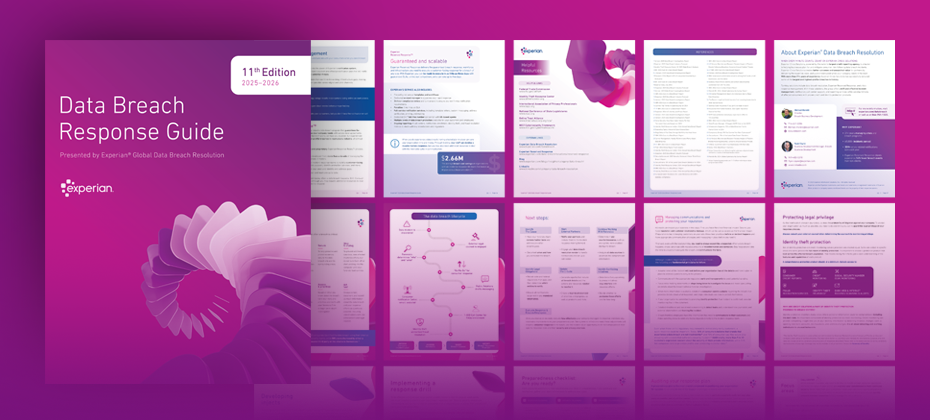
Data breaches continue to be a reality for organizations across industries, and the complexity of responding to them is only increasing. From AI-driven fraud to third-party exposures, the risk landscape is shifting fast. Having a modern and tested response plan is essential to containing the damage, protecting your customers, and preserving your organization’s reputation when a breach occurs. Experian’s eleventh annual Data Breach Response Guide draws on decades of breach support experience. It offers practical strategies and insights for navigating the moments that matter most: the first hours after a breach and the days that follow. The 2025–2026 guide explores: How AI is shaping new breach and fraud patterns Where organizations are most vulnerable, including third-party and supply chain weak points Consumer expectations and how they influence crisis response How prepared organizations are reducing impact and protecting trust What is required to build a modern, effective breach response plan Organizations with a tested plan can potentially reduce the cost, impact, and long-term consequences of a breach. From real-world case insights to crisis communication templates, this guide is designed to help teams act quickly and confidently. Download the 2025–2026 Data Breach Response Guide to learn how you can strengthen your breach preparedness, reduce risk exposure, and build resilience against the next wave of cybersecurity threats. Download guide

Now in its tenth year, Experian’s U.S. Identity and Fraud Report continues to uncover the shifting tides of fraud threats and how consumers and businesses are adapting. Our latest edition sheds light on a decade of change and unveils what remains consistent: trust is still the cornerstone of digital interactions. This year’s report draws on insights from over 2,000 U.S. consumers and 200 businesses to explore how identity, fraud and trust are evolving in a world increasingly shaped by generative artificial intelligence (GenAI) and other emerging technologies. Highlights: Over a third of companies are using AI, including generative AI, to combat fraud. 72% of business leaders anticipate AI-generated fraud and deepfakes as major challenges by 2026. Nearly 60% of companies report rising fraud losses, with identity theft and payment fraud as top concerns. Digital anxiety persists with 57% of consumers worried about doing things online. Ready to go deeper? Explore the full findings and discover how your organization can lead with confidence in an evolving fraud landscape. Download report Watch on-demand webinar Read press release

An OTP bot is an automated tool designed to trick users into revealing their one-time password, a temporary code used in MFA.
Learn how behavioral analytics, device and network intelligence, and credit card owner verification can help e-commerce merchants combat key fraud threats.