
All posts by Julie Lee

Click fraud is a costly, often overlooked threat affecting digital businesses. Learn more about how behavioral analytics can help stop it.

Fake IDs have been around for decades, but today’s fraudsters aren’t just printing counterfeit driver’s licenses — they’re using artificial intelligence (AI) to create synthetic identities. These AI fake IDs bypass traditional security checks, making it harder for businesses to distinguish real customers from fraudsters. To stay ahead, organizations need to rethink their fraud prevention solutions and invest in advanced tools to stop bad actors before they gain access. The growing threat of AI Fake IDs AI-generated IDs aren’t just a problem for bars and nightclubs; they’re a serious risk across industries. Fraudsters use AI to generate high-quality fake government-issued IDs, complete with real-looking holograms and barcodes. These fake IDs can be used to commit financial fraud, apply for loans or even launder money. Emerging services like OnlyFake are making AI-generated fake IDs accessible. For $15, users can generate realistic government-issued IDs that can bypass identity verification checks, including Know Your Customer (KYC) processes on major cryptocurrency exchanges.1 Who’s at risk? AI-driven identity fraud is a growing problem for: Financial services – Fraudsters use AI-generated IDs to open bank accounts, apply for loans and commit credit card fraud. Without strong identity verification and fraud detection, banks may unknowingly approve fraudulent applications. E-commerce and retail – Fake accounts enable fraudsters to make unauthorized purchases, exploit return policies and commit chargeback fraud. Businesses relying on outdated identity verification methods are especially vulnerable. Healthcare and insurance – Fraudsters use fake identities to access medical services, prescription drugs or insurance benefits, creating both financial and compliance risks. The rise of synthetic ID fraud Fraudsters don’t just stop at creating fake IDs — they take it a step further by combining real and fake information to create entirely new identities. This is known as synthetic ID fraud, a rapidly growing threat in the digital economy. Unlike traditional identity theft, where a criminal steals an existing person’s information, synthetic identity fraud involves fabricating an identity that has no real-world counterpart. This makes detection more difficult, as there’s no individual to report fraudulent activity. Without strong synthetic fraud detection measures in place, businesses may unknowingly approve loans, credit cards or accounts for these fake identities. The deepfake threat AI-powered fraud isn’t limited to generating fake physical IDs. Fraudsters are also using deepfake technology to impersonate real people. With advanced AI, they can create hyper-realistic photos, videos and voice recordings to bypass facial recognition and biometric verification. For businesses relying on ID document scans and video verification, this can be a serious problem. Fraudsters can: Use AI-generated faces to create entirely fake identities that appear legitimate Manipulate real customer videos to pass live identity checks Clone voices to trick call centers and voice authentication systems As deepfake technology improves, businesses need fraud prevention solutions that go beyond traditional ID verification. AI-powered synthetic fraud detection can analyze biometric inconsistencies, detect signs of image manipulation and flag suspicious behavior. How businesses can combat AI fake ID fraud Stopping AI-powered fraud requires more than just traditional ID checks. Businesses need to upgrade their fraud defenses with identity solutions that use multidimensional data, advanced analytics and machine learning to verify identities in real time. Here’s how: Leverage AI-powered fraud detection – The same AI capabilities that fraudsters use can also be used against them. Identity verification systems powered by machine learning can detect anomalies in ID documents, biometrics and user behavior. Implement robust KYC solutions – KYC protocols help businesses verify customer identities more accurately. Enhanced KYC solutions use multi-layered authentication methods to detect fraudulent applications before they’re approved. Adopt real-time fraud prevention solutions – Businesses should invest in fraud prevention solutions that analyze transaction patterns and device intelligence to flag suspicious activity. Strengthen synthetic identity fraud detection – Detecting synthetic identities requires a combination of behavioral analytics, document verification and cross-industry data matching. Advanced synthetic fraud detection tools can help businesses identify and block synthetic identities. Stay ahead of AI fraudsters AI-generated fake IDs and synthetic identities are evolving, but businesses don’t have to be caught off guard. By investing in identity solutions that leverage AI-driven fraud detection, businesses can protect themselves from costly fraud schemes while ensuring a seamless experience for legitimate customers. At Experian, we combine cutting-edge fraud prevention, KYC and authentication solutions to help businesses detect and prevent AI-generated fake ID and synthetic ID fraud before they cause damage. Our advanced analytics, machine learning models and real-time data insights provide the intelligence businesses need to outsmart fraudsters. Learn more *This article includes content created by an AI language model and is intended to provide general information. 1 https://www.404media.co/inside-the-underground-site-where-ai-neural-networks-churns-out-fake-ids-onlyfake/

Fraud rings cause an estimated $5 trillion in financial damages every year, making them one of the most dangerous threats facing today’s businesses. They’re organized, sophisticated and only growing more powerful with the advent of Generative AI (GenAI). Armed with advanced tools and an array of tried-and-true attack strategies, fraud rings have perfected the art of flying under the radar and circumventing traditional fraud detection tools. Their ability to adapt and innovate means they can identify and exploit vulnerabilities in businesses' fraud stacks; if you don’t know how fraud rings work and the right signs to look for, you may not be able to catch a fraud ring attack until it’s too late. What is a fraud ring? A fraud ring is an organized group of cybercriminals who collaborate to execute large-scale, coordinated attacks on one or more targets. These highly sophisticated groups leverage advanced techniques and technologies to breach fraud defenses and exploit vulnerabilities. In the past, they were primarily humans working scripts at scale; but with GenAI they’re increasingly mobilizing highly sophisticated bots as part of (or the entirety of) the attack. Fraud ring attacks are rarely isolated incidents. Typically, these groups will target the same victim multiple times, leveraging insights gained from previous attack attempts to refine and enhance their strategies. This iterative approach enables them to adapt to new controls and increase their impact with each subsequent attack. The impacts of fraud ring attacks far exceed those of an individual fraudster, incurring significant financial losses, interrupting operations and compromising sensitive data. Understanding the keys to spotting fraud rings is crucial for crafting effective defenses to stop them. Uncovering fraud rings There’s no single tell-tale sign of a fraud ring. These groups are too agile and adaptive to be defined by one trait. However, all fraud rings — whether it be an identity fraud ring, coordinated scam effort, or large-scale ATO fraud scheme — share common traits that produce warning signs of imminent attacks. First and foremost, fraud rings are focused on efficiency. They work quickly, aiming to cause as much damage as possible. If the fraud ring’s goal is to open fraudulent accounts, you won’t see a fraud ring member taking their time to input stolen data on an application; instead, they’ll likely copy and paste data from a spreadsheet or rely on fraud bots to execute the task. Typically, the larger the fraud ring attack, the more complex it is. The biggest fraud rings leverage a variety of tools and strategies to keep fraud teams on their heels and bypass traditional fraud defenses. Fraud rings often test strategies before launching a full-scale attack. This can look like a small “probe” preceding a larger attack, or a mass drop-off after fraudsters have gathered the information they needed from their testing phase. Fraud ring detection with behavioral analytics Behavioral analytics in fraud detection uncovers third-party fraud, from large-scale fraud ring operations and sophisticated bot attacks to individualized scams. By analyzing user behavior, organizations can effectively detect and mitigate these threats. With behavioral analytics, businesses have a new layer of fraud ring detection that doesn’t exist elsewhere in their fraud stack. At a crowd level, behavioral analytics reveals spikes in risky behavior, including fraud ring testing probes, that may indicate a forthcoming fraud ring attack, but would typically be hidden by sheer volume or disregarded as normal traffic. Behavioral analytics also identifies the high-efficiency techniques that fraud rings use, including copy/paste or “chunking” behaviors, or the use of advanced fraud bots designed to mimic human behavior. Learn more about our behavioral analytics solutions and their fraud ring detection capabilities. Learn more

Fraud never sleeps, and neither do the experts working to stop it. That’s why we’re thrilled to introduce Meet the Maker, our new video series spotlighting the brilliant minds behind Experian’s cutting-edge fraud solutions. In our first episode, Matt Ehrlich, Senior Director of Identity and Fraud Product Management, and Andrea Nighswander, Senior Director of Global Solution Strategy, share how they use data, advanced analytics, and deep industry expertise to stay ahead of fraudsters. With 35+ years of combined experience, these fraud-fighting veterans know exactly what it takes to keep bad actors at bay. Watch now for an exclusive look at the minds shaping the future of fraud prevention. Stay tuned for more episodes featuring the visionaries driving fraud innovation.
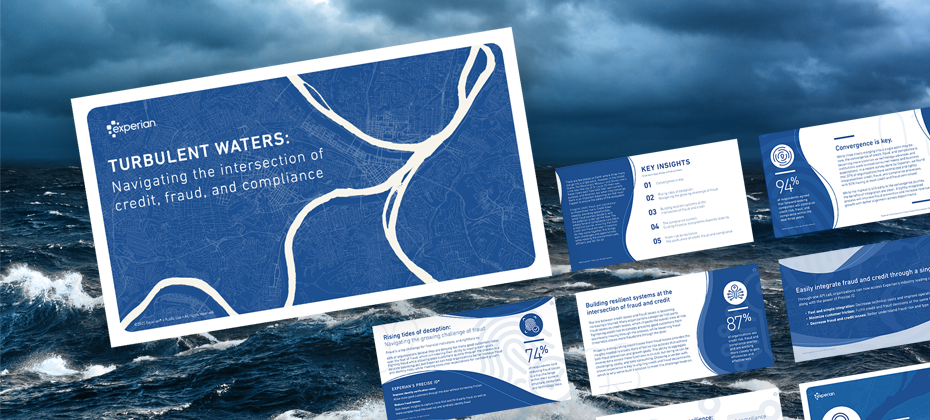
The days of managing credit risk, fraud prevention, and compliance in silos are over. As fraud threats evolve, regulatory scrutiny increases, and economic uncertainty persists, businesses need a more unified risk strategy to stay ahead. Our latest e-book, Navigating the intersection of credit, fraud, and compliance, explores why 94% of forward-looking companies expect credit, fraud, and compliance to converge within the next three years — and what that means for your business.1 Key insights include: The line between fraud and credit risk is blurring. Many organizations classify first-party fraud losses as credit losses, distorting the true risk picture. Fear of fraud is costing businesses growth. 68% of organizations say they’re denying too many good customers due to fraud concerns. A unified approach is the future. Integrating risk decisioning across credit, fraud, and compliance leads to stronger fraud detection, smarter credit risk assessments, and improved compliance. Read the full e-book to explore how an integrated risk approach can protect your business and fuel growth. Download e-book 1Research conducted by InsightAvenue on behalf of Experian

A spoofing attack occurs when a threat actor impersonates a trusted source to gain access to sensitive information, disrupt operations or manipulate systems.

Bots have been a consistent thorn in fraud teams’ side for years. But since the advent of generative AI (genAI), what used to be just one more fraud type has become a fraud tsunami. This surge in fraud bot attacks has brought with it: A 108% year-over-year increase in credential stuffing to take over accounts1 A 134% year-over-year increase in carding attacks, where stolen cards are tested1 New account opening fraud at more than 25% of businesses in the first quarter of 2024 While fraud professionals rush to fight back the onslaught, they’re also reckoning with the ever-evolving threat of genAI. A large factor in fraud bots’ new scalability and strength, genAI was the #1 stress point identified by fraud teams in 2024, and 70% expect it to be a challenge moving forward, according to Experian’s U.S. Identity and Fraud Report. This fear is well-founded. Fraudsters are wasting no time incorporating genAI into their attack arsenal. GenAI has created a new generation of fraud bot tools that make bot development more accessible and sophisticated. These bots reverse-engineer fraud stacks, testing the limits of their targets’ defenses to find triggers for step-ups and checks, then adapt to avoid setting them off. How do bot detection solutions fare against this next generation of bots? The evolution of fraud bots The earliest fraud bots, which first appeared in the 1990s2 , were simple scripts with limited capabilities. Fraudsters soon began using these scripts to execute basic tasks on their behalf — mainly form spam and light data scraping. Fraud teams responded, implementing bot detection solutions that continued to evolve as the threats became more sophisticated. The evolution of fraud bots was steady — and mostly balanced against fraud-fighting tools — until genAI supercharged it. Today, fraudsters are leveraging genAI’s core ability (analyzing datasets and identifying patterns, then using those patterns to generate solutions) to create bots capable of large-scale attacks with unprecedented sophistication. These genAI-powered fraud bots can analyze onboarding flows to identify step-up triggers, automate attacks at high-volume times, and even conduct “behavior hijacking,” where bots record and replicate the behaviors of real users. How next-generation fraud bots beat fraud stacks For years, a tried-and-true tool for fraud bot detection was to look for the non-human giveaways: lightning-fast transition speeds, eerily consistent keystrokes, nonexistent mouse movements, and/or repeated device and network data were all tell-tale signs of a bot. Fraud teams could base their bot detection strategies off of these behavioral red flags. Stopping today’s next-generation fraud bots isn’t quite as straightforward. Because they were specifically built to mimic human behavior and cycle through device IDs and IP addresses, today’s bots often appear to be normal, human applicants and circumvent many of the barriers that blocked their predecessors. The data the bots are providing is better, too3, fraudsters are using genAI to streamline and scale the creation of synthetic identities.4 By equipping their human-like bots with a bank of high-quality synthetic identities, fraudsters have their most potent, advanced attack avenue to date. Skirting traditional bot detection with their human-like capabilities, next-generation fraud bots can bombard their targets with massive, often undetected, attacks. In one attack analyzed by NeuroID, a part of Experian, fraud bots made up 31% of a business's onboarding volume on a single day. That’s nearly one-third of the business’s volume comprised of bots attempting to commit fraud. If the business hadn’t had the right tools in place to separate these bots from genuine users, they wouldn’t have been able to stop the attack until it was too late. Beating fraud bots with behavioral analytics: The next-generation approach Next-generation fraud bots pose a unique threat to digital businesses: their data appears legitimate, and they look like a human when they’re interacting with a form. So how do fraud teams differentiate fraud bots from an actual human user? NeuroID’s product development teams discovered key nuances that separate next-generation bots from humans, and we’ve updated our industry-leading bot detection capabilities to account for them. A big one is mousing patterns: random, erratic cursor movements are part of what makes next-generation bots so eerily human-like, but their movements are still noticeably smoother than a real human’s. Other bot detection solutions (including our V1 signal) wouldn’t flag these advanced cursor movements as bot behavior, but our new signal is designed to identify even the most granular giveaways of a next-generation fraud bot. Fraud bots will continue to evolve. But so will we. For example, behavioral analytics can identify repeated actions — down to the pixel a cursor lands on — during a bot attack and block out users exhibiting those behaviors. Our behavior was built specifically to combat next-gen challenges with scalable, real-time solutions. This proactive protection against advanced bot behaviors is crucial to preventing larger attacks. For more on fraud bots’ evolution, download our Emerging Trends in Fraud: Understanding and Combating Next-Gen Bots report. Learn more Sources 1 HUMAN Enterprise Bot Fraud Benchmark Report 2 Abusix 3 NeuroID 4 Biometric Update

There’s a common saying in the fraud prevention industry: where there’s opportunity, fraudsters are quick to follow. Recent advances in technology are providing ample new opportunities for cybercriminals to exploit. One of the most prevalent techniques being observed today is password spraying. From email to financial and health records, consumers and businesses are being impacted by this pervasive form of fraud. Password spraying attacks often fly under the radar of traditional security measures, presenting a unique and growing threat to businesses and individuals. What is password spraying? Also known as credential guessing, password spraying involves an attacker applying a list of commonly used passwords against a list of accounts in order to guess the correct password. When password spraying first emerged, an individual might hand key passwords to try to gain access to a user’s account or a business’s management system. Credential stuffing is a similar type of fraud attack in which an attacker gains access to a victim’s credentials in one system (e.g., their email, etc.) and then attempts to apply those known credentials via a script/bot to a large number of sites in order to gain access to other sites where the victim might be using the same credentials. Both are brute-force attack vectors that eventually result in account takeover (ATO), compromising sensitive data that is subsequently used to scam, blackmail, or defraud the victim. As password spraying and other types of fraud evolved, fraud rings would leverage “click farms” or “fraud farms” where hundreds of workers would leverage mobile devices or laptops to try different passwords in order to perpetrate fraud attacks on a larger scale. As technology has advanced, bot attacks fueled by generative AI (Gen AI) have taken the place of humans in the fraud ring. Now, instead of hand-keying passwords into systems, workers at fraud farms are able to deploy hundreds or thousands of bots that can work exponentially faster. The rise and evolution of bots Bots are not necessarily new to the digital experience — think of the chatbot on a company’s support page that helps you find an answer more quickly. These automated software applications carry out repetitive instructions mimicking human behavior. While they can be helpful, they can also be leveraged by fraudsters, to automate fraud on a brute-force attack, often going undetected resulting in substantial losses. Generation 4 bots are the latest evolution of these malicious programs, and they’re notoriously hard to detect. Because of their slow, methodical, and deliberate human-like behavior, they easily bypass network-level controls such as firewalls and popular network-layer security. Stopping Gen4 bots For any company with a digital presence or that leverages digital networks as part of doing business, the threat from Gen AI enabled fraud is paramount. The traditional stack for fighting fraud including firewalls, CAPTCHA and block lists are not enough in the face of Gen4 bots. Companies at the forefront of fighting fraud are leveraging behavioral analytics to identify and mitigate Gen AI-powered fraud. And many have turned to industry leader, Neuro ID, which is now part of Experian. Watch our on-demand webinar: The fraud bot future-shock: How to spot & stop next-gen attacks Behavioral analytics is a key component of passive and continuous authentication and has become table stakes in the fraud prevention space. By measuring how a user interacts with a form field (e.g., a website, mobile app, etc.) our behavioral analytics solutions can determine if the user is: a potential fraudster, a bot, or a genuine user familiar with the PII entered. Because it’s available at any digital engagement, behavioral data is often the most consistent signal available throughout the customer lifecycle and across geographies. It allows risky users to be rejected or put through more rigorous authentication, while trustworthy users get a better experience, protecting businesses and consumers from Gen AI-enabled fraud. As cyber threats evolve, so must our defenses. Password spraying exemplifies the sophisticated methods and technologies attackers now employ to scale their fraud efforts and gain access to sensitive information. To fight next-generation fraud, organizations must employ next-generation technologies and techniques to better defend themselves against this and other types of cyberattacks. Experian’s approach embodies a paradigm shift where fraud detection increases efficiency and accuracy without sacrificing customer experience. We can help protect your company from bot attacks, fraudulent accounts and other malicious attempts to access your sensitive data. Learn more about behavioral analytics and our other fraud prevention solutions. Learn more

Our behavioral analytics solutions help you stop fraud rings, fraud bots, and other third-party fraud attacks.
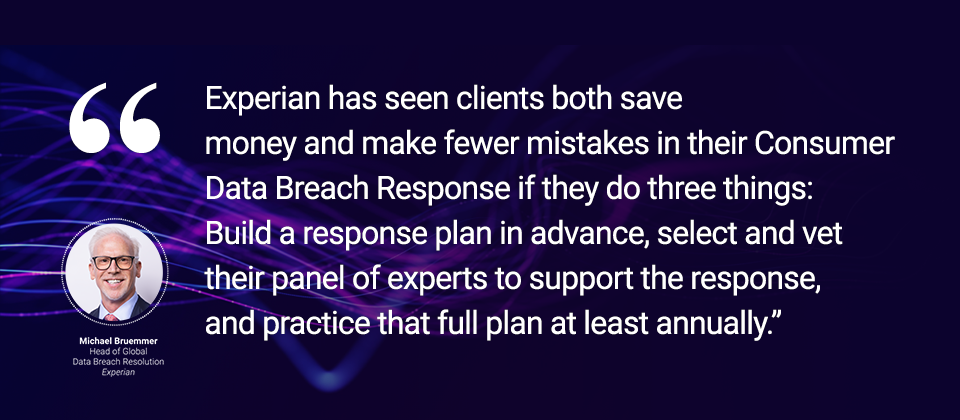
With cyber threats intensifying and data breaches rising, understanding how to respond to incidents is more important than ever. In this interview, Michael Bruemmer, Head of Global Data Breach Resolution at Experian, is joined by Matthew Meade, Chair of the Cybersecurity, Data Protection & Privacy Group at Eckert Seamans, to discuss the realities of data breach response. Their session, “Cyber Incident Response: A View from the Trenches,” brings insights from the field and offers a preview of Experian's 2025 Data Breach Industry Forecast, including the role of generative artificial intelligence (AI) in data breaches. From the surge in business email compromises (BEC) to the relentless threat of ransomware, Bruemmer and Meade dive into key issues facing organizations big and small today. Drawing from Experian's experience handling nearly 5,000 breaches this year, Bruemmer sheds light on effective response practices and reveals common pitfalls. Meade, who served as editor-in-chief for the Sedona Conference’s new Model Data Breach Notification Law, explains the implications of these regulatory updates for organizations and highlights how standardized notification practices can improve outcomes. Bruemmer and Meade’s insights offer a proactive guide to tackling tomorrow’s cyber threats, making it a must-listen for anyone aiming to stay one step ahead. Listen to the full interview for a valuable look at both the current landscape and what's next. Click here for more insight into safeguarding your organization from emerging cyber threats.

Account farming is the process of creating and cultivating multiple user accounts, often using fake or stolen identities.

Mobile identity verification confirms the legitimacy of users accessing services via their mobile device.

Reject inferencing techniques unlock a more comprehensive view of your applicant pool for more informed underwriting decisions.
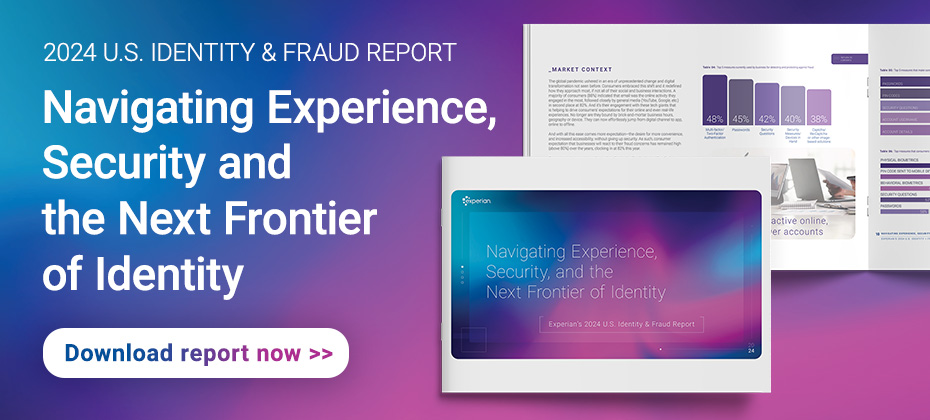
In this report, we explore how the evolving fraud landscape is impacting identity verification, customer experience, and business priorities for the future.

AI fraud detection helps organizations enhance their security measures, reduce fraud losses, authenticate identity, and improve customer experience.