Tag: customer experience

To drive competitive growth and customer retention, banks must find innovative ways to elevate the banking customer experience.

Explore credit card marketing trends and strategies to help you identify, engage, and acquire the right customers.

Financial institutions need an automated, data-driven solution to simplify and streamline the online form completion process.

Explore what identity resolution for credit marketing is and how it enables lenders to create more cohesive and personalized customer interactions.

Want to retain more customers and onboard new prospects, too? A customer-driven marketing strategy might be the tool you need to boost your marketing ROI.

For banks, remaining competitive doesn’t just involve enhancing their processes — it requires investing in the future of their business: Gen Z.

A data-driven credit customer experience offers personalization and low friction — it's a win-win for consumers and businesses.

To increase efficiency and digital customer acquisition, forward-thinking lenders are seeking flexible technologies that enable automated decisioning.

With an abundance of loan options in today’s market, retaining customers can be challenging for banks and credit unions, especially small or regional institutions. And as more consumers look for personalization and digital tools in their banking experience, the likelihood of switching to institutions that can meet these demands is increasing.1 According to a recent Experian survey, 78% of consumers have conducted personal banking activities online in the last three months. However, 58% of consumers don’t feel that businesses completely meet their expectations for a digital online experience. To remain competitive in today's market, organizations must enhance their prescreen efforts by accelerating their digital transformation. Prescreen in today's economic environment While establishing a strong digital strategy is crucial to meeting the demands of today’s consumers, economic conditions are continuing to change, causing many financial institutions to either tighten their marketing budgets or hold off on their prescreen efforts completely. Fortunately, lenders can still drive growth during a changing economy without having to make huge cuts to their marketing budgets. How? The answer lies in digital prescreen. Case study: Uncover hidden growth opportunities Wanting to grow their business and existing relationships, Clear Mountain Bank looked for a solution that could help them engage customers with money-saving product offers while delivering a best-in-class digital banking experience. Leveraging Digital Prescreen with Micronotes, the bank was able to identify and present dollarized savings to customers who held higher-priced loans with other lenders. What’s more, the bank extended these offers through personalized conversations within their online and mobile banking platforms, resulting in improved digital engagement and increased customer satisfaction. By delivering competitive prescreen offers digitally, Clear Mountain Bank generated more than $1 million in incremental loans and provided customers with an average of $1,615 in cost savings within the first two months of deployment. “Digital Prescreen with Micronotes supplied the infrastructure to create higher-quality, personalized offers, as well as the delivery and reporting. They made prescreen marketing a reality for us.” – Robert Flockvich, Director of Community Outreach and Retail Lending at Clear Mountain Bank To learn more about how you can grow your portfolio and customer relationships, read the full case study or visit us. Download the case study Visit us 1The Keys to Solving Banking’s Customer Loyalty & Retention Problems, The Financial Brand, 2022.
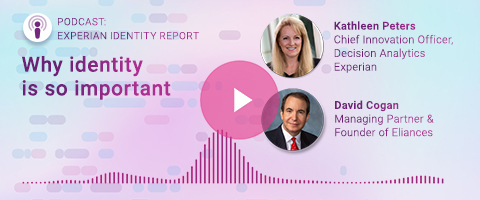
Kathleen Peters, Chief Innovation Officer, Decision Analytics for Experian, was recently featured on the Eliances Heroes podcast as part of the new weekly segment, the “Experian Identity Report.” In the introductory show, podcast host David Cogan, spoke with Kathleen about why identity is so important to our society. Listen to the podcast for the full discussion and see the transcript below. Learn more about Experian Identity David Cogan: How critical is it? Well, I’ll tell you. Payment fraud will exceed $206 billion in the next five years and let’s face it. Managing one’s personal identity is very complicated on its own and if the business enterprise managing customer identities in a strategic and secure way and scale across countless interaction is extremely complicated. And it’s only going to get more complex with the future from what I understand and all the technology that’s coming out if not by the day, by the hour. And that’s why we’re bringing this to you. Interviews with the world’s leading experts on the game changing impact of identity and the need to use reliable data to make confident decisions that securely accelerate customer engagement and that’s why we’re honored here today to have with us Kathleen Peters, Chief Innovation Officer, Experian Decision Analytics North America. Kathleen Peters: Thanks so much David, it’s great to be here with you. DC: $206 billion of payment fraud in the next five years? I mean who’s going to want to turn on their computer after this. That is a serious number. What do we do? KP: It’s really important that we get our arms around this both as consumers as well as businesses because we want to engage online. So much of what we’re doing is digital. It especially started in COVID when we were having our groceries delivered and everything else and even our grandparents are having to do their banking transactions online. The world is changing, and fraudsters take notice of that as well. Fraudsters are opportunistic and when they see a bunch of folks doing stuff online that they’ve never done before, they’re seeing that as an opportunity too. DC: You know the days of people horseback riding and overtaking trains are long gone and now it’s all digital. KP: It’s a lot easier these days. DC: Why is identity so important to our daily digital lives and in business? KP: It’s a great question, David. And as a consumer myself, you, and I when we transact online whether that’s to have food delivered, or I’m buying something for my kids or I’m even paying a bill, I want to be able to trust that my information will be safe, that my privacy will be protected and that my experience will be as smooth as possible. I think that’s what we all want. So as consumers and as businesses, how do we enable all the opportunities this new digital world is presenting to us in a way that we are safe and also businesses can transact with us securely and have confidence on who’s engaging with them online. DC: Let’s talk about identity. What really makes identity so challenging to manage at a business enterprise level especially with how complex the business portion is? KP: Absolutely. It really comes down to there are so many elements that comprise our identity. It’s multidimensional. So historically, when we think about identity, we probably think about the things that were on our DL or passport the kind of information that’s pretty static – name, address, SSN, date of birth – those kinds of things. Once we get online, that identity becomes a little more challenging. We’re not necessarily physically in front of the business that we’re engaging with so the business needs to determine if the person is who we say we are. There’s a famous Far Side comic from years ago where a dog is sitting in front of the computer and he says “On the internet, no one knows you’re a dog.” And that still rings true in that you need to be able to ensure that the customer that’s coming to your business online is a real person and not a bot, is a person with good intent and not a fraudster. You need to look no farther than some of the recent controversies around Twitter and Elon Musk’s on-again, off-again, on-again intent to buy the company. A few months ago he had pulled back because he wanted to know definitively how many users on Twitter are humans versus bots and sometimes determining that can be really hard. And that comes down to managing all these new definitions of identity. DC: That’s very important. The thing is businesses and consumers want to know really what to be able to do. So, what kinds of things is Experian able to offer to help with all of that? KP: We’re in a great position as Experian because we have such a depth and breadth of identity data. We have the analytics horsepower and really touchpoints that are really unique when it comes to thinking about identity. So we’ve been talking about these traditional identity elements and digital, online identity. When you think about it, Experian also really understands your financial identity. So when you bring those things together and a consumer is looking to maybe understand what their financial identity means, their credit score or even how to improve their credit score, Experian’s there. We’ve got a robust direct to consumer business, we’ve got offerings like Boost and Go that help people establish and build their credit. We’ve got marketplaces for cards, insurance, etc. And then when consumers want to open a new account at a financial institution, or a fintech, or a retailer, or even maybe buy some crypto or log into a business, Experian can bring that wealth of capability to help our clients, help businesses, separate those good consumers with good intent from the fraudsters and do that very quickly and efficiently so that consumers can have a great experience and build that trust with who they’re engaging with. DC: Kathleen, that’s really amazing. Alright, now with all of that going on, what is Experian doing now with innovating for the identity space? KP: This is a real passion of mine David and this is where I spend a lot of my time. We’re always looking ahead to see what is the new data, new capabilities that can help us improve that consumer experience and engagement, help clients find the right consumers online to engage and target, and really allow our clients to grow their businesses safely. So, we’re building some products in house, where we’re connecting new pieces that might be new to Experian like linking some of that traditional identity data with particular payment instruments. Is this Kathleen’s credit card? Is this my bank account? When I come and try to do transactions online. But we’re also partnering with new companies. There are a number of startups that are being formed that have been in business looking at new ways to stop fraud and new ways to help identify and authenticate users online. So, as we innovate, we’re building some things in house, we’re partnering, we’re investing in young companies, and sometimes we’re even acquiring. So, bringing together that breadth of data, analytics, really trying to think about what will be the next way that we’ll think about identifying ourselves online is some of the ways we’re innovating. DC: Well, we’re very fortunate to have you and your company here to be able to do that because it’s growing by leaps and bounds. I’m amazed by the number $206 billion which is probably going to go higher, so we’re very fortunate that Experian is around and really identifying this issue and trying to do something now. What do you think our audience will learn about these weekly, critical chats about identity with Experian experts? KP: These are going to be great conversations that we’re going to be able to share and talk about how rapidly things are changing and evolving and how this really relates to our daily lives and the things that are going on in this very dynamic economic climate, digital climate, the way things are changing the way we’re engaging. I think people are also going to learn a lot about Experian’s mission around financial inclusion and opportunity creation. We’re a very mission driven company and we’re the consumer’s bureau, so we want to do this journey in partnership with consumers so that you can take an active part in protecting yourself, understanding what’s going on, helping us fight fraud, but also just really be able to take advantage of all of these new opportunities in a safe way.

With consumers having more credit options than ever before, it’s imperative for lenders to get their message in front of ideal customers at the right time and place. But without clear insights into their interests, credit behaviors or financial capacity, you may risk extending preapproved credit offers to individuals who are unqualified or have already committed to another lender. To increase response rates and reduce wasted marketing spend, you must develop an effective customer targeting strategy. What makes an effective customer targeting strategy? A customer targeting strategy is only as good as the data that informs it. To create a strategy that’s truly effective, you’ll need data that’s relevant, regularly updated, and comprehensive. Alternative data and credit-based attributes allow you to identify financially stressed consumers by providing insight into their ability to pay, whether their debt or spending has increased, and their propensity to transfer balances and consolidate loans. With a more granular view of consumers’ credit behaviors over time, you can avoid high-risk accounts and focus only on targeting individuals that meet your credit criteria. While leveraging additional data sources can help you better identify creditworthy consumers, how can you improve the chances of them converting? At the end of the day, it’s also the consumer that’s making the decision to engage, and if you aren’t sending the right offer at the precise moment of interest, you may lose high-value prospects to competitors who will. To effectively target consumers who are most likely to respond to your credit offers, you must take a customer-centric approach by learning about where they’ve been, what their goals are, and how to best cater to their needs and interests. Some types of data that can help make your targeting strategy more customer-centric include: Demographic data like age, gender, occupation and marital status, give you an idea of who your customers are as individuals, allowing you to enhance your segmentation strategies. Lifestyle and interest data allow you to create more personalized credit offers by providing insight into your consumers’ hobbies and pastimes. Life event data, such as new homeowners or new parents, helps you connect with consumers who have experienced a major life event and may be receptive to event-based marketing campaigns during these milestones. Channel preference data enables you to reach consumers with the right message at the right time on their preferred channel. Target high-potential, high-value prospects By using an effective customer targeting strategy, you can identify and engage creditworthy consumers with the greatest propensity to accept your credit offer. To see if your current strategy has what it takes and what Experian can do to help, view this interactive checklist or visit us today. Review your customer targeting strategy Visit us

A false decline is a legitimate transaction that is not completed due to suspected fraud or the friction that occurs during verification. Read more.

To drive growth and customer retention in today’s competitive landscape, financial services must optimize their customer acquistion strategies.

In today’s evolving and competitive market, the stakes are high to deliver both quantity and quality. That is, to deliver growth goals while increasing customer satisfaction. OneAZ Credit Union is the second largest credit union in Arizona, serving over 157,000 members across 21 branches. Wanting to fund more loans faster and offer a better member experience through their existing loan origination system (LOS), OneAZ looked to improve their decisioning system and long-standing underwriting criteria. They partnered with Experian to create an automated underwriting strategy to meet their aggressive approval rate and loss rate goals. By implementing an integrated decisioning system, OneAZ had flexible access to data credit attributes and scores, resulting in increased automation through their existing LOS – meaning they didn’t have to completely overhaul their decisioning systems. Additionally, they leveraged software that enabled champion/challenger strategies and the flexibility to manage their decision criteria. Within one month of implementation, OneAZ saw a 26% increase in loan funding rates and a 25% decrease in manual reviews. They can now pivot quickly to respond to continuously evolving conditions. “The speed at which we can return a decision and our better understanding of future performance has really propelled us in being able to better serve our members,” said John Schooner, VP Credit Risk Management at OneAZ. Read our case study for more insight on how automation and Experian Decisioning can move the needle for your organization, including: Streamlined strategy development and execution to minimize costly customizations and coding Comprehensive data assets across multiple sources to ensure ID verification and a holistic view of your prospect Proactive monitoring and real-time visibility to challenge and rapidly adjust strategies as needed Download the full case study

While many view Millennials and Gen Z through the same lens, savvy automotive marketers are adjusting their strategies to capture the market of this generation.