Latest Posts

Click fraud is a costly, often overlooked threat affecting digital businesses. Learn more about how behavioral analytics can help stop it.

Experian and Plaid are teaming up to power smarter, faster, and more inclusive lending — fueled by real-time cashflow insights.

The Automotive Finance Market Stabilizes; Data Indicates a Shift in Lending Strategies
Apply Automotive TagAmid interest rates leveling out and some lenders reassessing go-to-market strategies, the automotive finance landscape is experiencing notable shifts in market share. According to Experian’s State of the Automotive Finance Market Report: Q1 2025, banks recouped some of their total finance market share for the first time in several years, reaching 26.6% during the quarter, up from 24.8% a year ago. On the other hand, captives’ total market share declined from 31.3% to 29.8% year-over-year and credit unions experienced a modest increase from 20.2% to 20.6%. Despite the overall market share shifts, captives continue to lead in new vehicle financing at 57.1% in Q1 2025, although down from 62.1% the year prior. Meanwhile, banks increased to 24.1% this quarter, from 20.4% in Q1 2024 and credit unions went from 9.6% to 10.9% during the same period. On the used side, banks and credit unions were grouped much closer together. Banks led the way with 28.4% of the used finance market in Q1 2025, up from 27.9% last year, while credit unions went from 27.7% to 28.2% year-over-year and captives declined from 8.5% to 7.4%. As market share movement continues to be a valuable indicator of shifting strategies and consumer behavior, it’s important for automotive professionals to keep a close eye on these shifts to uncover new opportunities while looking for ways to stay ahead of the rapidly evolving industry. Breaking down the latest finance trends Data in the first quarter of 2025 shows the automotive finance market continues to stabilize as automotive professionals gain clearer visibility into lender behavior and consumer demand. For example, the average loan amount for a new vehicle increased $1,110 year-over-year to $41,720 in Q1 2025. However, the average interest rate dropped from 6.9% to 6.7%, and the average monthly payment went from $737 last year to $745 this quarter. For used vehicles, the average loan amount saw a slight uptick of $90 year-over-year, reaching $26,144 this quarter. Meanwhile, the average interest rate declined from 12.4% last year to 11.9% this quarter and the average monthly payment trended lower at $521, from $524 in Q1 2024. Monitoring and leveraging market share shifts and financing trends can support strategic planning while empowering automotive professionals to anticipate consumer purchasing patterns and tailor conversations more effectively to meet buyers where they are during their car buying journey. To learn more about automotive finance trends, view the full State of the Automotive Finance Market: Q1 2025 presentation on demand.

For financial institutions to achieve success, they need to develop high-performing models with easy access to top-tier data sources. It’s also important to focus on data governance, compliance, and risk management throughout the lending lifecycle. Industry leaders implement advanced analytics and AI solutions to improve their lending decisions, and they also incorporate integrated, efficient feature engineering into their business operations. What’s feature engineering? Feature engineering helps organizations turn raw data into comprehensive model development, following this process: Data collection Data cleaning and transformation Feature engineering Model training and evaluation Decision-making Effectively transforming data into valuable insights depends heavily on creating new custom features to enhance model performance, as well as the quality of the data being used. When data is fragmented or managed poorly, it can lead to increased operational costs, missed revenue opportunities, and compliance risks. Our feature engineering solution: Experian Feature Builder Financial institutions require optimized workflows that can accelerate development while supporting governance and ensuring transparency. Experian’s feature engineering tool, Experian Feature Builder, streamlines custom feature development and deployment across the modeling lifecycle. Providing access to 20+ years of proprietary data, Experian Feature Builder enables organizations to: Break data silos by creating unified access across multiple data types Ensure trust and compliance by embedding audit and lineage tracking at each stage Enable strategic agility with faster and more consistent feature experimentation, testing, and deployment Download our latest e-book to find out more about how Experian’s Feature Builder provides centralized feature development to accelerate time-to-market, enhance compliance, and minimize risk. Download the e-book

Industry leaders are leveraging GenAI technology to accelerate the modeling lifecycle, streamline workflows and ensure regulatory compliance.

Proactive credit limit increases can be a game-changer for financial institutions, improve financial health and stability.

Vehicle price. Monthly payment. Loan terms. Interest rates. Those are the more prominent buzz words dealers hear from consumers throughout the vehicle shopping process, particularly in our current environment. And rightfully so, in-market shoppers are hoping to get the most value for their wallets. But let’s not forget how valuable transparency can be, especially with used vehicles. Hidden damage from accidents or natural disasters, as well as title brands, among other factors, can have a significant negative impact on the drivability of any given vehicle. Ensuring consumers have visibility to that information can help them make a more informed purchasing decision, and more importantly, help dealers potentially build a lifelong relationship with them. Plus, consumers want that information. According to a recent Experian survey [1], nearly all respondents (98%) said a vehicle history report is important to them when considering the purchase of a used vehicle. Furthermore, almost 70% said accident history information in a report would likely influence their purchasing decision, followed by frequent repairs (61%) and title problems such as salvage or flood damage (55%). Given the significance of used vehicles in the automotive market, having tools such as Experian AutoCheck® vehicle history reports readily available on dealership and manufacturer websites can help buyers make more informed decisions. Where today’s consumers start their vehicle search Knowing what resources consumers are using to search for their next vehicle plays a role in identifying where they’re gathering their information, and in turn, can help guide dealers in offering relevant information during the decision-making process. The survey revealed that 64% of consumers browse dealership websites and 46% look at manufacturer websites during their buying process. In a competitive market, having instant access to a vehicle’s history can help streamline the shopping experience while allowing buyers to feel more confident and drive conversions. Leveraging this information will allow businesses to tailor their consumer engagement strategies to meet the specific needs or concerns of potential buyers at each stage of the journey. To learn more, visit Experian AutoCheck® Vehicle History Reports. [1] Experian commissioned Atomik Research to conduct an online survey of 2,005 adults throughout the United States. The sample consists of adults who estimate they will purchase or lease their next vehicle within the next 24 months or sooner. The margin of error is +/- 2 percentage points with a confidence level of 95 percent. Fieldwork took place between March 24 and March 27, 2025.

By adopting a proactive approach to credit limit management, financial institutions can improve customer satisfaction and increase revenue.

Electric vehicles (EVs) continue to gain traction in certain markets. In fact, at the end of 2024, 9.2% of all new retail registrations were electric, up from 8%+ in 2023 and 6%+ in 2022. Clearly, more and more in-market shoppers are leaning towards EVs, but what is actually a determining factor in their decision? A recent Experian survey [1] found 65% of respondents said they prioritize battery life, while 62% consider price, 58% are concerned with range on a full battery and 53% are focused on infrastructure and maintenance. It’s not just EVs, hybrids are getting into the mix While EVs certainly are the buzzword in the industry, it’s not the only alternative fuel type consumers are opting for. For instance, 55% of respondents said they’d consider a new hybrid and 50% said they’d consider a new EV for their next vehicle purchase. On the used side, 38% of respondents said they’d consider an EV and 42% would consider a hybrid. More granularly, the survey revealed 67% of Gen Z and 61% of Millennials are likely to buy a new EV, while 62% and 63% of these groups, respectively, expressed similar intentions for purchasing new hybrid. Gen Z and Millennials also showed a stronger-than-average interest on the used side, with 57% and 49% opting for EVs, and 57% and 52% choosing hybrids. With the younger generations gravitating towards these fuel types, it’s likely going to influence adoption rates down the road, a trend that should be watched closely as manufacturers roll out more models to meet the growing demand. However, when assessing the viewpoints of other generations, some are less likely to purchase an alternative fuel type. Two-in-five, albeit still a healthy percentage, of Gen X respondents said they’re likely to purchase a new EV and only 25% of Baby Boomers shared a similar sentiment. Meanwhile, 27% of Gen X and 12% of Baby Boomers say they’re likely to purchase a used EV. Furthermore, 46% of Gen X and 43% of Baby Boomers indicated they are likely to buy a new hybrid, while 33% and 21% of these groups, respectively, conveyed similar thoughts towards purchasing used hybrids. It’s crucial for professionals to stay attuned to shifting trends and concerns among consumers, as these factors play a role in consumer decision-making. By addressing potential setbacks and knowing where their target audience is, they can better align their strategies with consumer needs as these fuel types continue to move up on the list for everyday commuters. To learn more about EV insights, visit Experian Automotive’s EV Resource Center. [1] Experian commissioned Atomik Research to conduct an online survey of 2,005 adults throughout the United States. The sample consists of adults who estimate they will purchase or lease their next vehicle within the next 24 months or sooner. The margin of error is +/- 2 percentage points with a confidence level of 95 percent. Fieldwork took place between March 24 and March 27, 2025.

AI in Telecommunications: How AI is Transforming the Telecom Industry Amid Market and Regulatory Pressures
Telecommunications, Cable & UtilitiesExplore how AI in telecommunications helps providers navigate industry challenges and how Experian's advanced analytics drives results.

By integrating feature engineering, organizations can convert raw data into more accurate features and build higher-performing models.

By leveraging loan loss analysis, lenders can create more profitable business opportunities throughout the entire customer lifecycle.

During economic uncertainty, lenders can leverage retention triggers to proactively engage customers and reduce churn.
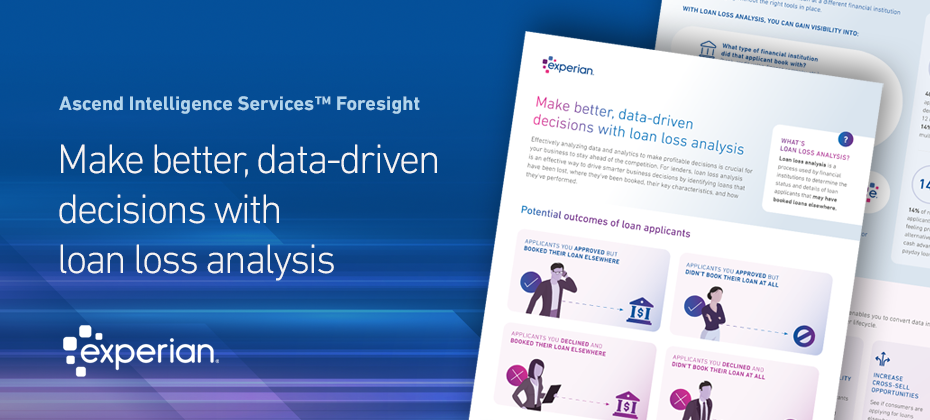
Loan loss analysis helps financial institutions identify the characteristics and performance of loans that have been lost to competitors.

GenAI is pushing financial institutions to focus on improving efficiency, productivity, and time to value during the modeling lifecycle.