
All posts by Alan Ikemura

Proactive credit limit increases can be a game-changer for financial institutions, improve financial health and stability.

By adopting a proactive approach to credit limit management, financial institutions can improve customer satisfaction and increase revenue.

By leveraging loan loss analysis, lenders can create more profitable business opportunities throughout the entire customer lifecycle.
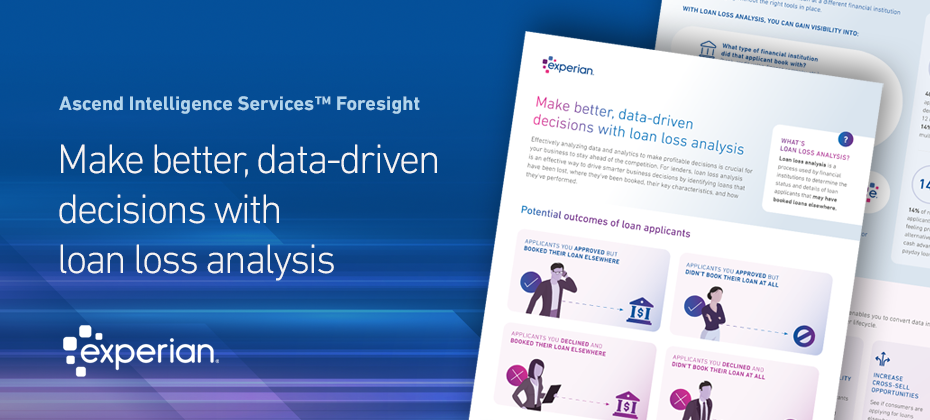
Loan loss analysis helps financial institutions identify the characteristics and performance of loans that have been lost to competitors.

Ascend Intelligence Services™ Target leverages custom response models and optimized prescreen strategies to enhance response rates.

How can lenders ensure they’re making the most accurate and fair lending decisions? The answer lies in consistent model validations.

Machine learning's ability to consume vast amounts of data to uncover patterns and deliver results makes it well suited for the credit risk industry

Will the U.S. consumer spend more this holiday season? One way to measure this behavior is through bankcard utilization rates.

With the constant (and improving!) changes in the consumer credit landscape, understanding the latest trends is vital for institutions to validate current business strategies or make adjustments to shifts in the marketplace. For example, a recent article in American Banker described how a couple of housing advocates who foretold the housing crisis in 2005 are now promoting a return to subprime lending. Good story lead-in, but does it make sense for MY business? How do you profile this segment of the market and its recent performance? Are there differences by geography? What other products are attracting this risk segment that could raise concerns for meeting a new mortgage obligation? There is a proliferation of consumer loan and credit information online from various associations and organizations, but in a static format that still makes it challenging to address these types of questions. Fortunately, new web-based solutions are being made available that allow users to access and interrogate consumer trade information 24x7 and keep abreast of constantly changing market conditions. The ability to manipulate and tailor data by geography, VantageScore® credit score risk segments and institution type are just a mouse click away. More importantly, these tools allow users to customize the data to meet specific business objectives, so the next subprime lending headline is not just a story, but a real business opportunity based on objective, real-time analysis. Explore the features from one such tool available.
The Fed’s Comprehensive Capital Analysis and Review (CCAR) and Capital Plan Review (CapPR) stress scenarios depict a severe recession that, although unlikely, the largest U.S. banks must now account for in their capital planning process. The bank holding companies’ ability to maintain adequate capital reserves, while managing the risk levels of growing portfolios are key to staying within the stress test parameters and meeting liquidity requirements. While each banks’ portfolios will perform differently, as a whole, the delinquency performance of major products such as Auto, Bankcard and Mortgage continues to perform well. Here is a comparison between the latest quarter results and two years ago from the Experian – Oliver Wyman Market Intelligence Reports. Although not a clear indication of how well a bank will perform against the hypothetical scenario of the stress tests, measures such as Probability of Default, Loss Given Default and Exposure at Default to indicate a bank’s risk may be dramatically improved from just a few years ago given recent delinquency trends in core portfolios. Recently we released a white paper that provides an introduction to Basel III regulation and discusses some of its impact on banks and the banking system. We also present a real business case showing how organizations turn these regulatory challenges into buisness opportunities by optimizing their credit strategies. Download the paper - Creating value in challenging times: An innovative approach to Basel III compliance.
With the constant (and improving!) changes in the consumer credit landscape, understanding the latest trends is vital for institutions to validate current business strategies or make adjustments to shifts in the marketplace. For example, a recent article in American Banker described how a couple of housing advocates who foretold the housing crisis in 2005 are now promoting a return to subprime lending. Good story lead-in, but does it make sense for “my” business? How do you profile this segment of the market and its recent performance? Are there differences by geography? What other products are attracting this risk segment that could raise concerns for meeting a new mortgage obligation? There is a proliferation of consumer loan and credit information online from various associations and organizations, but in a static format that still makes it challenging to address these types of questions. Fortunately, new web-based solutions are being made available that allow users to access and interrogate consumer trade information 24x7 and keep abreast of constantly changing market conditions. The ability to manipulate and tailor data by geography, VantageScore risk segments and institution type are just a mouse click away. More importantly, these tools allow users to customize the data to meet specific business objectives, so the next subprime lending headline is not just a story, but a real business opportunity based on objective, real-time analysis.
Up to this point, I’ve been writing about loan originations and the prospects and challenges facing bankcard, auto and real estate lending this year. While things are off to a good start, I’ll use my next few posts to discuss the other side of the loan equation: performance. If there’s one thing we learned during the post-recession era is that growth can have consequences if not managed properly. Obviously real estate is the poster child for this phenomenon, but bankcards also realized significant and costly performance deterioration following the rapid growth generated by relaxed lending standards. Today, bankcard portfolios are in expansion mode once again, but with delinquency rates at their lowest point in years. In fact, loan performance has improved nearly 50% in the past three years through a combination of tighter lending requirements and consumers’ self-imposed deleveraging. Lessons learned from issuers and consumers have created a unique climate in which growth is now balanced with performance. Even areas with greater signs of payment stress have realized significant improvements. For example, the South Atlantic region’s 4.2% 30+ DPD performance is 11% higher than the national average, but down 27% from a year ago. Localized economic factors definitely play a part in performance, but the region’s higher than average origination growth from a broader range of VantageScore® credit score consumers could also explain some of the delinquency stress here. And that is the challenge going forward: maintaining bankcard’s recent growth while keeping performance in check. As the economy and consumer confidence improves, this balancing act will become more difficult as issuers will want to meet the consumer’s appetite for spending and credit. Increased volume and utilization is always good for business, but it won’t be until the performance of these loans materializes that we’ll know whether it was worth it.
In my last two posts on bankcard and auto originations, I provided evidence as to why lenders have reason to feel optimistic about their growth prospects in 2012. With real estate lending however, the recovery, or lack thereof looks like it may continue to struggle throughout the year. At first glance, it would appear that the stars have aligned for a real estate turnaround. Interest rates are at or near all-time lows, housing prices are at post-bubble lows and people are going back to work with the unemployment rate at a 3-year low just above 8%. However, mortgage originations and HELOC limits were at $327B and $20B for Q3 2011, respectively. Admittedly not all-time quarterly lows, but well off levels of just a couple years ago. And according to the Mortgage Bankers Association, 65% of the mortgage volume was from refinance activity. So why the lull in real estate originations? Ironically, the same reasons I just mentioned that should drive a recovery. Low interest rates – That is, for those that qualify. The most creditworthy, VantageScore® credit score A and B consumers made up nearly 77% of the $327B mortgage volume and 87% of the $20B HELOC volume in Q3 2011. While continuing to clean up their portfolios, lenders are adjusting their risk exposure accordingly. Housing prices at multi-year lows - According to the S&P Case Shiller index, housing prices were 4% lower at the end of 2011 when compared to the end of 2010 and at the lowest level since the real estate bubble. Previous to this report, many thought housing prices had stabilized, but the excess inventory of distressed properties continues to drive down prices, keeping potential buyers on the sidelines. Unemployment rate at 3-year low – Sure, 8.3% sounds good now when you consider we were near 10% throughout 2010. But this is a far cry from the 4-5% rate we experienced just five years ago. Many consumers continue to struggle, affecting their ability to make good on their debt obligations, including their mortgage (see “Housing prices at multi-year lows” above), in turn affecting their credit status (see “Low interest rates” above)… you get the picture. Ironic or not, the good news is that these forces will be the same ones to drive the turnaround in real estate originations. Interest rates are projected to remain low for the foreseeable future, foreclosures and distressed inventory will eventually clear out and the unemployment rate is headed in the right direction. The only missing ingredient to make these variables transform from the hurdle to the growth factor is time.
If you attended any of our past credit trends Webinars, you’ve heard me mention time and again how auto originations have been a standout during these times when overall consumer lending has been a challenge. In fact, total originated auto volumes topped $100B in the third quarter of 2011, a level not seen since mid-2008. But is this growth sustainable? Since bottoming at the start of 2009, originations have been on a tear for nearly three straight years. Given that, you might think that auto origination’s best days are behind it. But these three key factors indicate originations may still have room to run: 1. The economy Just as it was a factor in declining auto originations during the recession, the economy will drive continued increases in auto sales. If originations were growing during the challenges of the past couple of years, the expected improvements in the economy in 2012 will surely spur new auto originations. 2. Current cars are old A recent study by Experian Automotive showed that today’s automobiles on the road have hit an all-time high of 10.6 years of age. Obviously a result of the recent recession, consumers owning older cars will result in pent up demand for newer and more reliable ones. 3. Auto lending is more diversified than ever I’m talking diversification in a couple of ways: Auto lending has always catered to a broader credit risk range than other products. In recent years, lenders have experimented with moving even further into the subprime space. For example, VantageScore® credit score D consumers now represent 24.4% of all originations vs. 21.2% at the start of 2009. There is a greater selection of lenders that cater to the auto space. With additional players like Captives, Credit Unions and even smaller Finance companies competing for new business, consumers have several options to secure a competitively-priced auto loan. With all three variables in motion, auto originations definitely have a formula for continued growth going forward. Come find out if auto originations do in fact continue to grow in 2012 by signing up for our upcoming Experian-Oliver Wyman credit trends Webinar.
As we kick off the new year, I thought I’d dedicate a few blog posts to cover what some of the consumer credit trends are pointing to for potential growth opportunities in 2012, specifically on new loan originations for bankcard, automotive and real estate lending. With the holiday season behind us (and if you’re anything like me, you have the credit card statements to prove it!), I thought I’d start off with bankcards for my first post of the year. Everyone’s an optimist at the start of a new year and bankcard issuers have a right to feel cautiously optimistic about 2012 based on the trends of last year. In the second quarter of 2011, origination volumes grew to nearly $47B, up 28% from the same quarter a year earlier. Actually, originations have been steadily growing since the middle of 2010 with increasing distribution across all VantageScore risk bands and an impressive 42% increase in A paper volume. So, is bankcard the new power portfolio for growth in 2012? The broad origination risk distribution may signal the return of balance-carrying consumers (aka: revolvers) from those that pay with credit cards, but pay off the balance every month (aka: transactors). The tighter lending criteria imposed in recent years has improved portfolio performance significantly, but at the expense of interest fee profitability from revolver use. This could change as more credit cards are put in the hands of a broader consumer risk base. And as consumer confidence continues to grow, (it reached 64.5 in December, 10 points higher than November according to the Conference Board) , consumers in all risk categories will no doubt begin to leverage credit cards more heavily for continued discretionary spend, as highlighted in the most recent Experian – Oliver Wyman quarterly webinar. Of course, portfolio growth with the increased risk exposure requires a watchful eye on the delinquency performance of outstanding balances. We continue to be at or near historic lows for delinquency, but did see a small uptick in early stage delinquencies in the third quarter of 2011. That being said, issuers appear to have a good pulse on the card-carrying consumer and are capitalizing on the improved payment behavior to maximize their risk/reward payoff. So all-in-all, strong 2011 results and portfolio positioning has set the table for a promising 2012. Add an improving economy to the mix and card issuers could shift from cautious to confident in their optimism for the new year.