Market Trends

Banking uncertainty creates opportunity for fraud The recent regional bank collapses left anxious consumers scrambling to withdraw their funds or open new accounts at other institutions. Unfortunately, this situation has also created an opportunity for fraudsters to take advantage of the chaos. Criminals are exploiting the situation and posing as legitimate customers looking to flee their current bank to open new accounts elsewhere. Financial institutions looking to bring on these consumers as new clients must remain vigilant against fraudulent activity. Fraudsters also prey on vulnerable individuals who may be financially stressed and uncertain about the future. This creates a breeding ground for scams as fear and uncertainty cloud judgment and make people more susceptible to manipulation. Beware of fraudulent tactics Now, it is more important than ever for financial institutions to be vigilant in their due diligence processes. As they navigate this period of financial turbulence, they must take extra precautions to ensure that new customers are who they say they are by verifying customer identities, conducting thorough background checks where necessary, and monitoring transactions for any signs of suspicious activity. Consumers should also maintain vigilance — fraudulent schemes come in many forms, from phishing scams to fake investment opportunities promising unrealistic returns. To protect yourself against these risks, it is important to remain vigilant and take precautions such as verifying the legitimacy of any offers or investments before investing, monitoring your bank and credit card statements regularly for suspicious activity, and being skeptical of unsolicited phone calls, emails, or text messages. Security researcher Johannes Ulrich reported that threat actors are jumping at the opportunity, registering suspicious domains related to Silicon Valley Bank (SVB) that are likely to be used in attacks. Ulrich warned that the scammers might try to contact former clients of SVB to offer them a support package, legal services, loans, or other fake services relating to the bank's collapse. Meanwhile, on the day of the SVB closure, synthetic identity fraud began to climb from an attack rate of .57 to a first peak of 1.24% on the Sunday following the closure, or an increase of 80%. After the first spike reduced on March 14, we only saw a return of an even higher spike on March 21 to 1.35%, with bumps continuing since then. As the economy slows and fraud rises, don’t let your guard down The recent surge in third-party attack rates on small business and investment platforms is a cause for concern. There was a staggering nearly 500% increase in these attacks between March 7th and 11th, which coincided with the release of negative news about SVB. Bad actors had evidently been preparing for this moment and were quick to exploit vulnerabilities they had identified across our financial system. They used sophisticated bots to create multiple accounts within minutes of the news dropping and stole identities to perpetrate fraudulent activities. This underscores the need for increased vigilance and proactive measures to protect against cyber threats impacting financial institutions. Adopting stronger security measures like multi-factor authentication, real-time monitoring, and collaboration with law enforcement agencies for timely identification of attackers is of paramount importance to prevent similar fraud events in the future. From frictionless to friction-right As businesses seek to stabilize their operations in the face of market turbulence, they must also remain vigilant against the threat of fraud. Illicit activities can permeate a company's ecosystem and disrupt its operations, potentially leading to financial losses and reputational damage. Safeguarding against fraud is not a simple task. Striking a balance between ensuring a smooth customer experience and implementing effective fraud prevention measures can be a challenging endeavor. For financial institutions in particular, being too stringent in fraud prevention efforts may drive customers away, while being too lenient can expose them to additional fraud risks. This is where a waterfall approach, such as that offered by Experian CrossCore®, can prove invaluable. By leveraging an array of fraud detection tools and technologies, businesses can tailor their fraud prevention strategies to suit the specific needs and journeys of different customer segments. This layered, customized approach can help protect businesses from fraud while ensuring a seamless customer experience. Learn more

High property values and rising interest rates have priced many borrowers out of the market. In the face of declining home purchases, lenders are focusing on their portfolios and opportunities to expand borrower relationships. At the same time, portfolio health is increasingly important. Keeping a pulse on and successfully managing portfolio risk is just as important as portfolio growth. To effectively manage a mortgage portfolio, an understanding of the complete financial standing of a borrower, along with the most recent loan performance and property data characteristics, is crucial. Below we discuss three ways to analyze your portfolio to maximize performance. Portfolio risk While mortgage delinquencies remain well below pre-pandemic levels, rolling delinquency rates are seeing an uptick. In a recent study, we found that, of the at-risk population, over 24% may be at high risk of delinquency or default. Having the tools and resources to segment your portfolio and identify these borrowers is key to preemptively assisting or modifying loan terms and reducing risk exposure to the business. Growth and retention Did you know up to 64% of prime and above borrows may be ideal Home Equity Line of Credit (HELOC) candidates? Having the ability to segment your portfolio to identify borrowers who can tap into their home equity as a line of credit for upgrades, remodeling, or simply a rainy-day fund, will allow you to grow your originations pipeline while also supporting your mortgage retention strategy. To optimize your segmentation strategy, consider leveraging In the Market Models (ITMM) to identify borrowers with a high propensity to respond to HELOC offers. Through a retrospective analysis, we found that ITMM can improve campaign performance by over 700%. Similarly, a HELOC can be a prime option for borrowers with increasing debt. Through our newly launched solution, Mortgage Insights Dashboard for Servicing, we found that up to 46% of prime and above borrowers may be ideal candidates for debt consolidation. For this segment of your portfolio, a HELOC can consolidate high-interest debt from credit cards, retail cards, or even short-term loans. Peer analysis Like sports teams, many mortgage lenders and servicers are interested in comparing their performance against that of their peers. Are your portfolio runoff rates above, equal to, or below that of your competitors? In some instances, we’ve seen a lender’s runoff rate averaging 10% MoM higher than their peers. By comparing your portfolio performance against your peers (and the market) you can assess both the efficacy of portfolio recapture strategies and demonstrate loan quality to investors. While these are just a few examples of ways to analyze your portfolio, perhaps what’s most important is having the data, such as credit, income, DTI, and property information, needed for this type of intelligence available in one place. Partner with a provider that can offer you the mortgage servicing solutions to easily segment your portfolio to gain insights and inform ongoing strategic decisions. Learn more *Data charts source: Experian's Mortgage Insights Dashboard for Servicing

Jennifer Schulz, CEO of Experian, North America kicked off Experian’s annual Vision conference Tuesday morning pointing to data, analytics, technology and collective curiosity as the drivers for change and a more impactful tomorrow to more than 700 attendees. Keynote speaker: Jennifer Bailey Jennifer Bailey, Vice President of Apple Pay and Apple Wallet, spoke about the customer experience “ethos.” She explained how Apple takes a long-term view and values the single most important performance metric as customer experience. She said creating a seamless customer experience comes down to making things simple and understandable, and asking, “Are we solving a customer problem?” and “How are we making it easier for customers to enjoy and liver their lives. Bailey, who said of all apps she uses the weather app the most, also talked about innovation, and that both intent and making mistakes are important parts of the process. Apple’s products are known for their user-friendliness, and design is part of that. She encouraged the audience to give design teams room to create without bottom line pressures and not to be afraid to take well-considered risks. Keynote Speaker: Gary Cohn Gary Cohn, Vice Chairman of IBM, talked about the current economic climate, and while it’s a natural viewpoint to look to the past for guidance, the current environment is unlike any before. Cohn discussed regulatory compliance in the banking industry and prioritizing safety and soundness. While AI is topical and in numerous headlines recently, Cohn reminded the conference goers that AI isn’t new. He said what is new and important is that you can now teach models to find the information needed rather than having to feed all the information yourself. He believes AI is not the end of employment, but rather helps boost productivity, efficiency, and job satisfaction and provides organizations more data. As for advice for the audience, Cohn shared opportunities are in the uncomfortable zones and you have to be willing to fail in order to succeed. Session highlights – Day 1 The conference hall was buzzing with conversations, discussions and thought leadership. Overall themes that were frequently part of the conversation included seamless customer experiences, agility in face of economic changes and leveraging AI/ML into strategies. Fraud automation and preventing commercial fraud More businesses are opening than ever before and lenders and service providers need a way to determine risk from businesses who are less than a year old. There is no one-size-fits-all approach to fraud. A layered solution assesses risk and applies the correct friction to resolve the risk and pass or refer the applicant. Identity Today’s consumer wants a personalized experience and is privacy conscious. Additionally, regulators are also pushing for greater privacy. Clean rooms allow you and a partner to add data to a safe space and learn more about consumers without exposing data. The right data improves acquisition rates, identity verification and allows you to anticipate customer needs. Advanced scoring Data, models and strategy are the levers institutions are using to leverage responsible analytics to meet their objectives like safely growing existing portfolios, managing the “right” level of risk, and providing a seamless digital experience. However, the total value of a decisioning system is almost always constrained by its most rudimentary component. The panel of experts discussed their uses and goals for leveraging models and customer experience was at the top of their priorities. Recession preparedness Delinquency is on the rise and lending offers made continue to drop. Changes in the economic climate require frequent monitoring of portfolio and decisions, benchmarking against peers, updating credit models and decision strategies, and stress testing portfolio and models. Trends in credit risk management While AI at the hands of everyone is topical today, it ranked lowest on the list of trends attendees believed were impacting their business. At the top of the list? The growing demand for simpler, faster and seamless experiences. More insights from Vision to come. Follow @ExperianVision and @ExperianInsights to see more of the action.

Customer-driven marketing isn't just a buzzword — it's a strategic priority, especially in today's competitive digital landscape. Rather than pushing product-centric messaging, leading financial institutions (FIs) are shifting to strategies that put the customer at the core of every decision, message and experience. This means providing personalized experiences that enable customers to feel seen and heard. What is customer-driven marketing? Customer-driven marketing doesn't just improve visibility — it turns customers into brand advocates. It's a strategy that begins by understanding and prioritizing the needs, motivations and behaviors of customers, and then aligning every campaign, channel and touchpoint with those insights. This methodology focuses on relevance, personalization and responsiveness to customer signals. Why does customer-driven credit marketing matter? Today's consumers expect FIs to understand them beyond surface-level demographics. They demand tailored content, offers that match their needs and seamless interactions across channels. An effective customer-driven marketing strategy: Enhances personalization and relevance. By understanding consumer preferences, life stages and intent signals, FIs can move beyond generic messaging and create timely, relevant communications that resonate. The result is stronger engagement, higher response rates and more meaningful customer interactions. Boosts customer acquisition and retention. Customer-driven marketing enables FIs to identify and reach the most profitable, highly responsive prospects in the most efficient way, while also engaging with current customers to improve long-term retention. Improves campaign ROI and performance. By focusing marketing investments on the right audiences, customer-driven marketing ensures budgets are allocated strategically and impact is maximized. Enables stronger brand loyalty and trust. Customer-driven marketing fosters trust by respecting consumer preferences, delivering helpful content and creating seamless omnichannel experiences. Over time, this builds deeper brand loyalty, increases customer lifetime value and turns satisfied customers into advocates. Step-by-step: Developing the strategy Customer-driven marketing is less funnel, more spiral. You research, test, refine and repeat, all while taking into account customer feedback and campaign results. Start with deep audience understanding The foundation of effective customer-driven marketing lies in data-informed customer insights. Unlock a comprehensive view of your customers by combining first-party data with enriched analytics from trusted data partners. For example, Experian’s ConsumerView database lets marketers build audiences of more than 300 million U.S. consumers and 126 million households, supporting granular segmentation and personalization. Define and prioritize target segments Once your data foundation is in place, identify high-value segments based on behavior, purchase history, and life stage — not just basic demographics. This is where customer-driven marketing shines: instead of broad audience buckets, you target precise groups with tailored communications that feel 1:1. Deliver personalized experiences across channels Customers interact with brands in many ways — from email and social media to connected TV, search and in-store visits. A customer-driven marketing strategy ensures your brand message feels cohesive, relevant and timely across every touchpoint. Measure, learn and iterate A core part of customer-driven marketing is continuous improvement. Track how audiences respond to messaging and experiences — and refine your approach based on performance metrics. This “research, test, refine, repeat” mindset is essential for staying aligned with evolving customer expectations and maximizing ROI over time. Importance of a customer-driven marketing strategy Putting consumers at the center of credit marketing strategies — and at the center of your business as a whole — is the foundation for personalized experiences that can ultimately increase response rates and customer satisfaction. For more on how your organization can develop an effective customer-driven marketing strategy, learn about our credit marketing solutions. Learn more

Despite economic uncertainty, new-customer acquisition remains a high priority in the banking industry, especially with increasing competition from fintech and big tech companies. For traditional banks, standing out in this saturated market doesn’t just involve enhancing their processes — it requires investing in the future of their business: Generation Z. Explore what Gen Z wants from financial technology and how to win them over in 2023 and beyond: Accelerate your digital transformation As digital natives, many Gen Zers prefer interacting with their peers and businesses online. In fact, more than 70% of Gen Zers would consider switching to a financial services provider with better digital offerings and capabilities.1 With a credit prescreen solution that harnesses the power of digital engagement, you can extend and represent firm credit offers through your online and mobile banking platforms, allowing for greater campaign reach and more personalized digital interactions. READ: Case study: Drive loan growth with digital prescreen Streamline your customer onboarding process With 70% of Gen Z and millennials having already opened an account online, it’s imperative that financial institutions offer a digital onboarding experience that’s quick, intuitive, and seamless. However, 44% of Gen Z and millennials state that their digital customer experience has been merely average, noting that the biggest gaps exist in onboarding and account opening.2 To improve the onboarding process, consider leveraging a flexible decisioning platform that accepts applications from multiple channels and automates data collection and identity verification. This way, you can reduce manual activity, drive faster decisions, and provide a frictionless digital customer experience. WATCH: OneAZ Credit Union saw a 25% decrease in manual reviews after implementing an integrated decisioning system Provide educational tools and resources Many Gen Zers feel uncertain and anxious about their financial futures, with their top concern being the cost of living. One way to empower this cohort is by offering credit education tools like step-by-step guides, score simulators, and credit alerts. These resources enable Gen Z to better understand their credit and how certain choices can impact their score. As a result, they can establish healthy financial habits, monitor their progress, and gain more control of their financial lives. By helping Gen Z achieve financial wellness, you can establish trust and long-lasting relationships, ultimately leading to higher customer retention and increased revenue for your business. To learn how Experian can help you engage the next generation of consumers, check out our credit marketing solutions. Learn more 1Addressing banking’s key business challenges in 2023.

With nearly seven billion credit card and personal loan acquisition mailers sent out last year, consumers are persistently targeted with pre-approved offers, making it critical for credit unions to deliver the right offer to the right person, at the right time. How WSECU is enhancing the lending experience As the second-largest credit union in the state of Washington, Washington State Employees Credit Union (WSECU) wanted to digitalize their credit decisioning and prequalification process through their new online banking platform, while also providing members with their individual, real-time credit score. WSECU implemented an instant credit decisioning solution delivered via Experian’s Decisioning as a ServiceSM environment, an integrated decisioning system that provides clients with access to data, attributes, scores and analytics to improve decisioning across the customer life cycle. Streamlined processes lead to upsurge in revenue growth Within three months of leveraging Experian’s solution, WSECU saw more members beginning their lending journey through a digital channel than ever before, leading to a 25% increase in loan and credit applications. Additionally, member satisfaction increased with 90% of members finding the simplified process to be more efficient and requiring “low effort.” Read our case study for more insight on using our digital credit solutions to: Prequalify members in real-time at point of contact Match members to the right loan products Increase qualification, approval and take rates Lower operational and manual review costs Read case study
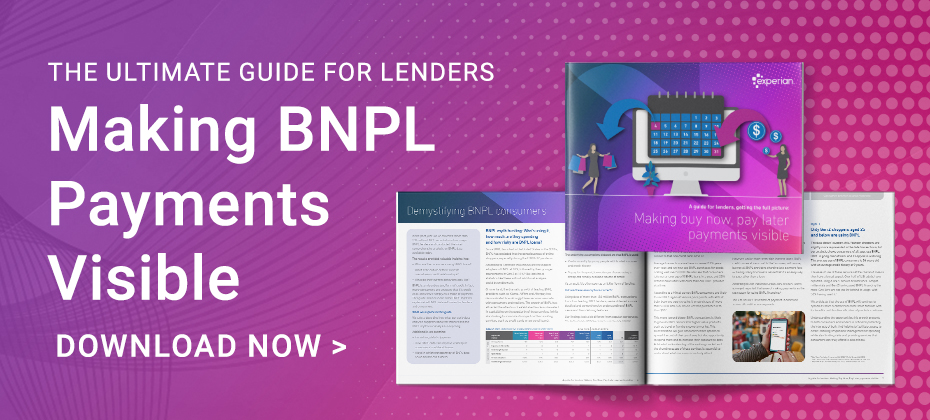
BNPL is a misunderstood form of credit. In fact, many consumers are unaware that it is credit at all and view it simply as a mode of payment. This guide debunks common BNPL myths to explain what BNPL data will mean for lenders and consumers. In the past year, Experian collected more than 130 million buy now, pay later (BNPL) records from four major BNPL fintech lenders and conducted the most comprehensive analysis of BNPL data available today. The results provided valuable insights on: Who are the consumers using BNPL loans? What is the nature of their current mainstream credit relationships? What do their current BNPL behaviors look like? BNPL myth-busting: Who’s using it, how much are they spending and how risky are BNPL loans? Since BNPL launched in the United States in the 2010s, BNPL has exploded into the consciousness of online shoppers, especially during the COVID-19 pandemic. According to Forrester, Millennials are the biggest adopters of BNPL at 18%, followed by their younger counterparts in Gen Z at 11%.1 But looking at statistics like these without additional analysis could be problematic. The dramatic growth of leading BNPL fintechs such as Klarna, Affirm and Afterpay has demonstrated how strongly these services resonate with consumers and retailers. The growth of BNPL has attracted the attention of established lenders interested in capitalizing on the popularity of these services (while also looking to minimize its impact on their existing services, such as credit cards or personal loans). Meanwhile, the Consumer Financial Protection Bureau (CFPB) has urged caution about potential risks, calling for more consistent consumer protections market-wide and transparency into consumer debt accumulation and overextension across lenders. The underlying assumptions debated are that BNPL is used: Predominantly by young people with limited incomes and credit history To pay for frequent, low-value purchases using a cheap and readily available source of credit As a result, it is often seen as a riskier form of lending. But are these assumptions correct? Using data from more than 130 million BNPL transactions from four leading BNPL fintech lenders, we’ve obtained a more detailed and comprehensive understanding of BNPL users and their defining features. Our findings look somewhat different to the popular stereotypes. Myth 1: BNPL is used only for low-value purchases According to our analysis, most BNPL purchases, 95 percent are for items costing $300 or less.2 Some of it is low-value, but not all. In fact, we found that the average purchase using BNPL was similar to that of a credit card, at $132.Average transaction sizes have increased 10 percent year-over-year, and we now see BNPL purchases for goods costing well over $1,000. We also see that consumers take out an average of 5 BNPL loans in a year and 23 percent of them have loans with more than one BNPL provider at a time. Myth 2: BNPL is simply an easier payment method Consumers see BNPL as a simple, quick and convenient way to pay. But, as shoppers receive goods for which payment is deferred, it’s also a form of credit. However, unlike short-term high-interest loans, BNPL credit comes at zero cost to the borrower, with some, but not all BNPL fintech providers charging late payment fees – fueling many borrowers’ sense that it’s an easy way to pay, rather than a loan. Myth 3: Only Gen Z shoppers aged 25 and below are using BNPL Younger shoppers are slightly more represented in the data transactions, but our analysis shows consumers of all ages use BNPL. BNPL is going mainstream, and its appeal is widening. The average age of BNPL consumers is 36 years old, with an average credit history of 9 years.2 The ease of use of these services at the checkout means they have a broad appeal. Over half of U.S. adults have reported using a BNPL service at least once. Despite Millennials and Gen Z having used BNPL financing the most, Gen Xers are not too far behind in usage, with 52% having used it.2 We anticipate that in the use of BNPL will continue to grow as more customers become more familiar with the benefits, and the diversification of products continues. Understanding the opportunities this growth presents to both consumers and lenders is critical to protecting their interests. And helping to facilitate access to credit, enabling responsible spending, while also limiting risks and providing services that consumers can afford is also critical. Download the full guide for additional myths we’re exposing We will take a deep dive into what our early data analysis suggests about the market and the BNPL myths our analysis is exposing. Additionally, we will examine: Why BNPL data matters to providers and lenders How BNPL data can improve visibility of consumers’ creditworthiness Ways in which transparency of BNPL data could benefit consumers 1The Buy Now, Pay Later (BNPL) Opportunity,” Forrester Report, April 29, 2022.2Experian data and analytics derived from 130M+ BNPL transactions

"Out with the old and in with the new" is often used when talking about a fresh start or change we make in life, such as getting a new job, breaking bad habits or making room in our closets for a new wardrobe. But the saying doesn't exactly hold true in terms of business growth. While acquiring new customers is critical, increasing customer retention rates by just 5% can increase profits by up to 95%.1 So, what can your organization do to improve customer retention? Here are three quick tips: Stay informed Keeping up with your customers’ changing interests, behaviors and life events enables you to identify retention opportunities and create personalized credit marketing campaigns. Are they new homeowners? Or likely to purchase a vehicle within the next five months? With a comprehensive consumer database, like Experian’s ConsumerView®, you can gain granular insights into who your customers are, what they do and even what they will potentially do. To further stay informed, you can also leverage Retention TriggersSM, which alert you of your customers changing credit needs, including when they shop for new credit, open a new trade or list their property. This way, you can respond with immediate and relevant retention offers. Be more than a business – be human Gen Z's spending power is projected to reach $12 trillion by 2030, and with 67% looking for a trusted source of personal finance information,2 financial institutions have an opportunity to build lifetime loyalty now by serving as their trusted financial partners and advisors. To do this, you can offer credit education tools and programs that empower your Gen Z customers to make smarter financial decisions. By providing them with educational resources, your younger customers will learn how to strengthen their financial profiles while continuing to trust and lean on your organization for their credit needs. Think outside the mailbox While direct mail is still an effective way to reach consumers, forward-thinking lenders are now also meeting their customers online. To ensure you’re getting in front of your customers where they spend most of their time, consider leveraging digital channels, such as email or mobile applications, when presenting and re-presenting credit offers. This is important as companies with omnichannel customer engagement strategies retain on average 89% of their customers compared to 33% of retention rates for companies with weak omnichannel strategies. Importance of customer retention Rather than centering most of your growth initiatives around customer acquisition, your organization should focus on holding on to your most profitable customers. To learn more about how your organization can develop an effective customer retention strategy, explore our marketing solutions. Increase customer retention today 1How investing in cardholder retention drives portfolio growth, Visa. 2Experian survey, 2023.
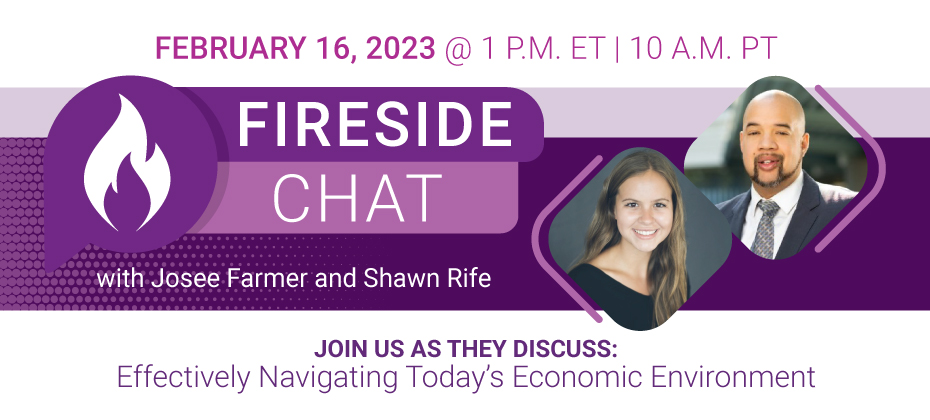
How businesses respond to economic uncertainty can determine whether they get ahead or fall behind. To better prepare for the coming months, you must remain up to date on the latest economic developments to better understand and evolve with changing consumer needs. With insight into critical macroeconomic and consumer trends, you can proactively manage your portfolio, enhance your decisioning and seize new opportunities. Grab a cup of coffee and join Experian's Shawn Rife, Client Executive, and Josee Farmer, Economic Analyst, during our fireside chat on February 16 @ 1 P.M. ET/10 A.M. PT. Our expert speakers will provide a view of the latest economic and market trends, their impact on consumers, and how financial institutions can survive and thrive. Highlights include: Macroeconomic and consumer credit trends Economic implications on consumer behavior How financial institutions can adapt Register now

E-commerce digital transactions are rapidly increasing with global ecommerce sales forecast to grow to $7.89 trillion by 2028. While in-store shopping still earns more sales dollars than online shopping, consumers spent more than 18% of total average retail spend from e-commerce during the first half of 2025. Additionally, mobile technology and AI are major drivers of ecommerce growth, with mobile phones accounting for 77% of ecommerce website visits, and nearly 60% of U.S. shoppers turning to AI engines for help, even when online stores embed generative AI tools ton their websites. As a result, opportunities for fraudsters to exploit businesses and consumers for monetary gain are reaching high levels. Businesses must be aware of the risks associated with card not present (CNP) fraud and take steps to protect themselves and their customers. What is card not present fraud? CNP fraud occurs when a criminal uses a stolen or compromised credit card to make a purchase online, over the phone, or through some other means where the card is not physically present at the time of the transaction. This type of fraud can be particularly difficult to detect and prevent, as it relies on the use of stolen card information rather than the physical card itself. CNP fraud can yield significant losses for businesses — these attacks are estimated to reach a staggering $28 billion in losses by 2026. Many have adopted various fraud prevention and identity resolution and verification tools to better manage risk and prevent fraud losses. Since much of the success or failure of e-commerce depends on how easy merchants make it for consumers to complete a transaction, incorporating CNP fraud prevention and identity verification tools in the checkout process should not come at the expense of completing transactions for legitimate customers. What do we mean by that? Let’s look at false declines. What is a false decline? False declines occur when legitimate transactions are mistakenly declined due to the business's fraud detection system incorrectly flagging the transaction as potentially fraudulent. This can not only be frustrating for cardholders, but also for merchants. Businesses may lose the sale and also be on the hook for any charges that result from the fraudulent activity. They can also result in damage to the business's reputation with customers. In either case, it is important for businesses to have measures in place to mitigate the risks of both. How can online businesses increase sales without compromising their fraud defense? One way to mitigate the risk of CNP fraud is to implement additional security measures at the time of transaction. This can include requiring additional verification information, such as a CVV code or a billing zip code to further authenticate the card holder’s identity. These measures can help to reduce the risk of CNP fraud by making it more difficult for fraudsters to complete a transaction. Machine learning algorithms can help analyze transaction data and identify patterns indicating fraudulent activity. These algorithms can be trained on historical data to learn what types of transactions are more likely to be fraudulent and then be used to flag potentially fraudulent transactions before it occurs. Businesses require data and technology that raise confidence in a shopper’s identity. Currently, the data merchants receive to approve transactions is not enough. A credit card owner verification solution like Experian Link fills this gap by enabling online businesses to augment their real-time decisions with data that links customer identity to the credit card being presented for payment to help verify the legitimacy of a transaction. Using Experian Link, businesses can link names, addresses and other identity markers to the customer’s credit card. The additional data enables better decisions, increased sales, decreased costs, a better buyer experience and better fraud detection. Get started with Experian Link™ - our frictionless credit card owner verification solution. Learn more

The only thing constant is change. And as 2022 wraps up and businesses and consumers look toward 2023, the need for insights and data is at an all-time high to help forge the path ahead. With recent slowing economic growth, and uncertain macroeconomic and geopolitical climates, leading organizations are turning to credit, market, and economic trends, to help shape and inform future strategies. The challenge? With so many sources of information, it can be overwhelming to determine which information is relevant. Experian Edge, our new thought leadership hub, compiles proprietary Experian data, and economic, credit and market trends in a single, easy-to-consume place. Covering the automotive, financial services, healthcare, retail and small business sectors, Experian Edge helps businesses navigate tomorrow with today’s insights. Featured Publication: 2022 Experian Edge Chartbook The data stories told during 2022 - particularly credit and economic trends - run the full gamut. From economic growth and the labor market, to consumer health and inflation, there is no shortage of insights to glean. The inaugural 2022 Experian Edge Chartbook compiles those key insights giving a comprehensive look at economic and credit trends and what they could mean for 2023. Download 2022 Experian Edge Chartbook Want more insights? Examples of what else you’ll find on Experian Edge include: State of the Automotive Finance Market Report: Exclusive quarterly report on the latest trends and analysis of the U.S. automotive finance market. State of Alternative Credit Data Report: A deep dive into the uses of alternative data in consumer and small business lending. State of Claims: 200 executive healthcare professionals shed light on the current claims environment. Holiday Retail Guide 2022: Learn what types of behaviors you can expect to see from consumers this holiday shopping season. Beyond the Trends Report: Quarterly insights and commentary on economic conditions and future small business performance. Visit and bookmark Experian Edge for the latest intel you need to propel your business forward. Visit Experian Edge

Financial institutions have gone through a whirlwind in the last few years, with the pandemic forcing many to undergo digital transformations. More recently, rising interest rates and economic uncertainty are leading to a pullback, highlighting the need for lenders to level up their marketing strategies to win new customers. To get started, here are a few key trends to look out for in the new year and fresh marketing ideas for lenders. Challenges and consumers expectations in 2023 It might be cliche to mention the impact that the pandemic had on digital transformations — but that doesn't make it any less true. Consumers now expect a straightforward online experience. And while they may be willing to endure a slightly more manual process for certain purchases in their life, that's not always necessary. Lenders are investing in front-end platforms and behind-the-scenes technology to offer borrowers faster and more intuitive services. For example, A McKinsey report from December 2021 highlighted the growth in nonbank mortgage lenders. It suggested nonbank lenders could hold onto and may continue taking market share as these tech-focused lenders create convenient, fast and transparent processes for borrowers.2 Marketers can take these new expectations to heart when discussing their products and services. To the extent you have one in place, highlight the digital experience that you can offer borrowers throughout the application, verifications, closing and loan servicing. You can also try to show rather than tell with interactive online content and videos. Build a data-driven mortgage lending marketing strategy The McKinsey report also highlighted a trend in major bank and nonbank lenders investing in proprietary and third-party technology and data to improve the customer experience.2 Marketers can similarly turn to a data-driven credit marketing strategy to help navigate shifting lending environments. Segment prospects with multidimensional data Successful marketers can incorporate the latest technological and multidimensional data sources to find, track and reach high-value prospects. By combining traditional credit data with marketing data and Fair Credit Report Act-compliant alternative credit data* (or expanded FCRA-regulated data), you can increase the likelihood of connecting with consumers who meet your credit criteria and will likely respond. For example, Experian's mortgage-specific In the Market Models predict a consumer's propensity to open a new mortgage within a one to four-month period based on various inputs, including trended credit data and Premier Attributes. You can use these propensity models as part of your prescreen criteria, to cross-sell current customers and to help retain customers who might be considering a new lender. But propensity models are only part of the equation, especially when you're trying to extend your marketing budget with hyper-segmented campaigns. Incorporating your internal CRM data and non-FCRA data can help you further distinguish look-alike populations and help you customize your messaging. LEARN MORE: Use this checklist to find and fix gaps in your prospecting strategy Maintain a single view of your borrowers An identity management platform can give you a single view of a consumer as they move through the customer journey. The persistent identity can also help you consistently reach consumers in a post-cookie world and contact them using their preferred channel. You can add to the persistent identity as you learn more about your prospects. However, you need to maintain data accuracy and integrity if you want to get a good ROI. Use triggers to guide your outreach You can also use data-backed credit triggers to implement your marketing plan. Experian's Prospect Triggers actively monitors a nationwide database to identify credit-active consumers who have new tradelines, inquiries or a loan nearing term. Lenders using Prospect Triggers can receive real-time or periodic updates and customize the results based on their screening strategy and criteria, such as score ranges and attributes. They can then make firm credit offers to the prospects who are most likely to respond, which can improve cross-selling opportunities along with originations. Benefit from our expertise Forward-thinking lenders should power their marketing strategies with a data-backed approach to incorporate the latest information from internal and external sources and reach the right customer at the right time and place. From list building to identity management and verification, you can turn to Experian to access the latest data and analytics tools. Learn about Experian credit prescreen and marketing solutions. Explore our credit prescreen solutions Learn about our marketing solutions 1Mortgage Bankers Association (October 2022). Mortgage Applications Decrease in Latest MBA Weekly Survey 2McKinsey & Company (2021). Five trends reshaping the US home mortgage industry

The collections landscape is changing due to shifting consumer behaviors, demands, regulations and an economy that’s in a constant state of flux. As the market evolves, the need for greater insight and analysis grows. Matthew Baltzer, Experian’s Senior Director of Product Marketing, discusses challenges facing the collections industry and how you can continue to build a profitable portfolio. For more information on enhancing your collections strategy, view our full Q&A video. Q: Which macroeconomic trends should debt collectors be the most aware of and why? A:While we are still seeing a reasonably healthy consumer, there are trends to monitor. The first would be employment, which continues to be strong. Laid-off individuals are typically able to move back into the labor force. Second, we're seeing strong consumer spending, with rates higher than in the past three years and high origination activity. A third is declining savings rates. During the pandemic, consumers stored away extra cash, which has since come to a halt. Part of that is likely due to inflation, but it could also point to signs of financial strain. Q: How could these trends impact debt collections strategies moving forward? A: At a portfolio level, they’re good news. The average consumer’s ability to pay has yet to degrade significantly. So, collectors should be able to continue collecting payments. However, six months from now, the impact of inflation and interest rates could take a toll, and settlement offers, or higher upfront payments, may be important tools to consider. Due to increasing interest rates, many households will send money to creditors, leaving less for everyday spending. Q: How has the average consumer been affected by inflation? A: As I mentioned, both consumer spending and overall debt are up. However, when it comes to spending, certain ‘categories’ are more impacted by inflation than others. Of course, home equity and mortgages are higher, which while important, is less impactful for debt collectors. In our recent webinar, ‘Economic Outlook and the Influence on Debt Collections,’ we highlighted the uneven impact inflation has on lower earners in categories such as rent, food and energy. Due to this, collectors may see a rise in delinquency rates, particularly in unsecured personal loans and potentially automotive loans. Q: How should consumers' response to inflation impact collections efforts? A: There may be an increase in opportunities in certain trades, such as utilities, automotive and unsecured personal loans. Are you positioned as an organization to target and serve those markets? For those in the industry, the real potential for an economic weakness should present an opportunity to evaluate your collection strategy. How will you adapt to a 20 to 30% increase in volume? What about working accounts with smaller balances, which we've seen more of since the last larger recession? Experian offers software and decisioning solutions that help debt collectors optimize their strategies for an improved return on investment. Q: What consumer specific data can help lenders better predict distressed consumers? A: As an originator, the first approach to consider should be leveraging new types of data that were not available during the last recession, such as trended, third-party and alternative credit data. Supplementary data can provide leading indicators that risk is increasing before a consumer goes delinquent and their accounts are past due. Additionally, advanced analytics scoring models can help you determine which accounts are more likely to be recoverable. Experian has a new scoring model that uses a complex blend of attributes to assess each trade's history and position in wallet to better predict the likelihood of that account self-curing and separate accounts that need the most attention from those that may need more time. Finally, with accurate consumer contact data, you can enhance your digital engagement strategy and reach the right person, at the right time, on the channel they prefer There’s no time like the present to equip yourself with a successful debt management strategy. With a more holistic consumer view, you can improve account prioritization, predictability and right-party contact rates. Learn more about our debt management solutions here. Watch on-demand webinar

More than seven million Americans who are unbanked cite high account fees, insufficient funds to meet minimum balances and a lack of needed products and services as the main reasons for not having a checking or savings account.1 Credit unions understand that being unbanked comes at a steep cost and have turned their focus to developing products and strategies that prioritize financial inclusion — a movement to combat inequities in banking and better serve the financial needs of marginalized communities. In 2022, the House passed Expanding Financial Access for Underserved Communities Act to allow federal credit unions to add underserved areas to their fields of membership as a means of improving financial inclusion. “We believe diversity, inclusion, equity, belonging and accessibility has to be weaved into the strategic fabric of an organization [and its] culture," says Max Villaronga, President and Chief Executive Officer of Raiz Federal Credit Union. “When we don't participate in [diversity, equity and inclusion], we are complicit in essentially keeping people out of the banking system." For credit unions, driving financial inclusion starts with setting a vision that will leave a lasting legacy that includes fostering financial empowerment, closing the credit gap and building generational wealth among the communities they serve. Here's a roadmap for getting started. Best practices for engagement Establishing a set of best practices is the essential starting point for improving financial inclusion. The process begins with the mission statement and extends to all aspects of operations from hiring procedures to sponsorships and donations. Villaronga advocates three strategies for engagement: Engage the leadership team Conversations about financial inclusion need to start at the top. The C-suite must be willing to be honest about the barriers and willing to adopt changes that will make credit unions more inclusive. “[T]hese systemic barriers will exist until somebody deliberately moves them out of the way," Villaronga says. “The people who are feeling those barriers are not in the position to do the moving it's up to [CEOs and CFOs] to decide to do something to make a difference." Making a difference starts with choosing a leadership team that reflects the demographics of local communities. Case in point: At Raiz Federal Credit Union in El Paso, Texas, senior management and the board have LGBTQIA+ representation and include members from diverse racial and ethnic identities. The board of directors has also prioritized creating a pipeline that will attract more diverse talent to the board. “Many of [our board members] come from underserved backgrounds in our border community," Villaronga says. “This is a very personal journey for them because they can see themselves in the lives of the people we're serving." Build trust in underserved communities According to an FDIC Survey, “unbanked" U.S. households listed a lack of trust in financial institutions as a top reason for not having a bank account. And lack of access to a checking or savings account is most prominent among racial and ethnic minorities and low-income communities.2 Actions speak louder than words, according to Villaronga. Raiz Federal Credit Union uses diverse images in its advertising and provides information in both English and Spanish. The credit union was also awarded the Juntos Avanzamos (Together We Advance) designation from Inclusiv for its commitment to serving and empowering Hispanic communities by providing safe, affordable and relevant financial services. Villaronga believes that a designation like Juntos Avanzamos sends the message to the community that the credit union is committed to improving general financial literacy and pre-loan education, as well as reducing higher charge-offs and other barriers to accessing financial services that exist in lending and serving underserved communities. Dispel financial inclusion myths Among traditional financial institutions, myths about financial inclusion are widespread and include falsehoods that pricing products for marginalized communities are too challenging, reaching out is not profitable, and providing financial products to underserved markets is too risky. “Credit unions were really built to extend credit [and] were also originally established to serve consumers that were being ignored by the existing systems that were in place but those consumers are still being ignored today," Villaronga says. “Are those communities too risky to serve? Some companies are serving them [and] they would not be doing so if it was not profitable." Raiz Federal Credit Union offers several affordable loan products — from credit builder loans to citizenship loans and payday lender payoff loans along with credit cards — that allow members to build their credit scores and establish positive credit histories. Rather than pricing loans based on what the competition is charging, Villaronga calculates the fixed and variable costs, failure fraction and target return on assets to get a floor pricing per unit. The approach, he adds, allowed Raiz Federal Credit Union to report earnings of over 150 basis points in 2021 while maintaining a 12 percent capital ratio, proving that financial inclusion is good for the bottom line. “THE IDEA THAT YOU CANNOT [ACHIEVE FINANCIAL INCLUSION] IN A WAY THAT'S SAFE AND SOUND AND SATISFIES THE [NATIONAL CREDIT UNION ADMINISTRATION] IS TRULY A MYTH." - Max Villaronga, President and CEO, Raiz Federal Credit Union Partner for Success For credit unions, an important part of achieving financial inclusion goals is identifying partners that can help. Raiz Federal Credit Union set a goal to increase automated lending from 20 percent to 60 percent, but using a traditional loan origination program was insufficient to hit that target. A partnership with Experian allowed the credit union to access tools that allowed it to better identify non-traditional risks and opportunities, as well as develop more robust lending and optimized decision strategies. Experian launched Inclusion ForwardTM, an initiative to help boost financial inclusion and close the wealth gap, and support financial institutions by enhancing their inclusion approach by leveraging FCRA-regulated data sources (otherwise known as alternative data).3 In addition to providing a deeper view of unbanked and underbanked consumers and reducing friction and speed of decisioning through increased automation, Experian Lift PremiumTM uses income and employer data, social security and financial management insights — transaction behaviors that were historically credit invisible or unscorable — to help credit unions meet the needs of underserved markets and increase opportunities for inclusion. “This automation also allows us to reduce our fixed cost per unit — [and] it's a really big deal because this is not by little, but a lot," Villaronga says. “This lower cost to produce [a loan] allows us to improve our interest rates to underserved members, further creating an appealing value proposition that's in line with our financial inclusion strategy." Access our case study to learn more about how Experian can help grow your business with a frictionless digital prequalification experience. Access now 1Federal Reserve Bank of Cleveland (May 2022). Unbanked in America: A Review of Literature 2 Federal Deposit Insurance Corporation (December 2021). American Banks: Household use of Banking and Financial Services 3When we refer to “Alternative Credit Data," this refers to the use of alternative data and its appropriate use in consumer credit lending decisions, as regulated by the Fair Credit Reporting Act. Hence, the term “Expanded FCRA Data" may also apply in this instance and both can be used interchangeably

Written by: Mihail Blagoev As there is talk about the global economy potentially heading into a recession, while some suggest that it has already started, there is an expectation that many of the world's countries will see their economic output decline in the next couple of months or a year. Among the negative trends that can occur during a recession are companies making fewer sales and people losing their jobs. Unfortunately, just like any other economic crisis, fraud is expected to go in the opposite direction as criminals continue finding innovative ways to attack consumers when they’re most vulnerable. There is also a concern that first-party fraud attempts might rise as genuine consumers are pushed over the edge by inflation and economic uncertainty. With that in mind, here are six fraud trends that are likely to happen during a recession: Fraudsters exploiting the vulnerable It is well-documented that fraudsters found numerous ways to exploit the vulnerable during the pandemic. Unfortunately, this is expected to happen again in the coming months. As the cost of living rises, criminals will try to use that in their favor by looking for people who can't pay their utility bills or can't afford the price of gas or even food. Fraudsters will try to exploit that by offering them deals, discounts, refunds, or just about anything that will make people believe they are paying less for something that has increased in value or is out of reach at its normal price. Fraudsters have two main goals behind these tactics – stealing personal information to use in other crimes or gaining immediate financial benefits. Although their tactics are well-known – applying pressure on their victims to make quick decisions or offering them something that sounds like a great deal, but in truth, it isn't – that won't prevent them from trying. These scams show that, unlike in other industries, criminals do not rely on high success rates to achieve their goals. All they need is one or two victims out of every few hundred to fall for their schemes. Loan origination fraud Periods of financial instability often result in an increase in first-party fraud, among others. This could take many forms, and there is a possibility for an increase in fraudulent loan applications by genuine consumers to be among the most popular ones. In this type of fraud, bad actors lie on registration forms or applications to gain access to funds they wouldn't normally receive if they added their real information. That could be done by lying about their income and employment information, usually inflating their salaries, extending the amount of time they worked for a certain company, or simply adding a company they have never worked for. Other popular forgeries include anything from supplying fake phone numbers and addresses to providing fake bank statements and utility bills. Money mules Recessions can result in layoffs or people looking for work not being able to find any. That's another opportunity for fraudsters to exploit the vulnerable by offering them “jobs.” This could be achieved by posting job ads on real employment websites or social media. Once recruited, people are asked to open new bank accounts or use their previously opened accounts to transfer funds to accounts that are in the possession of criminals. In the end, the funds get laundered, while the genuine account holder receives a fee for the service. People of all ages are a possible target, but this is especially true for younger generations who often don't understand the consequences of their activities. Friendly fraud Another type of first-party fraud that could go up as a result of the increased economic pressures could be friendly fraud. In this type of fraud that mostly affects the retail industry, consumers charge back genuine payments made by them in order to end up with both the product purchased and the funds for it back in their possession. They could then keep the product or quickly resell it for less than its original value. Luxury goods and electronics could be especially attractive for this type of fraud. Claiming non-deliveries or transactions not being recognized could be among the top reasons used for charging back the transactions. Investment fraud During times of economic hardship, people are often looking for ways to keep their savings from getting eaten by inflation. Investments in property could be one solution, but as it is not affordable for everyone, people are also looking for other ways to invest their money. While this isn’t exactly a vulnerability, it is something that criminals are looking to exploit greatly. They usually reach out to potential victims through social media while also presenting them with fake websites that mimic those by real investors. The opportunities being offered can range from cryptocurrency to various schemes and products that don’t exist or are worthless. However, after the criminals obtain possession of the funds, they discontinue their contact with the victims. Fake goods While this shouldn't happen to the same extent that was seen in 2020, there is a chance that some goods might disappear from certain markets. There could be a variety of reasons for that, from companies limiting their production or going out of business due to inability to pay their bills or shortage in sales to issues with supply chains due to the high gas and oil prices. Expect fraudsters to be the first to move in if there are shortages and start offering fake products or goods that will never arrive. It is still difficult to measure if or when a recession will hit each corner of the world or how long it will take for the next phase in the financial cycle to begin. However, one thing that is certain is that the longer it takes the economy to settle, the more opportunities criminals will have to benefit from their schemes and come up with new ways to defraud people. Businesses should monitor the fraud environment around them closely and be ready to adjust their fraud management strategies quickly. They should also understand the complexity of the problems in front of them and that they will likely need a mixture of capabilities to sort them out while keeping their customer base happy. This is where fraud orchestration platforms could help by offering the needed solutions to solve multiple fraud issues and the flexibility to turn any of these tools on and off when needed. Contact us