Tag: data

Seamless financial services onboarding requires organizations to enhance their identity verification methods.

Data-driven marketing insights can help your organization target more accurately and create a better customer experience.
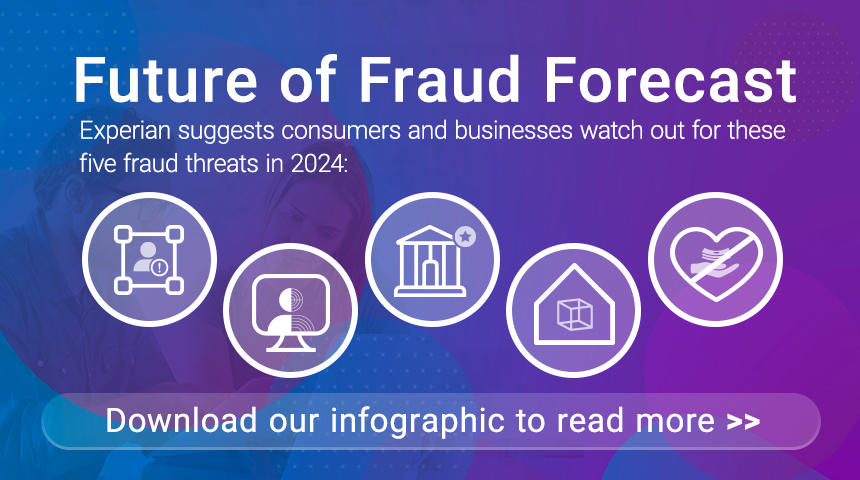
Spoiler alert: Gen AI is everywhere, including the top of Experian’s list of fraud trends 2024. “The speed and complexity of fraud attacks due to new technology and sophisticated fraudsters is leaving both businesses and consumers at risk in 2024,” said Kathleen Peters, chief innovation officer at Experian Decision Analytics in North America. “At Experian, we’re constantly innovating to deliver data-driven solutions to help our customers fight fraud and to protect the consumers they serve.” To deter fraudulent activity in 2024, businesses and consumers must get tactical for their fraud fighting strategies. And for businesses, the need for more sophisticated fraud protection solutions leveraging data and technology is greater than ever before. Experian suggests consumers and businesses watch out for these big five rounding out our fraud trends 2024. Generative AI: Generative AI accelerates DIY fraud: Experian predicts fraudsters will use generative AI to accelerate “do-it-yourself” fraud ranging from deepfake content – think emails, voice and video – as well as code creation to set up scam websites. A previous blog post of ours highlighted four types of generative AI used for fraud, including fraud automation at scale, text content generation, image and video manipulation and human voice generation. The way around it? Fight AI fraud with AI as part of a multilayered fraud prevention solution. Fraud at bank branches: Bank branches are making a comeback. A growing number of consumers prefer visiting bank branches in person to open new accounts or get financial advice with the intent to conduct safer transactions. However, face-to-face verification is not flawless and is still susceptible to human error or oversight. According to an Experian report, 85% of consumers report physical biometrics as the most trusted and secure authentication method they’ve recently encountered, but the measure is only currently used by 32% of businesses to detect and protect against fraud. Retailers, beware: Not all returns are as they appear. Experian predicts an uptick in cases where customers claim to return their purchases, only for the business to receive an empty box in return. Businesses must be vigilant with their fraud strategy in order to mitigate risk of lost goods and revenue. Synthetic identity fraud will surge: Pandemic-born synthetic identities may have been dormant, but now have a few years of history, making it easier to elude detection leading to fraudsters using those dormant accounts to “bust out” over the next year. Cause-related and investment deception: Fraudsters are employing new methods that strike an emotional response from consumers with cause-related asks to gain access to consumers’ personal information. Experian predicts that these deceptive cause-related methods will surge in 2024 and beyond. How businesses and consumers feel about fraud in 2024 According to an Experian report, over half of consumers feel they’re more of a fraud target than a year ago and nearly 70% of businesses report that fraud losses have increased in recent years. Business are facing mounting challenges – from first-party fraud and credit washing to synthetic identity and the yet-to-be-known impacts generative AI may have on fraud schemes. Synthetic identity fraud has been mentioned in multiple Experian Fraud Forecasts and the threat is ever growing. As technology continues to enhance consumers’ connectedness, it also heightens the stakes for various fraud attacks. As highlighted by this list of fraud trends 2024, the ways that fraudsters are looking to deceive is increasing from all angles. “Now more than ever, businesses need to implement a multilayered approach to their identity verification and fraud prevention strategies that leverages the latest technology available,” said Peters. Consumers are increasingly at risk from sophisticated fraud schemes. Increases in direct deposit account and check fraud, as well as advanced technologies like deepfakes and AI-generated phishing emails, put consumers in a precarious position. The call to action for consumers is to remain vigilant of seemingly authentic interactions. Experian can help with your fraud strategy To learn more about Experian’s fraud prevention solutions, please visit https://www.experian.com/business/solutions/fraud-management. Download infographic Watch Future of Fraud webinar

What is a data breach? It could impact your organization, and it is important for businesses to understand how to operate in it.

Meeting Know Your Customer (KYC) regulations and staying compliant is paramount to running your business with ensured confidence in who your customers are, the level of risk they pose, and maintained customer trust. What is KYC?KYC is the mandatory process to identify and verify the identity of clients of financial institutions, as required by the Financial Conduct Authority (FCA). KYC services go beyond simply standing up a customer identification program (CIP), though that is a key component. It involves fraud risk assessments in new and existing customer accounts. Financial institutions are required to incorporate risk-based procedures to monitor customer transactions and detect potential financial crimes or fraud risk. KYC policies help determine when suspicious activity reports (SAR) must be filed with the Department of Treasury’s FinCEN organization. According to the Federal Financial Institutions Examinations Council (FFIEC), a comprehensive KYC program should include:• Customer Identification Program (CIP): Identifies processes for verifying identities and establishing a reasonable belief that the identity is valid.• Customer due diligence: Verifying customer identities and assessing the associated risk of doing business.• Enhanced customer due diligence: Significant and comprehensive review of high-risk or high transactions and implementation of a suspicious activity-monitoring system to reduce risk to the institution. The following organizations have KYC oversight: Federal Financial Institutions Examinations Council (FFIEC), Federal Reserve Board, Federal Deposit Insurance Corporation (FDIC), national Credit Union Administration (NCUA), Office of the Comptroller of the Currency (OCC) and the Consumer Financial Protection Bureau (CFPB). How to get started on building your Know Your Customer checklist 1. Define your Customer Identification Program (CIP) The CIP outlines the process for gathering necessary information about your customers. To start building your KYC checklist, you need to define your CIP procedure. This may include the documentation you require from customers, the sources of information you may use for verification and the procedures for customer due diligence. Your CIP procedure should align with your organization’s risk appetite and be comply with regulations such as the Patriot Act or Anti-money laundering laws. 2. Identify the customer's information Identifying the information you need to gather on your customer is key in building an effective KYC checklist. Typically, this can include their first and last name, date of birth, address, phone number, email address, Social Security Number or any government-issued identification number. When gathering sensitive information, ensure that you have privacy and security controls such as encryption, and that customer data is not shared with unauthorized personnel. 3. Determine the verification method There are various methods to verify a customer's identity. Some common identity verification methods include document verification, facial recognition, voice recognition, knowledge-based authentication, biometrics or database checks. When selecting an identity verification method, consider the accuracy, speed, cost and reliability. Choose a provider that is highly secure and offers compliance with current regulations. 4. Review your checklist regularly Your KYC checklist is not a one and done process. Instead, it’s an ongoing process that requires periodic review, updates and testing. You need to periodically review your checklist to ensure your processes are up to date with the latest regulations and your business needs. Reviewing your checklist will help your business to identify gaps or outdated practices in your KYC process. Make changes as needed and keep management informed of any changes. 5. Final stage: quality control As a final step, you should perform a quality control assessment of the processes you’ve incorporated to ensure they’ve been carried out effectively. This includes checking if all necessary customer information has been collected, whether the right identity verification method was implemented, if your checklist matches your CIP and whether the results were recorded correctly. KYC is a vital process for your organization in today's digital age. Building an effective KYC checklist is essential to ensure compliance with regulations and mitigate risk factors associated with fraudulent activities. Building a solid checklist requires a clear understanding of your business needs, a comprehensive definition of your CIP, selection of the right verification method, and periodic reviews to ensure that the process is up to date. Remember, your customers' trust and privacy are at stake, so iensuring that your security processes and your KYC checklist are in place is essential. By following these guidelines, you can create a well-designed KYC checklist that reduces risk and satisfies your regulatory needs. Taking the next step Experian offers identity verification solutions as well as fully integrated, digital identity and fraud platforms. Experian’s CrossCore & Precise ID offering enables financial institutions to connect, access and orchestrate decisions that leverage multiple data sources and services. By combining risk-based authentication, identity proofing and fraud detection into a single, cloud-based platform with flexible orchestration and advanced analytics, Precise ID provides flexibility and solves for some of financial institutions’ biggest business challenges, including identity and fraud as it relates to digital onboarding and account take over; transaction monitoring and KYC/AML compliance and more, without adding undue friction. Learn more *This article includes content created by an AI language model and is intended to provide general information.

For companies that regularly engage in financial transactions, having a customer identification program (CIP) is mandatory to comply with the regulations around identity verification requirements across the customer lifecycle. In this blog post, we will delve into the essentials of a customer identification program, what it entails, and why it is important for businesses to implement one. What is a customer identification program? A CIP is a set of procedures implemented by financial institutions to verify the identity of their customers. The purpose of a CIP is to be a part of a financial institution’s fraud management solutions, with similar goals as to detect and prevent fraud like money laundering, identity theft, and other fraudulent activities. The program enables financial institutions to assess the risk level associated with a particular customer and determine whether their business dealings are legitimate. An effective CIP program should check the following boxes: Confidently verify customer identities Seamless authentication Understand and anticipate customer activities Where does Know Your Customer (KYC) fit in? KYC policies must include a robust CIP across the customer lifecycle from initial onboarding through portfolio management. KYC solutions encompass the financial institution’s customer identification program, customer due diligence and ongoing monitoring. What are the requirements for a CIP? Customer identification program requirements vary depending on the type of financial institution, the type of account opened, and other factors. However, the essential components of a CIP include verifying the customer's identity using government-issued identification, obtaining and verifying the customer's address, and checking the customer against a list of known criminals, terrorists, or suspicious individuals. These measures help detect and prevent financial crimes. Why is a CIP important for businesses? CIP helps businesses mitigate risk by ensuring they have accurate and up-to-date information about their customers. This also helps financial institutions comply with laws and regulations that require them to monitor financial transactions for any suspicious activities. By having a robust CIP in place, businesses can establish trust and rapport with their customers. According to Experian’s 2024 U.S. Identity and Fraud Report, 63% of consumers say it's extremely or very important for businesses to recognize them online. Having an effective CIP in place is part of financial institutions showing their consumers that they have their best interests top of mind. Finding the right partner It’s important to find a partner you trust when working to establish processes and procedures for verifying customer identity, address, and other relevant information. Companies can also utilize specialized software that can help streamline the CIP process and ensure that it is being carried out accurately and consistently. Experian’s proprietary and partner data sources and flexible monitoring and segmentation tools allow you to resolve CIP discrepancies and fraud risk in a single step, all while keeping pace with emerging fraud threats with effective customer identification software. Putting consumers first is paramount. The security of their identity is priority one, but financial institutions must pay equal attention to their consumers’ preferences and experiences. It is not just enough to verify customer identities. Leading financial institutions will automate customer identification to reduce manual intervention and verify with a reasonable belief that the identity is valid and eligible to use the services you provide. Seamless experiences with the right amount of friction (I.e., multi-factor authentication) should also be pursued to preserve the quality of the customer experience. Putting it all together As cybersecurity threats are becoming more sophisticated, it is essential for financial institutions to protect their customerinformation and level up their fraud prevention solutions. Implementing a customer identification program is an essential component in achieving that objective. A robust CIP helps organizations detect, prevent, and deter fraudulent activities while ensuring compliance with regulatory requirements. While implementing a CIP can be complex, having a solid plan and establishing clear guidelines is the best way for companies to safeguard customer information and maintain their reputation. CIPs are an integral part of financial institutions security infrastructures and must be a business priority. By ensuring that they have accurate and up-to-date data on their customers, they can mitigate risk, establish trust, and comply with regulatory requirements. A sound CIP program can help financial institutions detect and prevent financial crimes and cyber threats while ensuring that legitimate business transactions are not disrupted, therefore safeguarding their customers' information and protecting their own reputation. Learn more

Data-driven machine learning model development is a critical strategy for financial institutions to stay ahead of their competition, and according to IDC, remains a strategic priority for technology buyers. Improved operational efficiency, increased innovation, enhanced customer experiences and employee productivity are among the primary business objectives for organizations that choose to invest in artificial intelligence (AI) and machine learning (ML), according to IDC’s 2022 CEO survey. While models have been around for some time, the volume of models and scale at which they are utilized has proliferated in recent years. Models are also now appearing in more regulated aspects of the business, which demand increased scrutiny and transparency. Implementing an effective model development process is key to achieving business goals and complying with regulatory requirements. While ModelOps, the governance and life cycle management of a wide range of operationalized AI models, is becoming more popular, most organizations are still at relatively low levels of maturity. It's important for key stakeholders to implement best practices and accelerate the model development and deployment lifecycle. Read the IDC Spotlight Challenges impeding machine learning model development Model development involves many processes, from wrangling data, analysis, to building a model that is ready for deployment, that all need to be executed in a timely manner to ensure proper outcomes. However, it is challenging to manage all these processes in today’s complex environment. Modeling challenges include: Infrastructure: Necessary factors like storage and compute resources incur significant costs, which can keep organizations from evolving their machine learning capabilities. Organizational: Implementing machine learning applications requires talent, like data scientists and data and machine learning engineers. Operational: Piece meal approaches to ML tools and technologies can be cumbersome, especially on top of data being housed in different places across an organization, which can make pulling everything together challenging. Opportunities for improvement are many While there are many places where individuals can focus on improving model development and deployment, there are a few key places where we see individuals experiencing some of the most time-consuming hang-ups. Data wrangling and preparation Respondents to IDC's 2022 AI StrategiesView Survey indicated that they spend nearly 22% of their time collecting and preparing data. Pinpointing the right data for the right purpose can be a big challenge. It is important for organizations to understand the entire data universe and effectively link external data sources with their own primary first party data. This way, stakeholders can have enough data that they trust to effectively train and build models. Model building While many tools have been developed in recent years to accelerate the actual building of models, the volume of models that often need to be built can be difficult given the many conflicting priorities for data teams within given institutions. Where possible, it is important for organizations to use templates or sophisticated platforms to ease the time to build a model and be able to repurpose elements that may already be working for other models within the business. Improving Model Velocity Experian’s Ascend ML BuilderTM is an on-demand advanced model development environment optimized to support a specific project. Features include a dedicated environment, innovative compute optimization, pre-built code called ‘Accelerators’ that simply, guide, and speed data wrangling, common analyses and advanced modeling methods with the ability to add integrated deployment. To learn more about Experian’s Ascend ML Builder, click here. To read the full Technology Spotlight, download “Accelerating Model Velocity with a Flexible Machine Learning Model Development Environment for Financial Institutions” here. Download spotlight *This article includes content created by an AI language model and is intended to provide general information.

In today's fast-paced financial landscape, financial institutions must stay ahead of the curve when it comes to account opening and onboarding. Digital account opening, empowering a prospective client to securely and efficiently open a new account, is key to how banks, credit unions and other financial institutions grow their business and expand their portfolio. Regardless of the time, money and other resources a financial institution invests in marketing to the right target prospect and tailoring an attractive offer, it’s worthless if that prospective customer can’t complete the process due to a poor account opening experience. Unhappy customers vote with their feet. A recent Experian study found that of the more 2,000 consumers surveyed who’d opened a new account in the last six months, 37% took their business elsewhere due to a negative account opening experience. The choice of a reliable partner can make all the difference to your account opening and onboarding experience. The right partner must provide your financial institution with access to the freshest credit data; advanced analytics, scores and models to empower you to say yes to the right customers that meet your lending criteria; and industry-leading decision engines that make the best decisions and enable you to provide a seamless customer experience. Moreover, the right partner will also help you in maintaining high levels of security without compromising user experience, all while adhering to regulatory compliance. Recently, Liminal, a leading advisory and market intelligence firm specializing in the digital identity, cybersecurity, and fintech markets, released its highly anticipated Link™ Index Report for Account Opening in Financial Services, which evaluates solution providers in the financial sector, in the areas of compliance and fraud prevention for account opening. The report recognized Experian as a market leader for compliance and fraud prevention capabilities and market execution. Experian’s identity verification and fraud prevention solutions, including CrossCore® and Precise ID®, received the highest score out of the 32 companies highlighted in the report. It found that Experian was recognized by 94% of buyers and 89% identified Experian as a market leader. “We’re thrilled to be named the top market leader in compliance and fraud prevention capabilities and execution by Liminal’s Link Index Report,” said Kathleen Peters, Chief Innovation Officer for Experian’s Decision Analytics business in North America. “We’re continually innovating to deliver the most effective identity verification and fraud prevention solutions to our clients so they can grow their business, mitigate risk and provide a seamless customer experience.” You can access the full report here. To learn more about Experian’s award-winning fraud solutions, visit our identity fraud hub. Download Liminal Link Index Report

From science fiction-worthy image generators to automated underwriting, artificial intelligence (AI), big data sets and advances in computing power are transforming how we play and work. While the focus in the lending space has often been on improving the AI models that analyze data, the data that feeds into the models is just as important. Enter: data-centric AI. What is a data-centric AI? Dr. Andrew Ng, a leader in the AI field, advocates for data-centric AI and is often credited with coining the term. According to Dr. Ng, data-centric AI is, ‘the discipline of systematically engineering the data used to build an AI system.’1 To break down the definition, think of AI systems as a combination of code and data. The code is the model or algorithm that analyzes data to produce a result. The data is the information you use to train the model or later feed into the model to request a result. Traditional approaches to AI focus on the code — the models. Multiple organizations download and use the same data sets to create and improve models. But today, continued focus on model development may offer a limited return in certain industries and use cases. A data-centric AI approach focuses on developing tools and practices that improve the data. You may still need to pay attention to model development but no longer treat the data as constant. Instead, you try to improve a model's performance by increasing data quality. This can be achieved in different ways, such as using more consistent labeling, removing noisy data and collecting additional data.2 Data-centric AI isn't just about improving data quality when you build a model — it's also part of the ongoing iterative process. The data-focused approach should continue during post-deployment model monitoring and maintenance. Data-centric AI in lending Organizations in multiple industries are exploring how a data-centric approach can help them improve model performance, fairness and business outcomes. For example, lenders that take a data-centric approach to underwriting may be able to expand their lending universe, drive growth and fulfill financial inclusion goals without taking on additional risk. Conventional credit scoring models have been trained on consumer credit bureau data for decades. New versions of these models might offer increased performance because they incorporate changes in the economic landscape, consumer behavior and advances in analytics. And some new models are built with a more data-centric approach that considers additional data points from the existing data sets — such as trended data — to score consumers more accurately. However, they still solely rely on credit bureau data. Explainability and transparency are essential components of responsible AI and machine learning (a type of AI) in underwriting. Organizations need to be able to explain how their models come to decisions and ensure they are behaving as expected. Model developers and lenders that use AI to build credit risk models can incorporate new high-quality data to supplement existing data sets. Alternative credit data can include information from alternative financial services, public records, consumer-permissioned data, and buy now, pay later (BNPL) data that lenders can use in compliance with the Fair Credit Reporting Act (FCRA).* The resulting AI-driven models may more accurately predict credit risk — decreasing lenders' losses. The models can also use alternative credit data to score consumers that conventional models can't score. Infographic: From initial strategy to results — with stops at verification, decisioning and approval — see how customers travel across an Automated Loan Underwriting Journey. Business benefit of using data-centric AI models Financial services organizations can benefit from using a data-centric AI approach to create models across the customer lifecycle. That may be why about 70 percent of businesses frequently discuss using advanced analytics and AI within underwriting and collections.3 Many have gone a step further and implemented AI. Underwriting is one of the main applications for machine learning models today, and lenders are using machine learning to:4 More accurately assess credit risk models. Decrease model development, deployment and recalibration timelines. Incorporate more alternative credit data into credit decisioning. AI analytics solutions may also increase customer lifetime value by helping lenders manage credit lines, increase retention, cross-sell products and improve collection efforts. Additionally, data-centric AI can assist with fraud detection and prevention. Case study: Learn how Atlas Credit, a small-dollar lender, used a machine learning model and loan automation to nearly doubled its loan approval rates while decreasing its credit risk losses. How Experian helps clients leverage data-centric AI for better business outcomes During a presentation in 2021, Dr. Ng used the 80-20 rule and cooking as an analogy to explain why the shift to data-centric AI makes sense.5 You might be able to make an okay meal with old or low-quality ingredients. However, if you source and prepare high-quality ingredients, you're already 80% of the way toward making a great meal. Your data is the primary ingredient for your model — do you want to use old and low-quality data? Experian has provided organizations with high-quality consumer and business credit solutions for decades, and our industry-leading data sources, models and analytics allow you to build models and make confident decisions. If you need a sous-chef, Experian offers services and has data professionals who can help you create AI-powered predictive analytics models using bureau data, alternative data and your in-house data. Learn more about our AI analytics solutions and how you can get started today. 1DataCentricAI. (2023). Data-Centric AI.2Exchange.scale (2021). The Data-Centric AI Approach With Andrew Ng.3Experian (2021). Global Insights Report September/October 2021.4FinRegLab (2021). The Use of Machine Learning for Credit Underwriting: Market & Data Science Context. 5YouTube (2021). A Chat with Andrew on MLOps: From Model-Centric to Data-Centric AI *Disclaimer: When we refer to “Alternative Credit Data," this refers to the use of alternative data and its appropriate use in consumer credit lending decisions, as regulated by the Fair Credit Reporting Act. Hence, the term “Expanded FCRA Data" may also apply in this instance and both can be used interchangeably.

Digital transformation in banking reshapes processes, boosts innovation, and delivers personalized experiences to modern financial consumers.

Learn how high-quality data from multiple data sources can help drive business growth.

With an ever-present need for efficiency, security, and seamless citizen services, many agencies are looking at the benefits of a data-driven government. Last year, the federal government kicked off a unified effort to enable data-driven decision making. The goal at that level – and across all agencies – is to serve citizens more efficiently and effectively. By embracing the power of data and analytics, agencies of all sizes can set themselves up to better serve their citizens. What is a data-driven government? Agencies collect citizen data from a variety of service-based sources, including the Postal Service, Census Bureau, social welfare departments, and agencies that issue government IDs. When properly leveraged, this data holds many possibilities. However, many agencies face challenges when it comes to efficient collection, sharing, usage, integrity, and accessibility. Due to the amount of data collected and the potential lack of consistency in the collection and storage techniques, the data may not be usable. Without proper management and analysis, there’s little government agencies can do with their data to improve their processes. A data-driven government has well-managed data and uses that data to drive their decisions as they relate to citizen requests for benefits, tax collection, elections, and more. What are the benefits of data-driven decision making? Data management and government data analytics enable agencies to react quickly to citizen demands and concerns and proactively anticipate an issue before it becomes a crisis. With the right tools, agencies can gain a holistic view of their citizens, communicate effectively internally, provide digitally-driven services and improve overall efficiency through government-wide data integration and management. These changes have a wide range of benefits, including reduction of cost, fraud, waste and abuse, the automation of manual processes, and better service delivery. Why is a data-driven strategy required? In addition to the benefits listed above, a data-driven strategy also helps agencies align with published NIST guidelines and the need to monitor, evaluate, and maintain digital identity systems. Proper use of data-driven digital identity strategies will enhance equity and the usability of the solutions agencies provide to their citizens. Building an effective data-driven strategy The right strategy starts with ensuring that all departments about the need for proper data management and analytics and the guidelines that will govern it, such as maintaining up-to-date data, removing silos, and leveraging the right tools. The next step is finding the right partner. An effective partner can help agencies develop and maintain data management systems and implement the right tools and analytics – things like machine learning in government – to help each agency function efficiently and safeguard the data of its citizens. To learn how Experian can help your agency improve its use of data, visit us or request a call. Visit us

Business intelligence analytics can help financial institutions optimize their decisioning and uncover safe growth opportunities.

Jennifer Schulz, CEO of Experian, North America kicked off Experian’s annual Vision conference Tuesday morning pointing to data, analytics, technology and collective curiosity as the drivers for change and a more impactful tomorrow to more than 700 attendees. Keynote speaker: Jennifer Bailey Jennifer Bailey, Vice President of Apple Pay and Apple Wallet, spoke about the customer experience “ethos.” She explained how Apple takes a long-term view and values the single most important performance metric as customer experience. She said creating a seamless customer experience comes down to making things simple and understandable, and asking, “Are we solving a customer problem?” and “How are we making it easier for customers to enjoy and liver their lives. Bailey, who said of all apps she uses the weather app the most, also talked about innovation, and that both intent and making mistakes are important parts of the process. Apple’s products are known for their user-friendliness, and design is part of that. She encouraged the audience to give design teams room to create without bottom line pressures and not to be afraid to take well-considered risks. Keynote Speaker: Gary Cohn Gary Cohn, Vice Chairman of IBM, talked about the current economic climate, and while it’s a natural viewpoint to look to the past for guidance, the current environment is unlike any before. Cohn discussed regulatory compliance in the banking industry and prioritizing safety and soundness. While AI is topical and in numerous headlines recently, Cohn reminded the conference goers that AI isn’t new. He said what is new and important is that you can now teach models to find the information needed rather than having to feed all the information yourself. He believes AI is not the end of employment, but rather helps boost productivity, efficiency, and job satisfaction and provides organizations more data. As for advice for the audience, Cohn shared opportunities are in the uncomfortable zones and you have to be willing to fail in order to succeed. Session highlights – Day 1 The conference hall was buzzing with conversations, discussions and thought leadership. Overall themes that were frequently part of the conversation included seamless customer experiences, agility in face of economic changes and leveraging AI/ML into strategies. Fraud automation and preventing commercial fraud More businesses are opening than ever before and lenders and service providers need a way to determine risk from businesses who are less than a year old. There is no one-size-fits-all approach to fraud. A layered solution assesses risk and applies the correct friction to resolve the risk and pass or refer the applicant. Identity Today’s consumer wants a personalized experience and is privacy conscious. Additionally, regulators are also pushing for greater privacy. Clean rooms allow you and a partner to add data to a safe space and learn more about consumers without exposing data. The right data improves acquisition rates, identity verification and allows you to anticipate customer needs. Advanced scoring Data, models and strategy are the levers institutions are using to leverage responsible analytics to meet their objectives like safely growing existing portfolios, managing the “right” level of risk, and providing a seamless digital experience. However, the total value of a decisioning system is almost always constrained by its most rudimentary component. The panel of experts discussed their uses and goals for leveraging models and customer experience was at the top of their priorities. Recession preparedness Delinquency is on the rise and lending offers made continue to drop. Changes in the economic climate require frequent monitoring of portfolio and decisions, benchmarking against peers, updating credit models and decision strategies, and stress testing portfolio and models. Trends in credit risk management While AI at the hands of everyone is topical today, it ranked lowest on the list of trends attendees believed were impacting their business. At the top of the list? The growing demand for simpler, faster and seamless experiences. More insights from Vision to come. Follow @ExperianVision and @ExperianInsights to see more of the action.

Businesses must be aware of the risks associated with card not present fraud and take steps to protect themselves and their customers.