Fraud Trends 2024 – Experian’s Future of Fraud Forecast

by Stefani Wendel 4 min read February 15, 2024

Spoiler alert: Gen AI is everywhere, including the top of Experian’s list of fraud trends 2024.
“The speed and complexity of fraud attacks due to new technology and sophisticated fraudsters is leaving both businesses and consumers at risk in 2024,” said Kathleen Peters, chief innovation officer at Experian Decision Analytics in North America. “At Experian, we’re constantly innovating to deliver data-driven solutions to help our customers fight fraud and to protect the consumers they serve.”

To deter fraudulent activity in 2024, businesses and consumers must get tactical for their fraud fighting strategies. And for businesses, the need for more sophisticated fraud protection solutions leveraging data and technology is greater than ever before.

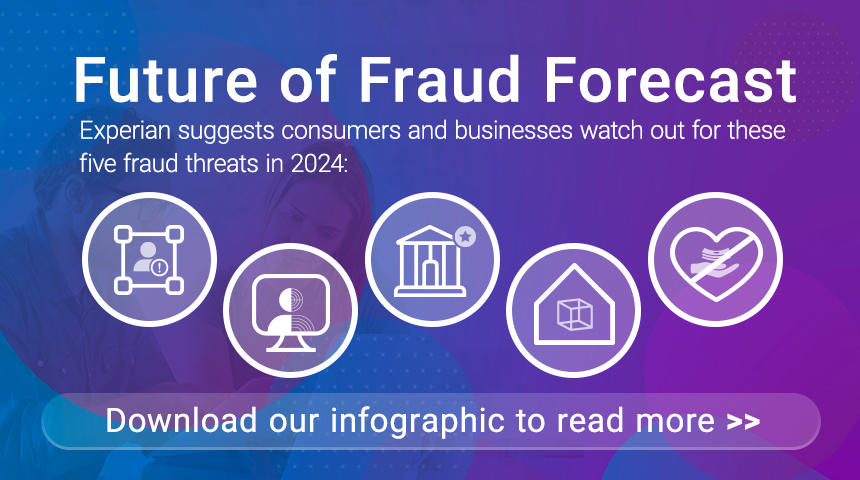
Experian suggests consumers and businesses watch out for these big five rounding out our fraud trends 2024.

  • Generative AI: Generative AI accelerates DIY fraud: Experian predicts fraudsters will use generative AI to accelerate “do-it-yourself” fraud ranging from deepfake content – think emails, voice and video – as well as code creation to set up scam websites. A previous blog post of ours highlighted four types of generative AI used for fraud, including fraud automation at scale, text content generation, image and video manipulation and human voice generation. The way around it? Fight AI fraud with AI as part of a multilayered fraud prevention solution.
  • Fraud at bank branches: Bank branches are making a comeback. A growing number of consumers prefer visiting bank branches in person to open new accounts or get financial advice with the intent to conduct safer transactions. However, face-to-face verification is not flawless and is still susceptible to human error or oversight. According to an Experian report, 85% of consumers report physical biometrics as the most trusted and secure authentication method they’ve recently encountered, but the measure is only currently used by 32% of businesses to detect and protect against fraud.
  • Retailers, beware: Not all returns are as they appear. Experian predicts an uptick in cases where customers claim to return their purchases, only for the business to receive an empty box in return. Businesses must be vigilant with their fraud strategy in order to mitigate risk of lost goods and revenue.
  • Synthetic identity fraud will surge: Pandemic-born synthetic identities may have been dormant, but now have a few years of history, making it easier to elude detection leading to fraudsters using those dormant accounts to “bust out” over the next year.
  • Cause-related and investment deception: Fraudsters are employing new methods that strike an emotional response from consumers with cause-related asks to gain access to consumers’ personal information. Experian predicts that these deceptive cause-related methods will surge in 2024 and beyond.

How businesses and consumers feel about fraud in 2024

According to an Experian report, over half of consumers feel they’re more of a fraud target than a year ago and nearly 70% of businesses report that fraud losses have increased in recent years.

Business are facing mounting challenges – from first-party fraud and credit washing to synthetic identity and the yet-to-be-known impacts generative AI may have on fraud schemes. Synthetic identity fraud has been mentioned in multiple Experian Fraud Forecasts and the threat is ever growing. As technology continues to enhance consumers’ connectedness, it also heightens the stakes for various fraud attacks. As highlighted by this list of fraud trends 2024, the ways that fraudsters are looking to deceive is increasing from all angles.

“Now more than ever, businesses need to implement a multilayered approach to their identity verification and fraud prevention strategies that leverages the latest technology available,” said Peters.

Consumers are increasingly at risk from sophisticated fraud schemes. Increases in direct deposit account and check fraud, as well as advanced technologies like deepfakes and AI-generated phishing emails, put consumers in a precarious position. The call to action for consumers is to remain vigilant of seemingly authentic interactions.

Experian can help with your fraud strategy

To learn more about Experian’s fraud prevention solutions, please visit https://www.experian.com/business/solutions/fraud-management.


Related Posts

Rewriting the Road Ahead with Longer Loan Terms and Increased Refinancing Options

The automotive market is entering a new phase defined not just by what consumers are buying, but by how they’re choosing to finance it. According to Experian Automotive’s State of the Automotive Finance Market Report: Q1 2026, nearly one-third (35.55%) of all new vehicle loans now stretch more than six years, up from 30.83% in Q1 2025. Similarly on the used side, 31.54% of loans extended more than six years, an increase from 28.60% last year. The shift highlights why affordability is reshaping how consumers are financing their vehicles, particularly in larger and higher-priced vehicles. Refinancing gains traction as interest rates stabilize In addition to longer-term loans, consumers are becoming increasingly deliberate with their financing decisions and managing monthly payments as refinancing activity has gained momentum. For instance, consumers who refinanced this quarter lowered their interest rate by 2.2% and saved an average of $81 on their monthly payment. Credit unions, in particular, continued to play a major role in helping consumers secure more affordable payment options. In Q1 2025, credit unions accounted for the lion’s share of automotive refinancing at 63.43%, from 62.31% a year ago. By comparison, banks went from 23.51% to 22.59% year-over-year. Furthermore, those who refinanced with a credit union saved an average of $101 this quarter, whereas those who refinanced with banks saved $60. Expanding credit access through flexible financing Another notable trend this quarter was the incessant growth in subprime financing as credit accessibility across the market continues to increase. In the first quarter of this year, subprime borrowers made up 15.75% of total vehicle financing, from 14.40% last year. For new vehicles in particular, the subprime market went from 5.61% to 6.88% year-over-year, while subprime in used vehicle financing grew to 20.60% this quarter, from 19.36% a year ago. Increased activity in the subprime segment highlights continued confidence in the automotive market and underscores the importance of expanded financing options. As consumers seek greater flexibility with financing decisions that fit their lifestyle, lenders and dealers have the opportunity to approach them with more personalized solutions. These trends are helping keep both new and used vehicle markets moving forward, while creating new opportunities for consumers to manage payments and purchase confidently. To learn more about automotive finance trends, view the full State of the Automotive Finance Market Report: Q1 2026 presentation on demand.

Published: June 2, 2026 by Melinda Zabritski
Staying Competitive After Trigger Leads Evolve: A Roadmap For Lenders

Trigger leads have long been the preferred solution for identifying high-intent mortgage borrowers. But with the implementation of the Homebuyers Privacy Protection Act (HPPA), which introduces new limitations and consumer protections around trigger leads, that playbook will need to shift. Now, lenders are quickly facing a pivotal shift in how they discover, engage, and convert prospective borrowers into customers. The industry now stands at a crossroads. Lenders who adapt early—leaning into predictive tools, consent-based engagement, and smarter prescreening—will redefine borrower acquisition in a more privacy-centric era.  HPPA: A structural change to mortgage marketing  The HPPA amends the Fair Credit Reporting Act by significantly restricting the use of mortgage inquiries for prescreen purposes. As of March 5, 2026, credit bureaus may only provide or utilize mortgage inquiries to:  End users with explicit borrower consent  The originator of the consumer’s current mortgage  The servicer of the consumer’s current mortgage  An insured depository institution or credit union where the consumer has an existing account  While these exemptions may provide continuity for banks and credit unions, many mortgage brokers and nonbank lenders will need to overhaul their prescreen practices—or risk being cut off entirely from a previously high-performing acquisition channel.  Why this isn’t just a compliance shift—It’s a strategic recalibration  Mortgage triggers in prescreen allow lenders to react instantly to consumer intent. Lenders rely on a prompt and convincing narrative to entice applicants to switch lenders. Mortgage inquiry triggers are effective and were, therefore, a prospecting strategy for many lenders. Recent legislative changes significantly restrict the availability of these inquiry triggers, and impacted lenders are focusing on a more intentional prospecting strategy to compete.   Without these mortgage triggers in prescreen, lenders need to ask:  Who are we trying to reach?  What early signals can we act on?  How do we earn permission and attention before a mortgage inquiry ever happens?  Transforming the funnel: From reaction to anticipation  The shift in mortgage inquiry-based prescreen isn’t the end of high-intent lead targeting. It’s the beginning of a more strategic and intentional approach—one that leverages earlier indicators of mortgage readiness and focuses on building relationships, not just closing transactions.  Here’s where the momentum is evolving, creating a new and smarter funnel:  Prescreen marketing: Using credit and behavioral attributes to help identify consumers who meet specific lending criteria before they signal active intent.  Predictive modeling: Leveraging propensity scores or custom models to prioritize outreach based on conversion likelihood.  Consent-based engagement: Implementing compliant mechanisms to capture and manage borrower opt-ins at scale.  The power of predictive modeling  According to recent industry interviews, propensity modeling is emerging as one of the most effective replacements for trigger-based prescreen. These models analyze hundreds of credit attributes—such as utilization, account mix, account age, and depth—to help identify consumers statistically more likely to seek a mortgage.  For lenders just beginning to use predictive modeling, off-the-shelf models can be a quick way to identify potential borrowers. For example, when layering propensity scores on top of credit eligibility, which can improve borrower targeting, many lenders see an increase in open mortgage loan rates.  Meanwhile, custom-built models, which analyze a lender’s own campaign performance over time, offer the highest level of precise targeting. These models isolate the attributes most predictive of conversions within a specific product mix—optimizing not just volume, but fit.  Speed without traditional triggers? It’s possible  One of the biggest concerns among lenders is maintaining the speed historically enabled by trigger leads. But that concern may be overblown.  Self-service prescreen platforms now allow marketers to generate qualified lead lists in as little as 24 hours, enabling rapid response during rate drops, competitive shifts, or seasonal demand spikes.   For those new to prescreening, batch campaigns still offer value, especially with analyst support.   Don’t overlook retention  In an era of intense acquisition competition, retention becomes a key differentiator.  Lenders who monitor property status, cash flow, and consumer credit behavior can proactively identify when an existing borrower is likely to list, refinance, or exit. Armed with that intelligence, lenders can re-engage with the borrower at the right moment—sometimes before a competitor is considered or contacted.  This level of behavioral intelligence may soon separate proactive lenders from reactive ones.  Actions instead of reactions  The evolution of trigger-based prescreen doesn’t just require new tools; it demands new thinking. Lenders should begin by auditing their current pipelines and determining:  What percentage of our acquisition is dependent on triggers?  What share of our book falls under the HPPA exemptions?  How will we scale compliant opt-in collection?  Are our current prescreen or modeling capabilities future-ready?  Those who answer these questions today—and act on them—won’t just be in compliance with the new laws, they’ll lead in a transformed market. Lenders should also be asking:   Do we have the infrastructure to collect and act on borrower consent?  Are our acquisition teams equipped to run prescreen campaigns — both batch and self-service?  What predictive models are we using (or could we use) to prioritize leads?  Are we proactively monitoring our portfolio to catch retention risks early?  How are we preparing our sales teams for longer, more consultative buying journeys?  Conclusion  The HPPA signals a shift away from relying on passive, inquiry-based prescreen acquisition and the beginning of smarter, more strategic engagement with potential borrowers. Lenders who embrace this transition early will find themselves not just compliant, but competitive—with deeper borrower insights, better conversion rates, and stronger long-term customer relationships.  The market is moving. The only question is: will you lead the change or chase it?  Citation  Experian. (2025, November). Interview: How the Homebuyers Privacy Protection Act is reshaping mortgage marketing—and what lenders should do now [transcript]. Experian Mortgage Insights. Insights based on lender feedback, campaign performance data, and analysis of prescreen marketing strategies and predictive modeling outcomes were gathered from Experian client engagements and internal mortgage analytics between May and October 2025. Homebuyers Privacy Protection Act timeline and legal context referenced from legislation signed September 5, 2025, with implementation beginning March 5, 2026.   

Published: April 22, 2026 by Ivan Ahmed