Tag: data
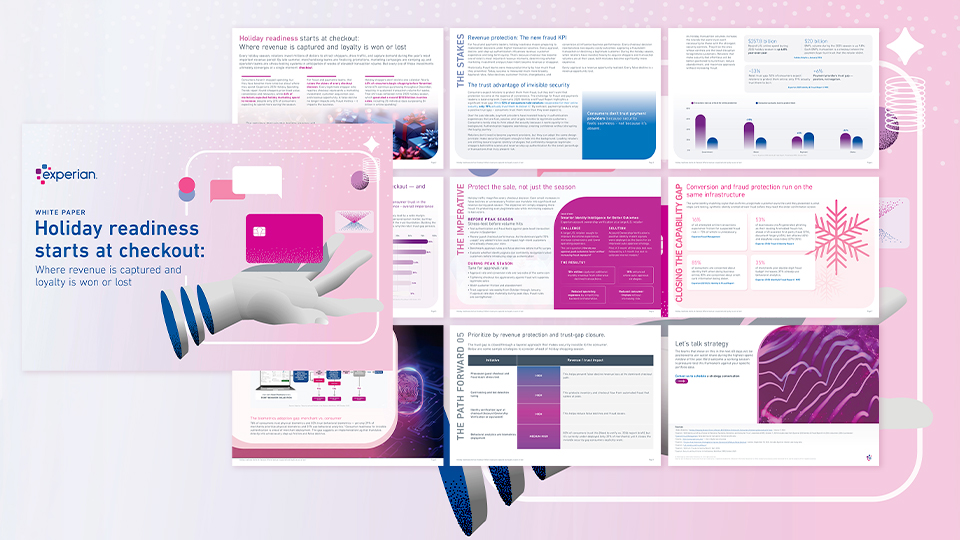
Every retailer invests heavily to drive shoppers to its website during the holidays. But after months of planning and thousands to millions of dollars spent on marketing, every customer journey comes down to one critical moment: Checkout. Today, fraud prevention means protecting revenue by ensuring legitimate customers complete their purchase, not just stopping bad actors. That's becoming increasingly important as holiday shopping evolves. In 2025, U.S. online holiday spending reached a record $257.8 billion,1 with shoppers spreading their purchases across months rather than just Black Friday and Cyber Monday. Every approval and every false decline has a bigger business impact than ever. Trust is becoming a conversion strategy Consumers expect retailers to protect them from fraud, but they don't want that protection to slow them down. That's where a significant opportunity exists. Experian research found that 52% of consumers expect retailers to protect them online, yet only 19% trust them to do so.2 Meanwhile, payment providers enjoy a positive trust gap because security happens quietly in the background with minimal friction. The takeaway? Customers don't equate more authentication with more trust. Instead, they equate less friction with better experiences. Learn how retailers can improve approvals, reduce false declines and build customer trust through layered identity intelligence. Download the white paper Invisible security is the future of checkout Modern identity verification, behavioral analytics and account intelligence allow retailers to recognize trusted customers behind the scenes – reserving step-up authentication only for higher-risk transactions. Why does that matter? Because friction is measurable. Research from Experian and cited in our white paper, shows that 16% of online transactions encounter suspected fraud friction, and 70% of that friction is unnecessary.3 Meanwhile, 25% of consumers abandon the purchase after experiencing onboarding friction, choosing a competitor instead. Reducing unnecessary friction isn't just good customer experience; it's good business. One retailer that used Experian's account ownership verification and identity intelligence captured more than $8 million in additional monthly revenue by improving auto-approval strategies and reducing customer friction. Learn how to protect revenue, not just prevent fraud As holiday traffic ramps up, retailers have an opportunity to rethink checkout as more than a fraud control. It's a revenue engine. Our latest white paper explores how layered identity strategies can help retailers improve approvals, reduce false declines and deliver the frictionless experiences customers increasingly expect. Download the full white paper to learn how invisible security can help strengthen customer trust while maximizing holiday conversion. Download now
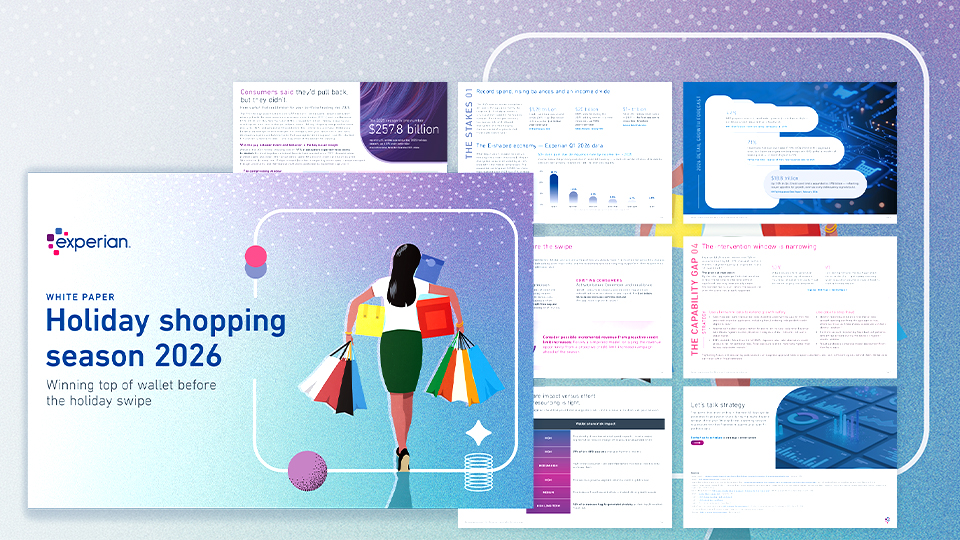
Every year, consumers say they'll spend less during the holidays. Every year, many do the opposite. Ahead of the 2025 holiday shopping season, 57% of consumers told Deloitte they expected the economy to weaken, the most pessimistic outlook recorded in the survey's history. Planned holiday spending was down 10%. Yet by the end of the season, online holiday sales reached a record $257.8 billion, up 6.8% year over year. Credit card balances climbed to $1.28 trillion, and Buy Now, Pay Later (BNPL) financing surpassed $20 billion during the holiday period. For lenders, the takeaway is to identify and engage the right consumers before the holidays were best equipped to capture that spending while effectively managing risk. As the 2026 holiday season approaches, Experian's latest market insights suggest that while credit performance appears relatively stable at the portfolio level, important shifts beneath the surface are changing how lenders should evaluate both opportunity and risk. Holiday shopping season 2026 Winning top of wallet before the holiday swipe Download the white paper now Holiday lending decisions happen long before the holidays It’s been observed that the holiday shopping season has expanded – beginning before Black Friday – over recent years. While Cyber Week continues to generate headlines, holiday spending is becoming more distributed throughout the quarter. For lenders, that means strategies must be in place before peak shopping begins. Credit line increases, portfolio reviews, acquisition strategies and risk segmentation completed in late summer often determine how much holiday spending an institution can safely capture. At the same time, early signs of credit deterioration are emerging faster than traditional portfolio metrics suggest reinforcing the importance of identifying emerging portfolio risk early rather than relying solely on broad portfolio performance indicators. Income is becoming a stronger predictor of credit performance One of the most notable shifts in today's lending environment is the growing relationship between income and future credit performance. Experian's data suggests the market is becoming increasingly polarized. The population earning more than $250,000 annually has more than doubled since 2023, but more than one-quarter of those consumers have since moved into lower income brackets, often following retirement or job loss. Meanwhile, consumers earning less than $50,000 annually show relatively little income mobility, with approximately 85% remaining in the same income band year-over-year. These trends highlight an important reality: a credit score alone may no longer provide a complete picture of borrower risk. Four priorities before peak holiday spending With only a short window before holiday borrowing accelerates, lenders have an opportunity to strengthen both growth and risk strategies. Key areas of focus include: Refine acquisition strategies Move beyond score-only targeting by incorporating verified income, cash flow and existing credit relationships to identify qualified borrowers. Optimize existing portfolios Identify customers demonstrating positive credit migration and proactively evaluate opportunities to increase credit lines before peak spending begins. Monitor emerging credit risks Use early-stage delinquency indicators and behavioral signals to identify potential performance issues before losses accelerate. Strengthen fraud management and prevention Seasonal account openings and increased transaction volumes create greater fraud exposure. Identity verification, synthetic identity detection and dormant account monitoring remain critical during high-volume acquisition periods. Preparing for the holiday shopping season ahead The 2025 holiday season demonstrated that consumer spending decisions don't always align with consumer sentiment. How does that translate for the 2026 shopping season? For lenders, success will depend less on reacting to spending trends in November and more on making informed credit decisions months earlier. As consumer financial behavior continues to evolve, combining traditional credit data with income, cash flow and alternative data can provide a more complete understanding of both opportunity and risk. Institutions that incorporate these broader insights into acquisition, portfolio management and fraud strategies will be better positioned to grow responsibly during one of the year's most active lending periods. Ready to learn more? Access the full white paper

Consumer visibility is changing Roughly 45 million Americans, or 1 in 5 consumers, are considered credit invisible or unscoreable.[1] They’re working, paying bills and participating in the economy, yet many are not fully visible during the lending process. That creates both a visibility challenge and a growth opportunity for lenders. In this Ask the Expert session, Corliss Hill, Senior Director, Inclusion and Belonging at Experian, joins Dr. Vaneesha Dutra, Endowed Professor of Finance at Morehouse College, to discuss how evolving consumer behaviors are reshaping conversations around financial inclusion and lending decisions. For lenders, visibility matters because confident decisions depend on reliable context and insight. Broader consumer signals can help institutions better understand repayment behaviors, financial stability and consumer capacity. “The benefit of banks using alternative data is that they capture a very significant and new consumer base. That's 20% of the population, 45 million Americans.”Dr. Vaneesha Dutra, Endowed Professor of Finance A more complete understanding of today’s consumers Today’s consumers often manage obligations across a wide range of payment types and financial channels, creating additional signals through cash flow activity, recurring payments and consumer-permissioned financial data. Rent, utilities, subscriptions and mobile phone payments can all provide meaningful insight into how consumers manage their financial lives. What’s changing isn’t the need for risk assessment. It’s the amount of consumer behavior lenders can now evaluate. For example, a consumer experiencing temporary financial disruption may fall behind on certain obligations while continuing to consistently pay rent, utilities and phone bills. Those recurring payment behaviors can provide important context into financial priorities and stability. “These are consumers that pay rent on time every month, pay utilities every month on time and meet many other financial obligations in a timely manner.”Dr. Vaneesha Dutra, Endowed Professor of Finance From visibility to more-informed decisioning Broader consumer insights may help lenders move from limited visibility to more informed decisioning. The conversation shifts when lenders move from asking: “Should we take a risk on this consumer?” to: “Do we have enough information to fully understand this consumer?” That broader context can help institutions: Strengthen risk assessment. Identify financially active consumers with strong repayment behaviors. Support more informed lending strategies. Alternative data isn’t about replacing established credit approaches. It’s about helping lenders build on trusted credit foundations with additional context and insight. Responsible lending starts with better context For lenders, the path forward is practical and actionable. As lenders evaluate broader consumer behaviors, three priorities become increasingly important: Modernize data strategies Incorporate broader consumer signals alongside existing credit data to create a more holistic view of repayment behavior and financial stability. Engage consumers earlier Earlier intervention may help lenders better support consumers before financial challenges become more severe. Create pathways to financial access Smaller lending opportunities can help consumers establish stronger financial profiles and demonstrate positive repayment behaviors over time. The institutions that lead will be the ones that can combine strong risk practices with a broader understanding of consumer behavior. Whitepaper: Bridging the credit divide: income, risk and inclusion in consumer finance Building on the themes discussed in this Ask the Expert session, Dr. Dutra explores how demographic shifts, evolving borrower behaviors and broader consumer visibility are reshaping lending strategies and what they mean for lenders seeking to balance growth, risk management and financial inclusion. Download whitepaper Explore alternative data with Experian Experian can help lenders combine broader consumer insights with trusted credit data to strengthen decisioning, improve risk assessment and support more-informed lending strategies. With solutions spanning identity, cash flow and advanced analytics, lenders can gain a more complete view of consumer behavior and expand access to credit with greater confidence. Learn more Watch episode 1 About our experts Corliss Hill Senior Director, Belonging Business Partner, Experian Corliss Hill is a collaborative leader well-versed in working with executive stakeholders, crossfunctional teams, external partners and community organizations to design and deliver initiatives and programs that create sustainable impact. With over 25 years of extensive experience in multicultural marketing, communications, PR and inclusion and belonging initiatives, she is dedicated to advancing equitable access to financial. Her mission is to drive impactful marketing initiatives that foster meaningful change and address systemic barriers to inclusion and the communities they serve.Hill has been a part of the Experian family since 2021, and resides in Atlanta with her daughter who is a rising 11-year-old entrepreneur. Vaneesha Dutra, Ph.D. Endowed Professor of Finance and Associate Dean, Morehouse College Vaneesha Dutra, Ph.D., serves as Associate Dean in the Division of Business and Economics. With more than 20 years of experience spanning higher education, banking and real estate, Dr. Dutra’s work focuses on the racial and gender wealth gap, financial literacy and financial decision-making. She is an active researcher and consultant whose work has earned numerous grants and fellowships, including serving as the inaugural Tracy A. Pruitt Visiting Research Faculty Fellow at the Wharton School of Business. Dr. Dutra has also been named a Research Faculty Fellow for both the Center for Black Entrepreneurship and the PNC Bank Center for Entrepreneurship. [1] Consumer Financial Protection Bureau, Expanding access to credit.

Model inventories are rapidly expanding. AI-enabled tools are entering workflows that were once deterministic and decisioning environments are more interconnected than ever. At the same time, regulatory scrutiny around model risk management continues to intensify. In many institutions, classification determines validation depth, monitoring intensity, and escalation pathways while informing board reporting. If classification is wrong, every downstream control is misaligned. And, in 2026, model classification is no longer just about assigning a tier, but rather about understanding data lineage, use case evolution, interdependencies, and governance accountability in a decentralized, AI-driven environment. We recently spoke with Mark Longman, Director of Analytics and Regulatory Technology, and here are some of his thoughts around five blind spots risk and compliance leaders should consider addressing now. 1. The “Set It and Forget It” Mentality The Blind Spot Model classification frameworks are often designed during a regulatory remediation effort or inventory modernization initiative. Once documented and approved, they can remain largely unchanged for years. However, model risk management is an ongoing process. “There’s really no sort of one and done when it comes to model risk management,” said Longman. Why It Matters Classification is not merely descriptive, it’s prescriptive. It drives the depth of validation, the frequency of monitoring, the intensity of governance oversight and the level of senior management visibility. As Longman notes, data fragmentation is compounding the challenge. “There’s data everywhere – internal, cloud, even shadow IT – and it’s tough to get a clear view into the inputs into the models,” he said. When inputs are unclear, tiering becomes inherently subjective and if classification frameworks are not reviewed regularly, governance intensity can become misaligned with real exposure. Therefore, static classification is a growing risk, especially in a world of rapidly expanding AI use cases. In a supervisory environment that continues to scrutinize model definitions, particularly as AI tools proliferate, a dynamic, periodically refreshed classification process can demonstrate institutional vigilance. 2. Assuming Third-Party Models Reduce Governance Accountability The Blind SpotThere is often an implicit belief that vendor-provided models carry less governance burden because they were developed externally. Why It Matters Vendor provided models continue to grow, particularly in AI-driven solutions, but supervisory expectations remain firm. “Third-party models do not diminish the responsibility of the institution for its governance and oversight of the model – whether it’s monitoring, ongoing validation, just evaluating model drift” Longman said. “The board and senior managers are responsible to make sure that these models are performing as expected and that includes third-party models.” Regulators consistently emphasize that institutions remain responsible for the outcomes produced by models used in their decisioning environments, regardless of origin. If a vendor model influences credit approvals, pricing, fraud decisions, or capital calculations, it directly affects customers, financial performance and compliance exposure. Treating third-party models as inherently lower risk can also distort internal tiering frameworks. When vendor models are under-classified, validation depth and monitoring rigor may be insufficient relative to their true impact. 3. Limited Situational Awareness of Model Interdependencies The Blind SpotModern decisioning environments are interconnected ecosystems. Forecasting models may influence reserve calculations. Marketing models may be repurposed across product lines. Data transformations may feed multiple downstream models simultaneously. Why It Matters Risk often flows across interdependencies. When upstream models degrade in performance or introduce bias, downstream models inherit that exposure. If multiple material decisions depend on the same data transformation or feature engineering process, concentration risk emerges. Without visibility into these dependencies, tiering assessments may underestimate cumulative risk, and monitoring frameworks may fail to detect systemic vulnerabilities. “There has to be a holistic view of what models are being used for – and really somebody to ensure there’s not that overlap across models,” Longman said. Supervisors are increasingly interested in understanding how model risk propagates through business processes. When institutions cannot articulate how models interact, it raises broader concerns about situational awareness and control effectiveness. Therefore, capturing interdependencies within the classification framework enhances more than documentation. It enables more accurate tiering, more targeted monitoring and more informed governance oversight. 4. Excluding Models Without Defensible Rationale The Blind SpotGray-area tools frequently sit outside formal inventories: rule-based engines, spreadsheet models, scenario calculators, heuristic decision aids, or emerging AI tools used for analysis and summarization. These tools may not neatly fit legacy definitions of a “model,” and so they are sometimes excluded without robust documentation. Why It Matters Regulatory definitions of “model” have broadened over time. What creates risk is the absence of defensible reasoning and documentation. Longman describes the risk clearly: “Some [teams] are deploying AI solutions that are sort of unbeknownst to the model risk management community – and almost creating what you might think of as a shadow model inventory.” Without visibility, institutions cannot confidently characterize use, trace inputs, or assign appropriate tiers, according to Longman. It also undermines the credibility of the official inventory during examinations. A well-governed program can articulate why certain tools fall outside model risk management scope, referencing documented criteria aligned with regulatory guidance. Without that evidence, exclusions can appear arbitrary, suggesting gaps in oversight. 5. Inconsistent or Subjective Classification Frameworks The Blind SpotAs inventories scale and governance teams expand, classification decisions are often distributed across reviewers. Over time, discrepancies can emerge. Why It Matters Inconsistency undermines both risk management and regulatory confidence. If two models with comparable use cases and impact profiles are assigned different tiers without clear justification, it signals that the framework is not being applied uniformly. AI adds even more complexity. When it comes to emerging AI model governance versus traditional model governance, there’s a lot to unpack, says Longman: “The AI models themselves are a lot more complicated than your traditional logistic or multiple regression models. The data, the prompting, you need to monitor the prompts that the LLMs for example are responding to and you need to make sure you can have what you may think of as prompt drift,” Longman said. As frameworks evolve, particularly to incorporate AI, automation, and new regulatory interpretations, institutions must ensure that changes are cascaded across the entire inventory. Partial updates or selective reclassification introduce fragmentation. Longman recommends formalizing classification through a structured decision tree embedded in policy to ensure consistent outcomes across business units. Beyond clear documentation, a strong classification program is applied consistently, measured objectively, and periodically reassessed across the full portfolio. BONUS – 6. Elevating Classification with Data-Level Visibility Some institutions are extending classification discipline beyond models to the data layer itself. Longman describes organizations that maintain not only a model inventory, but a data inventory, mapping variables to the models they influence. This approach allows institutions to quickly assess downstream effects when operational or environmental changes occur including system updates or even natural disasters affecting payment behavior. In an AI-driven environment, traceability may become a competitive differentiator. Conclusion Model classification is foundational. It determines how risk is measured, monitored, escalated, and reported. In a rapidly evolving regulatory and technological environment, it cannot remain static. Institutions that invest now in transparency, consistency, and data-level visibility will not only reduce supervisory friction – they will build a governance framework capable of supporting the next generation of AI-enabled decisioning. Learn more

Day 1 of Vision 2025 is in the books – and what a start. From bold keynotes to breakout sessions and networking under the Miami sun, the energy and inspiration were undeniable. A wave of change: Jeff Softley opens Vision 2025 The day kicked off with a powerful keynote from Jeff Softley, Experian North America CEO, who issued a call to action for the industry: to not just adapt to change, but to lead it. “It isn’t a ripple – it’s a tidal wave of technology,” Jeff said. “Together we ride this wave with confidence.” His keynote set the tone for a day centered on innovation and the future of financial services – where technology, insight and trust converge to create lasting impact. Jeff continues this conversation in the latest Experian Exchange episode, where he explores three forces shaping the industry: the rise of AI, the demand for personalized digital experiences and the mission to expand credit access for all. Turning vision into action: Alex Lintner on agentic AI Building on Jeff’s message, Alex Lintner, CEO of Experian Software and Technology, took the stage to show how Experian is turning innovation into measurable results. His keynote explored how agentic and advanced AI capabilities are redefining financial services ROI and powering the next generation of the Ascend Platform™. For a deeper look into how Experian is reshaping the economics of credit and fraud decisioning, read the latest American Banker feature. Unfiltered insights from “Mr. Wonderful” The day’s highlight came from Kevin O’Leary, investor, entrepreneur and the always-candid “Mr. Wonderful.” With his trademark wit and honesty, Kevin shared sharp insights on thriving in a disruptive economy, offering candid advice on leadership, risk and opportunity. He even gave attendees a peek behind the Shark Tank curtain, revealing a few surprises and the mindset that drives his bold business decisions. Breakouts that inspired and informed The conference floor buzzed with energy as attendees joined breakout sessions on fraud defense, AI-driven personalization, regulatory trends and consumer insights. Sessions highlighted how Experian’s unified value proposition is fueling double-digit growth, how to future-proof credit risk strategies and how data and innovation are redefining customer engagement across the lifecycle. Hands-on innovation and connection The Innovation Showcase gave attendees an up-close look at Experian’s latest tools and technologies in action. Meanwhile, friendly competition kept the excitement high through the Vision mobile app leaderboard – with every check-in and connection earning points toward the top spot. Networking beyond the conference hall walls As the sun set, Vision 2025 shifted into high gear with unforgettable networking events across Miami – from golf at the Miller Course to art walks, brewery tours and a scenic cruise through Biscayne Bay. An evening to remember The day closed with the first-ever Vision Awards Dinner, celebrating standout leaders who are shaping the future of financial services. Up Next: Day 2 The momentum continues tomorrow as more keynote speakers take the stage. Stay tuned for more insights, innovation, and inspiration from Vision 2025.

Tenant screening fraud is rising, with falsified paystubs and AI-generated documents driving risk. Learn how income and employment verification tools powered by observed data improve fraud detection, reduce costs, and streamline tenant screening.

As financial behavior becomes more dynamic, real-time data is emerging as a powerful tool in reshaping how lenders assess risk.

By integrating feature engineering, organizations can convert raw data into more accurate features and build higher-performing models.

By leveraging loan loss analysis, lenders can create more profitable business opportunities throughout the entire customer lifecycle.

Discover how data analytics in utilities helps energy providers navigate regulatory, economic, and operational challenges. Learn how utility analytics and advanced analytics solutions from Experian can optimize operations and enhance customer engagement.

We are squarely in the holiday shopping season. From the flurry of promotional emails to the endless shopping lists, there are many to-dos and even more opportunities for financial institutions at this time of year. The holiday shopping season is not just a peak period for consumer spending; it’s also a critical time for financial institutions to strategize, innovate, and drive value. According to the National Retail Federation, U.S. holiday retail sales are projected to approach $1 trillion in 2024, , and with an ever-evolving consumer behavior landscape, financial institutions need actionable strategies to stand out, secure loyalty, and drive growth during this period of heightened spending. Download our playbook: "How to prepare for the Holiday Shopping Season" Here’s how financial institutions can capitalize on the holiday shopping season, including key insights, actionable strategies, and data-backed trends. 1. Understand the holiday shopping landscape Key stats to consider: U.S. consumers spent $210 billion online during the 2022 holiday season, according to Adobe Analytics, marking a 3.5% increase from 2021. Experian data reveals that 31% of all holiday purchases in 2022 occurred in October, highlighting the extended shopping season. Cyber Week accounted for just 8% of total holiday spending, according to Experian’s Holiday Spending Trends and Insights Report, emphasizing the importance of a broad, season-long strategy. What this means for financial institutions: Timing is crucial. Your campaigns are already underway if you get an early start, and it’s critical to sustain them through December. Focus beyond Cyber Week. Develop long-term engagement strategies to capture spending throughout the season. 2. Leverage Gen Z’s growing spending power With an estimated $360 billion in disposable income, according to Bloomberg, Gen Z is a powerful force in the holiday market. This generation values personalized, seamless experiences and is highly active online. Strategies to capture Gen Z: Offer digital-first solutions that enhance the holiday shopping journey, such as interactive portals or AI-powered customer support. Provide loyalty incentives tailored to this demographic, like cash-back rewards or exclusive access to services. Learn more about Gen Z in our State of Gen Z Report. To learn more about all generations' projected consumer spending, read new insights from Experian here, including 45% of Gen X and 52% of Boomers expect their spending to remain consistent with last year. 3. Optimize pre-holiday strategies Portfolio Review: Assess consumer behavior trends and adjust risk models to align with changing economic conditions. Identify opportunities to engage dormant accounts or offer tailored credit lines to existing customers. Actionable tactics: Expand offerings. Position your products and services with promotional campaigns targeting high-value segments. Personalize experiences. Use advanced analytics to segment clients and craft offers that resonate with their holiday needs or anticipate their possible post-holiday needs. 4. Ensure top-of-mind awareness During the holiday shopping season, competition to be the “top of wallet” is fierce. Experian’s data shows that 58% of high spenders shop evenly across the season, while 31% of average spenders do most of their shopping in December. Strategies for success: Early engagement: Launch educational campaigns to empower credit education and identity protection during this period of increased transactions. Loyalty programs: Offer incentives, such as discounts or rewards, that encourage repeat engagement during the season. Omnichannel presence: Utilize digital, email, and event marketing to maintain visibility across platforms. 5. Combat fraud with multi-layered strategies The holiday shopping season sees an increase in fraud, with card testing being the number one attack vector in the U.S. according to Experian’s 2024 Identity and Fraud Study. Fraudulent activity such as identity theft and synthetic IDs can also escalate. Fight tomorrow’s fraud today: Identity verification: Use advanced fraud detection tools, like Experian’s Ascend Fraud Sandbox, to validate accounts in real-time. Monitor dormant accounts: Watch these accounts with caution and assess for potential fraud risk. Strengthen cybersecurity: Implement multi-layered strategies, including behavioral analytics and artificial intelligence (AI), to reduce vulnerabilities. 6. Post-holiday follow-up: retain and manage risk Once the holiday rush is over, the focus shifts to managing potential payment stress and fostering long-term relationships. Post-holiday strategies: Debt monitoring: Keep an eye on debt-to-income and debt-to-limit ratios to identify clients at risk of defaulting. Customer support: Offer tailored assistance programs for clients showing signs of financial stress, preserving goodwill and loyalty. Fraud checks: Watch for first-party fraud and unusual return patterns, which can spike in January. 7. Anticipate consumer trends in the New Year The aftermath of the holidays often reveals deeper insights into consumer health: Rising credit balances: January often sees an uptick in outstanding balances, highlighting the need for proactive credit management. Shifts in spending behavior: According to McKinsey, consumers are increasingly cautious post-holiday, favoring savings and value-based spending. What this means for financial institutions: Align with clients’ needs for financial flexibility. The holiday shopping season is a time that demands precise planning and execution. Financial institutions can maximize their impact during this critical period by starting early, leveraging advanced analytics, and maintaining a strong focus on fraud prevention. And remember, success in the holiday season extends beyond December. Building strong relationships and managing risk ensures a smooth transition into the new year, setting the stage for continued growth. Ready to optimize your strategy? Contact us for tailored recommendations during the holiday season and beyond. Download the Holiday Shopping Season Playbook

Ensuring fair lending practices while leveraging machine learning models is crucial for organizations committed to ethical and compliant operations.

Experian’s award-winning platform now brings together market-leading data, generative AI and cutting-edge machine learning solutions.

Open banking is revolutionizing the financial services industry. But what is open banking and how can you adapt to this new landscape?

As part of banks’ anti-money laundering (AML) programs, KYC in banking can help stop corruption, money laundering and terrorist financing. Creating and maintaining KYC programs is also important for regulatory compliance, reputation management and fraud prevention. The three components of KYC in banking programs Banks can largely determine how to set up their KYC and AML programs within the applicable regulatory guidelines. In the United States, KYC needs to happen when banks initially onboard a new customer. But it’s not a one-and-done event—ongoing customer and transaction monitoring is also important. 1. Customer Identification Program (CIP) Creating a robust Customer Identification Program (CIP) is an essential part of KYC. At a minimum, a bank’s CIP requires it to collect the following information from new customers: Name Date of birth Address Identification number, such as a Social Security number (SSN) or Employer Identification Number (EIN) Banks' CIPs also have to use risk-based procedures to verify customers’ identities and form a reasonable belief that they know the customer's true identity.1 This might involve comparing the information from the application to the customer’s government-issued ID, other identifying documents and authoritative data sources, such as credit bureau databases. Additionally, the bank's CIP will govern how the bank: Retains the customer’s identifying information Compares customer to government lists Provides customers with adequate notices Banks can create CIPs that meet all the requirements in various ways, and many use third-party solutions to quickly collect data, detect forged or falsified documents and verify the provided information. 2. Customer due diligence (CDD) CIP and CDD overlap, but the CIP primarily verifies a customer’s identity while customer due diligence (CDD) helps banks understand the risk that each customer poses. To do this, banks try to understand what various types of customers do, what those customers’ normal banking activity looks like, and in contrast, what could be unusual or suspicious activity. Financial institutions can use risk ratings and scores to evaluate customers and then use simplified, standard or enhanced due diligence (EDD) processes based on the results. For example, customers who might pose a greater risk of laundering money or financing terrorism may need to undergo additional screenings and clarify the source of their funds. 3. Ongoing monitoring Ongoing or continuous monitoring of customers’ identities and transactions is also important for staying compliant with AML regulations and stopping fraud. The monitoring can help banks spot a significant change in the identity of the customer, beneficial owner or account, which may require a new KYC check. Unusual transactions can also be a sign of money laundering or fraud, and they may require the bank to file a suspicious activity report (SAR). Why is KYC important in banking? Understanding and implementing KYC in banking processes can be important for several reasons: Regulatory compliance: Although the specific laws and rules can vary by country or region, many banks are required to have AML procedures, including KYC. The fines for violating AML regulations can be in the hundreds of millions— a few banks have been fined over $1 billion for lax AML enforcement and sanctions breaching. Reputation management: In some cases, enforcement actions and fines were headline news. Banks that don’t have robust KYC procedures in place risk losing their customers' trust and respect. Fraud prevention: In addition to the regulatory requirements, KYC policies and systems can also work alongside fraud management solutions for banks. Identity verification at onboarding can help banks identify synthetic identities attempting to open money mule accounts or take out loans. Ongoing monitoring can also be important for identifying long-term fraud schemes and large fraud rings. KYC in a digital-first world Modernizing KYC in banking is a key part of financial institutions’ digital transformation efforts. Part of that journey is updating the systems and tools in place to meet the expectations of customers and regulators. Experian’s 2025 U.S. Identity and Fraud Report shows four in 10 consumers considered abandoning a new account setup midway through the process – rising to 50% among high-income earners – highlighting growing expectations for seamless digital experiences. The survey wasn’t specific to financial services, but friction could be a problem for banks wanting to attract new account holders. Just as access to additional data sources and machine learning help automate underwriting, financial institutions can use technological advances to add an appropriate amount of friction based on various risk signals. Some of these can be run in the background, such as an electronic Consent Based Social Security Number Verification (eCBSV) check to verify the customer’s name, SSN and date of birth match the Social Security Administration’s records. Others may require more customer involvement, such as taking a selfie that’s then compared to the image on their photo ID — Experian CrossCore® Doc Capture enables this type of verification. Experian is a leader in identity and data management Our identity verification solutions use proprietary and third-party data to help banks manage their KYC procedures, including identity verification and Customer Identification Programs (CIP). As a global leader in identity management and fraud prevention, we combine advanced analytics, rich data assets, and innovative technology to deliver secure, seamless identity experiences. Our comprehensive identity ecosystem enables organizations to confidently verify, authenticate and manage customer identities across the lifecycle—reducing fraud risk, improving compliance and enhancing the customer experience.By bundling identity verification with fraud assessment, banks can stop fraudsters while quickly resolving identity discrepancies. The automated processes also allow you to offer a low-friction identity verification experience and use step-up authentications as needed. Explore identity solutions