Latest Posts

Ensuring fair lending practices while leveraging machine learning models is crucial for organizations committed to ethical and compliant operations.

New eBrochures reveal frequented websites, streaming services, and more for reaching in-market car buyers by vehicle segment.

Learn what a TOAD attack is and effective measures you can take to safeguard your organization. Read more!

In the ever-evolving landscape of automotive marketing, insight and measurement are paramount. Recognizing this, Strategus and Experian Automotive have joined forces to help improve digital automotive marketing campaign measurement. The Challenge The case study unfolds against a backdrop familiar to many advertisers: a regional advertising agency representing an OEM sought to evaluate the performance of their CTV automotive marketing campaign. Their objectives were clear: Assess digital and TV campaign performance, attributing actual vehicle sales accurately. Pinpoint top-performing audience segments and offers, factoring in demographic and psychographic variations. Adapt marketing strategy based on real-time campaign performance metrics. The Solution Strategus took the helm, leveraging Experian’s OmniImpact for Automotive solution to navigate these goals. They crafted a programmatic campaign targeting previous buyers of a specific vehicle model within a targeted geographic region. Through CTV advertising, they heightened awareness among the targeted audience, ensuring maximum engagement. Joel Cox, co-founder and EVP of Innovation and Strategy at Strategus summarizes the value of this collaboration perfectly: “Strategus is thrilled to collaborate with Experian to offer this novel auto sales attribution solution. While we know the positive influence CTV advertising can play in driving auto sales, the measurement and attribution of those sales can be a murky and incongruent snapshot heavily reliant on assumption and incomplete first-party datasets. While Experian’s OmniImpact for Automotive campaign measurement solution has been available to the largest auto advertisers, this relationship between Strategus and Experian Automotive democratizes this comprehensive measurement solution to all auto-selling clients of Strategus, regardless of size or sales volume.” Click here to learn more about the specific results and how Strategus and Experian Automotive work together to optimize campaign focus. Conclusion In a digital age where data reigns supreme, collaborations like that between Strategus and Experian Automotive showcase the power of leveraging precise insights to drive campaign results and automotive sales. By combining innovative strategies with advanced analytics, advertisers can not only measure campaign performance accurately but also adapt in real-time to maximize impact. As automotive marketing continues to evolve, relationships such as these that prioritize precision and insight will undoubtedly shape the industry's future. Or

Over the past few years, we’ve seen in-market shoppers lean into the used vehicle space; however, with new vehicle inventory continuing to rebound, we’re starting to see a reversal of fortune. Data in the first quarter of 2024 shows how the resurgence of new vehicle inventory is reshaping the automotive landscape.

Learn about the financial profiles and buying preferences of first-time homebuyers to meet the unique needs of this demographic.
Learn how Experian Verify™ can help mortgage companies optimize their business expenses and protect qualified prospects.

The morning kicked off with the buzz of innovation. Shri Santhanam, Financial Services and Data General Managers Platforms and Software, and leaders from Experian debuted the latest enhancements for the Experian Ascend Technology PlatformTM. The demo touted faster automation, seamless data integration, security and compliance, and simplified experience. Resiliency, security and gen AI capabilities are all core components and outputs of the new platform. Keynote speakers: Steffi Graf and Andre AgassiTennis icons Steffi Graf and Andre Agassi captivated the audience with stories of their memorable matches, how they met and their foray into pickleball. From notorious rivals to the pivotal moments that were part of their weeks at seeding in the number 1 position – 377 weeks and 101 weeks respectively. Keynote speaker: Jason SudeikisEmmy-award winning actor, comedian, writer and producer – and also known as the affable Ted Lasso – Jason Sudeikis had the crowd laughing reminiscing his favorite skits from his time at Saturday Night Live and outtakes from his numerous films. He talked about the impact of Ted Lasso and the origin of the “Believe” sign, as well as what’s ahead. Sessions – Day 2 highlights The conference hall was buzzing with conversations, discussions and thought leadership. Some themes definitely rose to the top — the increasing proliferation of fraud and how to combat it without diminishing the customer experience, leveraging AI and transformative technology in decisioning and how Experian is pioneering the GenAI era in finance and technology. Alternative dataAlternative data can be used to holistically measure a consumer's creditworthiness. Property data to banking insights to consumer-permissioned data and more can be a critical part of your strategies to segment, analyze and underwrite unbanked and new-to-credit consumers. EngagementEconomic headwinds and fierce competition in the banking industry have acquisition costs soaring, making it more important than ever to be critical of your organization’s advertising spend. Meanwhile, consumers are trending back toward the convenience of banking bundles, and they expect their financial institutions to help them improve their financial health. These conditions create a unique opportunity to extract value from digital experiences. CollectionsData, advanced analytics and machine learning are transforming all aspects of collections during a time when consumer debt pressure is building. Organizations can harness the power of data-driven insights, predictive modeling, enhanced segmentation and optimized decisions to ensure they have the strongest contact data and best collections strategy to reduce delinquencies and boost recovery rates. See you next year for Vision 2025!
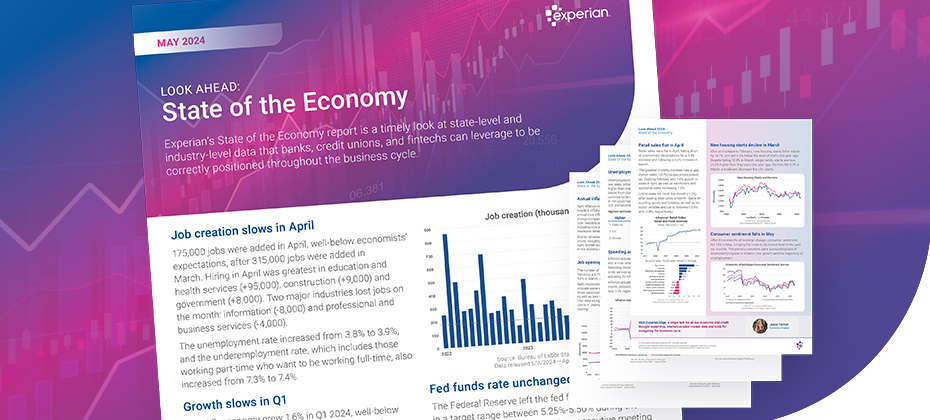
Check out May's report for a deep dive into the latest economic trends and market insights, including those around job creation and spending.

Experian’s award-winning platform now brings together market-leading data, generative AI and cutting-edge machine learning solutions.

“Learn how to learn.” One of Zack Kass’, AI futurist and one of the keynote speakers at Vision 2024, takeaways readily embodies a sentiment most of us share — particularly here at Vision. Jennifer Schulz, CEO of Experian, North America, talked about AI and transformative technologies of past and present as she kicked off Vision 2024, the 40th Vision. Keynote speaker: Dr. Mohamed El-Erian Dr. Mohamed El-Erian, President of Queens’ College, Cambridge and Chief Economic Advisor at Allianz, returned to the Vision stage to discuss the labor market, “sticky” inflation and the health of consumers. He emphasized the need to embrace and learn how to talk to AI engines and that AI can facilitate content, creation, collaboration and community Keynote speaker: Zack Kass Zack Kass, AI futurist and former Head of Go-To-Market at OpenAI, spoke about the future of work and life and artificial general intelligence. He said AI is aiding in our entering of a superlinear trajectory and compared the thresholds of technology versus those of society. Sessions – Day 1 highlights The conference hall was buzzing with conversations, discussions and thought leadership. Some themes definitely rose to the top — the increasing proliferation of fraud and how to combat it without diminishing the customer experience, leveraging AI and transformative technology in decisioning and how Experian is pioneering the GenAI era in finance and technology. Transformative technologiesAI and emerging technologies are reshaping the finance sector and it's the responsibility of today's industry leaders to equip themselves with cutting-edge strategies and a comprehensive understanding to master the rapidly evolving landscape. That said, transformation is a journey and aligning with a partner that's agile and innovative is critical. Holistic fraud decisioningGenerative AI, a resurgence of bank branch transactions, synthetic identity and pig butchering are all fraud trends that today's organizations must be acutely aware of and armed to protect their businesses and customers against. Leveraging a holistic fraud decisioning strategy is important in finding the balance between customer experience and mitigating fraud. Unlocking cashflow to grow, protect and reduce riskCash flow data can be used not only across the lending lifecycle, but also as part of assessing existing portfolio opportunities. Incorporating consumer-permissioned data into models and processes powers predicatbility and can further assess risk and help score more consumers. Navigating the economyAmid a slowing economy, consumers and businesses continue to struggle with higher interest rates, tighter credit conditions and rising delinquencies, creating a challenging environment for lenders. Experian's experts outlined their latest economic forecasts and provided actionable insights into key consumer and commercial credit trends. More insights from Vision to come. Follow @ExperianVision and @ExperianInsights to see more of the action.

Preventing chargeback fraud is critical to protecting your organization. Learn how you can leverage fraud prevention solutions. Read more!

As digital borrowing continues to gain prominence, fintech lenders must leverage data and analytics to fuel growth while mitigating risk.

Learn where first-time homebuyers are having the most success securing a mortgage and what you can do to engage this audience.

The world of finance can be a dangerous place, where cunning schemes lurk in the shadows, ready to pounce on unsuspecting victims. In the ever-evolving landscape of financial crime, the insidious ‘pig butchering’ scam has emerged as a significant threat, targeting both financial institutions and their clients. What is a ‘pig butchering’ scam? ‘Pig butchering’ scams are named after the practice of farmers fattening up their livestock before “butchering” them. This comparison describes the core of ‘pig butchering’ scams, where criminals entice victims to participate in investment schemes and cryptocurrency fraud. Originating in Southeast Asia and now rampant in the United States, these scams often start with online interactions via social media or dating applications. Scammers build trust with the victim, eventually gaining access to their online accounts. They "fatten the pig" by enticing more cryptocurrency investments and then make off with their ill-gotten gains. The repercussions are staggering, with reported losses exceeding $3.5 billion in 2023 alone according to an AP News article, and around 40,000 victims in the United States, including cases of losses as massive as $4 million. The real-life impact The story of “RB,” a San Francisco man who engaged with a scammer named "Janey Lee," serves as a stark warning. Through social media, Janey orchestrated an elaborate scheme, promising "RB” substantial returns in cryptocurrency investment. Seduced by false promises, “RB” emptied his life savings into the scam, only to be rescued by a Federal Bureau of Investigation (FBI) intervention, narrowly avoiding financial ruin.1 Malicious actors are improving their targeting skills, and often pursue executives and victims with a large sum of money, such as C-level officials from financial institutions. This past February, a $50 million pig slaughtering fraud incident caused the CEO of a local bank in Kansas to lose all his funds and the bank to collapse a few months later. FinCEN's vigilance and updates The Financial Crimes Enforcement Network (FinCEN) remains vigilant, issuing advisories to financial institutions to combat ‘pig butchering’ scams. Their latest advisory highlights evolving scam tactics, including aggressive promotions, using money mules for illegal fund transfers, and leveraging new financial products like decentralized finance (DeFi) platforms to obfuscate transactions. FinCEN also warns about red flags such as large and sudden investments from older customers, quick fund withdrawals after big deposits, and the frequent use of coins or mixers that hide transactions. Financial institutions are encouraged to: Report any suspicious activities by using specific terms like "pig butchering fraud advisory" in their reports to make analysis and response easier. File suspicious activity reports (SARs) using the key term “FIN-2023-PIGBUTCHERING.” Guide potential victims to report to the FBI’s IC3 or the Security and Exchange Commission (SEC’s) reporting system. A call to action for financial institutions The fight against ‘pig butchering’ scams requires proactive measures from financial institutions: Enhance fraud detection and anti-money laundering (AML) programs: Implement robust systems compliant with regulatory guidelines, conduct thorough customer enhanced due diligence, and leverage fraud detection software to spot anomalies and red flags., and leverage fraud detection software to spot anomalies and red flags. Leverage data analytics: Utilize data analytics tools to monitor customer behavior, identify irregular patterns, and swiftly detect potential ‘pig butchering’ activities. Employee training: Educate employees on scam risks, fraud detection techniques, and FinCEN red flags to empower them as the first line of defense., and FinCEN red flags to empower them as the first line of defense. Community education: Educate customers on recognizing and avoiding investment scams, promoting awareness, and safeguarding their assets. Navigating challenges with effective solutions ‘Pig butchering’ scams cause not only money losses but also personal troubles and reputational harm. Awareness, learning, and cooperation are essential in protecting from these complex financial fraudsters, securing the safety and confidence of your institutions and stakeholders. By combining the best data with our automated identification verification processes, you can protect your business and onboard new talents efficiently. Our industry-leading solutions employ device recognition, behavioral biometrics, machine learning, and global fraud databases to spot and block suspicious activity before it becomes a problem. Learn more 1San Francisco Chronical (2023). Crypto Texting Scam *This article includes content created by an AI language model and is intended to provide general information.