
Housing

Do you know where your customers stand? Not literally, of course, but do you know how recent macroeconomic changes and their personal circumstances are currently affecting your portfolio? While refreshing your customers’ credit data quarterly works for some aspects of portfolio management, you need more frequent access to fresh data to quickly respond to risky customer behavior and new credit needs before your portfolio takes a hit. Use triggers to improve portfolio management Event-based credit triggers provide daily or real-time alerts about important changes in your customers’ financial situations. You can use these to manage risk by promptly responding to signs of changing creditworthiness or to prevent attrition by proactively reaching out to customers who are shopping for credit. Risk Triggers℠ and Retention Triggers℠ offer a real-time solution that can be customized to fit your needs for daily portfolio management. What are Risk Triggers? Experian’s Risk Triggers alert you of notable information, such as unfavorable utilization rate changes, delinquencies with other lenders and recent activity with high-interest, short-term loan products. This solution allows you to monitor how your customers manage accounts with other lenders to get ahead of potential risk on your book. You can use Risk Triggers to get daily insights into your customers’ activity — allowing you to quickly identify potentially risky behavior and take appropriate action to limit your exposure and losses. Types of Risk Triggers Choose from a defined Risk Triggers package that could help you identify high-risk customers, including: New trades Increasing credit utilization or balances over limit New collection accounts An account is charged-off A credit grantor closes an account New delinquency statuses (30 to 180 days past due) Consumers seeking access to short-term, high-risk financing options Bankruptcy and deceased events How to use Risk Triggers You can use the daily alerts from Risk Triggers to help inform your account management strategy. Depending on the circumstances, you might: Decrease credit limits Close or freeze accounts Accelerate payment requests Continue monitoring accounts for other signs of risk Spotlight on Experian’s Clarity Services events Included in Risk Triggers are events from Experian’s Clarity Services, which draw on expanded FCRA-regulated data* from a leading source of alternative financial credit data. For example, you could get an alert when someone has a new inquiry from non-traditional loans. These triggers provide a broader view of the customer – offering added protection against risky behavior. What are Retention Triggers? Experian’s Retention Triggers can alert you when a customer improves their creditworthiness, is shopping for new credit, opens a new tradeline or lists property. Proactively responding to these daily alerts can help you retain and strengthen relationships with your customers — which is often less expensive than acquiring new customers. Types of Retention Triggers Choose from over 100 Retention Triggers to bundle, including: New trades New inquiries Credit line increases Property listing statuses Improving delinquency status Past-due accounts are brought current or paid off How to use Retention Triggers You can use Retention Triggers to increase lifetime customer value by proactively responding to your customers’ needs and wants. You might: Increase credit limits Offer promotional financing, such as balance transfers Introduce perks or rewards to strengthen the relationship Append attributes for improved decisioning By appending credit attributes to Risk and Retention Trigger outputs, you can gain greater insight into your accounts. Premier AttributesSM is Experian's core set of 2,100-plus attributes. These can quickly summarize data from consumers' credit reports, allowing you to more easily segment accounts to make more strategic decisions across your portfolio. Trended 3DTM attributes can help you spot and understand patterns in a customer's behavior over time. Integrating trended attributes into a triggers program can help you identify risk and determine the next best action. Trended 3D includes more than 2,000 attributes and provides insights into industries such as bankcard, mortgage, student loans, personal loans, collections and much more. By working with both triggers and attributes, you'll proactively review an account, so you can then take the next best action to improve your portfolio's profits. Customize your trigger strategy When you partner with Experian, you can bundle and choose from hundreds of Risk and Retention Triggers to focus on risk, customer retention or both. Additionally, you can work with Experian’s experts to customize your trigger strategy to minimize costs and filter out repetitive or unneeded triggers: Use cool-off periods Set triggering thresholds Choose which triggers to monitor Establish hierarchies for which triggers to prioritize Create different strategies for segments of your portfolio Learn more about Risk and Retention Triggers. Learn more *Disclaimer: “Alternative Financial Credit Data” refers to the use of alternative data and its appropriate use in consumer credit lending decisions, as regulated by the Fair Credit Reporting Act. Hence, the term “Expanded FCRA-Regulated Data” may also apply in this instance, and both can be used interchangeably.

In the latest episode of “The Chrisman Commentary” podcast, Experian experts Joy Mina, Director of Product Commercialization, and Ivan Ahmed, Senior Director of Product Management, explore how lenders can navigate a tight mortgage market, from rates to equity. “Current rates exceed their locked in rates,” said Ivan. “Homeowners are choosing options as alternatives to selling with the refinancing for cash outs and HELOC." Listen to the full episode for all the details and check out the previous episode to learn how mortgage companies can optimize their business expenses and protect prospects. Listen to podcast

The advent of artificial intelligence (AI) is significantly transforming the landscape of real estate fraud, enabling criminals to execute complex schemes like deed theft with greater ease. A notable case involves Spelling Manor, a $137.5 million mansion in Los Angeles, where the owner alleges they are entangled in deed fraud. Scammers reportedly filed fraudulent documents that have prevented the owner from selling the estate, thwarting offers from buyers, including former Google CEO Eric Schmidt. Understanding deed/title fraud Deed fraud, also known as title or property fraud, occurs when someone illegally transfers ownership of a property without the owner’s knowledge or consent. Typically, fraudsters create fake documents or forge the owner’s signature on a deed to make it look like the property has been legally transferred to them. Once the title is in their name, they may try to sell or mortgage the property, leaving the original owner unaware until it’s too late. How deed fraud works Identify a target: Fraudsters often look for properties that appear vulnerable, such as vacant land, unoccupied homes, or properties owned by elderly individuals who may not check their records frequently. Forge documentation: Using fake IDs and forged signatures, scammers create documents that appear to show a legitimate transfer of ownership. With modern technology, these documents can look highly convincing. Record the fake deed: Fraudsters then file these documents with the local county clerk or recorder’s office. This officially changes the ownership records, making it seem as if the scammer is the legitimate owner. Exploit the ownership: Once listed as the owner, the fraudster may sell the property to an unsuspecting buyer, take out loans against it, or even rent it out. The impact on victims In the summer of 2024, Elvis Presley’s family got confronted to a forged deed scam. A fake firm, Naussany Investments, falsely claimed Lisa Marie Presley owed millions and used Graceland as collateral. They placed a foreclosure notice and attempted to auction the estate. Riley Keough filed a lawsuit, exposing the firm as fraudulent and halting the foreclosure through a judge’s injunction. Lisa Jeanine Findley, who forged documents and posed as firm employees, was arrested and charged with deed forgery fraud and identity theft. She faces up to 22 years in prison if convicted. The FBI's Internet Crime Complaint Center does not specifically monitor deed fraud. However, in 2023, it processed a total of 9,521 real estate-related complaints defined as the loss of funds from a real estate investment, resulting in more than $145 million in losses. Victims of deed fraud can face severe financial and legal issues. They may discover the fraud only when trying to sell, refinance, or even pay taxes on the property. Reversing deed fraud typically requires a costly and time-consuming legal process, as courts must determine that the transfer was fraudulent and restore the original owner’s rights. Prevention and safeguards There are several preventive measures and fraud prevention solutions that can be established to help mitigate the risks associated with deed/title fraud. These include: For lending institutions: Enhanced ID verification: Implement multi-factor identity checks at the loan approval stage. Regular portfolio audits: Conduct periodic audits to detect unusual property transfers and title changes in their loan portfolios. For title companies: AI-driven document verification tools: Use machine learning algorithms to identify inconsistencies in deed and ownership documents. Real-time fraud monitoring: Employ analytics to track suspicious behavior patterns, such as rapid ownership changes. Seller authentication: Require biometric or multi-step identity verification for anyone claiming ownership or initiating sales. For realtors: Training and awareness: Educate realtors on how to spot warning signs of fraudulent listings and seller impersonations. Pre-transaction verification: Collaborate with title companies to validate ownership early in the listing process. Acting with the right solution Mortgage fraud is a constant threat that demands ongoing vigilance and adaptability. As fraudsters evolve their tactics, the mortgage industry must stay one step ahead to safeguard homeowners and lenders alike. With concerns over deed/title-related fraud rising, it is vital to raise awareness, strengthen preventive measures, and foster collaboration to protect the integrity of the mortgage market. By staying informed and implementing robust safeguards, we can collectively combat and prevent mortgage fraud from disrupting the financial security of individuals and the industry. Experian mortgage powers advanced capabilities across the mortgage lifecycle by gaining market intelligence, enhancing customer experience to remove friction and tapping into industry leading data sources to gain a complete view of borrower behavior. Visit our website to see how these solutions can help your business prevent deed fraud. Learn more

The Fed finally made their long-awaited rate cut. Hooray! The industry is saved! Brush off the dust everyone, it’s time to start originating mortgages like it’s 2006 again! Not so fast. While it's true that there are opportunities to take advantage of now that rates have declined, there remain open questions: How much further will rates decline? So far, only this single drop has been signaled. How many customers will realize benefit from a rate & term refinance offer given the rate drop(s)? What does this rate drop mean for the purchase market given that home prices remain at all-time highs? To put it simply, there are lending opportunities for home lenders (mortgage and home equity), but only for those with the ability to effectively leverage data and analytical strategies to identify and execute on the pockets of opportunity. By “pockets of opportunity,” we mean the following categories of consumers will benefit from specific mortgage or home equity offers. Rate & term refi: According to Experian research, over 83% of mortgages have an interest rate below 6.5%. This means that only the loans originated in the past couple of years (including one held by your author) will be eligible for a rate & term refi. The dollar amount on these loans will be high along with the interest rates, so even a minor savings on the interest rate will translate to potentially hundreds of thousands of dollars in lifetime interest savings for the borrowers. Being able to accurately identify which borrowers have an interest rate that is higher than the rate you can offer them is key to efficiently targeting and originating rate & term refinances. Cashout refi: Equity levels exploded over the past several years for homeowners. Home prices show no sign of slowing down and home equity continues to be a significant, and in many cases untapped, financial resource for borrowers. A cashout refi is an excellent option for those consumers with high amounts of available equity in their homes. Some borrowers may choose to originate a cashout refinance loan even if the interest rate is similar to their existing rate, such is the value of partially liquidating their equity position. Having the consumer-level data to identify what equity positions are and the current interest rate is crucial to crafting personalized, effective marketing offers. The ability to target qualified customers with a personalized offer is critical given that in August 2024, over 2.9 million cashout direct mail offers were mailed to consumers.1 Streamlined refi: The VA and FHA have streamlined refinance programs that minimize the consumer lift to refinance their loan. Additionally, there are also non-VA and FHA loans that could benefit from what is called an “Express Title,” which removes the need for a full title workup and expedites the originations process. Borrowers that meet the criteria for these streamlined refinance offers can be identified using credit data. Since these refinances are easier for consumers, they will be more likely to respond and book a refinance offer, which means more ROI for your marketing spend. Home equity lines/loans: Similar to cashout refi, home equity products are an option for consumers to access the equity they have in their price-appreciated homes. Although this is no mystery to most lenders, many lenders do not leverage adequate data or analytics to identify the needle in the haystack of customers that still remain to be targeted. Experian data shows over $25B in monthly HELOC originations as of August 2024. Understanding which consumers have a second lien position available, how much equity they have by leveraging trade-level mortgage data and Automated Valuation Model (AVM) data, and other methods can help your home equity products stand out from the sea of offers in the mail and online. At Experian, we help our clients target and originate all four categories of borrowers: rate & term refinancers, cashout refinancers, streamlined refinancers, and home equity borrowers. Crafting a marketing strategy with the accurate data to precisely identify which consumers qualify for which product is crucial to making the most of your marketing spend. Without the guidance of such data and the personalized offers they enable, your marketing message is liable to be lost among all of the other direct mail and email blasts. Market with confidence Crafting an effective holistic marketing strategy across these segments is crucial to campaign success. Consider these borrower situations and prepare to respond with confidence: Does the consumer have a high interest rate? Would the consumer benefit from a quick rate & term refi? If yes, ship the offer out. Does the consumer have a significant equity position and outstanding revolving debt balances, but not qualify for a rate & term due to a relatively low rate? If yes, ship them a cashout refi offer with language about using their equity to pay off revolving debt. Does the consumer meet the criteria for a streamlined refi, and would they benefit financially from such an offer? If yes, ship them a VA IRRRL (Interest Rate Reduction Refinance Loan), FHA streamline, or an offer to cover their refi title expenses if they qualify for an express title. Does the consumer have an open second lien on their primary residence, but not qualify for either kind of refi? If yes, ship them a home equity offer. By creating this kind of specialized marketing waterfall, lenders can ensure they have valuable offers for all borrowers, not just for a specialized market. Such strategies allow you to target your existing portfolio or a prospect population to facilitate portfolio growth and prevent portfolio attrition. Be sure to join our upcoming webinar, "Return of the Refi: Top Lending Strategies for Becoming a Refi Master." Register now and learn more about how Experian can help you win more mortgage and home equity customers in this declining rate environment. Register now Learn more 1 Mintel data

Colorado has a great deal to offer first-time homebuyers (FTHBs). While the Denver area attracts many people with its combination of outdoor recreation, culture, and economic opportunities, other parts of Colorado are worthy of attention as well. Take Colorado Springs for example – it ranks third among best places to live in the U.S. when considering lifestyle, the job market, and overall popularity.1 Overview of the Colorado FTHB market Colorado accounts for 2.15% of all U.S. first-time homebuyers, according to Experian Housing’s recent first-time homebuyer report. This figure puts Colorado in the top 20 of all states across the country. Colorado's charm holds a special appeal for younger generations. Known for its wealth of enriching experiences, Colorado naturally attracts adventure-seekers. With an array of outdoor activities like hiking and skiing, it's no wonder that Generation Y and Generation Z make up 75% of all first-time homebuyers in the state, surpassing the national average of ~70%. Affordability With three-quarters of all FTHBs in the younger market segments, affordability is a key consideration in buying a home as housing costs are a significant part of an individual or family’s overall cost of living.2 What determines affordability? Affordability can be assessed through various metrics. For the purposes of this study, Experian Housing defined affordability by calculating the rent-to-mortgage ratio (RTM). This involves comparing monthly rent payments to monthly mortgage payments. A higher rent-to-mortgage ratio suggests renters may find mortgage payments more feasible, potentially making home buying a more appealing option. Comparison of rent costs to mortgage costs What we observed: Based on the RTM ratio, home buying is most affordable in Colorado Springs, Pueblo, and Castle Rock, while renting may look more attractive in Lakewood, Fort Collins, and Arvada. Additional measures to consider: Other realities play a key role in determining what is affordable. A prospective homebuyer’s income, monthly expenses, downpayment funds available, and the cost of the rent or mortgage payment as an added expense against income, factor heavily in final decision-making. In this regard, Experian Housing examined other metrics for assessing affordability. Debt-to-income What we observed: Down payments Sample of CO data observations: (High, mid, low down payments) Sale prices and income What we observed: Experian Housing examined the median sales prices and median incomes across the U.S. This metric is useful to see how much of one’s income typically is going to housing costs in a given area, which again, impacts overall cost of living. Comparison is essential because while sales prices may be higher in a given area, correlation with income helps determine affordability. A closer look at Colorado Springs Colorado Springs ranks #1 in affordability based on Experian’s research, and its status of best affordable place to live considering overall living costs, jobs, and livability is solid.4 The younger generation is the fastest growing population in Colorado Springs. Colorado Springs is expected to be the largest city in the state by 2050 given its current rate of growth and expansion.5 In addition to its five military installations, with a huge U.S. Air Force presence, key job sectors include the larger defense industry, education, technology, and manufacturing. Affordability coupled with opportunity and lifestyle suggest Colorado Springs deserves a closer look and area mortgage lenders have a lot to tout. Experian’s data system offers unique value to lenders given the ability to take a more comprehensive look at a borrower’s financial behavior. Experian uses credit, property, rental, and other alternative data sources to capture the borrower profile. Access to such data also gives Experian a unique ability to conduct research for reports like this one, and the recent reports on Texas and Florida. For more information about the lending possibilities for first-time homebuyers, download our white paper and visit us online. Download white paper Learn more 1 US News & World Report: Best Places to Live in the US 2024-2025 https://realestate.usnews.com/places/rankings/best-places-to-live 2 https://www.experian.com/blogs/insights/top-destinations-for-first-time-homebuyers/ 3 Arvada, Lakewood and Castle Rock, part of the Denver Metro Area and what is popularly known as the Front Range Urban Corridor, also have price to income ratios of 2.8%. 4 https://www.sofi.com/best-affordable-places-to-live-in-colorado/ 5 Colorado Springs Chamber & EDC, coloradospringschamberedc
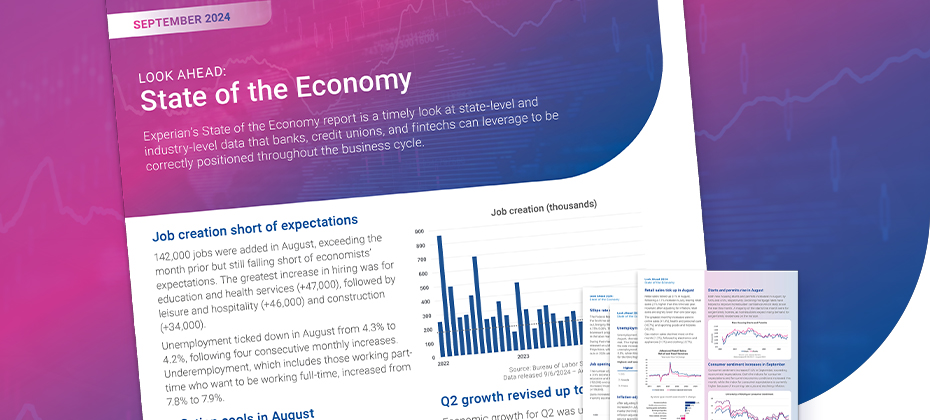
This series will explore our monthly State of the Economy report, which provides a snapshot of the top monthly economic and credit data for financial service professionals to proactively shape their business strategies. During their September meeting, the Federal Reserve made a highly-anticipated announcement to cut rates for the first time since 2020. Fed officials cut rates by 50bps, while also penciling in an additional 50bps of cuts for 2024 and 100bps of cuts in 2025 in their Summary of Economic Projections. While rates are coming down and inflation continues to cool, there were downward revisions to job creation made in August and declining job openings in July. Data highlights from this month’s report include: The Federal Reserve announced a 50bps rate cut during the September meeting. Annual headline inflation cooled from 2.9% to 2.5%, getting closer to the Fed’s 2% goal. Mortgage originations increased 7.0% in August. Check out our report for a deep dive into the rest of this month’s data, including the latest trends in job creation, retail sales, and consumer sentiment. Download September's report As our economy continues to fluctuate, it's critical to stay updated on the latest developments. Subscribe to our new series, The Macro Moment, for economic commentary from Experian North America's Chief Economist, Joseph Mayans, and download our new Lending Conditions Chartbook for additional insights. For more economic trends and market insights, visit Experian Edge.

As a mortgage lender, understanding the intricacies of the New York housing market is crucial, especially when dealing with first-time homebuyers (FTHBs). While the housing market fluctuates nationwide, New York presents unique challenges and opportunities that require a nuanced approach. Distinguishing NYC from the rest of New York New York City's housing market, along with its suburbs, stands distinct from the rest of the state. With a high cost of living and unique lifestyle, NYC demands a tailored mortgage marketing strategy. This article will highlight key factors affecting affordability in New York, providing valuable insights for mortgage lenders working in this market. Overview of the New York FTHB market According to Experian Housing’s recent report on first-time homebuyers, the state of New York accounts for nearly 4.9% of all first-time homebuyers nationwide.1 More than half of first-time homebuyers are from Generation Y. When combined with Gen Z, these younger buyers make up just over 67% of the state's FTHBs, a figure slightly below the national average of 69%. Affordability metrics: The rent-to-mortgage ratio For many Americans, homeownership represents stability, security, and the future for family, community, and life. However, the decision to buy versus rent often hinges on affordability. Mortgage lenders must understand this dynamic to better assist their clients. Affordability can be defined in various ways. For the purposes of this study, Experian Housing defined affordability by comparing rental and mortgage payments, known as the rent-to-mortgage ratio (RTM ratio). A higher ratio indicates that buying a home is more economically attractive. Again, this metric does not consider incomes and debt levels, but simply housing rental prices and mortgage costs. Based solely on the RTM ratio, the transition from renting to homeownership may be more attractive in New York City, Syracuse, and Oyster Bay, while the transition may be more difficult in Cheektowaga, Amherst, and Hempstead. For mortgage lenders, understanding local markets and buyer profiles is essential. Building trust through personalized service, such as educating buyers on relevant loan programs and showcasing geographic expertise, can set you apart. With this knowledge, you can help buyers make informed decisions about affordability, whether they prefer living in the city or the suburbs. In some areas, the suburbs may offer more affordable options, while in others, the city center might be more cost-effective. Additional factors: Income, debt, and down payments Affordability extends beyond just rent and mortgage payments. Prospective homebuyers must consider their income, monthly expenses, and access to funds for a down payment. Mortgage lenders need to account for these factors when advising first-time homebuyers. Debt-to-income Average DTI across the 14 cities observed was 25.6%. The chart below highlights those at the higher and lower end of the spectrum. Down payments Down payments varied greatly, but the median across the cities observed was 16.5%. The chart below highlights an example at the high, mid, and low point. Sale prices and income Experian Housing analyzed median sales prices and incomes across the U.S., with New York serving as a prime example of the importance of this comparison in assessing affordability. This correlation is crucial; while sales prices may be high, understanding how they align with local incomes helps lenders accurately gauge market dynamics and guide buyers more effectively. In conclusion, having a deep understanding of the New York housing market is invaluable for mortgage lenders aiming to support first-time homebuyers. By leveraging insights into market dynamics, affordability metrics, and borrower profiles, lenders can offer tailored advice that meets the specific needs of their clients. This not only helps buyers navigate the complexities of homeownership but also builds lasting trust and loyalty. Equipped with these insights, you, as a lender, can play a pivotal role in making the dream of homeownership a reality for first-time buyers in New York. Let's continue to empower our clients with the knowledge and guidance they need to make informed and confident decisions in their homebuying journey. For more insights, check out our recent studies on the Florida and Texas markets and download our first-time homebuyer whitepaper. Download white paper Learn more

At Experian, we believe in fostering innovation and collaboration to solve complex challenges. Recently, Ivan Ahmed, one of our talented product management leaders at Experian Housing, had the opportunity to participate in the FHFA 2024 TechSprint, where his team won the award for the best Risk Management and Compliance idea. In this article, we share Ivan's experience as he reflects on the TechSprint, the inspiration behind his team's project, and the valuable lessons learned. Can you share your experience participating in the FHFA 2024 TechSprint? What was the atmosphere like, and how did it feel to be recognized for the best Risk Management and Compliance idea? Let me start by explaining what a TechSprint is. It is a fast-paced, high-energy collaborative workshop where diverse experts and stakeholders come together to design technological solutions to complex problems. Each team is given a high-level problem and use case. From there, stakeholders and domain experts must develop a proof of concept within 3 days to best address the problem. On the last and final day, called the “Demo Day,” teams must showcase their solution in front of a panel of judges. It’s a fun, high-energy, challenging, and rewarding experience. A TechSprint is a convergence of everything I love – technology, business, and design and I think FHFA did a wonderful job orchestrating the event. Each team consisted of representatives from different functions in the housing ecosystem, including lenders, technologists, product managers, and regulators. We were given access to a room, whiteboards, and, most importantly, delicious snacks. We were also given access to industry subject matter experts outside our teams, including representatives from Fannie Mae and Freddie Mac, FHFA, and leaders from top companies. What I found the most impactful was the ability to pressure test our ideas and solutions against these industry subject matter experts. Ideating in a vacuum can be challenging, so being able to stress test things rapidly with these experts allowed us to change course quickly as new information was introduced. Winning the best Risk Management and Compliance idea award was rewarding, especially as we were able to ideate a solution to such a critical accessibility issue. Ultimately, our goal was to help create a fairer, more equitable, and inclusive housing finance system. A big shoutout to my teammates, Wemimo Abbey, Joseph Karbowski, Will Regenauer, and Eddy Atkins. What inspired Team Arsenal to focus on identifying potential gaps in ADA compliance within multifamily buildings, and what were some of the key challenges your team faced during the process? My mother has suffered from several disabilities most of her life. With age, she has become more wheelchair-dependent, and traveling has become a major challenge. On a recent family trip, the entry to our hotel building wasn’t ADA-compliant, and I had to carry her up a flight of stairs. It was frustrating to deal with. I later went down a rabbit hole around ADA compliance and, much to my surprise, learned that only 0.15% of all homes in the U.S. are wheelchair accessible! As we explored the problem space further as a team, we learned how difficult it is to ensure that new and existing rental homes are ADA-compliant. We hypothesized that a solution is needed to establish incentives for borrowers, lenders, and GSEs to meet compliance. A technological solution could more easily enable multi-family lenders and builders to identify rental units that are non-ADA compliant and could provide ways to address the gaps. We noticed two primary challenges: an enforcement gap and an incentive gap. We learned that agency loans (Fannie Mae and Freddie Mac) account for most multi-family home loan originations. If we could tackle the enforcement challenge at the GSE level, we could set up the proper incentives for all players in the multi-family lending process. By providing tools to both the borrower and the GSE’s, we could help foster a more inclusive and accessible rental housing market. How do you envision your AI-driven solution impacting the rental housing market and improving ADA compliance for multifamily buildings? We wanted to ensure that we leveraged the true power of Generative AI, which meant that our solution could take multimodal inputs and produce multimodal outputs. For example, we could train the Generative AI model on photos of interior multi-family rental units and structured or unstructured text like building sketches, site layouts, and local building codes. We could then incorporate ADA design requirements and analyze discrepancies. The result would be a compliance report or tool outlining the adherence level to ADA design requirements and providing tips and recommendations on remediation. The solution could be delivered as a free tool by the GSEs, who could incentivize its usage by offering price concessions to borrowers. Developers could also use the tool to evaluate whether new or existing builds were ADA-compliant. How did your background and experience with Experian contribute to developing your team's winning idea at the FHFA TechSprint? Much of my role at Experian has involved exploring ways to leverage proprietary and public record property data for marketing, account review, and analytical use cases. I work very closely with property data at Experian, so I was very familiar with the types of input fields of property data that would be the most relevant to improving a generative AI model output. Specifically, in our use case, we wanted to train the model to better identify homes and features that were non-compliant with ADA and provide clear remediation steps. We knew that public record property information was available from various sources and could be leveraged as additional third-party input data to improve our model accuracy. What advice would you give to other teams or individuals looking to participate in future TechSprint events, especially those aiming to tackle complex issues like risk management and compliance? It’s important to remember that an ideal solution is both impactful and practical. Practicality is achieved when the solution has both business and technical viability. Therefore, it’s crucial to carefully vet problems and solutions by understanding their viability. Working as a team to solve the problem means leveraging the expertise of subject matter experts around you. Each team member should draw on their strengths, making the collective effort stronger than individual contribution. Most importantly, fairness, inclusivity, and accessibility matter. An effective solution should strive to have a positive social impact in addition to other considerations. Winning with purpose Ivan’s journey through the FHFA 2024 TechSprint exemplifies the innovative and collaborative spirit that drives our team at Experian. His reflections highlight the impact of well-designed technological solutions on critical issues like ADA-compliance in multifamily housing. We hope Ivan’s experience inspires others to explore their potential in solving complex problems and to participate in future TechSprints, where innovative thinking and a commitment to social good can lead to meaningful change.

Housing affordability is a pressing concern across the United States, and Florida is no exception. The affordability issue can be particularly crucial for renters looking to become first-time homebuyers (FTHBs). The desire to live in a sunny location must be measured against the cost of living, particularly housing costs. Experts at Experian Housing carefully examined data from the top 15 Florida cities (by population) to gain insights into the state of housing affordability in Florida.1 Experian examined factors such as mortgage payments, rent prices, income levels, and sales prices to assess affordability. Overview of the Florida FTHB market Experian Housing’s recent report on first-time homebuyers ranked Florida the state with the third highest percentage of FTHBs nationwide, at nearly 7.7% of FTHBs.2 It outranked New York, falling behind Texas and California. In Florida, the younger populations of Generation Y and Z account for 60% of all first-time homebuyers. Nationwide, roughly 70% of FTHBs belong to these populations. Among younger buyers, affordability is often the deciding factor in whether they continue to rent or become homeowners as they balance housing costs with student loan debt and other expenses. Let’s look at some key metrics Comparative monthly mortgage payments and rent prices How this affects affordability: The bottom line for prospective homebuyers often comes down to whether it's more affordable to continue to rent or purchase a home. While the metrics discussed all contribute to the picture of affordability, for this study, Experian Housing defined affordability by calculating the rent-to-mortgage ratio, a comparison of monthly rental payments to monthly mortgage payments. Homebuying becomes more attractive to renters when the rent-to-mortgage ratio is higher because mortgage payments are more economically practical. What we observed: Experian Housing found that Pembroke Pines, Palm Bay, and Cape Coral have the highest rent-to-mortgage ratio in Florida, at nearly 80%. In other words, for example, if the average mortgage payment is $1,000, the average rental payment is ~$800. Compare this to Tallahassee, Hialeah, and Hollywood, where the rent-to-mortgage ratio is <60%. These numbers illustrate the varying home purchase and rental market trends across the state. Debt-to-income How this affects affordability: This metric compares monthly debt responsibilities, including mortgages, car loans, student loans, and minimum credit card payments, to monthly income. A high debt-to-income ratio indicates a significant portion of income is dedicated to paying debt, leaving little room for other essential living costs and discretionary spending. What we observed: Down payments How this affects affordability: A higher down payment can also assist buyers, especially first-time buyers, by increasing attractive financing options. Importantly, a down payment of 20% avoids the need for private mortgage insurance (PMI), which is insurance for the lender, protecting the lender against loss should a foreclosure occur. PMI typically costs between 0.5% and 2% of the loan amount, annually. What we observed: Sale prices and financial hurdles How this affects affordability: In comparing home affordability across Florida, first-time homebuyers should consider home prices in relation to income. While other considerations, including an individual’s debt level and other expenses, contribute to the bottom line, this gives an indication of how much income will be consumed by the home purchase. What we observed: Experian Housing examined the median sales prices and median. Comparison is essential because sales prices may be higher in a given area, but correlation with income helps determine affordability. A Florida housing opportunity, up close: Miami metropolitan area The Miami metropolitan area is an example of an area where mortgage lenders who understand their clients and the area they seek to live may well attract first-time homebuyers, loyal clients, and more word-of-mouth business. The Miami suburb of Pembroke Pines, roughly 20 miles from Miami, offers a more affordable housing market. With Florida sunshine, nearby beaches, and access to three main highways, mortgage lenders whose knowledge base is not limited to the Miami city center may have an opportunity to turn a renter into a homeowner. Florida residents navigate the cost of living in the Sunshine State Analysis from Experian Housing highlights the diversity in housing markets and the opportunities to enhance financial well-being for residents in Florida. These insights are crucial for lenders to identify affordable opportunities for all residents. Experian’s data system offers unique value to lenders given the ability to take a more comprehensive look at a borrower’s financial behavior. Experian uses credit, property, rental, and other alternative data sources to capture the borrower profile. Access to such data also gives Experian a unique ability to conduct research for reports like this one and the recent Texas affordability study. For more information about the lending possibilities for first-time homebuyers, download our white paper and visit us online. Download white paper Learn more 1 The analysis is based on the trade and rental data reported to Experian and considered first-time homebuyers during the period between November 2022 and January 2024. 2 Based on those getting a mortgage.
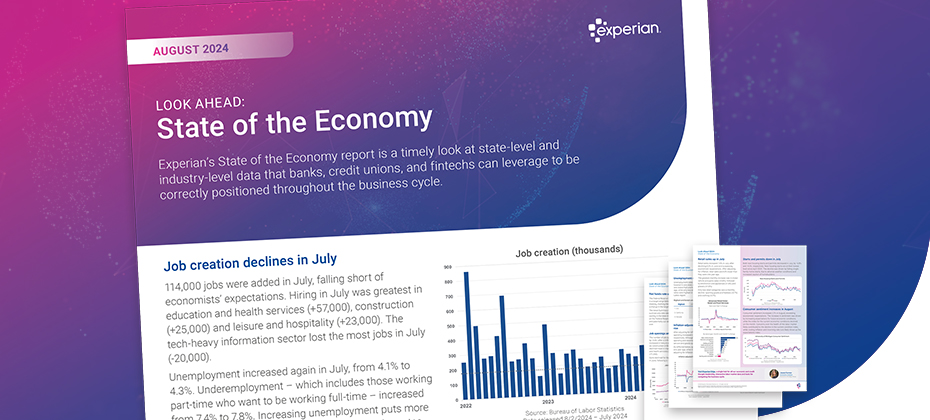
This series will dive into our monthly State of the Economy report, providing a snapshot of the top monthly economic and credit data for those in financial services to proactively shape their business strategies. The labor market has been a source of strength for the U.S. economy coming out of the pandemic, providing workers with stable employment and solid wages. However, the labor market has slowed in recent months, with lower-than-expected job creation and rising unemployment, causing weakening sentiment in the broader market. This has resulted in increased pressure on the Federal Reserve to begin cutting rates and places more importance on the incoming data between now and the September FOMC meeting. Data highlights from this month’s report include: Job creation declined in July, falling short of economists’ expectations. Unemployment increased from 4.1% to 4.3%. Inflation cooled again in July, with annual headline inflation easing from 3.0% to 2.9%. GDP picked up in Q2 to 2.8%, primarily driven by strong consumer spending. Check out our report for a deep dive into the rest of this month’s data, including the latest trends in originations, retail sales, and the new housing market. Download August's report To have a holistic view of our current environment, it’s important to view the economy from different angles and through different lenses. Download our latest macroeconomic forecasting report for our views on what's to come in the U.S. economy and listen to our latest Econ to Action podcast. For more economic trends and market insights, visit Experian Edge.

Alternative lending is continuing to revolutionize the financial services landscape. From full-file public records to cash flow transactions, alternative credit data empowers financial institutions to make more informed lending decisions. This article focuses on cash flow insights and how they help financial institutions drive profitable and inclusive growth. Challenges with traditional credit underwriting Traditional underwriting often limits access to credit for marginalized communities, including young adults, immigrants, and those from low-income backgrounds. Because the process relies heavily on credit history and credit scores to determine an applicant’s ability to pay, those with less-than-ideal credit profiles could be overlooked. This then creates a cycle — those who are already disadvantaged face further barriers to accessing credit, limiting their abilities to invest in opportunities that can improve their financial situations, such as education or homeownership. Additionally, traditional underwriting models can be rigid. Consumers with stable incomes or significant assets may be denied credit if their financial profiles don’t fit the narrow criteria established by traditional models. As the financial landscape evolves, it’s important for lenders to adopt more inclusive and adaptive approaches to credit underwriting. What is cash flow underwriting? Cash flow underwriting is a modern approach to evaluating a borrower’s creditworthiness. It uses fresh, consumer-permissioned bank account transaction (balance, income and expense) data, giving lenders greater visibility into loan applicants’ financial situation. This process is made possible through open banking, an established, secure framework that enables consumers to quickly and easily share their bank account information with third-party financial service providers. READ: Learn more about the open banking landscape. Let’s look at a few quick examples: A prospective tenant is filling out a rental application. Instead of manually submitting paystubs to verify their income, open banking facilitates the digital sharing of full cash flow data in seconds, enabling property managers to quickly access the applicant’s full cash flow information. A consumer was previously denied credit due to insufficient credit history. With cash flow underwriting, the consumer is offered a second chance to qualify for the loan by including cash flow data in the lender’s decisioning model. The additional information gathered on the consumer’s ability to pay can transform the initial decline decision into an approval. Cash flow underwriting can also be used for credit line management. By assessing a borrower’s income and expense transactions, lenders can recommend optimal credit limits that cater to their spending potential while minimizing risk. Benefits of cash flow underwriting There are many benefits to integrating cash flow data into the credit underwriting process, including: Enhanced risk assessment. Going off credit scores and repayment behaviors alone won’t provide lenders with a complete or current picture of applicants. Through open banking, lenders can gain access to cash flow data in real-time, allowing them to more accurately assess consumers, increase approvals, and reduce credit risk. Inclusive lending. Millions of American adults are considered unscoreable, invisible, or subprime. However, 71% of consumers are willing to share their banking information if it could improve their chances of getting approved for credit.1 With deeper insights into consumers’ income and expenses, lenders can increase credit access in underserved communities. Improved customer experiences. Gaining a more comprehensive view of a consumer’s financial situation enables lenders to determine what loan products they’re eligible for and craft personalized options. READ: Learn more about the benefits of leveraging alternative data for credit underwriting. Get started Cash flow underwriting represents a significant step forward in the world of lending. It offers a more comprehensive approach to assessing creditworthiness, helping financial institutions drive growth and profitability. Cashflow Attributes are one of Experian's open banking solutions that provides lenders with consumer-permissioned insights into borrowers’ financial behaviors. With 940+ attributes derived from transaction data across 133 categories, financial institutions can make smarter, more inclusive lending decisions. Learn more about Cashflow Attributes Learn more about open banking 1Atomik Research survey of 2,005 U.S. adults online, matching national demographics, 2024.
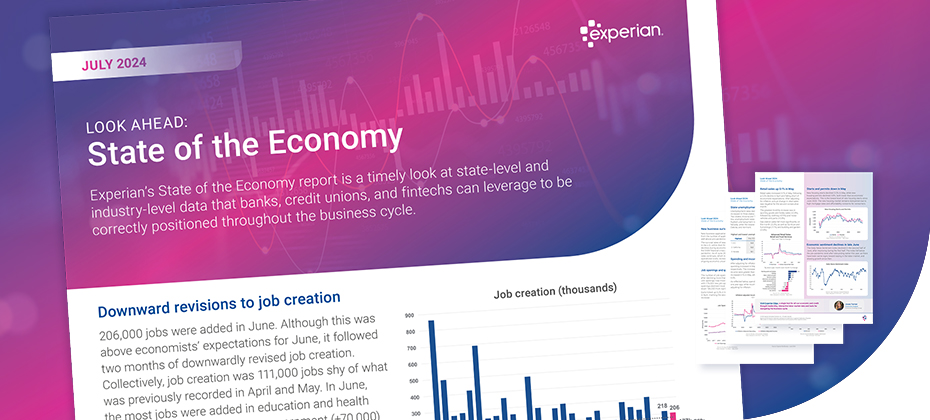
This series will dive into our monthly State of the Economy report, providing a snapshot of the top monthly economic and credit data for those in financial services to proactively shape their business strategies. While much of the economic data released this month remained steady, including continued downward progress in inflation and resilience in inflation-adjusted spending, June was a pivotal month for the labor market. With downward revisions to job creation over the past few months to an up-tick in unemployment, the potential for a sooner-than-expected rate cut increased. Data highlights from this month’s report include: While above economists’ expectations in June, job creation was 111,000 jobs shy of what was recorded in April and May, signaling some slowdown in the labor market. Inflation-adjusted spending and incomes increased in May, by 0.3% and 0.5%, respectively. Inflation eased more than economists expected, with annual headline inflation cooling from 3.3% to 3.0%. Check out our report for a deep dive into the rest of this month’s data, including the latest trends in job openings, new business survival rates, and bankcard delinquency rates. Download July's report To have a holistic view of our current environment, it’s important to view the economy from different angles and through different lenses. Watch our experts discuss the latest economic and credit trends in the next macroeconomic forecasting webinar and listen to our latest Econ to Action podcast. For more economic trends and market insights, visit Experian Edge.

First-time homebuyers (FTHBs) represent a significant portion of the homebuying market across the United States, particularly in Texas where we see the largest proportion. While an overall diverse market segment, affordability is paramount to all. Experian Housing recently examined the mortgage landscape, looking at who is buying, where, and why, uncovering both expected and surprising insights. Texas at a glance Eight of the top ten fastest-growing US cities are in Texas. Lately, Texas business growth has included large employers, such as Amazon, Oracle, Caterpillar, Chevron, and Schwab, moving or expanding to the state. Looking for a more affordable life, consumers have also made the move. No state income tax, no corporate taxes, overall lower business taxes, business incentives, and a generally favorable cost of living make it very attractive to individuals and businesses. Recent research by Experian Housing revealed Texas accounts for the largest percentage of FTHBs in the US at nearly 10.5%, based on those getting a mortgage. Among these buyers, ~72% are Generation Y (Gen Y) and Generation Z (Gen Z), meaning they are in their early 40s and younger. Defining and measuring affordability Affordability often tips the scale for prospective first-time homebuyers, particularly younger buyers, deciding to rent or buy. Texas mortgage lenders familiar with the geography of their local markets will likely have an advantage with these consumers if they understand affordability from a citywide perspective and at a hyper-focused neighborhood or zip code level. What determines affordability? Affordability can be assessed through various metrics. For the purposes of this study, Experian Housing defined affordability by calculating the rent-to-mortgage ratio. This involves comparing monthly rent payments to monthly mortgage payments. A higher rent-to-mortgage ratio suggests renters may find mortgage payments more feasible, potentially making home buying a more appealing option. According to Experian’s latest 2023 rental market report, Gen Z and Gen Y made up nearly 70% of the U.S. rental sector. When considered with their first-time homebuyer numbers in Texas and across the U.S., their importance in defining the market trend stands out. The rent-to-mortgage analysis provides important insights into whether these buyers may look to buy now or continue renting. Texas by the numbers Experian Housing examined affordability at the city and more granular, localized levels. Among those analyzed for affordability, Experian findings included: Lubbock is the most affordable city with a rent-to-mortgage ratio of 67%. Following Lubbock were Fort Worth (64%), San Antonio (63%), andEl Paso (62%) are the next cities. Among metro areas, Houston (58%), Arlington (56%), Dallas (52%) and Austin (49%). In these cities, the low to high average current home sales price rankings tracked the rent-to-mortgage ratios except for El Paso, with the 2nd lowest average sales price, but coming in 4th in the affordability metric. Lubbock had the lowest average home sales price at $212,812. El Paso had the next lowest average sales price ($216,424), then San Antonio ($269,232) and Fort Worth ($312,579). Next came Houston ($317,882), Arlington ($345,077), Dallas ($402,830), and Austin ($598,431). Is the city center or are the suburbs more affordable? A look at the city level only tells part of the story. Examining the area by zip code reveals more insights into where loan officers might direct first-time buyer prospects. In general, based on the median rent-to-mortgage payment ratio, the farther away from the city center (outer suburbs), the more affordable buying is for first-time buyers. San Antonio proved to be the notable exception where prices trended higher in the suburbs. Mortgage lenders who are savvy about these inner-market differences, set themselves up for a greater likelihood of attracting first-time homebuyers and keeping them as loyal customers. For more information about the lending possibilities for first-time homebuyers, download our white paper and visit us online. Download white paper Learn more
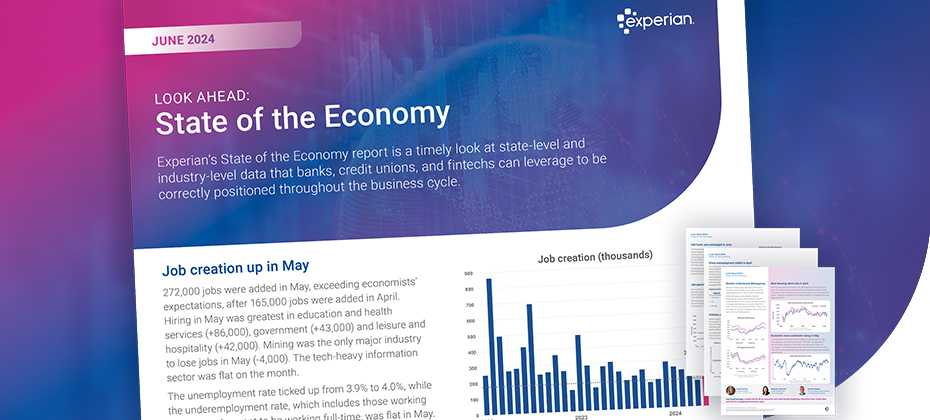
This series will dive into our monthly State of the Economy report, providing a snapshot of the top monthly economic and credit data for those in financial services to proactively shape their business strategies. During their June meeting, the Federal Reserve continued to hold rates steady and released an updated Summary of Economic Projections. In this update, the committee reduced 2024 rate cut projections from three to one and increased their year-end inflation expectations. Both of these updates were likely driven by a lack of downward progress in inflation in Q1. But as the Federal Reserve extends the period of restrictive rates, it places more weight on each monthly economic data release to inform the Fed’s next move. Data highlights from this month’s report include: Job creation exceeded economists’ expectations with 272,000 jobs added in May. Inflation cooled in May, with annual headline inflation down from 3.4% to 3.3% and annual core inflation down from 3.6% to 3.4%. Auto loan amounts decreased in Q1 as inventories continue to stabilize. Check out our report for a deep dive into the rest of this month’s data, including the latest trends in delinquencies, spending, and the new housing market. Download June's report To have a holistic view of our current environment, it’s important to view the economy from different angles and through different lenses. Watch our experts discuss the latest economic and credit trends in the recording of our latest macroeconomic forecasting webinar and listen to our latest Econ to Action podcast. For more economic trends and market insights, visit Experian Edge.

The Experian Vision conference is an annual event hosted by the leader in global information services. Vision 2024, held in Scottsdale, Arizona, from May 20-23, gathered industry leaders, data experts, and business professionals to discuss the latest trends and innovations in data and analytics. Aligned with the theme of “Powering Opportunities,” Vision 2024 featured breakout sessions offering attendees valuable insights and strategies for using data to drive business growth and success. Here are the highlights from three of the sessions focused on housing topics. Two industry experts, Sam Khater, Chief Economist at Freddie Mac and Susan Allen, SVP of Product, Experian Housing, engaged in a lively and thought-provoking discussion. The program covered the current state of the mortgage market. Susan and Sam took turns presenting their findings, exchanging ideas, and sharing their perspectives about where lenders could see opportunity in the current challenging mortgage market. They identified these current challenges and opportunities for lenders and borrowers. The economy continues to expand at a solid growth rate. Consumer spending remains firm, and the labor market is tight. The healthy economy is causing inflation and interest rates to remain higher for longer. Home purchase demand is coming off cyclical lows, but home sales remain low with mortgage rates remain above 7%. Inventory is improving modestly, but it remains very low due to chronic undersupply. The dynamic of low home sales, and even lower supply will continue to pressure home prices to increase, especially given many borrowers are moving to more affordable markets more frequently than in the past. There are 46 million likely qualified non-homeowner consumers, of which 7 million appear ready for first time homeownership. Although affordability remains a significant challenge, there are geographic regions where aspiring first-time homeowners are finding better success. Lenders are pursuing data-driven, nuanced approaches to identify and successfully reach these consumers. Three recognized industry professionals headlined this panel discussion. Eric Czajka, VP of Governance and Oversight at Rocket Companies, Experian Housing’s Susan Allen, and Product Manager for Experian Housing, Angad Paintal, shared their insights with a review of recent innovations from Rocket, including specific Experian solutions that are supporting Rocket’s consumer engagement strategy. Lenders in attendance also learned the next steps they can take to win borrowers that ready to consider a refinance. Experian showcased what’s possible with the combination of multiple data sources in a user-friendly interface to help lenders prepare for a rate reduction, including the potential triggers for conventional refinance, VA refinance and FHA refinances. Each segment needs to move 50 basis points to make the possibility of a refinance reasonable for the borrower. Vision 2024 continued with a casual conversation between Newrez COO Joshua Bishop and Chris Travis, Software Sales Expert at Experian. Participants experienced a glimpse into recent developments in mortgage technology from the Newrez leader and how these advancements reflect the industry. The program featured an exchange of questions and answers centered around three crucial topics that have significant implications for housing industry growth and development. These include economic uncertainty (interest rates, refinances, and delinquency trends), government regulations and policies (Basel III, CFPB) and technology (big data and generative AI). The key takeaway from this session was that the mortgage industry is undergoing a tech revolution. Lenders and servicers are utilizing predictive models to assess risk and personalize communication, while generative AI streamlines document processing and provides a cleaner experience for internal and external users alike. Deep analytical tools provide a clearer picture of borrower finances and hardship resolutions. This technological embrace is transforming the mortgage process, making it faster, more efficient, and more accessible. Be part of the future at Vision 2025 Vision 2024 was a resounding success, bringing together our valued clients to share innovative ideas and forge new connections. We were thrilled by the thought-provoking discussions and the collaborative spirit that permeated the event. As we look ahead to next year's conference, we eagerly anticipate even more groundbreaking conversations and opportunities for growth. Don't miss out - secure your spot now and be part of the future at Vision 2025. Register now