
Loading...

Exploring Affordability for First-time Homebuyers in the Texas Market

by Scott Hamlin 4 min read June 26, 2024

First-time homebuyers (FTHBs) represent a significant portion of the homebuying market across the United States, particularly in Texas where we see the largest proportion. While an overall diverse market segment, affordability is paramount to all. Experian Housing recently examined the mortgage landscape, looking at who is buying, where, and why, uncovering both expected and surprising insights.
Texas at a glance

Eight of the top ten fastest-growing US cities are in Texas. Lately, Texas business growth has included large employers, such as Amazon, Oracle, Caterpillar, Chevron, and Schwab, moving or expanding to the state. Looking for a more affordable life, consumers have also made the move. No state income tax, no corporate taxes, overall lower business taxes, business incentives, and a generally favorable cost of living make it very attractive to individuals and businesses.

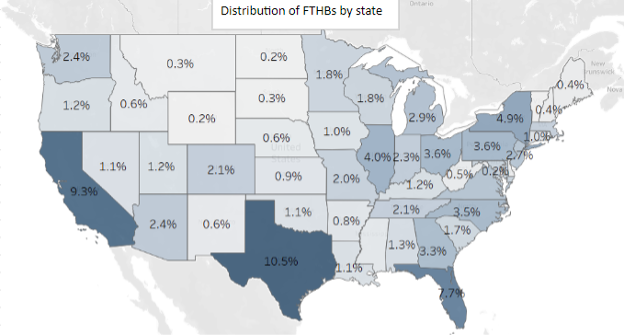
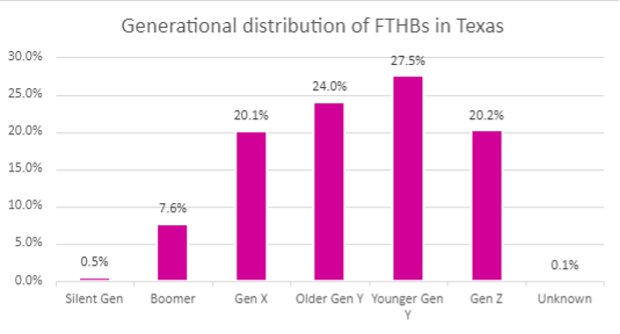
Recent research by Experian Housing revealed Texas accounts for the largest percentage of FTHBs in the US at nearly 10.5%, based on those getting a mortgage. Among these buyers, ~72% are Generation Y (Gen Y) and Generation Z (Gen Z), meaning they are in their early 40s and younger.
Defining and measuring affordability

Affordability often tips the scale for prospective first-time homebuyers, particularly younger buyers, deciding to rent or buy. Texas mortgage lenders familiar with the geography of their local markets will likely have an advantage with these consumers if they understand affordability from a citywide perspective and at a hyper-focused neighborhood or zip code level.

What determines affordability? Affordability can be assessed through various metrics. For the purposes of this study, Experian Housing defined affordability by calculating the rent-to-mortgage ratio. This involves comparing monthly rent payments to monthly mortgage payments. A higher rent-to-mortgage ratio suggests renters may find mortgage payments more feasible, potentially making home buying a more appealing option.

According to Experian’s latest 2023 rental market report, Gen Z and Gen Y made up nearly 70% of the U.S. rental sector. When considered with their first-time homebuyer numbers in Texas and across the U.S., their importance in defining the market trend stands out. The rent-to-mortgage analysis provides important insights into whether these buyers may look to buy now or continue renting.

Texas by the numbers

Experian Housing examined affordability at the city and more granular, localized levels. Among those analyzed for affordability, Experian findings included:

  • Lubbock is the most affordable city with a rent-to-mortgage ratio of 67%.
  • Following Lubbock were Fort Worth (64%), San Antonio (63%), andEl Paso (62%) are the next cities.
  • Among metro areas, Houston (58%), Arlington (56%), Dallas (52%) and Austin (49%).

In these cities, the low to high average current home sales price rankings tracked the rent-to-mortgage ratios except for El Paso, with the 2nd lowest average sales price, but coming in 4th in the affordability metric.

  • Lubbock had the lowest average home sales price at $212,812.
  • El Paso had the next lowest average sales price ($216,424), then San Antonio ($269,232) and Fort Worth ($312,579).
  • Next came Houston ($317,882), Arlington ($345,077), Dallas ($402,830), and Austin ($598,431).

Is the city center or are the suburbs more affordable?

A look at the city level only tells part of the story. Examining the area by zip code reveals more insights into where loan officers might direct first-time buyer prospects.

In general, based on the median rent-to-mortgage payment ratio, the farther away from the city center (outer suburbs), the more affordable buying is for first-time buyers. San Antonio proved to be the notable exception where prices trended higher in the suburbs.
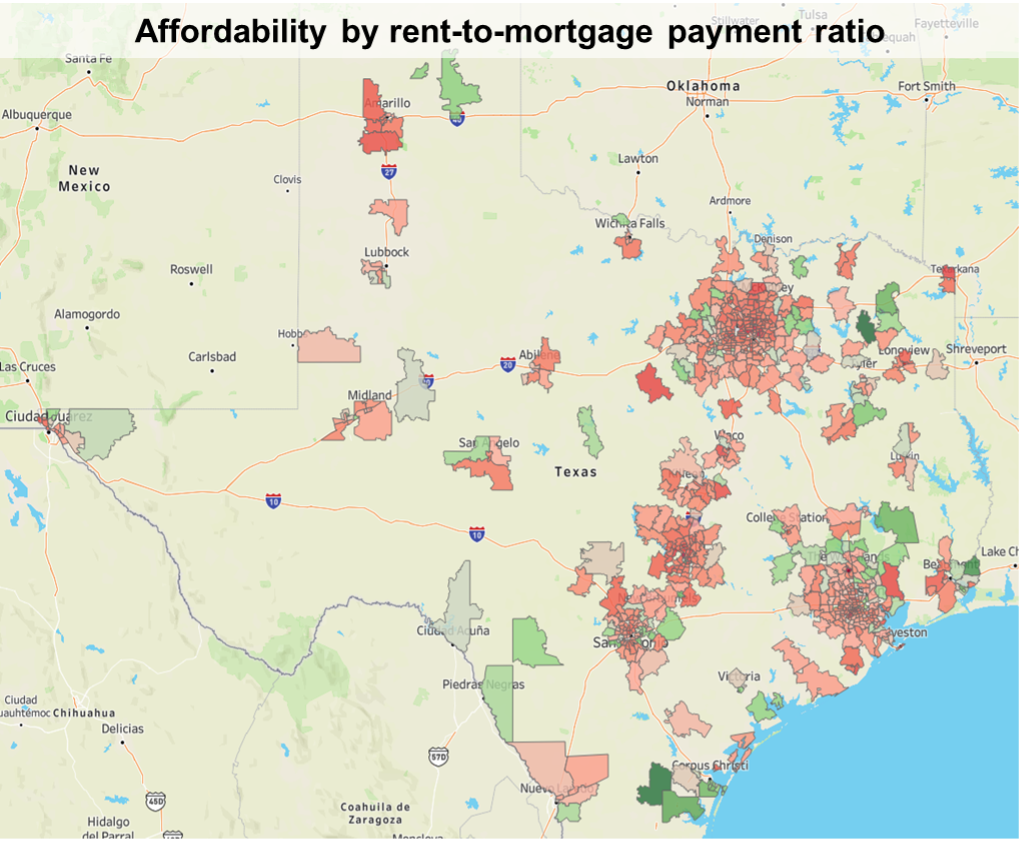
Mortgage lenders who are savvy about these inner-market differences, set themselves up for a greater likelihood of attracting first-time homebuyers and keeping them as loyal customers.

For more information about the lending possibilities for first-time homebuyers, download our white paper and visit us online.


Download white paper Learn more

Related Posts

Trigger leads have long been the preferred solution for identifying high-intent mortgage borrowers. But with the implementation of the Homebuyers Privacy Protection Act (HPPA), which introduces new limitations and consumer protections around trigger leads, that playbook will need to shift. Now, lenders are quickly facing a pivotal shift in how they discover, engage, and convert prospective borrowers into customers. The industry now stands at a crossroads. Lenders who adapt early—leaning into predictive tools, consent-based engagement, and smarter prescreening—will redefine borrower acquisition in a more privacy-centric era.  HPPA: A structural change to mortgage marketing  The HPPA amends the Fair Credit Reporting Act by significantly restricting the use of mortgage inquiries for prescreen purposes. As of March 5, 2026, credit bureaus may only provide or utilize mortgage inquiries to:  End users with explicit borrower consent  The originator of the consumer’s current mortgage  The servicer of the consumer’s current mortgage  An insured depository institution or credit union where the consumer has an existing account  While these exemptions may provide continuity for banks and credit unions, many mortgage brokers and nonbank lenders will need to overhaul their prescreen practices—or risk being cut off entirely from a previously high-performing acquisition channel.  Why this isn’t just a compliance shift—It’s a strategic recalibration  Mortgage triggers in prescreen allow lenders to react instantly to consumer intent. Lenders rely on a prompt and convincing narrative to entice applicants to switch lenders. Mortgage inquiry triggers are effective and were, therefore, a prospecting strategy for many lenders. Recent legislative changes significantly restrict the availability of these inquiry triggers, and impacted lenders are focusing on a more intentional prospecting strategy to compete.   Without these mortgage triggers in prescreen, lenders need to ask:  Who are we trying to reach?  What early signals can we act on?  How do we earn permission and attention before a mortgage inquiry ever happens?  Transforming the funnel: From reaction to anticipation  The shift in mortgage inquiry-based prescreen isn’t the end of high-intent lead targeting. It’s the beginning of a more strategic and intentional approach—one that leverages earlier indicators of mortgage readiness and focuses on building relationships, not just closing transactions.  Here’s where the momentum is evolving, creating a new and smarter funnel:  Prescreen marketing: Using credit and behavioral attributes to help identify consumers who meet specific lending criteria before they signal active intent.  Predictive modeling: Leveraging propensity scores or custom models to prioritize outreach based on conversion likelihood.  Consent-based engagement: Implementing compliant mechanisms to capture and manage borrower opt-ins at scale.  The power of predictive modeling  According to recent industry interviews, propensity modeling is emerging as one of the most effective replacements for trigger-based prescreen. These models analyze hundreds of credit attributes—such as utilization, account mix, account age, and depth—to help identify consumers statistically more likely to seek a mortgage.  For lenders just beginning to use predictive modeling, off-the-shelf models can be a quick way to identify potential borrowers. For example, when layering propensity scores on top of credit eligibility, which can improve borrower targeting, many lenders see an increase in open mortgage loan rates.  Meanwhile, custom-built models, which analyze a lender’s own campaign performance over time, offer the highest level of precise targeting. These models isolate the attributes most predictive of conversions within a specific product mix—optimizing not just volume, but fit.  Speed without traditional triggers? It’s possible  One of the biggest concerns among lenders is maintaining the speed historically enabled by trigger leads. But that concern may be overblown.  Self-service prescreen platforms now allow marketers to generate qualified lead lists in as little as 24 hours, enabling rapid response during rate drops, competitive shifts, or seasonal demand spikes.   For those new to prescreening, batch campaigns still offer value, especially with analyst support.   Don’t overlook retention  In an era of intense acquisition competition, retention becomes a key differentiator.  Lenders who monitor property status, cash flow, and consumer credit behavior can proactively identify when an existing borrower is likely to list, refinance, or exit. Armed with that intelligence, lenders can re-engage with the borrower at the right moment—sometimes before a competitor is considered or contacted.  This level of behavioral intelligence may soon separate proactive lenders from reactive ones.  Actions instead of reactions  The evolution of trigger-based prescreen doesn’t just require new tools; it demands new thinking. Lenders should begin by auditing their current pipelines and determining:  What percentage of our acquisition is dependent on triggers?  What share of our book falls under the HPPA exemptions?  How will we scale compliant opt-in collection?  Are our current prescreen or modeling capabilities future-ready?  Those who answer these questions today—and act on them—won’t just be in compliance with the new laws, they’ll lead in a transformed market. Lenders should also be asking:   Do we have the infrastructure to collect and act on borrower consent?  Are our acquisition teams equipped to run prescreen campaigns — both batch and self-service?  What predictive models are we using (or could we use) to prioritize leads?  Are we proactively monitoring our portfolio to catch retention risks early?  How are we preparing our sales teams for longer, more consultative buying journeys?  Conclusion  The HPPA signals a shift away from relying on passive, inquiry-based prescreen acquisition and the beginning of smarter, more strategic engagement with potential borrowers. Lenders who embrace this transition early will find themselves not just compliant, but competitive—with deeper borrower insights, better conversion rates, and stronger long-term customer relationships.  The market is moving. The only question is: will you lead the change or chase it?  Citation  Experian. (2025, November). Interview: How the Homebuyers Privacy Protection Act is reshaping mortgage marketing—and what lenders should do now [transcript]. Experian Mortgage Insights. Insights based on lender feedback, campaign performance data, and analysis of prescreen marketing strategies and predictive modeling outcomes were gathered from Experian client engagements and internal mortgage analytics between May and October 2025. Homebuyers Privacy Protection Act timeline and legal context referenced from legislation signed September 5, 2025, with implementation beginning March 5, 2026.   

by Ivan Ahmed 4 min read April 22, 2026

%%excerpt%% %%page%% Credit modernization, VantageScore 4.0, and smarter data are reshaping mortgage lending. Learn how lenders can reduce risk, optimize workflows, and expand access.

by Ted Wentzel 4 min read March 31, 2026

  Experian Verify is redefining how lenders streamline income and employment verification; a value clearly reflected in Marcus Bontrager’s experience at Freedom Mortgage. With access to the second-largest instant payroll network in the U.S., Experian Verify connects lenders to millions of unique employer records, including those sourced through Experian Employer Services clients, delivering instant results at scale. This reach enables lenders to reduce manual processes, accelerate loan decisions, and enhance the borrower experience from the very first touchpoint. Unlike traditional verification providers, Experian Verify offers transparent, value-driven pricing: it charges only when a consumer is successfully verified, not simply when an employer record is found. As lenders navigate increasing compliance requirements and secondary market expectations, they can also rely on Experian Verify’s FCRA-compliant framework, fully supporting both Fannie Mae and Freddie Mac. Combined with Experian’s industry-leading data governance and quality standards, lenders gain a verification partner they can trust for accuracy, security, and long-term operational efficiency. Perhaps most importantly, Experian Verify delivers 100% U.S. workforce coverage through its flexible, automated waterfall: instant verification, consumer-permissioned verification, and research verification. This multilayered approach ensures lenders meet every borrower where they are, whether they’re connected to a large payroll provider, a smaller employer, or require additional document-based validation. As Marcus highlights in the video, this comprehensive and configurable design empowers lenders to build verification workflows that truly fit their business needs while enhancing speed, completeness, and borrower satisfaction. Explore Experian Verify

by Ted Wentzel 4 min read February 20, 2026

Subscribe to our thought leadership

Enter your name and email for the latest updates.

This site is protected by reCAPTCHA and the Google Privacy Policy and Terms of Service apply.

Subscribe to our thought leadership

Don't miss out on the latest industry trends and insights!
Subscribe