Financial Services
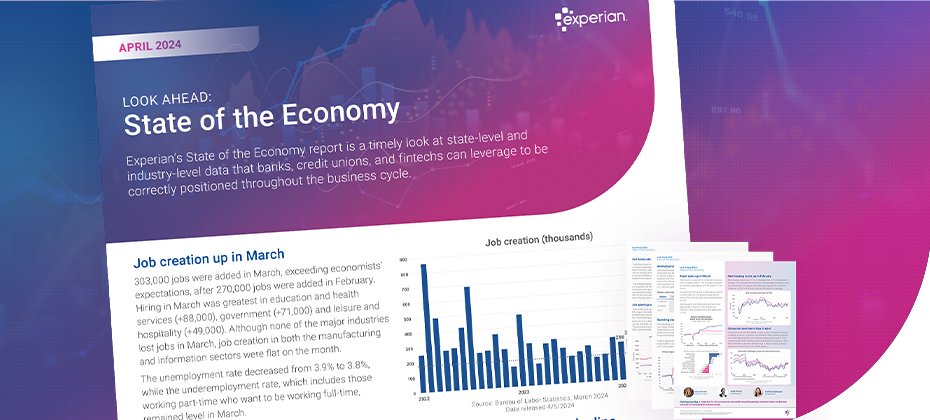
Check out April's report for a deep dive into the latest economic trends and market insights, including those around income and originations.

Learn about the misconceptions of income and employment verifications and what lenders can do to improve their strategies.

For lenders, mitigating first payment default requires data, advanced analytics, customer engagement, and agile risk management.

Anti-money laundering and fraud prevention have historically been separated, but here's why that might not be a good idea.
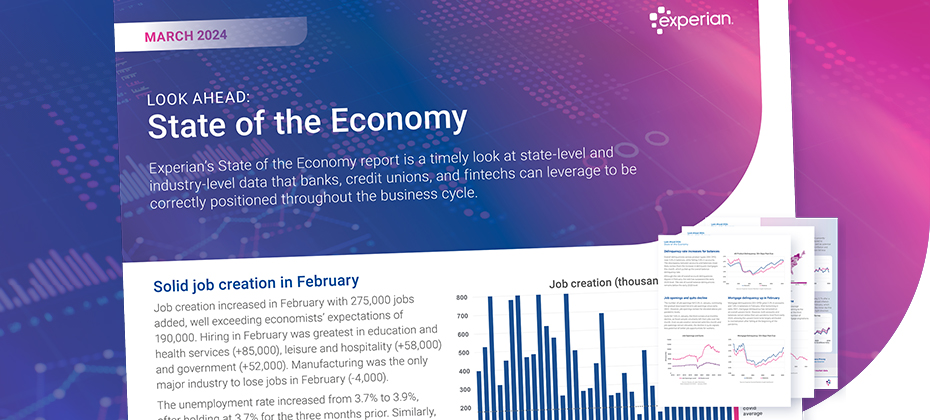
In March's State of the Economy report, we provide insights into consumer spending, the housing market, originations, and more.

To better understand a consumer's credit behavior over time, financial institutions must leverage trended data.

This article was updated on March 7, 2024. Like so many government agencies, the U.S. military is a source of many acronyms. Okay, maybe a few less, but there really is a host of abbreviations and acronyms attached to the military – and in the regulatory and compliance space, that includes SCRA and MLA. So, what is the difference between the two? And what do financial institutions need to know about them? Let’s break it down in this basic Q&A. SCRA and MLA: Who is covered and when are they covered? The Servicemember Civil Relief Act (SCRA) protects service members and their dependents (indirectly) on existing debts when the service member becomes active duty. In contrast, the Military Lending Act (MLA) protects service members, their spouses and/or covered dependents at point of origination if they are on active duty at that time. For example, if a service member opens an account with a financial institution and then becomes active military, SCRA protections will apply. On the other hand, if the service member is of active duty status when the service member or dependent is extended credit, then MLA protections will apply. Both SCRA and MLA protections cease to apply to a credit transaction when the service member ceases to be on active duty status. What is covered? MLA protections apply to all forms of payday loans, vehicle title loans, refund anticipation loans, deposit advance loans, installment loans, unsecured open-end lines of credit, and credit cards. However, MLA protections exclude loans secured by real estate and purchase-money loans, including a loan to finance the purchase of a vehicle. What are the interest rate limitations for SCRA and MLA? The SCRA caps interest rate charges, including late fees and other transaction fees, at 6 percent. The MLA limits interest rates and fees to 36 percent Military Annual Percentage Rate (MAPR). The MAPR is not just the interest rate on the loan, but also includes additional fees and charges including: Credit insurance premiums/fees Debt cancellation contract fees Debt suspension agreement fees and Fees associated with ancillary products. Although closed-end credit MAPR will be a one-time calculation, open-end credit transactions will need to be calculated for each covered billing cycle to affirm lender compliance with interest rate limitations. Are there any lender disclosure requirements? There is only one set of circumstances that triggers SCRA disclosures. The Department of Housing and Urban Development (HUD) requires that SCRA disclosures be provided by mortgage servicers on mortgages at 45 days of delinquency. This disclosure must be provided in written format only. For MLA compliance, financial institutions must provide the following disclosures: MAPR statement Payment obligation descriptions Other applicable Regulation Z disclosures. For MLA, it is also important to note that disclosures are required both orally and in a written format the borrower can keep. How Experian can help Experian's solutions help you comply with the Department of Defense's (DOD's) final amendment rule. We can access the DOD's database on your behalf to identify MLA-covered borrowers and provide a safe harbor for creditors ascertaining whether a consumer is covered by the final rule's protection. Visit us online to learn more about our SCRA and military lending act compliance solutions. Learn more

New account fraud can pose a serious risk to your business, and your current security methods might be hurting your customers' experience.

A multilayered defense can help detect and prevent synthetic ID fraud, one of the fastest-growing types of fraud. Read more!
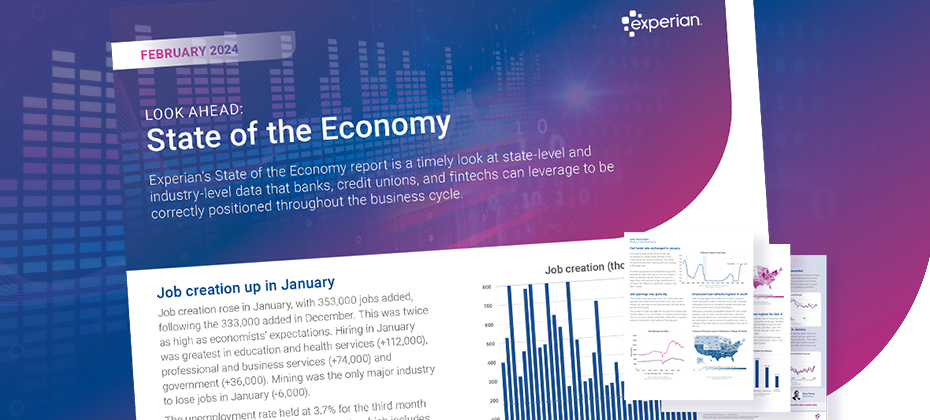
This report provides a snapshot of the top monthly economic and credit data, including inflation, the housing marketing, and card balances.

Seamless financial services onboarding requires organizations to enhance their identity verification methods.

Almost every business that has an online presence will have to face and counter bot attacks. Read more to learn how.

Data-driven marketing insights can help your organization target more accurately and create a better customer experience.

New approaches to model operations are also helping lenders accelerate their machine learning model development processes.
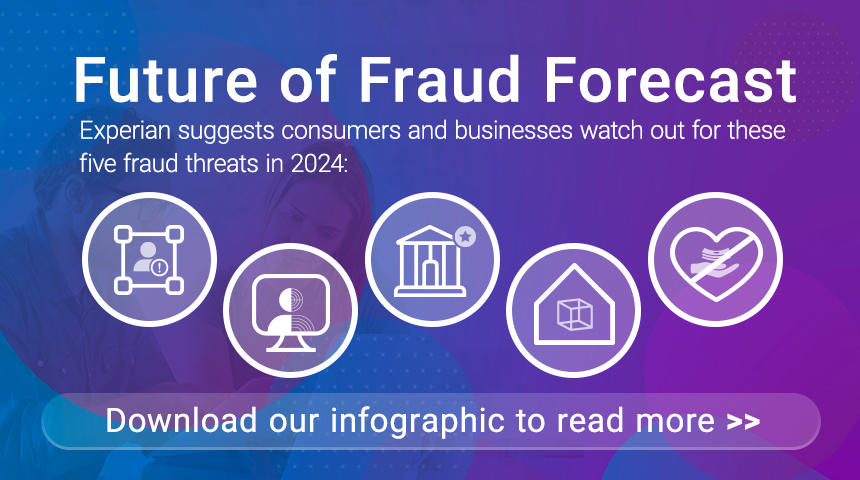
Spoiler alert: Gen AI is everywhere, including the top of Experian’s list of fraud trends 2024. “The speed and complexity of fraud attacks due to new technology and sophisticated fraudsters is leaving both businesses and consumers at risk in 2024,” said Kathleen Peters, chief innovation officer at Experian Decision Analytics in North America. “At Experian, we’re constantly innovating to deliver data-driven solutions to help our customers fight fraud and to protect the consumers they serve.” To deter fraudulent activity in 2024, businesses and consumers must get tactical for their fraud fighting strategies. And for businesses, the need for more sophisticated fraud protection solutions leveraging data and technology is greater than ever before. Experian suggests consumers and businesses watch out for these big five rounding out our fraud trends 2024. Generative AI: Generative AI accelerates DIY fraud: Experian predicts fraudsters will use generative AI to accelerate “do-it-yourself” fraud ranging from deepfake content – think emails, voice and video – as well as code creation to set up scam websites. A previous blog post of ours highlighted four types of generative AI used for fraud, including fraud automation at scale, text content generation, image and video manipulation and human voice generation. The way around it? Fight AI fraud with AI as part of a multilayered fraud prevention solution. Fraud at bank branches: Bank branches are making a comeback. A growing number of consumers prefer visiting bank branches in person to open new accounts or get financial advice with the intent to conduct safer transactions. However, face-to-face verification is not flawless and is still susceptible to human error or oversight. According to an Experian report, 85% of consumers report physical biometrics as the most trusted and secure authentication method they’ve recently encountered, but the measure is only currently used by 32% of businesses to detect and protect against fraud. Retailers, beware: Not all returns are as they appear. Experian predicts an uptick in cases where customers claim to return their purchases, only for the business to receive an empty box in return. Businesses must be vigilant with their fraud strategy in order to mitigate risk of lost goods and revenue. Synthetic identity fraud will surge: Pandemic-born synthetic identities may have been dormant, but now have a few years of history, making it easier to elude detection leading to fraudsters using those dormant accounts to “bust out” over the next year. Cause-related and investment deception: Fraudsters are employing new methods that strike an emotional response from consumers with cause-related asks to gain access to consumers’ personal information. Experian predicts that these deceptive cause-related methods will surge in 2024 and beyond. How businesses and consumers feel about fraud in 2024 According to an Experian report, over half of consumers feel they’re more of a fraud target than a year ago and nearly 70% of businesses report that fraud losses have increased in recent years. Business are facing mounting challenges – from first-party fraud and credit washing to synthetic identity and the yet-to-be-known impacts generative AI may have on fraud schemes. Synthetic identity fraud has been mentioned in multiple Experian Fraud Forecasts and the threat is ever growing. As technology continues to enhance consumers’ connectedness, it also heightens the stakes for various fraud attacks. As highlighted by this list of fraud trends 2024, the ways that fraudsters are looking to deceive is increasing from all angles. “Now more than ever, businesses need to implement a multilayered approach to their identity verification and fraud prevention strategies that leverages the latest technology available,” said Peters. Consumers are increasingly at risk from sophisticated fraud schemes. Increases in direct deposit account and check fraud, as well as advanced technologies like deepfakes and AI-generated phishing emails, put consumers in a precarious position. The call to action for consumers is to remain vigilant of seemingly authentic interactions. Experian can help with your fraud strategy To learn more about Experian’s fraud prevention solutions, please visit https://www.experian.com/business/solutions/fraud-management. Download infographic Watch Future of Fraud webinar