Financial Services
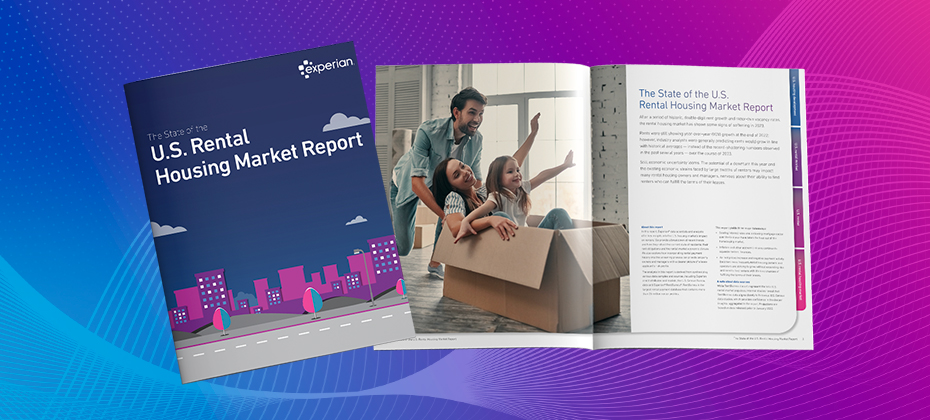
After a period of historic, double-digit rent growth and razor-thin vacancy rates, the rental housing market has shown some signs of softening in recent months. And economic uncertainty still looms. The potential of a downturn this year and the existing economic strains faced by large swaths of renters may impact many rental-housing owners and managers nervous about their ability to find renters who can fulfill their lease terms. In The State of the U.S. Rental Housing Market, a new report from Experian, our data scientists and analysts offer key insights into the U.S. housing market and its impact on renters. The analysis in this report is derived from synthesizing various data samples and sources, including Experian credit attributes and models as well as data from the U.S. Census Bureau and Experian RentBureau®. Experian RentBureau is the largest rental payment database and contains over 4.4 million transactions and more than 25 million renter profiles. This report yields three major takeaways: Soaring interest rates and a slowing mortgage sector over the last year have taken heat out of the homebuying market, leading to more renters remaining in the renter pool. Inflation and other economic strains continue to squeeze renters’ finances. As rent prices increase and negative payment activity becomes more frequent, rental-housing owners and operators are striving to grow without expanding default risk and need to find renters with the best chances of fulfilling the terms of their leases. Among the report’s other notable findings: The average renter spends 38.6% of their income on rent. Households that spend more than 30% of their income on housing costs — including rent or mortgage payments, utilities and other fees — are considered “housing cost burdened” by the U.S. Department of Housing and Urban Development. Experian data shows 28% of renters with negative payment activity in 2022 (negative payment activity is defined as having late charges, insufficient funds, write-offs or outstanding balances). The figure represented an increase of 5.7 percentage points from 2021 and 3.8 percentage points from 2020. Also of note, low-to-moderate income renters are twice as likely to have a negative payment activity compared to other renters. Rent-to-income ratios are highest in the West and the Northeast. Among all 50 states, the leaders are Washington D.C. (40.9%), California (39.7%), Washington state (35.6%), Utah (35.6%) and New York (35.3%). Keep pace with trends in future blog posts that will dive deeper into the current conditions affecting the rental housing market and renters. In the meantime, click here to download your free copy of The State of the U.S. Rental Housing Market Report in full.

The ability to verify customer identities is essential for financial institutions for numerous reasons: regulatory requirements, for the protection of their consumers and their business, mitigating risk and more. Being able to detect high-risk customers and large transactions is a critical component of Know Your Customer (KYC) strategies. In addition to being good business practices, this type of risk mitigation is also outlined in industry regulations. In an increasingly complex regulatory environment, companies may be faced with meeting multiple KYC and Anti-Money Laundering (AML) requirements. Actions taken to validate customers such as enhanced due diligence in KYC compliance have impacts spanning far beyond just regulatory compliance. As with any business, bottom line and budget are primary drivers for many financial institutions. Enhanced due diligence (EDD) can positively impact a business's bottom line by contributing to the reduction of fraud rates. And with increased security to discover potential fraudsters, organizations can protect both customers and reputational value. Enhanced due diligence explained: Why KYC, CIP and AML are critical in financial services EDD takes Customer Due Diligence (CDD) to the next level. Financial institutions conduct CDD to protect their organizations from financial crime. CDD is also a critical component of KYC steps to comply with AML laws. AML legislation requires financial institutions to validate their customers to ensure they aren’t part of explicitly illegal financial activity or funding terrorism. EDD is, as it sounds, a more involved form of due diligence, which encompasses additional procedures. EDD involves determining a customer’s risk, often requiring additional information and evidence to determine their viability. While CDD is performed on all customers, EDD is reserved for high-risk potential customers. Because EDD is often more costly and involved in terms of time and resources, a risk-based approach is recommended to flag only the instances when this additional level of validity is required. KYC references the mandatory process of identifying and verifying a client’s identity at account opening and over the course of their relationship with a company to ensure they are the person they say they are. KYC consists of three parts: Customer identification program (CIP), CDD and EDD. CIP requires, at minimum, that financial institutions provide four pieces of identifying information including name, date of birth, address and identification number. CDD consists of classifying the identifying information that was collected. After identifying who the client is (via CIP), CDD assesses the information to determine risk. Enhanced due diligence in KYC In order to establish a competent EDD program, you must improve your CIP and KYC programs. Objective, automated and efficient identity verification capabilities help you acquire profitable, legitimate customers and monitor them effectively over time to meet regulatory compliance expectations. How can EDD benefit your business? Failing to comply with EDD regulations can result in countless risks for financial institutions like fines and reputational losses. While many customers pose little to no risk, high-risk individuals must be flagged quickly and efficiently. The primary benefit of EDD is to protect both financial institutions and their customers from financial crimes such as money laundering and terrorist financing, but there are other risks as well. By mitigating potential risks associated with higher-risk customers, EDD can prevent financial institutions from incurring regulatory fines, legal action, and damage to their reputation. In turn, this ensures that customers have more trust in their financial service providers. Financial institutions can then gain a competitive advantage by offering more secure financial products and services that investors, businesses and customer demand. Access EDD from Experian Experian leverages our advanced analytics, reliable data sources, and team of experts to conduct objective, full and comprehensive due diligence with confidence and certainty. Our solutions, including flexible monitoring and segmentation tools, allow you to resolve discrepancies and fraud risk in a single step, all while keeping pace with emerging fraud threats with effective customer identification software. Improving your Customer Identification Program (CIP) and KYC programs In conclusion, Enhanced Due Diligence in KYC, CIP, and AML are critical components of the financial services regulatory compliance framework. EDD goes beyond the standard KYC, CIP, and AML checks to mitigate risks associated with higher-risk customers. Implementing EDD can help financial institutions comply with regulatory requirements, protect against potential risks, and prevent financial crimes. Ultimately, this benefits not only the institutions but also their customers and the broader economy. It’s vital that financial institutions understand and appreciate the importance of EDD and take appropriate measures to implement it effectively. Experian offers objective, automated and efficient identity verification solutions to help you acquire profitable, legitimate customers and monitor them over time to meet regulatory compliance expectations. Discover the power of CIP and KYC solutions. Learn more

More than half of U.S. businesses say they discuss fraud management often, making fraud detection in banking top-of-mind. Banking fraud prevention can seem daunting, but with the proper tools, banks, credit unions, fintechs, and other financial institutions can frustrate and root out fraudsters while maintaining a positive experience for good customers. What is banking fraud? Banking fraud is a type of financial crime that uses illegal means to obtain money, assets, or other property owned or held by a bank, other financial institution, or customers of the bank. This type of fraud can be difficult to detect when misclassified as credit risk or written off as a loss rather than investigated and prevented in the future. Fraud that impacts financial institutions consists of small-scale one-off events or larger efforts perpetrated by fraud rings. Not long ago, many of the techniques utilized by fraudsters required in-person or phone-based activities. Now, many of these activities are online, making it easier for fraudsters to disguise their intent and perpetrate multiple attacks at once or in sequence. Banking fraud can include: Identity theft: When a bad actor steals a consumer’s personal information and uses it to take money, open credit accounts, make purchases, and more. Check fraud: This type of fraud occurs when a fraudster writes a bad check, forges information, or steals and alters someone else’s check. Credit card fraud: A form of identity theft where a bad actor makes purchases or gets a cash advance in the name of an unsuspecting consumer. The fraudster may takeover an existing account by gaining access to account numbers online, steal a physical card, or open a new account in someone else’s name. Phishing: These malicious efforts allow scammers to steal personal and account information through use of email, or in the case of smishing, through text messages. The fraudster often sends a link to the consumer that looks legitimate but is designed to steal login information, personally identifiable information, and more. Direct deposit account fraud: Also known as DDA fraud, criminals monetize stolen information to open new accounts and divert funds from payroll, assistance programs, and more. Unfortunately, this type of fraud doesn’t just lead to lost funds – it also exposes consumer data, impacts banks’ reputations, and has larger implications for the financial system. Today, top concerns for banks include generative AI (GenAI) fraud, peer-to-peer (P2P) payment scams, identity theft and transaction fraud. Without the proper detection and prevention techniques, it’s difficult for banks to keep fraudsters perpetrating these schemes out. What is banking fraud prevention? Detecting and preventing banking fraud consists of a set of techniques and tasks that help protect customers, assets and systems from those with malicious intent. Risk management solutions for banks identify fraudulent access attempts, suspicious transfer requests, signs of false identities, and more. The financial industry is constantly evolving, and so are fraudsters. As a result, it’s important for organizations to stay ahead of the curve by investing in new fraud prevention technologies. Depending on the size and sophistication of your institution, the tools and techniques that comprise your banking fraud prevention solutions may look different. However, every strategy should include multiple layers of friction designed to trip up fraudsters enough to abandon their efforts, and include flags for suspicious activity and other indicators that a user or transaction requires further scrutiny. Some of the emerging trends in banking fraud prevention include: Use of artificial intelligence (AI) and machine learning (ML). While these technologies aren’t new, they are finding footing across industries as they can be used to identify patterns consistent with fraudulent activity – some of which are difficult or time-consuming to detect with traditional methods. Behavioral analytics and biometrics. By noting standard customer behaviors — e.g., which devices they use and when — and how they use those devices — looking for markers of human behavior vs. bot or fraud ring activity — organizations can flag riskier users for additional authentication and verification. Leveraging additional data sources. By looking beyond standard credit reports when opening credit accounts, organizations can better detect signs of identity theft, synthetic identities, and even potential first-party fraud. With real-time fraud detection tools in place, financial institutions can more easily identify good consumers and allow them to complete their requests while applying the right amount and type of friction to detect and prevent fraud. How to prevent and detect banking fraud In order to be successful in the fight against fraud and keep yourself and your customers safe, financial institutions of all sizes and types must: Balance risk mitigation with the customer experience Ensure seamless interactions across platforms for known consumers who present little to no risk Leverage proper identity resolution and verification tools Recognize good consumers and apply the proper fraud mitigation techniques to riskier scenarios With Experian’s interconnected approach to fraud detection in banking, incorporating data, analytics, fraud risk scores, device intelligence, and more, you can track and assess various activities and determine where additional authentication, friction, or human intervention is required. Learn more

Credit risk refers to the likelihood that a borrower will fail to repay a debt as agreed. Credit risk management is the art and science of utilizing risk mitigation tools to minimize losses while maximizing profits from lending activities. Lenders can establish credit underwriting criteria for each of their products and utilize risk-based pricing to adjust the terms of a loan or line of credit based on the risk associated with the product and borrower. Credit portfolio management extends beyond originations and individual decisions to encompass portfolios as a whole. Why is credit risk management important? Continuously managing credit risk matters because there's always a balancing act. Tightening a credit box – using more restrictive underwriting criteria – might reduce credit losses. However, it can also decrease approval rates, excluding borrowers who would have repaid as agreed. Expanding a credit box might increase approval rates, but it is only beneficial if the profit from good new loans exceeds credit losses. Fraud is also on the rise and becoming increasingly complex, making fraud management a crucial part of understanding risk. For instance, with synthetic identity fraud, fraudsters might “age an account" or make on-time payments before “busting out” or maxing out a credit card, and then abandoning the account. If you examine payment activity alone, it may be challenging to classify the loss as either a fraud loss or a credit loss. Additionally, external economic forces and consumer behavior are constantly in flux. Financial institutions need effective consumer risk management and to adjust their strategies to minimize losses. And they must dynamically adjust their underwriting criteria to account for these changes. You could be pushed off balance if you don't react in time. What does managing credit risk entail? Lenders have used the five C’s of credit to measure credit risk and make lending decisions for decades: Character: The likelihood a borrower will repay the loan as agreed, often measured by analyzing their credit report and a credit risk score. Capacity: The borrower's ability to pay, which lenders might measure by reviewing their outstanding debt, income, and debt-to-income ratio. Capital: The borrower's commitment to the purchase, such as their down payment when buying a vehicle or home. Collateral: The value of the collateral, such as a vehicle or home, for an auto loan or mortgage. Conditions: The external conditions that can impact a borrower's ability to afford payments, such as broader economic trends. Credit risk management considers these within the context of a lender’s goals and its specific lending products. For example, capital and collateral aren't relevant for unsecured personal loans, which makes character and capacity the primary drivers of a decision. Credit risk management best practices at origination Advances in analytics, computing power and real-time access to additional data sources are helping lenders better measure some of the C’s. For example, credit risk scores can more precisely assess character for a lender's target market than generic risk scores. Open banking data enables lenders to more accurately assess a borrower's capacity by directly analyzing their cash flows. With these advances in mind, leading lenders: View underwriting as a dynamic process: Lenders have always had to respond to changing forces, and the pandemic highlighted the need to be nimble. Consider how you can utilize analytical insights to quickly adjust your strategies. Test the latest credit risk modeling techniques: Artificial intelligence (AI) and machine learning (ML) techniques can improve credit risk model performance and drive automated credit risk decisioning. Use multiple data sources: Alternative credit data and consumer-permissioned data offer increased and real-time visibility into borrowers' creditworthiness to help lenders more accurately assess credit risk. These additional data sources can score those who are unscoreable by conventional models and help fuel ML credit risk models. Experian helps lenders measure and manage credit risk Experian is a leading provider of traditional credit data, alternative credit data and credit risk analytics. For those who want to quickly benefit from the latest technological advancements, our Lift Premium credit risk model utilizes both traditional and alternative data to score up to 96 percent of U.S. consumers — compared to the 81 percent that conventional models can score.¹ Experian’s Ascend Platform and Ascend Intelligence Services™ can help lenders develop, deploy and monitor custom credit risk models to optimize their decisions. With end-to-end platforms, our account and portfolio management services can help you limit risk, detect fraud, automate underwriting and identify opportunities to grow your business. Learn more about credit risk management ¹Experian (2023). Lift Premium™ and Lift Plus™

Experian’s eighth annual identity and fraud report found that consumers continue to express concerns with online security, and while businesses are concerned with fraud, only half fully understand its impact – a problem we previously explored in last year’s global fraud report. In our latest report, we explore today’s evolving fraud landscape and influence on identity, the consumer experience, and business strategies. We surveyed more than 2,000 U.S. consumers and 200 U.S. businesses about their concerns, priorities, and investments for our 2023 Identity and Fraud Report. This year’s report dives into: Consumer concerns around identity theft, credit card fraud, online privacy, and scams such as phishing.Business allocation to fraud management solutions across industries.Consumer expectations for both security and their experience.The benefits of a layered solution that leverages identity resolution, identity management, multifactor authentication solutions, and more. To identify and treat each fraud type appropriately, you need a layered approach that keeps up with ever-changing fraud and applies the right friction at the right time using identity verification solutions, real-time fraud risk alerts, and enterprise orchestration. This method can reduce fraud risks and help provide a more streamlined, unified experience for your consumers. To learn more about our findings and how to implement an effective solution, download Experian’s 2023 Identity and Fraud Report. Download the report

In a changing economy, banks of all sizes are more budget conscious, leading many to pull back on their marketing spend for new customer acquisition. But by making strategic marketing moves now, banks can uncover new opportunities and drive profitable, long-term growth. So, how can you find, engage, and win over high-value customers? Know who’s in the market for credit To build an effective bank customer acquisition strategy, you’ll want to be proactive with your campaign planning. Let’s say you’ve already defined your customer profile and have insights into their interests, lifestyles, and demographics. With predictive metrics and advanced tools like trended data and propensity-to-open models, you can further refine your segmentation strategies by identifying individuals who are likely to be in the market for your product. This way, you can reach consumers at the right time and personalize offers to achieve higher open rates. Embrace the digital era With today’s consumers increasing their banking activities online, leveraging digital channels in your bank customer acquisition strategy is imperative. In addition to connecting with consumers through direct mail, consider reaching out to them through email, social media, or your mobile banking applications. This will not only help increase the visibility of the offer, but also allow consumers to receive and respond faster. Another way to enhance your banking strategies for growth while meeting consumer expectations for digital is by making it easier and more convenient for consumers to onboard. With an automated and data-driven credit decisioning solution, you can streamline steps that are traditionally manual and time-consuming, such as data collection and identity verification. By providing seamless customer acquisition in banking, you can accelerate your decision-making and increase the likelihood of conversion. Make the most of your marketing spend While customer acquisition in banking should remain a high priority, we understand that driving growth on a tight marketing budget can be challenging. That’s why we created a tip sheet outlining ways for banks and other lenders to enhance their customer acquisition processes while effectively managing costs. Some of the tips include: Going beyond conventional scoring methods. By leveraging an advanced customer acquisition solution, you can gain a holistic view of your prospective customers to enhance predictive performance and identify hidden growth opportunities. Focusing on high-potential customers. Pinpointing consumers who are actively seeking credit enables you to focus your offers and resources on those who are likely to respond, resulting in a greater return on marketing investment. Amplifying your credit offers. Re-presenting preapproved credit offers through the digital channels that consumers most frequent enables you to expand your campaign reach, increase response rates, and reduce direct mailing costs. View the tip sheet to learn how you can make the most of your marketing budget to acquire new customers and drive long-term growth. Access tip sheet

After being in place for more than three years, the student loan payment pause is scheduled to end 60 days after June 30, with payments resuming soon after. As borrowers brace for this return, there are many things that loan servicers and lenders should take note of, including: Potential risk factors demonstrated by borrowers. About one in five student loan borrowers show risk factors that suggest they could struggle when scheduled payments resume.1 These include pre-pandemic delinquencies on student loans and new non-medical collections during the pandemic. The impact of pre-pandemic delinquencies. A delinquent status dating prior to the pandemic is a statistically significant indicator of subsequent risk. An increase in non-student loan delinquencies. As of March 2023, around 2.5 million student loan borrowers had a delinquency on a non-student loan, an increase of approximately 200,000 borrowers since September 2022.2 Transfers to new servicers. More than four in ten borrowers will return to repayment with a new student loan servicer.3 Feelings of anxiety for younger borrowers. Roughly 70% of Gen Z and millennials believe the current economic environment is hurting their ability to be financially independent adults. However, 77% are striving to be more financially literate.4 How loan servicers and lenders can prepare and navigate Considering these factors, lenders and servicers know that borrowers may face new challenges and fears once student loan payments resume. Here are a few implications and what servicers and lenders can do in response: Non-student loan delinquencies can potentially soar further. Increased delinquencies on non-student loans and larger monthly payments on all credit products can make the transition to repayment extremely challenging for borrowers. Combined with high balances and interest rates, this can lead to a sharp increase in delinquencies and heightened probability of default. By leveraging alternative data and attributes, you can gain deeper insights into your customers' financial behaviors before and during the payment holidays. This way, you can mitigate risk and improve your lending and servicing decisions. Note: While many student loan borrowers have halted their payments during forbearance, some have continued to pay anyway, demonstrating strong financial ability and willingness to pay in the future. Trended data and advanced modeling provide a clearer, up-to-date view of these payment behaviors, enabling you to identify low-risk, high-value customers. Streamlining your processes can benefit you and your customers. With some student loan borrowers switching to different servicers, creating new accounts, enrolling in autopay, and confirming payment information can be a huge hassle. For servicers that will have new loans transferred to them, the number of queries and requests from borrowers can be overwhelming, especially if resources are limited. To make transitions as smooth as possible, consider streamlining your administrative tasks and processes with automation. This way, you can provide fast and frictionless service for borrowers while focusing more of your resources on those who need one-on-one assistance. Providing credit education can help borrowers take control of their financial lives. Already troubled by higher costs and monthly payments on other credit products, student loan payments are yet another financial obligation for borrowers to worry about. Some borrowers have even stated that student loan debt has delayed or prevented them from achieving major life milestones, such as getting married, buying a home, or having children.5 By arming borrowers with credit education, tools, and resources, they can better navigate the return of student loan payments, make more informed financial decisions, and potentially turn into lifelong customers. For more information on effective portfolio management, click here. 1Consumer Financial Protection Bureau. (June 2023). Office of Research blog: Update on student loan borrowers as payment suspension set to expire. 2Ibid. 3Ibid. 4Experian. (May 2023). Take a Look: Millennial and Gen Z Personal Finance Trends 5AP News. (June 2023). The pause on student loan payment is ending. Can borrowers find room in their budgets?

Credit portfolio management has often involved navigating uncertainty, but some periods are more extreme than others. With the right data and analytics you can gain deeper insight into financial behaviors and risk to make better decisions and drive profitable growth. Along with access to an increasing amount of data, advanced analytics can help lenders more accurately: Forecast losses under different economic scenarios to estimate liquidity requirements. Identify fraud by detecting behaviors that could indicate identity theft, account takeover fraud, first-party or synthetic identity fraud. Incorporate real-time and alternative data,1 such as cash flow transaction data and specialty bureau data, in decisioning and scoring to accurately assess creditworthiness and expand your lending pool without taking on undue risk. Precisely segment consumers using internal and external data to increase automation during underwriting and identify cross-sell opportunities. Improve collections using AI-driven strategies and automated debt collection software to enhance operations and increase recovery rates. It’s imperative to take a proactive approach to portfolio monitoring. Monthly portfolio reviews with bureau scores, credit attributes and specialized scores — and using the results to manage credit lines and loan terms — are critical during volatile times. View our interactive e-book for the latest economic and consumer trends and learn how to set your portfolio up to succeed in any economic cycle. Download e-book 1"Alternative credit data" refers to the use of alternative data and its appropriate use in consumer credit lending decisions, as regulated by the Fair Credit Reporting Act. Hence, the term “expanded FCRA data" may also apply in this instance, and both can be used interchangeably.

Banking uncertainty creates opportunity for fraud The recent regional bank collapses left anxious consumers scrambling to withdraw their funds or open new accounts at other institutions. Unfortunately, this situation has also created an opportunity for fraudsters to take advantage of the chaos. Criminals are exploiting the situation and posing as legitimate customers looking to flee their current bank to open new accounts elsewhere. Financial institutions looking to bring on these consumers as new clients must remain vigilant against fraudulent activity. Fraudsters also prey on vulnerable individuals who may be financially stressed and uncertain about the future. This creates a breeding ground for scams as fear and uncertainty cloud judgment and make people more susceptible to manipulation. Beware of fraudulent tactics Now, it is more important than ever for financial institutions to be vigilant in their due diligence processes. As they navigate this period of financial turbulence, they must take extra precautions to ensure that new customers are who they say they are by verifying customer identities, conducting thorough background checks where necessary, and monitoring transactions for any signs of suspicious activity. Consumers should also maintain vigilance — fraudulent schemes come in many forms, from phishing scams to fake investment opportunities promising unrealistic returns. To protect yourself against these risks, it is important to remain vigilant and take precautions such as verifying the legitimacy of any offers or investments before investing, monitoring your bank and credit card statements regularly for suspicious activity, and being skeptical of unsolicited phone calls, emails, or text messages. Security researcher Johannes Ulrich reported that threat actors are jumping at the opportunity, registering suspicious domains related to Silicon Valley Bank (SVB) that are likely to be used in attacks. Ulrich warned that the scammers might try to contact former clients of SVB to offer them a support package, legal services, loans, or other fake services relating to the bank's collapse. Meanwhile, on the day of the SVB closure, synthetic identity fraud began to climb from an attack rate of .57 to a first peak of 1.24% on the Sunday following the closure, or an increase of 80%. After the first spike reduced on March 14, we only saw a return of an even higher spike on March 21 to 1.35%, with bumps continuing since then. As the economy slows and fraud rises, don’t let your guard down The recent surge in third-party attack rates on small business and investment platforms is a cause for concern. There was a staggering nearly 500% increase in these attacks between March 7th and 11th, which coincided with the release of negative news about SVB. Bad actors had evidently been preparing for this moment and were quick to exploit vulnerabilities they had identified across our financial system. They used sophisticated bots to create multiple accounts within minutes of the news dropping and stole identities to perpetrate fraudulent activities. This underscores the need for increased vigilance and proactive measures to protect against cyber threats impacting financial institutions. Adopting stronger security measures like multi-factor authentication, real-time monitoring, and collaboration with law enforcement agencies for timely identification of attackers is of paramount importance to prevent similar fraud events in the future. From frictionless to friction-right As businesses seek to stabilize their operations in the face of market turbulence, they must also remain vigilant against the threat of fraud. Illicit activities can permeate a company's ecosystem and disrupt its operations, potentially leading to financial losses and reputational damage. Safeguarding against fraud is not a simple task. Striking a balance between ensuring a smooth customer experience and implementing effective fraud prevention measures can be a challenging endeavor. For financial institutions in particular, being too stringent in fraud prevention efforts may drive customers away, while being too lenient can expose them to additional fraud risks. This is where a waterfall approach, such as that offered by Experian CrossCore®, can prove invaluable. By leveraging an array of fraud detection tools and technologies, businesses can tailor their fraud prevention strategies to suit the specific needs and journeys of different customer segments. This layered, customized approach can help protect businesses from fraud while ensuring a seamless customer experience. Learn more

The fraud problem is ever-present, with 94% of businesses reporting it as a top priority, and fraudsters constantly finding new targets for theft. Preventing fraud requires a carefully orchestrated strategy that can recognize and treat a variety of types — without adding so much friction that it drives customers away. Experian’s fraud prevention and detection platform, CrossCore®, was recently named an Overall Leader, Product Leader in Fraud Reduction Intelligence Platforms, Innovation Leader and Market Leader in Fraud Reduction by KuppingerCole. CrossCore is an integrated digital identity and fraud risk platform that enables organizations to connect, access, and orchestrate decisions that leverage multiple data sources and services. CrossCore combines risk-based authentication, identity proofing, and fraud detection into a single, state-of-the-art cloud platform. It engages flexible decisioning workflows and advanced analytics to make real-time risk decisions throughout the customer lifecycle. This recognition highlights Experian’s comprehensive approach to combating fraud and validates that CrossCore offers best-in-class capabilities by augmenting Experian’s industry-leading identity and fraud offerings with a highly curated ecosystem of partners which enables further optionality for organizations based on their specific needs. To learn more about how CrossCore can benefit your organization, read the report or visit us. Learn more

On average, the typical global consumer owns three or more connected devices.1 80% of consumers bounce between devices, while 31% who turned to digital channels for their last purchase used multiple devices along the way.2 Considering these trends, many lenders are leveraging multiple channels in addition to direct mail, including email and mobile applications, to maximize their credit marketing efforts. The challenge, however, is effectively engaging consumers without becoming overbearing or inconsistent. In this article, we explore what identity resolution for credit marketing is and how the right identity tools can enable financial institutions to create more cohesive and personalized customer interactions. What is identity resolution? Identity resolution connects unique identifiers across touchpoints to build a unified identity for an individual, household, or business. This requires an identity graph, a proprietary database that collects, stitches, and stores identifiers from digital and offline sources. As a result, organizations can create a persistent, high-definition customer view, allowing for more consistent and meaningful brand experiences. What are the types of identity resolution? There are two common approaches to identity resolution: probabilistic ID matching and deterministic ID matching. Probabilistic ID matching uses multiple algorithms and data sets to match identity profiles that are most likely the same customer. Data points used in probabilistic models include IP addresses and device types. Deterministic ID matching uses first-party data that customers have produced, enabling you to merge new data with customer records and identify matches among existing identifiers. Examples of this type of data include phone numbers and email addresses. What role does identity resolution play in credit marketing? Maintaining a comprehensive customer view is crucial to credit marketing — the insights gained allow lenders to determine who they should engage and the type of offer or messaging that would resonate most. But there are many factors that can prevent financial institutions from doing this effectively: poor data quality, consumers bouncing between multiple devices, and so on. Seven out of 10 consumers find it important that companies they interact with online identify them across visits. Identity resolution for credit marketing solves these issues by matching and linking customer data from disparate sources back to a single profile. This enables lenders to: Create highly targeted campaigns. If your data is incomplete or inaccurate, you may waste your marketing spend by engaging the wrong audience or sending out irrelevant credit offers. An identity resolution solution that leverages expansive, regularly updated data gives you access to high-definition views of individuals, resulting in more personalization and greater campaign engagement. Deliver seamless, omnichannel experiences. To further improve your credit marketing efforts, you’ll need to keep up with consumers not only as their needs or preferences change, but also as they move across channels and devices. Instead of creating multiple identity profiles for the same person, identity resolution can recognize an individual across touchpoints, allowing you to create consistent offers and cohesive experiences. Picking the right marketing identity resolution solution While the type of identity resolution for marketing solution can vary depending on your business’s goals and challenges, Experian can help you get started. To learn more, visit us today. 1 Global number of devices and connections per capita 2018-2023, Statista. 2 Cross Device Marketing - Statistics and Trends, Go-Globe.

Breaking down, rethinking, and optimizing your debt collection recovery process can be complicated — but you risk falling behind if you don't invest in your business. From managing live agents to unlocking the latest machine-learning models, there are different options and routes you can take to improve recovery rates. Debt collection challenges in 2023 Collection agencies have embraced digitization. The benefits are numerous — cost savings, streamlined processes, and improved compliance, to name a few. However, digital tools aren't cure-alls, and they can even create new challenges if you're not careful. Maintaining accurate consumer data: Quickly reaching consumers can be difficult during times of economic uncertainty. Increased access to data can help you overcome this challenge, but only if you can manage and understand the information. If you simply turn on the metaphorical data streams, you could find yourself drowning in duplicate and erroneous entries. Keeping up with rising delinquencies: Delinquency rates steadily rose throughout 2022.1 Although rates may level out for some types of accounts in 2023, collection agencies need a plan for dealing with the potential increased volume. At the same time, continued low unemployment rates could make it difficult to hire and retain agents. Managing a tight budget: Recession worries also have companies rethinking expenses, which can impact your ability to increase head count and invest in technology. Finding effective trade-offs is going to be important for debt collection process optimization. Staying compliant: We've seen some major changes over the last few years, but there's no time to rest — debt collectors always need to be aware of new state and federal regulations. Digitization might make compliance more difficult if you're now managing an increasing amount of personal information or using text messages (or other omni-channels) to contact consumers. WATCH:Keeping pace with collections compliance changes Five ways to enhance your debt collection process Here are five ways that debt collectors can overcome today's challenges and take advantage of new opportunities. 1. Leverage clean data Continuously updating and checking the accuracy of your data can help increase right-party contact rates. But don't rely on your internal data and basic internet searches or public records. Leading data and skip-tracing services can give you access to additional data from credit bureaus, alternative financial services, collateral records, business listings and other helpful sources. Some skip-tracing tools can continuously verify and update contact information. They can also rank contact records, such as phone numbers, to save your agent's time. And identify consumers in a protected status such as bankrupt, deceased, and active military) and require special handling to help you stay compliant. 2. Implement advanced analytics and automation High-quality data can also be the foundation for a data-driven approach to collections. Use collections-specific models: Although credit risk scores can be a piece of the debt collection puzzle, debt collection recovery models are often a better fit. You may be able to use different models to score accounts based on exposure, risk, willingness to pay or behavioral factors. Segment accounts: Increased insights and models also allow you to more precisely segment accounts, which can help you handle larger volumes with fewer resources. For instance, you can more accurately determine which accounts require an agent's personal touch, which can move forward with an automated experience and which should go to the back of your queue. The data-driven approach also allows you to increasingly automate your collections — which can help you deal with rising delinquency rates in the face of a tight labor market and budget constraints. 3. Know when and how to make contact Segmentation and advanced analytics can tell you who and when to contact, but you also have to be mindful of how you reach out. Letters, calls, emails and texts can all be effective in the right circumstances, but no single option will always be best. For example, a text could be ideal when contacting Gen Z, but a call might work best for Baby Boomers. That's neither novel nor surprising, but it is important to stay up to date with the latest trends and preferences. Ideally, you reach people on their preferred channel at an appropriate time. You may also need to continually test, monitor and refine your process, especially if you want to increase automation. READ:Digital Debt Collection Future white paper 4. Offer financially appropriate treatments In addition to picking the right communication channel, consider the payment options you offer consumers. Various payment plans, settlements and policies can directly affect your recovery rates — and what performed best in previous years might not make sense anymore. Chatbots and virtual negotiators can also help improve recovery rates without straining your agents' time. And for accounts that will likely self-cure, automated texts or emails with links to self-service portals could be an ideal solution. Expanding payment methods, such as accepting payments from digital wallets when you're sending a text message, could also make sense. However, you want to be sure you're not wasting time or money by contacting consumers who don't have the means to make a payment. Instead, set those accounts aside for now, but monitor them for changes that could indicate their financial situation has changed — such as a new credit line. Then, try to offer a solution that will likely fit the consumer's circumstances. 5. Invest in your live agents Modern debt management and collection systems focus on digitization and automation, and these can improve recovery rates. But don't forget about your front-line agents. There will always be times when a personal touch gets you further than an automated message. Continued training and ongoing recognition can be important for retaining top performers, maintaining compliance and increasing agents' effectiveness. Partner for success Implementing an efficient and effective collections strategy can require a lot of work, but you don't have to go at it alone. Experian offers various debt collection solutions that can help optimize processes and free up your organization's resources and agents' time. Tap into our industry-leading data sources — including traditional credit data, alternative financial data and over 5,000 local phone exchange carriers — to find, update and verify account information. Available on the cloud or with secure file transfers, the TrueTrace™ and TrueTrace Live™ tools have led to a 10 percent lift in right-party contact rates compared to competitors. When it comes to optimizing outreach, you can prioritize accounts with over 60 industry-specific debt recovery scores via PriorityScore for CollectionsSM. Or work with Experian to create custom models for your organization. For an end-to-end decisioning solution, our AI-driven Experian Decisioning solution draws from internal and external data to determine the proper customer contact frequency, channel and treatment options, including self-service portals. Create your own strategies and workflows and manage the entire process with a single dashboard, cloud-based access and integrated reports. Learn more about Experian's debt collection process solutions 1Experian. (February 2023). Credit Scores Steady as Consumer Debt Balances Rise in 2022

Customer-driven marketing isn't just a buzzword — it's a strategic priority, especially in today's competitive digital landscape. Rather than pushing product-centric messaging, leading financial institutions (FIs) are shifting to strategies that put the customer at the core of every decision, message and experience. This means providing personalized experiences that enable customers to feel seen and heard. What is customer-driven marketing? Customer-driven marketing doesn't just improve visibility — it turns customers into brand advocates. It's a strategy that begins by understanding and prioritizing the needs, motivations and behaviors of customers, and then aligning every campaign, channel and touchpoint with those insights. This methodology focuses on relevance, personalization and responsiveness to customer signals. Why does customer-driven credit marketing matter? Today's consumers expect FIs to understand them beyond surface-level demographics. They demand tailored content, offers that match their needs and seamless interactions across channels. An effective customer-driven marketing strategy: Enhances personalization and relevance. By understanding consumer preferences, life stages and intent signals, FIs can move beyond generic messaging and create timely, relevant communications that resonate. The result is stronger engagement, higher response rates and more meaningful customer interactions. Boosts customer acquisition and retention. Customer-driven marketing enables FIs to identify and reach the most profitable, highly responsive prospects in the most efficient way, while also engaging with current customers to improve long-term retention. Improves campaign ROI and performance. By focusing marketing investments on the right audiences, customer-driven marketing ensures budgets are allocated strategically and impact is maximized. Enables stronger brand loyalty and trust. Customer-driven marketing fosters trust by respecting consumer preferences, delivering helpful content and creating seamless omnichannel experiences. Over time, this builds deeper brand loyalty, increases customer lifetime value and turns satisfied customers into advocates. Step-by-step: Developing the strategy Customer-driven marketing is less funnel, more spiral. You research, test, refine and repeat, all while taking into account customer feedback and campaign results. Start with deep audience understanding The foundation of effective customer-driven marketing lies in data-informed customer insights. Unlock a comprehensive view of your customers by combining first-party data with enriched analytics from trusted data partners. For example, Experian’s ConsumerView database lets marketers build audiences of more than 300 million U.S. consumers and 126 million households, supporting granular segmentation and personalization. Define and prioritize target segments Once your data foundation is in place, identify high-value segments based on behavior, purchase history, and life stage — not just basic demographics. This is where customer-driven marketing shines: instead of broad audience buckets, you target precise groups with tailored communications that feel 1:1. Deliver personalized experiences across channels Customers interact with brands in many ways — from email and social media to connected TV, search and in-store visits. A customer-driven marketing strategy ensures your brand message feels cohesive, relevant and timely across every touchpoint. Measure, learn and iterate A core part of customer-driven marketing is continuous improvement. Track how audiences respond to messaging and experiences — and refine your approach based on performance metrics. This “research, test, refine, repeat” mindset is essential for staying aligned with evolving customer expectations and maximizing ROI over time. Importance of a customer-driven marketing strategy Putting consumers at the center of credit marketing strategies — and at the center of your business as a whole — is the foundation for personalized experiences that can ultimately increase response rates and customer satisfaction. For more on how your organization can develop an effective customer-driven marketing strategy, learn about our credit marketing solutions. Learn more

Despite economic uncertainty, new-customer acquisition remains a high priority in the banking industry, especially with increasing competition from fintech and big tech companies. For traditional banks, standing out in this saturated market doesn’t just involve enhancing their processes — it requires investing in the future of their business: Generation Z. Explore what Gen Z wants from financial technology and how to win them over in 2023 and beyond: Accelerate your digital transformation As digital natives, many Gen Zers prefer interacting with their peers and businesses online. In fact, more than 70% of Gen Zers would consider switching to a financial services provider with better digital offerings and capabilities.1 With a credit prescreen solution that harnesses the power of digital engagement, you can extend and represent firm credit offers through your online and mobile banking platforms, allowing for greater campaign reach and more personalized digital interactions. READ: Case study: Drive loan growth with digital prescreen Streamline your customer onboarding process With 70% of Gen Z and millennials having already opened an account online, it’s imperative that financial institutions offer a digital onboarding experience that’s quick, intuitive, and seamless. However, 44% of Gen Z and millennials state that their digital customer experience has been merely average, noting that the biggest gaps exist in onboarding and account opening.2 To improve the onboarding process, consider leveraging a flexible decisioning platform that accepts applications from multiple channels and automates data collection and identity verification. This way, you can reduce manual activity, drive faster decisions, and provide a frictionless digital customer experience. WATCH: OneAZ Credit Union saw a 25% decrease in manual reviews after implementing an integrated decisioning system Provide educational tools and resources Many Gen Zers feel uncertain and anxious about their financial futures, with their top concern being the cost of living. One way to empower this cohort is by offering credit education tools like step-by-step guides, score simulators, and credit alerts. These resources enable Gen Z to better understand their credit and how certain choices can impact their score. As a result, they can establish healthy financial habits, monitor their progress, and gain more control of their financial lives. By helping Gen Z achieve financial wellness, you can establish trust and long-lasting relationships, ultimately leading to higher customer retention and increased revenue for your business. To learn how Experian can help you engage the next generation of consumers, check out our credit marketing solutions. Learn more 1Addressing banking’s key business challenges in 2023.

The rise of the digital channel lead to a rise in new types of fraud – like cryptocurrency and buy now, pay later scams. While the scams themselves are new, they’re based on tried-and-true schemes like account takeover and synthetic identity fraud that organizations have been working to thwart for years, once again driving home the need for a robust fraud solution. While the digital channel is extremely attractive to many consumers due to convenience, it represents a balancing act for organizations – especially those with outdated fraud programs who are at increased risk for fraud. As organizations look for ways to keep themselves and the consumers they serve safe, many turn to fraud risk mitigation. What are fraud risk management strategies? Fraud risk management is the process of identifying, understanding, and responding to fraud risks. Proper fraud risk management strategies involve creating a program that detects and prevents fraudulent activity and reduces the risks associated with fraud. Many fraud risk management strategies are built on five principles: Fraud Risk AssessmentFraud Risk GovernanceFraud PreventionFraud DetectionMonitoring and Reporting By understanding these principles, you can build an effective strategy that meets consumer expectations and protects your business. Fraud risk assessment Fraud protection begins with an understanding of your organization’s vulnerabilities. Review your top risk areas and consider the potential losses you could face. Then look at what controls you currently have in place and how you can dial those up or down to impact both risk and customer experience. Fraud risk governance Fraud risk governance generally takes the form of a program encompassing the structure of rules, practices, and processes that surround fraud risk management. This program should include the fraud risk assessment, the roles and responsibilities of various departments, procedures for fraud events, and the plan for on-going monitoring. Fraud prevention “An ounce of prevention is worth a pound of cure.” This adage certainly rings true when it comes to fraud risk management. Having the right controls and procedures in place can help organizations stop a multitude of fraud types before they even get a foot in the door. Account takeover fraud prevention is an ideal example of how organizations can keep themselves and consumers safe. Fraud detection The only way to stop 100% of fraud is to stop 100% of interactions. Since that’s not a sustainable way to run a business, it’s important to have tools in place to detect fraud that’s already entered your ecosystem so you can stop it before damage occurs. These tools should monitor your systems to look for anomalies and risky behaviors and have a way to flag and report suspicious activity. Monitoring and reporting Once your fraud detection system is in place, you need active monitoring and reporting set up. Some fraud detection tools may include automatic next steps for suspicious activity such as step-up authentication or another risk mitigation technique. In other cases, you’ll need to get a person involved. In these cases it’s critical to have documented procedure and routing in place to ensure that potential fraud is assessed and addressed in a timely fashion. How to implement fraud risk management By adhering to the principles above, you can gain a holistic view of your current risk level, determine where you want your risk level to be, and what changes you’ll need to make to get there. While you might already have some of the necessary tools in place, the right next step is usually finding a trusted partner who can help you review your current state and help you use the right fraud prevention services that fit your risk tolerance and customer experience goals. To learn more about how Experian can help you leverage fraud prevention solutions, visit us or request a call. Learn more