Market Trends
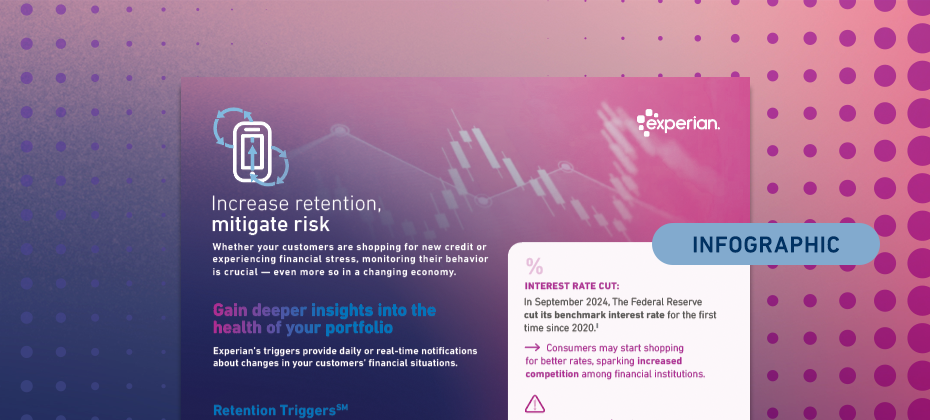
Whether consumers are shopping for new credit or experiencing financial stress, monitoring their behavior is crucial — even more so in an ever-changing economy. Our latest infographic explores economic trends impacting consumers’ financial behaviors and how Experian’s Risk and Retention TriggersSM enable lenders to detect early signs of risk or churn. Key highlights include: Credit card balances climbed to $1.17 trillion in Q3 2024. As prices of goods and services remain elevated, consumers may continue to experience financial stress, potentially leading to higher delinquency rates. Increasing customer retention rates by 5% can boost profits by 25% to 95%. View the infographic to learn how Risk and Retention Triggers can help you advance your portfolio management strategy. Access infographic

The credit card market is rapidly evolving, driven by technological advancements, economic volatility, and changing consumer behaviors. Our new 2025 State of Credit Card Report provides an in-depth analysis of the credit card landscape and strategy considerations for financial institutions. Findings include: Credit card debt reached an all-time high of $1.17 trillion in Q3 2024. About 19 million U.S. households were considered underbanked in 2023. Bot-led fraud attacks doubled from January to June 2024. Read the full report for critical insights and strategies to navigate a shifting market. Access report
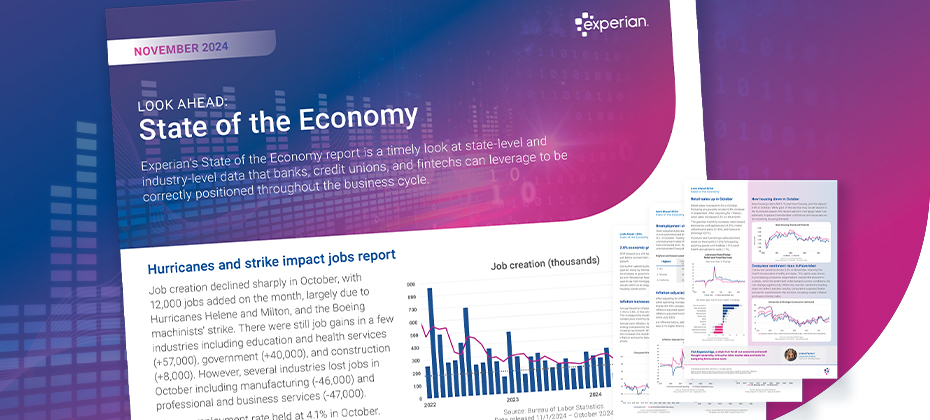
This series will explore our monthly State of the Economy report, which provides a snapshot of the top monthly economic and credit data for financial service professionals to proactively shape their business strategies. The U.S. economy remains on solid footing, as GDP grew at a healthy 2.8% rate in Q3, driven by consumer spending. Alongside growth, inflation ticked up, while the labor market eased across several measures. In response to these developments, the Federal Reserve announced a quarter-point cut in November, with another cut penciled in for December. The November State of the Economy report fills in the rest of the macroeconomic story. This month’s highlights include: Annual headline inflation ticked up from 2.4% to 2.6%. 12,000 jobs were added in October, amid hurricane and strike impacts. Retail sales increased by 0.4% in October. Check out the full report for a detailed analysis of the rest of this month’s data, including the latest trends in originations, job openings, and growth. Download November's report As our economy continues to fluctuate, it’s critical to stay updated on the latest developments. Subscribe to our new series, The Macro Moment, for economic commentary from Experian NA’s Chief Economist, Joseph Mayans, with additional economic resources, including our new Election Eve’s Scenario Forecasts report. For more economic trends and market insights, visit Experian Edge.

We are squarely in the holiday shopping season. From the flurry of promotional emails to the endless shopping lists, there are many to-dos and even more opportunities for financial institutions at this time of year. The holiday shopping season is not just a peak period for consumer spending; it’s also a critical time for financial institutions to strategize, innovate, and drive value. According to the National Retail Federation, U.S. holiday retail sales are projected to approach $1 trillion in 2024, , and with an ever-evolving consumer behavior landscape, financial institutions need actionable strategies to stand out, secure loyalty, and drive growth during this period of heightened spending. Download our playbook: "How to prepare for the Holiday Shopping Season" Here’s how financial institutions can capitalize on the holiday shopping season, including key insights, actionable strategies, and data-backed trends. 1. Understand the holiday shopping landscape Key stats to consider: U.S. consumers spent $210 billion online during the 2022 holiday season, according to Adobe Analytics, marking a 3.5% increase from 2021. Experian data reveals that 31% of all holiday purchases in 2022 occurred in October, highlighting the extended shopping season. Cyber Week accounted for just 8% of total holiday spending, according to Experian’s Holiday Spending Trends and Insights Report, emphasizing the importance of a broad, season-long strategy. What this means for financial institutions: Timing is crucial. Your campaigns are already underway if you get an early start, and it’s critical to sustain them through December. Focus beyond Cyber Week. Develop long-term engagement strategies to capture spending throughout the season. 2. Leverage Gen Z’s growing spending power With an estimated $360 billion in disposable income, according to Bloomberg, Gen Z is a powerful force in the holiday market. This generation values personalized, seamless experiences and is highly active online. Strategies to capture Gen Z: Offer digital-first solutions that enhance the holiday shopping journey, such as interactive portals or AI-powered customer support. Provide loyalty incentives tailored to this demographic, like cash-back rewards or exclusive access to services. Learn more about Gen Z in our State of Gen Z Report. To learn more about all generations' projected consumer spending, read new insights from Experian here, including 45% of Gen X and 52% of Boomers expect their spending to remain consistent with last year. 3. Optimize pre-holiday strategies Portfolio Review: Assess consumer behavior trends and adjust risk models to align with changing economic conditions. Identify opportunities to engage dormant accounts or offer tailored credit lines to existing customers. Actionable tactics: Expand offerings. Position your products and services with promotional campaigns targeting high-value segments. Personalize experiences. Use advanced analytics to segment clients and craft offers that resonate with their holiday needs or anticipate their possible post-holiday needs. 4. Ensure top-of-mind awareness During the holiday shopping season, competition to be the “top of wallet” is fierce. Experian’s data shows that 58% of high spenders shop evenly across the season, while 31% of average spenders do most of their shopping in December. Strategies for success: Early engagement: Launch educational campaigns to empower credit education and identity protection during this period of increased transactions. Loyalty programs: Offer incentives, such as discounts or rewards, that encourage repeat engagement during the season. Omnichannel presence: Utilize digital, email, and event marketing to maintain visibility across platforms. 5. Combat fraud with multi-layered strategies The holiday shopping season sees an increase in fraud, with card testing being the number one attack vector in the U.S. according to Experian’s 2024 Identity and Fraud Study. Fraudulent activity such as identity theft and synthetic IDs can also escalate. Fight tomorrow’s fraud today: Identity verification: Use advanced fraud detection tools, like Experian’s Ascend Fraud Sandbox, to validate accounts in real-time. Monitor dormant accounts: Watch these accounts with caution and assess for potential fraud risk. Strengthen cybersecurity: Implement multi-layered strategies, including behavioral analytics and artificial intelligence (AI), to reduce vulnerabilities. 6. Post-holiday follow-up: retain and manage risk Once the holiday rush is over, the focus shifts to managing potential payment stress and fostering long-term relationships. Post-holiday strategies: Debt monitoring: Keep an eye on debt-to-income and debt-to-limit ratios to identify clients at risk of defaulting. Customer support: Offer tailored assistance programs for clients showing signs of financial stress, preserving goodwill and loyalty. Fraud checks: Watch for first-party fraud and unusual return patterns, which can spike in January. 7. Anticipate consumer trends in the New Year The aftermath of the holidays often reveals deeper insights into consumer health: Rising credit balances: January often sees an uptick in outstanding balances, highlighting the need for proactive credit management. Shifts in spending behavior: According to McKinsey, consumers are increasingly cautious post-holiday, favoring savings and value-based spending. What this means for financial institutions: Align with clients’ needs for financial flexibility. The holiday shopping season is a time that demands precise planning and execution. Financial institutions can maximize their impact during this critical period by starting early, leveraging advanced analytics, and maintaining a strong focus on fraud prevention. And remember, success in the holiday season extends beyond December. Building strong relationships and managing risk ensures a smooth transition into the new year, setting the stage for continued growth. Ready to optimize your strategy? Contact us for tailored recommendations during the holiday season and beyond. Download the Holiday Shopping Season Playbook
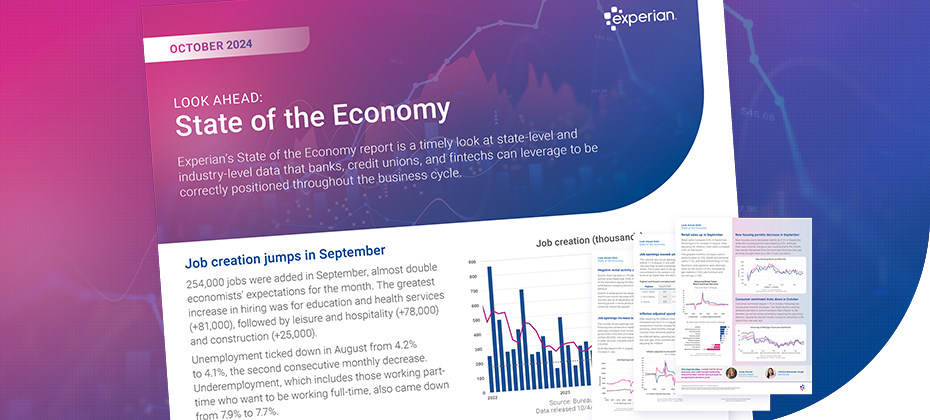
This series will explore our monthly State of the Economy report, which provides a snapshot of the top monthly economic and credit data for financial service professionals to proactively shape their business strategies. After the Federal Reserve announced its first cut since 2020 in September, several pieces of economic data have surpassed expectations. Job creation was almost double economists’ estimates, unemployment ticked down, and personal incomes were revised up. Alongside these areas of strength, inflation continued to prove stubborn. The October State of the Economy report fills in the rest of the developing macroeconomic story. This month’s highlights include: Unemployment decreased for the second month in a row, down to 4.1%. Core inflation increased from 3.2% to 3.3%, driven by shelter and service costs. Negative rental payment activity has declined 1.9% over the past year. Check out our report for a detailed analysis of the rest of this month’s data, including the latest trends in originations, retail sales, and consumer sentiment. Download October's report As our economy continues to fluctuate, it's critical to stay updated on the latest developments. Subscribe to our new series, The Macro Moment, for economic commentary from Experian NA’s Chief Economist, Joseph Mayans, with additional economic resources, including our new Lending Conditions Chartbook and our new Labor Market Monitor. For more economic trends and market insights, visit Experian Edge.
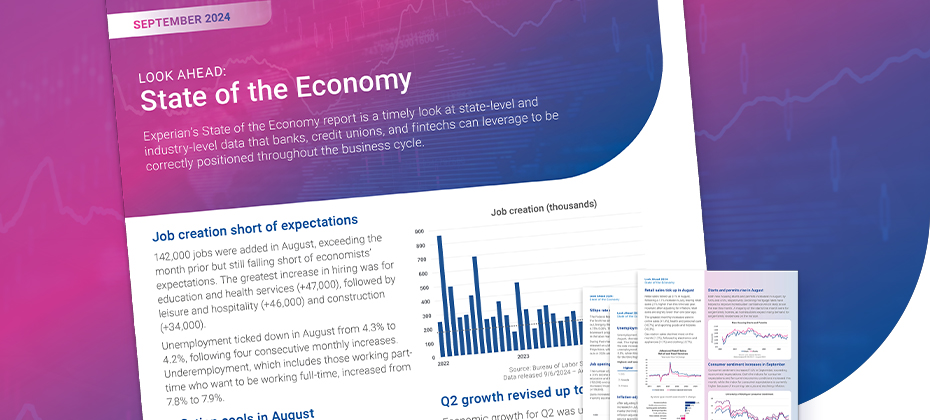
This series will explore our monthly State of the Economy report, which provides a snapshot of the top monthly economic and credit data for financial service professionals to proactively shape their business strategies. During their September meeting, the Federal Reserve made a highly-anticipated announcement to cut rates for the first time since 2020. Fed officials cut rates by 50bps, while also penciling in an additional 50bps of cuts for 2024 and 100bps of cuts in 2025 in their Summary of Economic Projections. While rates are coming down and inflation continues to cool, there were downward revisions to job creation made in August and declining job openings in July. Data highlights from this month’s report include: The Federal Reserve announced a 50bps rate cut during the September meeting. Annual headline inflation cooled from 2.9% to 2.5%, getting closer to the Fed’s 2% goal. Mortgage originations increased 7.0% in August. Check out our report for a deep dive into the rest of this month’s data, including the latest trends in job creation, retail sales, and consumer sentiment. Download September's report As our economy continues to fluctuate, it's critical to stay updated on the latest developments. Subscribe to our new series, The Macro Moment, for economic commentary from Experian North America's Chief Economist, Joseph Mayans, and download our new Lending Conditions Chartbook for additional insights. For more economic trends and market insights, visit Experian Edge.
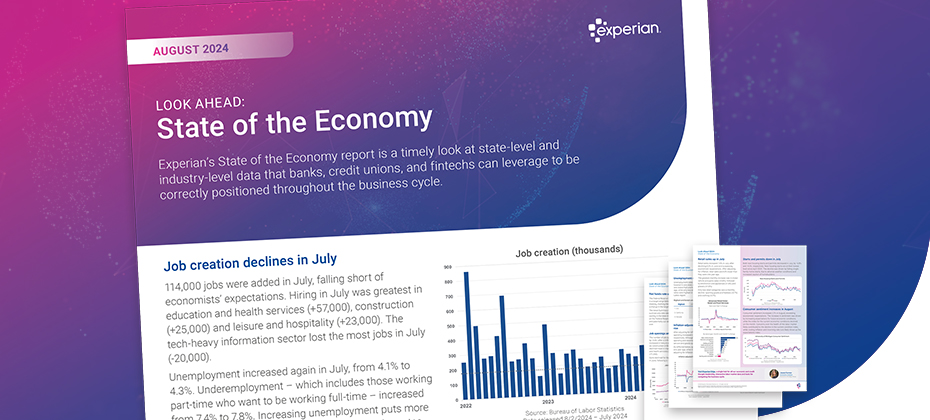
This series will dive into our monthly State of the Economy report, providing a snapshot of the top monthly economic and credit data for those in financial services to proactively shape their business strategies. The labor market has been a source of strength for the U.S. economy coming out of the pandemic, providing workers with stable employment and solid wages. However, the labor market has slowed in recent months, with lower-than-expected job creation and rising unemployment, causing weakening sentiment in the broader market. This has resulted in increased pressure on the Federal Reserve to begin cutting rates and places more importance on the incoming data between now and the September FOMC meeting. Data highlights from this month’s report include: Job creation declined in July, falling short of economists’ expectations. Unemployment increased from 4.1% to 4.3%. Inflation cooled again in July, with annual headline inflation easing from 3.0% to 2.9%. GDP picked up in Q2 to 2.8%, primarily driven by strong consumer spending. Check out our report for a deep dive into the rest of this month’s data, including the latest trends in originations, retail sales, and the new housing market. Download August's report To have a holistic view of our current environment, it’s important to view the economy from different angles and through different lenses. Download our latest macroeconomic forecasting report for our views on what's to come in the U.S. economy and listen to our latest Econ to Action podcast. For more economic trends and market insights, visit Experian Edge.
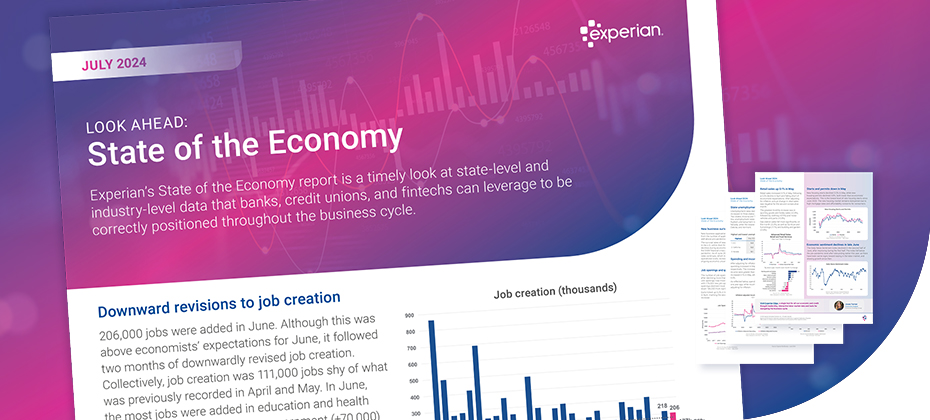
This series will dive into our monthly State of the Economy report, providing a snapshot of the top monthly economic and credit data for those in financial services to proactively shape their business strategies. While much of the economic data released this month remained steady, including continued downward progress in inflation and resilience in inflation-adjusted spending, June was a pivotal month for the labor market. With downward revisions to job creation over the past few months to an up-tick in unemployment, the potential for a sooner-than-expected rate cut increased. Data highlights from this month’s report include: While above economists’ expectations in June, job creation was 111,000 jobs shy of what was recorded in April and May, signaling some slowdown in the labor market. Inflation-adjusted spending and incomes increased in May, by 0.3% and 0.5%, respectively. Inflation eased more than economists expected, with annual headline inflation cooling from 3.3% to 3.0%. Check out our report for a deep dive into the rest of this month’s data, including the latest trends in job openings, new business survival rates, and bankcard delinquency rates. Download July's report To have a holistic view of our current environment, it’s important to view the economy from different angles and through different lenses. Watch our experts discuss the latest economic and credit trends in the next macroeconomic forecasting webinar and listen to our latest Econ to Action podcast. For more economic trends and market insights, visit Experian Edge.
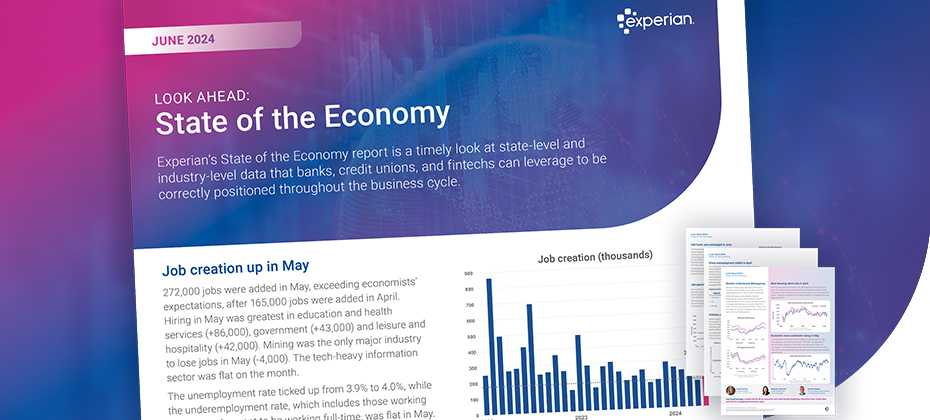
This series will dive into our monthly State of the Economy report, providing a snapshot of the top monthly economic and credit data for those in financial services to proactively shape their business strategies. During their June meeting, the Federal Reserve continued to hold rates steady and released an updated Summary of Economic Projections. In this update, the committee reduced 2024 rate cut projections from three to one and increased their year-end inflation expectations. Both of these updates were likely driven by a lack of downward progress in inflation in Q1. But as the Federal Reserve extends the period of restrictive rates, it places more weight on each monthly economic data release to inform the Fed’s next move. Data highlights from this month’s report include: Job creation exceeded economists’ expectations with 272,000 jobs added in May. Inflation cooled in May, with annual headline inflation down from 3.4% to 3.3% and annual core inflation down from 3.6% to 3.4%. Auto loan amounts decreased in Q1 as inventories continue to stabilize. Check out our report for a deep dive into the rest of this month’s data, including the latest trends in delinquencies, spending, and the new housing market. Download June's report To have a holistic view of our current environment, it’s important to view the economy from different angles and through different lenses. Watch our experts discuss the latest economic and credit trends in the recording of our latest macroeconomic forecasting webinar and listen to our latest Econ to Action podcast. For more economic trends and market insights, visit Experian Edge.
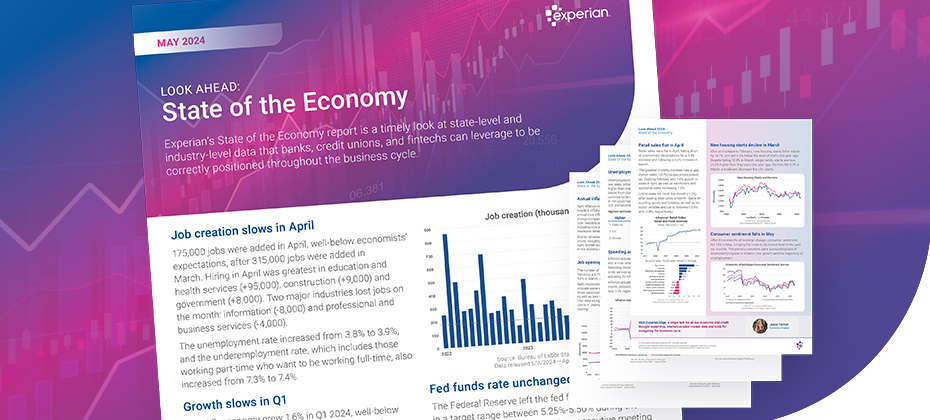
This series will dive into our monthly State of the Economy report, providing a snapshot of the top monthly economic and credit data for those in financial services to proactively shape their business strategies. After again announcing no change in the target fed funds rate during their May meeting, the Federal Reserve continues to face the decision of when to begin cutting rates. The economic data released this month only complicated this decision, as growth came in well-below expectations and the labor market seemed to ease on several fronts. However, there was only minimal downward progress in inflation, especially considering the high prices seen over the past few months. In this month’s report, we dive into the data developments that comprise this economic story. Data highlights from this month’s report include: Economic growth in Q1 came in at 1.6%, under economists’ expectations. Underlying components of consumer spending and business investment remained solid. Inflation cooled in April, with annual headline inflation down from 3.5% to 3.4% and annual core inflation down from 3.8% to 3.6%. Consumer sentiment fell 13% in May, due to stubborn inflation, low growth, and easing in the labor market. Check out our report for a deep dive into the rest of this month’s data, including the latest trends in job creation, spending, and the fed funds rate. Download May's State of the Economy report To have a holistic view of our current environment, it’s important to view the economy from different angles and through different lenses. Watch our team of experts discuss the latest economic and credit trends in the recording of our latest macroeconomic forecasting webinar, download our latest forecast scenario report, or listen to our latest Econ to Action podcast for views on the economic environment in different market segments. For more economic trends and market insights, visit Experian Edge.

“Learn how to learn.” One of Zack Kass’, AI futurist and one of the keynote speakers at Vision 2024, takeaways readily embodies a sentiment most of us share — particularly here at Vision. Jennifer Schulz, CEO of Experian, North America, talked about AI and transformative technologies of past and present as she kicked off Vision 2024, the 40th Vision. Keynote speaker: Dr. Mohamed El-Erian Dr. Mohamed El-Erian, President of Queens’ College, Cambridge and Chief Economic Advisor at Allianz, returned to the Vision stage to discuss the labor market, “sticky” inflation and the health of consumers. He emphasized the need to embrace and learn how to talk to AI engines and that AI can facilitate content, creation, collaboration and community Keynote speaker: Zack Kass Zack Kass, AI futurist and former Head of Go-To-Market at OpenAI, spoke about the future of work and life and artificial general intelligence. He said AI is aiding in our entering of a superlinear trajectory and compared the thresholds of technology versus those of society. Sessions – Day 1 highlights The conference hall was buzzing with conversations, discussions and thought leadership. Some themes definitely rose to the top — the increasing proliferation of fraud and how to combat it without diminishing the customer experience, leveraging AI and transformative technology in decisioning and how Experian is pioneering the GenAI era in finance and technology. Transformative technologiesAI and emerging technologies are reshaping the finance sector and it's the responsibility of today's industry leaders to equip themselves with cutting-edge strategies and a comprehensive understanding to master the rapidly evolving landscape. That said, transformation is a journey and aligning with a partner that's agile and innovative is critical. Holistic fraud decisioningGenerative AI, a resurgence of bank branch transactions, synthetic identity and pig butchering are all fraud trends that today's organizations must be acutely aware of and armed to protect their businesses and customers against. Leveraging a holistic fraud decisioning strategy is important in finding the balance between customer experience and mitigating fraud. Unlocking cashflow to grow, protect and reduce riskCash flow data can be used not only across the lending lifecycle, but also as part of assessing existing portfolio opportunities. Incorporating consumer-permissioned data into models and processes powers predicatbility and can further assess risk and help score more consumers. Navigating the economyAmid a slowing economy, consumers and businesses continue to struggle with higher interest rates, tighter credit conditions and rising delinquencies, creating a challenging environment for lenders. Experian's experts outlined their latest economic forecasts and provided actionable insights into key consumer and commercial credit trends. More insights from Vision to come. Follow @ExperianVision and @ExperianInsights to see more of the action.

In the dynamic consumer credit landscape, understanding emerging trends is paramount for fintechs to thrive. Experian's latest fintech trends report provides deep insights into the evolving market, shedding light on crucial areas such as origination volumes, average loan balances, and delinquency trends. Let's delve into some key findings and their implications for fintech lenders. Fintech lending origination volume trends The report reveals intriguing shifts in origination volumes for unsecured personal loans and credit cards. While overall origination amounts dipped, fintechs experienced a notable decrease, signaling potential challenges in funding availability and economic uncertainties. Despite this, the total origination volume for fintechs remains robust, underlining their continued significance in the market. Fintech market share versus traditional lenders Fintechs, known for their agility and digital prowess, witnessed fluctuations in market share, particularly in the unsecured personal loan segment. While digital loans continue to drive a significant portion of originations, there's a discernible shift in market dynamics, urging fintech lenders to explore diversification strategies, including expanding into credit card offerings. Fintech lending average loan balance trends Amidst changing economic landscapes, average loan balances for both unsecured personal loans and credit cards exhibited intriguing patterns. Fintech lenders, although maintaining a competitive edge in average balances, face the challenge of balancing risk and profitability, especially amidst rising delinquency levels. Fintech lending delinquency trends One of the most critical aspects highlighted in the report is the uptick in delinquency levels for unsecured personal loans and credit cards. While fintechs navigate through economic uncertainties, there's a growing imperative to enhance risk management strategies and focus on prime and above credit tiers to mitigate potential risks. Understanding the digital borrower As digital borrowing continues to gain prominence, it's essential for fintechs to grasp the nuances of the digital borrower. With millennials emerging as key players in the digital lending landscape, fintechs must tailor their offerings to cater to the unique preferences and behaviors of this demographic segment. Looking ahead to 2024 for fintech lenders As we look to the future, data-driven decision-making and strategic portfolio management are more important than ever for fintechs. With economic uncertainties still in the mix, fintechs must leverage data and analytics to fuel growth while safeguarding against potential risks. Experian's fintech trends report serves as a guiding beacon, equipping fintechs with the knowledge and strategies needed to navigate through uncertainties and unlock opportunities for sustainable growth. The report offers actionable insights, including the imperative to conduct periodic portfolio reviews, retool data analytics and models, and remodel lending criteria to stay ahead in the competitive landscape. Learn more about our fintech solutions and how we can work together to drive profitable growth for your company. Learn more Download the report About the report: Experian's Fintech Trends Report 2024 offers a comprehensive analysis of credit trends, leveraging data from January 2019 to November 2023. The report provides valuable insights into the evolving landscape of unsecured personal loans and credit cards, empowering fintechs with actionable intelligence to thrive in a competitive market environment.

Where in the U.S. would you guess first-time homebuyers are having the most success securing a mortgage? The answer may surprise you. While over one-third of first-time homebuyers reside in our most populous states, California, Texas, Florida, and New York, research from Experian Mortgage reveals they are having greater success securing a mortgage in more affordable locations, such as Minnesota, Iowa, and Indiana. Understanding who is buying properties around the nation and what drives their decision provides insight into where they are buying and why. This knowledge paves the way for mortgage lenders to create more targeted and effective marketing strategies to gain trust and win loyal borrowers. As discussed in a recent blog post on generational behaviors, Generation Z (Gen Z) and Generation Y (Gen Y) account for a sizeable majority of first-time homebuyers and nearly half of repeat buyers. Mortgage lenders who understand what motivates these young buyers and meet them where they are will be better positioned to win. Why understanding buyer traits and their motivations matters Nearly 70% of all renters are in their early 40s or younger. With rents up more than 30% since before the COVID-19 pandemic, many Americans yearn for the stability that homeownership brings to their financial well-being. Younger buyers are increasingly focusing on their overall financial health. Experian's survey of more than 2,000 millennial and Gen Z consumers across the United States revealed: ‘Better understanding personal finance’ is a goal for most consumers within both groups. Nearly 70% are actively searching for a trusted source for personal finance information. Over 30% of first-time homebuyers have a household income under $90,000 annually. They want to make decisions that align with their financial goals and position themselves well for the future, which is likely why we are seeing a higher concentration of first-time homebuyers converting in lower cost of living areas, such as the mid-west. Even for a mortgage lender outside of the geographically preferred states, those who understand their areas with minute specificity and know where opportunity and affordability meet will be best positioned for these buyers. Why strategically positioned lenders will win the day Affordability remains the operative word. The housing supply shortage heavily impacts affordability. A lack of new housing construction and limited existing home sale inventory contributed largely to the limited for sale stock. Lower interest rates can influence the affordability outlook, but rising inflation and the Federal Reserve not yet moving to lower rates has resulted in mortgage interest rates creeping upward this year.1 Additionally, overall economic indicators influence the housing market. While the Federal Reserve does not directly dictate mortgage interest rates, mortgage rates are influenced by the actions they take. Federal Reserve Chairman Jerome Powell’s recent remarks that the Fed will not likely lower rates until much later in the year due to inflation signals mortgage rates are unlikely to decrease soon.2 Mortgage lenders who dive into buyer behaviors, geographical nuances, and truly service these potential buyers will benefit. By employing market and buyer savvy strategies that resonate, you can drive both short and longer-term business growth. For more information about the lending possibilities for first-time homebuyers, read our latest white paper and visit us online. Download white paper Learn more 1 “Mortgage Rates Move Toward Seven Percent as Markets Digest Incoming Data,” freddiemac.com 2 “Federal Reserve Issues FOMC Statement,” March 20, 2024, federalreserve.gov
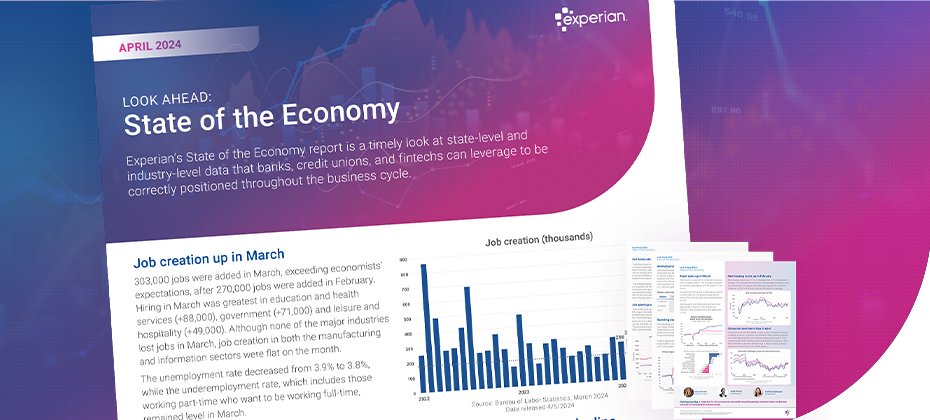
This series will dive into our monthly State of the Economy report, providing a snapshot of the top monthly economic and credit data for those in financial services to proactively shape their business strategies. During their March meeting, the Federal Reserve announced no change in the federal funds rate and released their updated Summary of Economic Projects for the remainder of 2024 and 2025. In response to slow but steady cooling inflation, they maintained projections for three rate cuts by the end of 2024. Additionally, they upgraded their growth projections and lowered their unemployment projections, signaling more optimism toward the U.S. economic trajectory. In this month's report, we dive into the data developments that are contributing to this economic story. Data highlights from this month's report include: The Federal Reserve held rates steady and maintained projections for three rate cuts by the end of the year. Inflation progress slowed, with annual headline inflation flat and annual core inflation ticking up from 3.2% to 3.5%. The median rent-to-income ratio increased 4.1% year-over-year to 37.9% nationally. Check out our report for a deep dive into the rest of April's data, including the latest trends in income, originations, and job creation. To have a holistic view of our current environment, we must understand our economic past, present, and future. Check out our annual chartbook for a comprehensive view of the past year and register for our upcoming macroeconomic forecasting webinar for a look at the year ahead. Download April's State of the Economy report Register for webinar For more economic trends and market insights, visit Experian Edge.

Open banking is revolutionizing the financial services industry by encouraging a shift from a closed model to one with greater transparency, competition, and innovation. But what does this mean for financial institutions, and how can you adapt to this new landscape, balancing opportunity against risk? In this article, we will define open banking, illustrate how it operates, and weigh the challenges and benefits for financial institutions. What is open banking? Open banking stands at the forefront of financial innovation, embodying a shift toward a more inclusive, transparent, and consumer-empowered system. At its core, open banking relies on a simple yet powerful premise: it uses consumer-permissioned data to create a networked banking ecosystem that benefits both financial institutions and consumers alike. By having secure, standardized access to consumer financial data — granted willingly by the customers themselves — lenders can gain incredibly accurate insights into consumer behavior, enabling them to personalize services and offers like never before. How does open banking work? Open banking is driven by Application Programming Interfaces (APIs), which are sets of protocols that allow different software components to communicate with each other and share data seamlessly and securely. In the context of open banking, these APIs enable: Account Information Services (AIS): These services allow third-party providers (TPPs) to access account information from financial institutions (with customer consent) to provide budgeting and financial planning services. Payment Initiation Services (PIS): These services permit TPPs to initiate payments on behalf of customers, often offering alternative, faster, or cheaper payment solutions compared to traditional banking methods. Financial institutions must develop and maintain robust and secure APIs that TPPs can integrate with. This requires significant investment in technology and cybersecurity to protect customer data and financial assets. There must also be clear customer consent procedures and data-sharing agreements between financial institutions and TPPs. Benefits of open banking Open banking is poised to create a wave of innovation in the financial sector. One of the most significant benefits is the ability to gain a more comprehensive view of a consumer’s financial situation. With a deeper view of consumer cashflow data and access to actionable insights, you can improve your underwriting strategy, optimize account management and make smarter decisions to safely grow your portfolio. Additionally, open banking promotes financial inclusion by enabling financial institutions to offer more tailored products that suit the needs of previously underserved or unbanked populations. This inclusivity can help bridge the gap in financial services, making them accessible to a broader segment of the population. Furthermore, open banking fosters competition among financial institutions and fintech companies, leading to the development of better products, services, and competitive pricing. This competitive environment not only benefits consumers but also challenges banks to innovate, improve their services, and operate more efficiently. The collaborative nature of open banking encourages an ecosystem where traditional banks and fintech startups co-create innovative open banking solutions. This synergy can accelerate the pace of digital transformation within the banking sector, leading to the development of cutting-edge technologies and platforms that address specific market gaps or consumer demands. Challenges of open banking While open banking presents a plethora of opportunities, its adoption is not without challenges. Financial institutions must grapple with several hurdles to fully leverage the benefits open banking offers. One of the most significant challenges is fraud detection in banking and ensuring data security and privacy. The sharing of financial data through APIs necessitates robust cybersecurity measures to protect sensitive information from breaches and fraud. Banks and TPPs alike must invest in advanced security technologies and protocols to safeguard customer data. Additionally, regulatory compliance poses a considerable challenge. Open banking regulations vary widely across different jurisdictions, requiring banks to adapt their operations to comply with diverse legal frameworks. Staying abreast of evolving regulations and ensuring compliance can be resource-intensive and complex. Furthermore, customer trust and awareness are crucial to the success of open banking. Many consumers are hesitant to share their financial data due to privacy concerns. Educating customers on the benefits of open banking and the measures taken to ensure their data’s security is essential to overcoming this obstacle. Despite these challenges, the strategic implementation of open banking can unlock remarkable opportunities for innovation, efficiency, and service enhancement in the financial sector. Banks that can successfully navigate these hurdles and capitalize on the advantages of open banking are likely to emerge as leaders in the new era of financial services. Our open banking strategy Our newly introduced open banking solution, Cashflow Attributes, powered by Experian’s proprietary data from millions of U.S. consumers, offers unrivaled categorization and valuable consumer insights. The combination of credit and cashflow data empowers lenders with a deeper understanding of consumers. Furthermore, it harnesses our advanced capabilities to categorize 99% of transaction Demand Deposit Account (DDA) and credit card data, guaranteeing dependable inputs for robust risk assessment, targeted marketing and proactive fraud detection. Watch open banking webinar Learn more about Cashflow Attributes