
Unlocking the Map: Top Destinations for First-time Homebuyers

by Scott Hamlin 3 min read May 16, 2024

Where in the U.S. would you guess first-time homebuyers are having the most success securing a mortgage? The answer may surprise you.

While over one-third of first-time homebuyers reside in our most populous states, California, Texas, Florida, and New York, research from Experian Mortgage reveals they are having greater success securing a mortgage in more affordable locations, such as Minnesota, Iowa, and Indiana.

Understanding who is buying properties around the nation and what drives their decision provides insight into where they are buying and why. This knowledge paves the way for mortgage lenders to create more targeted and effective marketing strategies to gain trust and win loyal borrowers.

As discussed in a recent blog post on generational behaviors, Generation Z (Gen Z) and Generation Y (Gen Y) account for a sizeable majority of first-time homebuyers and nearly half of repeat buyers. Mortgage lenders who understand what motivates these young buyers and meet them where they are will be better positioned to win.

Why understanding buyer traits and their motivations matters

Nearly 70% of all renters are in their early 40s or younger. With rents up more than 30% since before the COVID-19 pandemic, many Americans yearn for the stability that homeownership brings to their financial well-being.

Younger buyers are increasingly focusing on their overall financial health. Experian’s survey of more than 2,000 millennial and Gen Z consumers across the United States revealed:

  • ‘Better understanding personal finance’ is a goal for most consumers within both groups.
  • Nearly 70% are actively searching for a trusted source for personal finance information.

Over 30% of first-time homebuyers have a household income under $90,000 annually. They want to make decisions that align with their financial goals and position themselves well for the future, which is likely why we are seeing a higher concentration of first-time homebuyers converting in lower cost of living areas, such as the mid-west.
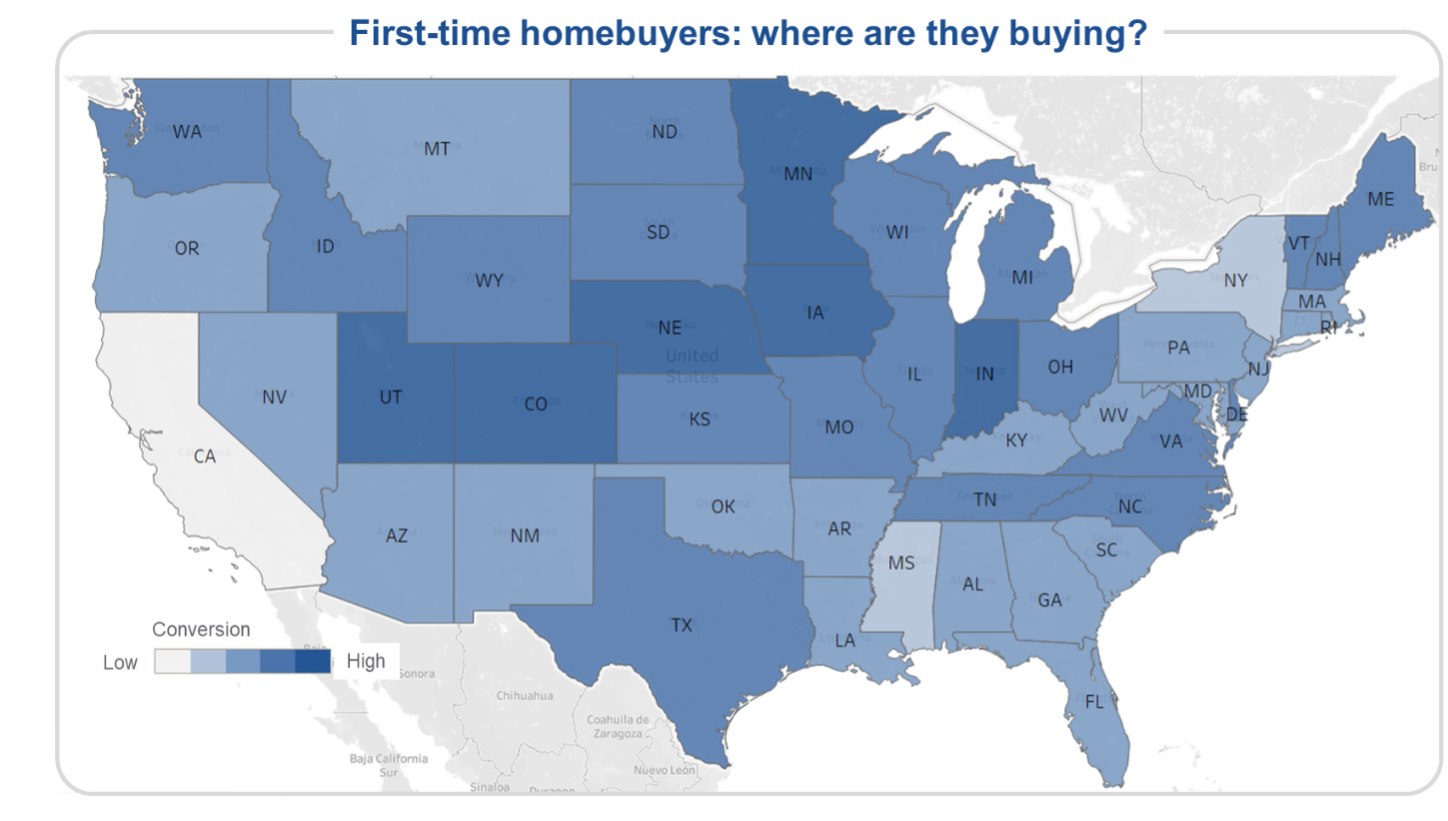
Even for a mortgage lender outside of the geographically preferred states, those who understand their areas with minute specificity and know where opportunity and affordability meet will be best positioned for these buyers.

Why strategically positioned lenders will win the day

Affordability remains the operative word. The housing supply shortage heavily impacts affordability.  A lack of new housing construction and limited existing home sale inventory contributed largely to the limited for sale stock.

Lower interest rates can influence the affordability outlook, but rising inflation and the Federal Reserve not yet moving to lower rates has resulted in mortgage interest rates creeping upward this year.1 Additionally, overall economic indicators influence the housing market. While the Federal Reserve does not directly dictate mortgage interest rates, mortgage rates are influenced by the actions they take. Federal Reserve Chairman Jerome Powell’s recent remarks that the Fed will not likely lower rates until much later in the year due to inflation signals mortgage rates are unlikely to decrease soon.2

Mortgage lenders who dive into buyer behaviors, geographical nuances, and truly service these potential buyers will benefit. By employing market and buyer savvy strategies that resonate, you can drive both short and longer-term business growth.

For more information about the lending possibilities for first-time homebuyers, read our latest white paper and visit us online.

Download white paper Learn more

1 “Mortgage Rates Move Toward Seven Percent as Markets Digest Incoming Data,” freddiemac.com

2 “Federal Reserve Issues FOMC Statement,” March 20, 2024, federalreserve.gov

Related Posts

Customer Spotlight: How Matrix Rental Solutions Strengthens Trust in Affordable Housing

Learn how Matrix continues to deliver a secure, trusted rental experience as fraud tactics evolve. Read more!

July 31, 2026 by Laura Burrows
What Is AI Decisioning?

Every business makes decisions about people and transactions all day long. Should we approve this loan? Is this purchase fraud? Which customer should get this offer, and what should it be? For a long time, those decisions were made in one of two ways: a person reviewed each case by hand, or the company wrote fixed rules, like "approve anyone with a credit score above 700." Both work. Both also leave value on the table. The manual review is slow and hard to scale. The fixed rule can turn away good applicants and is slow to adapt when the market shifts. AI decisioning is a third way. What makes AI decisioning work Instead of relying on a single reviewer or a rigid rule, automated decisioning uses models that learn from data — studying how thousands of past cases turned out, finding the patterns that predict an outcome, and applying them to each new decision, often in real time. The result is faster, more consistent decisions. But a model on its own isn't the whole story. Getting real value from AI decisioning takes good data to learn from, AI analytics to generate insights, the tools to act on it and the governance to keep it compliant. What we've found is that the pieces only pay off when they work together, and that is where we're built differently. A model is only as good as what it learns from, and we pair your data with one of the deepest views of consumer and commercial credit: decades of full-file history and vetted attributes. Then we give you the tools to act on it. Use cases across your business Whether you're trying to grow your customer base, reduce fraud, manage lending risk, or improve collections, automated decisioning brings all the pieces together to make more accurate, consistent and explainable decisions at scale. Fraud and Identity A fraudulent transaction that slips through costs money and erodes trust. Rules are static, and fraudsters move fast. They'll probe boundaries, find the blind spots and move to the next scheme. By the time the rules are updated, they're already three steps ahead. How AI decisioning changes this: AI fraud detection with real-time risk scoring and decisioning across transactions and customer interactions Intelligence that continuously learns from results to help adapt fraud strategies as threats evolve Reduced false positives and less friction for customers at account opening and checkout Identity verification tools that confirm someone is who they say they are without slowing down the experience Credit and Lending Loan approval is where the relationship begins. Credit risk decisioning helps lenders find that delicate balance between approving enough people to grow, but carefully enough to manage risk. Missing that balance means turning away good customers or taking on losses that are difficult to absorb. How AI decisioning changes this: Increased approval opportunities for creditworthy applicants without increasing overall risk Models you can update and deploy quickly as market conditions change, rather than waiting months Ability to run "what-if" scenarios to test how a new strategy would have performed on your historical data before putting it live Collections Which customer should your team reach out to today? Through which channel? What kind of message? If you reach out too aggressively, you push someone who might have recovered into default. If you wait too long, you lose them. If you call someone at work, they resent you; if you text, they might ignore it. If you offer a payment plan, they might accept it, but only if the terms make sense to their financial situation. How AI decisioning changes this: Optimized next-best-action and contact-channel strategies for each individual customer Improved recovery potential through better targeting Less time spent on accounts with a lower propensity to pay, freeing your team for higher-impact cases Ability to segment and test new strategies before rollout Customer Acqusition Finding the right customers is about reaching the right people with the right offer at the right time. To stay competitive, it’s now a requirement to balance growth with risk while creating a seamless experience converting prospects into customers. How AI decisioning changes this: More precise prospect targeting using credit, behavioral, and alternative data, where permitted, to identify consumers most likely to respond Personalized offers delivered in real time Dynamic decision strategies that can be updated quickly as market conditions and customer behavior change Ongoing testing and optimization of acquisition strategies to improve campaign performance and support customer lifetime value Driving results with AI decisioning Every customer interaction is a decision. Businesses that can adapt quickly will be better positioned to grow, manage risk, and deliver the experiences customers expect. The technology will continue to evolve, but the goal remains the same: making informed decisions that balance business objectives, risk, and customer experience. Learn more about our decisioning software

July 27, 2026 by Zohreen Ismail
Why Innovation Matters for Members First Credit Union

Learn how Members First Credit Union uses innovation and data-driven insights to better serve members and expand financial opportunity.

July 24, 2026 by Scarlet Nickel

Subscribe to our Newsletter

Enter your name and email for the latest updates.

This site is protected by reCAPTCHA and the Google Privacy Policy and Terms of Service apply.

Subscribe to our Newsletter

Don't miss out on the latest industry trends and insights!
Subscribe