Fintech

“The White House FinTech Summit” – the intent was to promote a discussion, on what could be done better to progress innovation in financial services,

Definition of first-party versus third-party fraud trends and shared actual case study of a first-party fraud scheme.

James W. Paulsen, Chief Investment Strategist for Wells Capital Management, kicked off the second day of Experian’s Vision 2016, sharing his perspective on the state of the economy and what the future holds for consumers and businesses alike. Paulsen joked this has been “the most successful, disappointing recovery we’ve ever had.” While media and lenders project fear for a coming recession, Paulsen stated it is important to note we are in the 8th year of recovery in the U.S., the third longest in U.S. history, with all signs pointing to this recovery extending for years to come. Based on his indicators – leverage, restored household strength, housing, capital spending and better global growth – there is still capacity to grow. He places recession risk at 20 to 25 percent – and only quotes those numbers due the length of the recovery thus far. “What is the fascination with crisis policies when there is no crisis,” asks Paulsen. “I think we have a good chance of being in the longest recovery in U.S. history.” Other noteworthy topics of the day: Fraud prevention Fraud prevention continues to be a hot topic at this year’s conference. Whether it’s looking at current fraud challenges, such as call-center fraud, or looking to future-proof an organization’s fraud prevention techniques, the need for flexible and innovative strategies is clear. With fraudsters being quick, and regularly ahead of the technology fighting them, the need to easily implement new tools is fundamental for you to protect your businesses and customers. More on Regulatory The Military Lending Act has been enhanced over the past year to strengthen protections for military consumers, and lenders must be ready to meet updated regulations by fall 2016. With 1.46 million active personnel in the U.S., all lenders are working to update processes and documentation associated with how they serve this audience. Alternative Data What is it? How can it be used? And most importantly, can this data predict a consumer’s credit worthiness? Experian is an advocate for getting more entities to report different types of credit data including utility payments, mobile phone data, rental payments and cable payments. Additionally, alternative data can be sourced from prepaid data, liquid assets, full file public records, DDA data, bill payment, check cashing, education data, payroll data and subscription data. Collectively, lenders desire to assess someone’s stability, ability to pay and willingness to repay. If alternative data can answer those questions, it should be considered in order to score more of the U.S. population. Financial Health The Center for Financial Services Innovation revealed insights into the state of American’s financial health. According to a study they conducted, 57 percent of Americans are not financially healthy, which equates to about 138 million people. As they continue to place more metrics around defining financial health, the center has landed on four components: how people plan, spend, save and borrow. And if you think income is a primary factor, think again. One-third of Americans making more than $60k a year are not healthy, while one-third making less than $60k a year are healthy. --- Final Vision 2016 breakouts, as well as a keynote from entertainer Jay Leno, will be delivered on Wednesday.
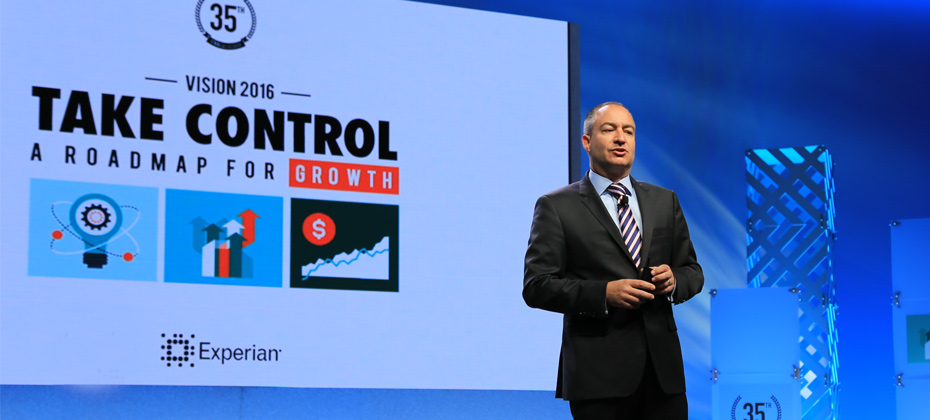
It’s impossible to capture all of the insights and learnings of 36 breakout sessions and several keynote addresses in one post, but let’s summarize a few of the highlights from the first day of Vision 2016. 1. Who better to speak about the state of our country, specifically some of the threats we are facing than Leon Panetta, former Secretary of Defense and Director of the CIA. While we are at a critical crossroads in the United States, there is room for optimism and his hope that we can be an America in Renaissance. 2. Alex Lintner, Experian President of Consumer Information Services, conveyed how the consumer world has evolved, in large part due to technology: 67 percent of consumers made purchases across multiple channels in the last six months. More than 88M U.S. consumers use their smartphone to do some form of banking. 68 percent of Millennials believe within five years the way we access money will be totally different. 3. Peter Renton of Lend Academy spoke on the future of Online Marketplace Lending, revealing: Banks are recognizing that this industry provides them with a great opportunity and many are partnering with Online Marketplace Lenders to enter the space. Millennials are not the largest consumers in this space today, but they will be in the future. Sustained growth will be key for this industry. The largest platforms have everything they need in place to endure – even through an economic downturn.In other words, Online Marketplace Lenders are here to stay. 4. Tom King, Experian’s Chief Information Security Officer, addressed the crowds on how the world of information security is growing increasingly complex. There are 1.9 million records compromised every day, and sadly that number is expected to rise. What can businesses do? “We need to make it easier to make the bad guys go somewhere else,” says King. 5. Look at how the housing market has changed from just a few years ago: Inventory continues to be extraordinarily lean. Why? New home building continues to run at recession levels. And, 8.5 percent of homeowners are still underwater on their mortgage, preventing them from placing it on the market. In the world of single-family home originations, 2016 projections show that there will be more purchases, less refinancing and less volume. We may see further growth in HELOC’s. With a dwindling number of mortgages benefiting from refinancing, and with rising interest rates, a HELOC may potentially be the cheapest and easiest way to tap equity. 6. As organizations balance business needs with increasing fraud threats, the important thing to remember is that the customer experience will trump everything else. Top fraud threats in 2015 included: Card Not Present (CNP) First Party Fraud/Synthetic ID Application Fraud Mobile Payment/Deposit Fraud Cross-Channel FraudSo what do the experts believe is essential to fraud prevention in the future? Big Data with smart analytics. 7. The need for Identity Relationship Management can be seen by the dichotomy of “99 percent of companies think having a clear picture of their customers is important for their business; yet only 24 percent actually think they achieve this ideal.” Connecting identities throughout the customer lifecycle is critical to bridging this gap. 8. New technologies continue to bring new challenges to fraud prevention. We’ve seen that post-EMV fraud is moving “upstream” as fraudsters: Apply for new credit cards using stolen ID’s. Provision stolen cards into mobile wallet. Gain access to accounts to make purchases.Then, fraudsters are open to use these new cards everywhere. 9. Several speakers addressed the ever-changing regulatory environment. The Telephone Consumer Protection Act (TCPA) litigation is up 30 percent since the last year. Regulators are increasingly taking notice of Online Marketplace Lenders. It’s critical to consider regulatory requirements when building risk models and implementing business policies. 10. Hispanics and Millennials are a force to be reckoned with, so pay attention: Millennials will be 81 million strong by 2036, and Hispanics are projected to be 133 million strong by 2050. Significant factors for home purchase likelihood for both groups include VantageScore® credit score, age, student debt, credit card debt, auto loans, income, marital status and housing prices. More great insights from Vision coming your way tomorrow!

Four Experian employees reflect on financial lessons and challenges learned during their time served in the military.

Credit invisibles often want access to credit, but are not easily scored via tradition credit models, and thus fall through the cracks. So how can lenders grow this population?

The numbers are staggering: more than $1.2 trillion in outstanding student loan debt, 40 million borrowers, and an average balance of $29,000. In fact, a recent Experian study revealed consumer debt is decreasing in every major consumer lending category with the exception of student loans. Student loans have increased by 84 percent since the recession (from 2008 to 2014) and surpassed home equity loans, home-equity lines of credit (HELOC), credit card debt and automotive debt. While the student loan issue has been looming for years, the magnitude is now taking center stage with each 2016 presidential candidate weighing in on solutions. In an effort to provide deeper insights into the student debt universe, Experian’s Kelley Motley and Holly Deason will share a new analysis at Vision 2016 in a session titled, Get educated – a study in the student lending marketplace. They will be joined by Gordon Cameron, executive vice president of PNC. Among the findings they will share include a snapshot of consumers with student loans from three time periods – Pre-recession (December 2007), Recession (December 2009) and Post-Recession/Current (December 2015). At each of these time periods, they will reveal trends around outstanding debt, delinquencies, originations, and also a compare how consumers with student loans rank when it comes to Vantage Score distribution. Finally, their data will explore opportunities for consolidation, showing segments that might be best suited for receiving offers from financial institutions based on Vantage Score, debt and total number of trades. Click here to learn more about Vision 2016 and the session on student loans.

Whether its new regulations and enforcement actions from the Consumer Financial Protection Bureau or emerging legislation in Congress, the public policy environment for consumer and commercial credit is dynamic and increasingly complex. If you are interested to learn more about how to navigate an increasingly choppy regulatory environment, consider joining a breakout session at Experian’s Vision 2016 Conference that I will be moderating. I’ll be joined by several experts and practitioners, including: John Bottega, Enterprise Data Management Conor French, Funding Circle Troy Dennis, TD Bank Don Taylor, President, Automated Collection Services During our session, you’ll learn about some of the most trying regulatory issues confronting the consumer and commercial credit ecosystem. Most importantly, the session will look at how to turn potential challenges into opportunities. This includes learning how to incorporate new alternative data sets into credit scoring models while still ensuring compliance with existing fair lending laws. We’ll also take a deep dive into some of the coming changes to debt collection practices as a result of the CFPB’s highly anticipated rulemaking. Finally, the panel will take a close look at the challenges of online marketplace lenders and some of the mounting regulations facing small business lenders. Learn more about Vision 2016 and how to register for the May conference.

Ensuring the quality of reported consumer credit data is a top priority for regulators, credit bureaus and consumers, and has increasingly become a frequent headline in press outlets when consumers find their data is not accurate. Think of any big financial milestone moment – securing a mortgage loan, auto loan, student loan, obtaining low-interest rate interest credit cards or even getting a job. These important transactions can all be derailed with an unfavorable and inaccurate credit report, causing consumers to hit social media, the press and regulatory entities to vent it out. Add in the laws and increased scrutiny from the Consumer Financial Protection Bureau (CFPB), and Federal Trade Commission (FTC) and it is clear data furnishers are seeking ways to manage their data in more effective ways. At Vision 2016, I am hosting a session, Achievements in data reporting accuracy – maximizing data quality across your organization, with several panel guests willing to share their journeys and learnings attached to the topic of data accuracy. Our diverse panel features leaders from varying industries: Jodi Cook, DriveTime Alissa Hess, USAA Bank Tom Danchik, Citi Julie Moroschan, Experian Each will speak to how they’ve overcome challenges to introduce a data quality program into their respective organizations, as well as best practices around assessing, monitoring and correcting credit reporting issues. One speaker will even touch on the challenging topic of securing funding for a data quality program, considering budgets are most often allocated to strategies, products and marketing directly tied to driving revenue. All lenders are advised to maintain a full 360-degree view of data reporting, from raw data submissions to the consumer credit profile. Better data input equals fewer inaccuracies, and an overarching data integrity program, can deliver a comprehensive view that satisfies regulators, improves the customer experience and provides better insight for internal decision making. To learn more about implementing a data quality plan for your organization, check out Vision 2016.

April is Financial Literacy Month, a special window of time dedicated to educating Americans about money management. But as stats and studies reveal, financial education is always needed.

Whether it is an online marketplace lender offering to refinance the student loan debt of a recent college graduate or an online small-business lender providing an entrepreneur with a loan when no one else will, there is no doubt innovation in the online lending sector is changing how Americans gain access to credit. This expanding market segment takes great pride in using “next-generation” underwriting and credit scoring risk models. In particular, many online lenders are incorporating noncredit information such as income, education history (i.e., type of degree and college), professional licenses and consumer-supplied information in an effort to strike the right balance between properly assessing credit risk and serving consumers typically shunned by traditional lenders because of a thin credit history. Regulatory concerns The exponential growth of the online lending sector has caught the attention of regulators — such as the U.S. Treasury Department, the Federal Deposit Insurance Corporation, Congress and the California Business Development Office — who are interested in learning more about how online marketplace lenders are assessing the credit risk of consumers and small businesses. At least one official, Antonio Weiss, a counselor to the Treasury secretary, has publicly raised concerns about the use of so-called nontraditional data in the underwriting process, particularly data gleaned from social media accounts. Weiss said that “just because a credit decision is made by an algorithm, doesn’t mean it is fair,” citing the need for lenders to be aware of compliance with fair lending obligations when integrating nontraditional credit data. Innovative and “tried and true” are not mutually exclusive Some have suggested the only way to assuage regulatory concerns and control risk is by using tried-and-true legacy credit risk models. The fact is, however, online marketplace lenders can — and should — continue to push the envelope on innovative underwriting and business models, so long as these models properly gauge credit risk and ensure compliance with fair lending rules. It’s not a simple either-or scenario. Lenders always must ensure their scoring analytics are based upon predictive and accurate data. That’s why lenders historically have relied on credit history, which is based upon data consumers can dispute using their rights under the Fair Credit Reporting Act. Statistically sound and validated scores protect consumers from discrimination and lenders from disparate impact claims under the Equal Credit Opportunity Act. The Office of the Comptroller of the Currency guidance on model risk management is an example of regulators’ focus on holding responsible the entities they oversee for the validation, testing and accuracy of their models. Marketplace lenders who want to push the limit can look to credit scoring models now being used in the marketplace without negatively impacting credit quality or raising fair lending risk. For example, VantageScore® allows for the scoring of 30 million to 35 million more people who currently are unscoreable under legacy credit score models. The VantageScore® credit score does this by using a broader, deeper set of credit file data and more advanced modeling techniques. This allows the VantageScore® credit score model to capture unique consumer behaviors more accurately. In conclusion, online marketplace lenders should continue innovating with their own “secret sauce” and custom decisioning systems that may include a mix of noncredit factors. But they also can stay ahead of the curve by relying on innovative “tried-and-true” credit score models like the VantageScore® credit score model. These models incorporate the best of both worlds by leaning on innovative scoring analytics that are more inclusive, while providing marketplace lenders with assurances the decisioning is both statistically sound and compliant with fair lending laws. VantageScore® is a registered trademark of VantageScore Solutions, LLC.

It’s hard to remember a world without online lenders. Today, fintech players continue to pop up, making it easier to cross-shop loans and land instant approvals. Gone are the days of lengthy applications and waiting to hear if you’ve scored the latest credit line or personal loan. Consumers, especially with top-tier credit, can easily seek lower monthly payments or consolidate another loan with a cash-out option. Whatever the need, there’s a lender ready to serve. Strike that. There’s actually two or three lenders waiting to serve you. In fact, a recent Experian data pull revealed an increasing share of personal loan balances is actually going to lenders outside of the traditional banks and credit union space (they still own the lion’s share of the business). In 2013 (Q4), these more non-traditional lenders had 15.36 percent of personal loan balances. In Q4 of 2015, that number increased to 27.26 percent. The personal loan business today is just over $222.9 billion in outstanding balances. As the competition heats up, lenders will need to diversify, stand out and provide more value to consumers. Those that engage with new, value-added services, and deliver timely, personalized needs-based messages will capture the greatest share of the market. Here is a sampling of ways to draw consumers in and deliver the value they seek in a financial institution: Be Transparent Lending Club, one of the original peer-to-peer lenders and currently the biggest in terms of dollars funded, continues to grow by providing consumers and investors with transparency, good loan terms and speed. Prosper, on the other hand, recently acquired an app that allows their customers to track spending, budget and monitor their credit. They plan to leverage this technology in the near future and offer it to customers and investors for free. Research reveals Millennials especially are looking to tech and free services to manage their personal finances. A recent Experian survey focused on Millennials and credit revealed 48 percent have used free financial services, like Mint, to manage their finances. Additionally, 57 percent use on average three financial apps. Know Your Customers Payoff uses survey data to segment their customers into roughly 10 financial personalities based on how they use and think about their debt. These personality types are used to tailor marketing messages and customer service conversations about how to improve their financial situation. Their site features a quiz, Discover the Secrets of Your Financial Personality, helping consumers and Payoff understand more about trends attached to spending, saving and managing money. Offer Solutions for Debt Consolidation Even after consumers consolidate debt and pay it off successfully, unforeseen expenses, unexpected life events, evolving spending habits and the increasing cost-of-living expenses mean there will always be a market for debt consolidation solutions. Understanding consolidation credit account behavior is mandatory for lenders looking to stand out and stay ahead of the consolidation needs of consumers. Having visibility to consumers’ interest rates, revolving loan balances and the remaining months on existing loans provides unique ways to segment and engage clients with need-based offers. Consumer-tailored messages during the prospecting, acquisition and account management stages of the relationship sets the stage for repeat business. The research is clear. Individuals are willing to switch brands if they feel a different provider will better meet their needs. Lenders – in both the traditional and fintech spaces – should not expect many chances when it comes to getting it right with consumers. Fail to keep them engaged and you’ll fail to keep them. Period. Learn more about identifying profitable consolidation candidates, check out Experian’s annual Vision Conference in May.

Time to dust off those compliance plans and ensure you are prepared for the new regulations, specifically surrounding the Military Lending Act (MLA). Last July, the Department of Defense (DOD) published a Final Rule to amend its regulation implementing the Military Lending Act, significantly expanding the scope of the existing protections. The new, beefed-up version encompasses new types of creditors and credit products, including credit cards. While the DOD was responsible for implementing the rule, enforcement will be led by the Consumer Financial Protection Bureau (CFPB). The new rule became effective on October 1, 2015, and compliance is required by October 3, 2016. Compliance, however, with the rules for credit cards is delayed until October 3, 2017. While there is no formal guidance yet on what federal regulators will look for in reviewing MLA compliance, there are some insights on the law and what’s coming. Why was MLA enacted? It was created to provide service members and their dependents with specific protections. As initially implemented in 2007, the law: Limited the APR (including fees) for covered products to 36 percent; Required military-specific disclosures, and; Prohibited creditors from requiring a service member to submit to arbitration in the event of a dispute. It initially applied to three narrowly-defined “consumer credit” products: Closed-end payday loans; Closed-end auto title loans; and Closed-end tax refund anticipation loans. What are the latest regulations being applied to the original MLA implemented in 2007? The new rule expands the definition of “consumer credit” covered by the regulation to more closely align with the definition of credit in the Truth in Lending Act and Regulation Z. This means MLA now covers a wide range of credit transactions, but it does not apply to residential mortgages and credit secured by personal property, such as vehicle purchase loans. One of the most significant changes is the addition of fees paid “for a credit-related ancillary product sold in connection with the credit transaction.” Although the MAPR limit is 36 percent, ancillary product fees can add up and — especially for accounts that carry a low balance — can quickly exceed the MAPR limit. The final rule also includes a “safe harbor” from liability for lenders who verify the MLA status of a consumer. Under the new DOD rule, lenders will have to check each credit applicant to confirm that they are not a service member, spouse, or the dependent of a service member, through a nationwide CRA or the DOD’s own database, known as the DMDC. The rule also permits the consumer report to be obtained from a reseller that obtains such a report from a nationwide consumer reporting agency. MLA status for dependents under the age of 18 must be verified directly with the DMDC. Experian will be permitted to gain access to the DMDC data to provide lenders a seamless transaction. In essence, lenders will be able to pull an Experian profile, and MLA status will be flagged. What is happening between now and October 2016, when lenders must be compliant? Experian, along with the other national credit bureaus, have been meeting with the DOD and the DMDC to discuss providing the three national bureaus access to its MLA database. Key parties, such as the Financial Services Roundtable and the American Bankers Association, are also working to ease implementation of the safe harbor check for banks and lenders. The end goal is to enable lenders the ability to instantly verify whether an applicant is covered by MLA by the Oct. 1, 2016 compliance date. --- If you have inquiries about the new Military Lending Act regulations, feel free to email MLA.Support@experian.com or contact your Experian Account Executive directly. Next Article: A check-in on the latest Military Lending Act news

For lenders, credit bureau data is vitally important in making informed risk determinations for consumer and small business loans. And the backbone of this data is credit reporting. With the rise of online marketplace lenders, there is a renewed focus on reporting credit data, particularly in light of the rapid growth of this sector. According to Morgan Stanley research, online marketplace loan volumes in the U.S. have doubled every year since 2010, reaching $12 billion in 2014. It is predicted this growth will nearly double by 2020. As more consumers and small businesses flock to online marketplace lenders, these lenders have a growing responsibility to be good stewards of the credit ecosystem, doing their part to support the value of information available for the entire industry – and for their own benefit. After all, failure to report credit data could have an adverse impact on the financial landscape, affecting consumers, small businesses and online lenders themselves. While there are already several online lenders currently reporting credit data, there is still a significant number of the marketplace that do not. So why specifically should marketplace lenders report? 1. Stay One Step Ahead of Regulators. It’s true data reporting is currently voluntary for marketplace lenders. But the Consumer Financial Protection Bureau’s (CFPB) recent activities reflect a growing focus by regulators to advocate for and protect consumers. Voluntary data reporting reflects the spirit of transparency and aligns with many regulatory priorities. By taking proactive steps and reporting data on their own, online lenders can stay one step ahead of regulators, hopefully alleviating the need for new regulations. 2. Gain a Competitive Advantage in the Long Run. Sure, data reporting is about “doing the right thing” for consumers, but it can be good for business too. Online marketplace lenders can gain distinct advantages by reporting. For example, with access to more accurate consumer information, lenders are able to develop and offer more competitive products tailored to the unique needs of their customers. By expanding their offerings, online lenders can differentiate themselves and thereby grow market share. Reporting also enables lenders to emphasize their commitment to consumers as part of their value proposition, demonstrating how they are helping to grow customer credit. Reporting rewards customers with good payment history, allowing them to take advantage of better loan rates and lower fees available to those with exemplary credit scores. This in turn can lead to higher customer satisfaction, loyalty and return business. With access to more complete and comprehensive consumer credit data, online lenders gain a clearer picture of a consumer’s credit worthiness, enabling them to make more informed, and less risky, lending decisions. Reporting also encourages on-time payments. When customers know that lenders report, they are more likely to pay on-time and less likely to default on their debt. 3. Have You Heard of the “Millennials?” Millennials, and their passion for all things Internet-enabled, are the perfect match for online marketplace lenders. In fact, the latest research from Experian reveals 47 percent of millennials expect to use alternative finance sources in the near future. And 57 percent reported they are willing to use alternative companies and services that innovate to meet their needs. Millennials are clearly more open to nontraditional banking, but at the same time have a greater expectation of transparency, making it all the more important for online marketplace lenders to report credit data. 4. Achieve Data Quality. Complying with Fair Credit Reporting Act (FCRA) data furnishing requirements might seem daunting for marketplace lenders, but there are tools and solutions available to help lenders proactively assess the accuracy of credit data and help identify systemic issues. Marketplace lenders can measure and monitor quality and completeness, dispute metrics, as well as industry and peer-benchmarking data. 5. Qualify More Consumers. With reporting, marketplace lenders can gain access to an invaluable wealth of information that goes well beyond the traditional credit score. Armed with robust analytics, online lenders are in a position to qualify more consumers and small businesses, which creates a significant opportunity to gain long-term customers by improving the overall customer experience. --- Reporting really is a win for marketplace lenders and consumers. In the end, it will contribute to a healthy credit ecosystem and ensure lending decisions are based on the highest quality of information available. For more information about data reporting, including how to start, visit www.experian.com/datareporting. Learn more about data reporting, or about our Online Marketplace Lending track, at Experian's annual Vision Conference in May.

Accuracy matters. It matters in dart throwing, math calculations, and now more than ever, in data reporting. The Consumer Financial Protection Bureau (CFPB) issued a bulletin on Feb. 3 warning banks and credit unions that if they fail to meet accuracy obligations when reporting negative account histories to credit reporting companies, the result could be bureau action. As noted in the Fair Credit Reporting Act (FCRA) section 623, data furnishers have an obligation to ensure the accuracy of the information furnished to a Credit Reporting Agency (CRA). Violation of these rules presents a variety of risks, and the regulatory agencies have enforced harsh consequences. Avoiding penalties is certainly a strong incentive for data furnishers to implement a formal compliance management system and data quality program. But there are additional benefits to ensuring accuracy – most notably keeping customers happy and loyal, and maintaining a reputable brand in the marketplace. Today’s consumers increasingly understand the impact of credit scoring and data reporting, and recognize a poor credit score can impact their lives in major ways. Credit is tied to so many milestone financial moments. Securing mortgage loans, auto loans, obtaining low-interest rate interest credit cards and securing private student loans can all be derailed with an unfavorable and inaccurate credit report. Not to mention credit reports can influence one’s eligibility for rental housing, setting premiums for auto and homeowners insurance in some states, or determining whether to hire an applicant for a job. To properly serve customers who simply expect a fair and accurate representation of their financial history, data furnishers must be able to guarantee the credibility of their reported data. Those organizations that cannot ensure accuracy put their reputation at risk and may lose a customer’s trust and business. “Consumers should not be sidelined out of the basic banking services they need because of the flaws and limitations in a murky system,” Cordray said in the bulletin. “People deserve to have more options for access to lower-risk deposit accounts that can better fit their needs.” The CFPB has handled more than 105,000 credit-reporting complaints in its short history, making credit reporting the third most-complained-about consumer issue. By far the most common types of credit-reporting issues identified by consumers is incorrect information on credit report (77 percent).* Certainly these mistakes are not made intentionally. But speak to a consumer battling an inaccuracy, especially someone in the midst of applying for credit for a specific need, and frustrations can soar quickly. All lenders are advised to maintain a full 360-degree view of data reporting, from raw data submissions to the consumer credit profile. Better data input equals fewer inaccuracies. Additionally, there are comprehensive reporting solutions available to assess the accuracy of consumer credit data. The regulatory environment will without a doubt continue to be a hot topic in the media, fueled by announcements such as these by the CFPB, so lenders should take note and identify processes to ensure complete and utter accuracy. It matters in so many ways, so it’s best to make data reporting a priority now, if it’s not already. Source: CFPB August 2015 Monthly Complaint Report