Fintech
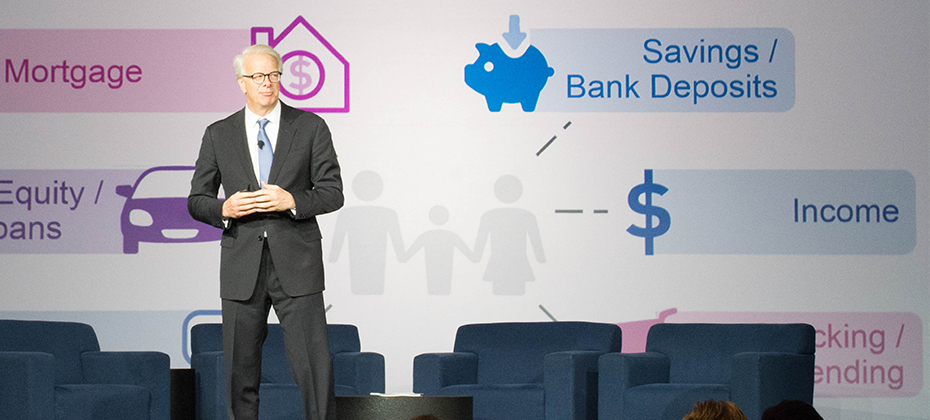
So many insights and learnings to report after the first full day of 2017 Vision sessions. From the musings shared by tech engineer and pioneer Steve Wozniak, to a panel of technology thought leaders, to countless breakout sessions on a wide array of business topics … here’s a look at our top 10 from the day. A mortgage process for the digital age. At last. In his opening remarks, Experian President of Credit Services Alex Lintner asked the audience to imagine a world when applying for a mortgage simply required a few clicks or swipes. Instead of being sent home to collect a hundred pieces of paper to verify employment, income and assets, a consumer could click on a link and provide a few credentials to verify everything digitally. Finally, lenders can make this a reality, and soon it will be the only way consumers expect to go through the mortgage process. The global and U.S. economies are stable. In fact, they are strong. As Experian Vice President of Analytics Michele Raneri notes, “the fundamentals and technicals look really solid across the countries.” While many were worried a year ago that Brexit would turn the economy upside down, it appears everything is good. Consumer confidence is high. The Dow Jones Index is high. The U.S. unemployment rate is at 4.7%. Home prices are up year-over-year. While there has been a great deal of change in the world – politically and beyond – the economy is holding strong. The rise of the micropreneur. This term is not officially in the dictionary … but it will be. What is it? A micropreneur is a business with 0 to 4 employees bringing in no more than $200k in annual revenue. But the real story is that numbers show microbusiness are improving on many fronts when it comes to contribution to the economy and overall performance compared to other small businesses. Keep an eye on these budding business people. Fraud is running fierce. Synthetic identity losses are estimated in the hundreds of millions annually, with 50% year-over year growth. Criminals are now trying to use credit cleaners to get tradelines removed from used Synthetic IDs. Oh, and it is essential for businesses to ready themselves for “Dark Web” threats. Experts advise to harden your defenses (and play offense) to keep pace with the criminal underground. As soon as you think you’ve protected everything, the criminals will find a gap. The cloud is cool and so are APIs. A panel of thought leaders took to the main stage to discuss the latest trends in tech. Experian Global CIO Barry Libenson said, “The cloud has changed the way we deliver services to our customers and clients, making it seamless and elastic.” Combine that with API, and the goal is to ultimately make all Experian data available to its customers. Experian President of Decision Analytics Steve Platt added, “We are enabling you to tap into what you need, when you need it.” No need to “rip and replace” all your tech. Expect more regulation – and less. A panel of regulatory experts addressed the fast-changing regulatory environment. With the new Trump administration settling in, and calls for change to Dodd-Frank and the Consumer Financial Protection Bureau (CFPB), it’s too soon to tell what will unfold in 2017. CFPB Director Richard Cordray may be making a run for governor of Ohio, so he could be transitioning out sooner than the scheduled close of his July 2018 term. The auto market continues to cruise. Experian’s auto expert, Malinda Zabritski, revealed the latest and greatest stats pertaining to the auto market. A few numbers to blow your mind … U.S. passenger cars and light trucks surpassed 17 million units for the second consecutive year Most new vehicle buyers in the U.S. are 45 years of age or older Crossover and sport utility vehicles remain popular, accounting for 40% of the market in 2016 – this is also driving up finance payments since these vehicles are more expensive. There are signs the auto market is beginning to soften, but interest rates are still low, and leasing is hot. Defining alternative data. As more in the industry discuss the need for alternative data to decision, it often gets labeled as something radical. But in reality, alternative data should be simple. Experian Sr. Director of Government Affairs Liz Oesterle defined it as “getting more financial data in the system that is predicted, validated and can be disputed.” #DeathtoPasswords – could it be a reality? It’s no secret we live in a digital world where we are increasingly relying on apps and websites to manage our lives, but let’s throw out some numbers to quantify the shift. In 2013, the average U.S. consumer had 26 online accounts. By 2015, that number increased to 118 online accounts. By 2020, the average person will have 207 online accounts. When you think about this number, and the passwords associated with these accounts, it is clear a change needs to be made to managing our lives online. Experian Vice President David Britton addressed his session, introducing the concept of creating an “ultimate consumer identity profile,” where multi-source data will be brought together to identify someone. It’s coming, and all of us managing dozens of passwords can’t wait. “The Woz.” I guess you needed to be there, but let’s just say he was honest, opinionated and notes that while he loves tech, he loves it even more when it enables us to live in the “human world.” Too much wonderful content to share, but more to come tomorrow …

In a May 4 speech before the ACA International Conference in Washington, FCC Commissioner Michael O’Rielly criticized the FCC’s past decisions on Telephone Consumer Protection Act (TCPA) and outlined his vision on the direction that the new Commission should head to provide more certainty to businesses. Commissioner O’Rielly noted that prior decisions by the FCC and courts have “expanded the boundaries of TCPA far beyond what I believe Congress intended.” He said that the new leadership at the Commission and a new Bureau head overseeing TCPA, provides the FCC with the opportunity to “undo the misguided and harmful TCPA decisions of the past that exposed legitimate companies to massive legal liability without actually protecting consumers.” O’Rielly laid out three principles that he thought would help to frame discussions and guide the development of replacement rules. First, he said that legitimate businesses need to be able to contact consumers to communicate information that they want, need or expect to receive. This includes relief for informational calls, as well as valid telemarketing calls or texts. Second, Commissioner O’Rielly said that FCC should change the definition of an autodialer so that valid callers can operate in an efficient manner. He went on to say that if FCC develops new rules to clarify revocation of consent, it should do so in a clear and convenient way for consumers, but also does not upend standard best practices of legitimate companies. Third, O’Rielly said that the FCC should focus on actual harms and bad actors, not legitimate companies. While Commissioner O’Rielly’ s comments signal his approach to TCPA reform, it is important to note that FCC action on the issue us unlikely to happen overnight. A rule must be considered by the Commission, which will have to allow for public notice and comment. Experian will continue to monitor regulatory and legislative developments on TCPA.

May is Military Appreciation Month, and also a fitting time to check in on the latest news attached to the Military Lending Act, with card compliance coming in October 2017.
Shifts in consumer payment behaviors are not always reflected in a credit score, so can trended data be the answer to providing a lender with insights on when to make line adjustments and prospect?

Policymakers in Washington continue to grapple with how to spur responsible innovation and how fintech fits into the existing regulatory paradigm.

Financial Literacy Month was introduced in 2004, but have we made significant strides? How can lenders help with financial education?

Trended data certainly seems to be the buzzword these days, but do lenders really understand what it is and how to use it?

Direct mail is not dead, but it's 2017. Financial services companies need to acknowledge there might be other ways to deliver credit offers and capture consumer eyeballs. There are multiple screens competing for our attention, including one of the originals - TV. Advertising and TV have been married forever, but addressable TV allows marketers to target on a much more sophisticated level. Welcome to credit marketing in the digital age. To help financial services companies understand the addressable TV channel, Experian marketing expert Brienna Pinnow answered the following questions in a short interview. What is addressable TV? Addressable TV is an amazing 1-to-1 direct marketing capability. To put it simply, addressable TV is the ability for an advertiser to deliver a TV ad to a specific household. From a consumer perspective, that means even if you and your next door neighbor are watching the latest episode of The Voice, you may see an ad for a mini-van while your neighbor sees an ad for upcoming one-day sale from their favorite retailer. With addressable TV, brands can define their target audience based on 1st, 2nd or 3rd party data (like Experian’s). With the help of satellite and cable companies, they can deliver a personalized, measurable experience. This is an exciting departure from the way that TV advertising has been planned and targeted for nearly 70 years. Instead of focusing on the program, marketers can now focus on the person. Addressable TV makes reaching a precise audience – the same way you would with a direct mail piece or an email – a marketing reality. How long have marketers been leveraging addressable TV? Experian has been an pivotal player in the development of the addressable TV space. Since the first addressable TV trials back in 2004, nearly 13 years ago, Experian has provided the audience targeting data and privacy-compliant matching capabilities that make addressable TV possible. The past 3 years, however, have demonstrated unprecedented, hockey-stick growth in addressable TV. In 2016 alone, the volume of addressable campaigns doubled from the previous year accounting for nearly $300 million spend. That trajectory remains the same in 2017 and beyond. So why are we seeing this growth now? Here are a few reasons addressable TV is continuing to grow… Scale: Millions of households can now be targeted using addressable technology, and the footprint continues to grow with smart TVs and additional cable operators. Data: As organizations put data at the heart of their business, addressable TV enables them to infuse their most important customer information into the targeting. Education: Agencies, data providers, and TV providers have invested time educating brands on the process and power of addressable TV. And now, advertisers are becoming more experienced at making this a consistent part of their marketing plan. Accountability: You’ll be hard pressed to find a marketer that doesn’t have to demonstrate ROI on their marketing campaigns. The measurement capabilities that addressable TV provides adds a layer of accountability and insight that was not previously possible. Technology: Experian has developed an audience management platform, the Audience Engine, which makes addressable TV possible in a matter of clicks. In the past year alone, our platform has distributed over 1,800 audiences for addressable advertising campaigns. What types of companies have been utilizing addressable TV? Have you seen many financial services companies test this channel? The early adopters of addressable TV were primarily automotive advertisers. Compared to other verticals, auto advertisers still spend the largest proportion of their budgets across TV. For that reason, they know it’s a necessity to see if their dollars are actually driving sales for their big-ticket items. Addressable TV solves that problem for auto advertisers. In a DIRECTV campaign leveraging Experian’s automotive data for audience targeting and post-campaign sales reporting, one major auto OEM saw a 26.2% lift in sales for the advertised model compared to the control group. In the past few years, Experian has worked closely with advertisers across verticals – from retail to travel to finance – to launch addressable campaigns. Financial services clients particularly find Experian’s financial related segments, such as income or net worth, to be accurate and powerful in creating qualified target audiences that improve campaign performance. I’ve read that millennials are abandoning cable and TV providers in favor of services like Hulu and Netflix. Does this mean the market for addressable TV will shrink in the coming years? There is a segment of consumers who are abandoning traditional cable services. However, this doesn’t mean they are abandoning content. In fact, content consumption is at an all-time high with offerings from Roku, Hulu, Netflix, Sling TV, CBS, and beyond. All this shift in behavior means is that the definition of TV is becoming more fluid. “TV” doesn’t have to be a big screen sitting in your living room; it can be a laptop on a red-eye flight. And from a marketing perspective, the concept of addressable, 1-to-1 targeting is already moving into some of these products and services. The footprint of addressable TV will only continue to rise as consumers stay connected to the content they love. How can companies measure the success of utilizing addressable TV as a channel? Not only does addressable TV provide laser-targeted ad delivery, but it also opens up measurement capabilities that were never possible for TV advertisers in the past. Traditionally, TV audience measurement has focused simply on eyeballs and not revenue impact, with little insight into how TV advertising converts into sales. The primary source for audience measurement in the TV world has been program ratings and expensive brand studies. With addressable TV, that story is changing. With companies that collect second-by-second viewership data linked to households, marketers now have the ability to tie this data back to their online and offline sales. Experian is pivotal in making closed-loop TV reporting possible. As a data and matching safe-haven, we link together the viewing information from the target audience with the sales data provided by the advertiser. The end result is a privacy compliant report that clearly demonstrates the impact of the campaign on the target audience. Did the targeted audience visit a bank location? Email customer service? Sign up for a new account? Spend a certain amount? These are all questions our TV attribution reporting answers for clients. If a company wants to begin marketing in addressable TV, what is required in terms of set-up? Addressable TV may sound new, exciting or even complex. But it doesn’t have to be. Getting started is as simple as defining the target audience. Decide whether you would like to leverage your own CRM data, a custom model, third-party data or a combination of these data sources. If you’re still not sure where to start, ask yourself a very simple question, “Who am I sending a direct mail piece or email to in the next month?” There’s your audience. Better yet, you will be amplifying your message, reaching the customer with a consistent message and meeting them wherever they are. After you’ve determined who you want to target, a matching partner like Experian can work with you to show you the reach of your audience across TV providers. You’ll finalize your budget, creative and media plan while Experian distributes your audience to the selected media destinations. Before you know it, your campaign will be live, and reaching your target audience whether they’re watching Shark Tank or Sharknado. When the campaign wraps, you’ll be on your way to measuring results like never before. Are there any additional trends you see emerging in the addressable TV space? The future of addressable TV is related to both the targeting and measurement capabilities. More advertisers are working with Experian, for example, to launch coordinated campaigns. That doesn’t just mean launching a digital campaign and TV campaign at the same time. It really means targeting the same exact people for the digital and TV campaign. We like to consider this a "surround sound" approach where the customer or prospect experiences a consistent message across channels. As for measurement, Experian is working closely with advertisers to explore the power of mobile data. Recently, Experian partnered with Ninth Decimal and DIRECTV to incorporate mobile location data into the post-campaign measurement process for Toyota. The results proved a 19% lift in dealership visits for those exposed to the campaign. This is an exciting development because this approach can translate well for any other advertiser who wants to measure metrics like location visitation. If you’d like to learn more, check out our Addressable TV whitepaper.

Personal loans have been booming for the past couple of years with double-digit growth year-over-year. But the party can’t last forever, right? In a recent Experian webinar, experts noted they have seen originations leveling off. In fact, numbers indicate it’s gone from leveled off to a slight year-over-year decline. They projected the first quarter of calendar year 2017 may also be down, but then we’ll see a peak again in the second quarter, which is typical with the seasonality often associated with personal loans. The landscape is changing. A recent data pull revealed a 9-point shift in the average VantageScore® credit score for originations from Q3 to Q4 of 2016. Lenders are digging deeper in order to keep their loan volumes up, and it is definitely a more competitive marketplace. The days where lenders were once able to grow their personal loan business with little effort are gone. Kelley Motley, Experian’s director of analytics, noted some of the personal loan origination volume shifts may be due to the rebound in the housing market and increased housing values, enabling super-prime and prime consumers to now also consider home equity loans and lines of credit, in lieu of personal loans. Still, the personal loan market is healthy. Lenders just need to be smart about their marketing efforts and utilize data to improve their response rates, expand their risk criteria to identify consumers trending upward in the credit ranks, and then retain them as their cash-flow and financial situations evolve. In the presentation, experts revealed a few interesting stats: 67% of those that open a personal installment loan had a revolving trade with a balance >$0 5% of consumer that close a personal loan reopen another within a few months of the original loan closure 68% of consumers that re-open a new personal loan within a short timeframe of closing another personal loan do so with the same company Together, these stats illustrate that individuals are largely leveraging personal loans to consolidate debt or perhaps fund an expense like a vacation or an unexpected event. Once the consumer comes into cash, they’ll pay off the loan, but consider revisiting a personal loan again if their financial situation warrants it. The calendar year Q2 peak has been consistent since the Great Recession. For many consumers, after racking up holiday debt and end-of-year expenses, the bills start coming in during the first quarter. With the high APRs often attached to revolving cards, there is a sense of urgency to consolidate and lock in a more reasonable rate. Others utilize the personal loan to fund weddings, vacations and home improvement projects. Kyle Matthies, a senior product manager for Experian, reminded participants that most people don’t need your product, so it’s essential to leverage data find those that do. Utilizing propensity score and attributes, as well as tools to dig into ability-to-pay metrics and offer alignment can really fine-tune both an organization’s marketing and retention strategies. To learn more about the current state of personal loans, access our free webinar How lenders can capitalize on the growth in personal loans.

When you think of criteria for prescreen credit marketing, what comes to mind? Most people will immediately discuss the risk criteria used to ensure consumers receiving the mailing will qualify for the product offered. Others mention targeting criteria to increase response rates and ROI. But if this is all you’re looking at, chances are you’re not seeing the whole picture. When it comes to building campaigns, marketers should consider the entire customer lifecycle, not just response rates. Yes, response rates drive ROI and can usually be measured within a couple months of the campaign drop. But what happens after the accounts get booked? Traditionally, marketers view what happens after origination as the responsibility of other teams. Managing delinquencies, attrition, and loyalty are fringe issues for the marketing manager, not the main focus. But more and more, marketers must expand their role in the organization by taking a comprehensive approach to credit marketing. In fact, truly successful campaigns will target consumers that build lasting relationships with the institution by using the three pillars of comprehensive credit marketing. Pillar #1: Maximize Response Rates At any point in time, most consumers have no interest in your products. You don’t have to look far to prove this out. Many marketing campaigns are lucky to achieve greater than a 1% response rate. As a result, marketers frequently leverage propensity to open models to improve results. These scores are highly effective at identifying consumers who are most likely to be receptive to your offer, while saving those that are not for future efforts. However, many stop with this single dimension. The fact is no propensity tool can pick out 100% of responders. Layering just a couple credit attributes to a propensity score allows you to swap in new consumers. Simultaneously, credit attributes can identify consumers with high propensity scores that are actually unlikely to open a new account. The net effect is even higher response rates than can be achieved by using a propensity score alone. Pillar #2: Risk Expansion Credit criteria are usually set using a risk score with some additional attributes. For example, a lender may target consumers with a credit score greater than 700 and no derogatory or delinquent accounts reported in the past 12 months. But, most of this data is based on a “snapshot” of the credit profile and ignores trends in the consumer’s use of credit. Consider a consumer who currently has a 690 credit score and has spent the past six months paying down debt. During that time, utilization has dropped from 66% to 41%, they’ve paid off and closed two trades, and balances have reduced from $21,000 to $13,000. However, if you only target consumers with a score greater than 700, this consumer would never appear on your prescreen list. Trended data helps spot how consumers use data over time. Using swap set analysis, you can expand your approval criteria without taking on the incremental risk. Being there when a consumer needs you is the first step in building long-term relationships. Pillar #3: Customer profitability and early attrition There’s more to profitability than just originating loans. What happens to your profitability assumptions when a consumer opens a loan and closes it within a few months? According to recent research by Experian, as many as 26% of prime and super-prime consumers, and 38% of near-prime consumers had closed a personal loan trade within nine months of opening. Further, nearly 32% of consumers who closed a loan early opened a new personal loan trade within a few months. Segmentation can help identify consumers who are likely to close a personal loan early, giving account management teams a head start to try and retain them. As it turns out, many consumers use personal loans as a form of revolving debt. These consumers occasionally close existing trades and open new trades to get access to more cash. Anticipating who is likely to close a loan early allows your retention team to focus on understanding their needs. If you don’t, you’re competition will take advantage through their marketing efforts. Building the strategy Building a comprehensive strategy is an iterative process. It’s critical for organizations to understand each campaign is an opportunity to learn and refine the methodology. Consistently leveraging control and test groups and new data assets will allow the process to become more efficient over time. Importantly, marketers should work closely across the organization to understand broader objectives and pain points. Credit data can be used to predict a range of future behaviors. As such, marketing managers should play a greater role as the gatekeepers to the organization’s growth.

When it comes to credit marketing, there's no magic bullet. Still, consumers have changed, so lenders should mix it up. It's time to evolve beyond direct mail.

The holidays are behind us, the presents are unwrapped, resolutions have been made and may already be broken. For many, it’s the most depressing time of the year as the reality of holiday spending settles in. According to the American Consumer Credit Council the average American spends $935 on gifts each holiday season. A recent report by Mintel showed the average consumer held $16,000 in debt at the end of 2015. Now is the time to reach out to consumers who may be suffering from a financial hangover; an Experian study revealed consumers typically look to personal loans for help with credit card debt in the second quarter of each year. What’s the best way to reach these consumers? Direct mail is still one of the most successful paths. Here are four keys to securing new personal loan customers via direct mail marketing: Focus on education: Some of the most successful direct mail campaigns for personal loans in 2015 focused on educating consumers about personal loans first, and then showing options for debt consolidation. Consumers are weary of trusting new lenders, according to Mintel, with 50% viewing them as riskier than banks and credit unions. Marketplace and online lenders should take the extra step of introducing their brand and showing their product as a safe option. Highlight the use of the loan: Consumers generally have a negative attitude toward debt, with 72% feeling uncomfortable holding any type of debt. Stressing that personal loans are a responsible tool for consolidating debt is critical. Some effective campaigns listed the top three reasons to choose a personal loan, while others used customer testimonials to show how a personal loan was used and how they benefited. Provide a competitive comparison: Another way to highlight the benefits of personal loans is by comparing the fixed rates and payments of a personal loan to credit cards. Many consumers consolidate credit card debt to one card immediately after the holidays, according to the Experian study. Simply showing the long-term benefit of a personal loan versus credit card is often enough to trigger action. Personalize the offer: Lenders are delivering more personal, relevant offers that are tailored to the interests of each recipient through the use of the latest personalization technology. For example, highlight the recipient’s specific qualifying loan amount or the qualifying loan rate for which they are eligible. Unsecured loans have experienced growing popularity in the last several years, and originations are poised for a seasonal peak in the coming months. Are you ready?

Experian shares five trends and twists coming over the next 12 months, that could push new boundaries and in many cases improve the customer experience as it pertains to the world of credit and finance.
As 2016 comes to a close, many in the financial services industry are trying to assess the impact the Trump administration and Republican controlled Congress will have on regulatory issues. Answers to these questions may be clearer after President-elect Trump is inaugurated on Jan. 20. However, those in the federal regulatory environment are already exploring oversight and regulation of the FinTech and marketplace lending sector. Warning on alternative credit risk models Inquiries by federal and state policymakers over the past year have centered on how FinTech and marketplace lenders are assessing credit risk. In particular, regulators have asked about how credit models different from traditional credit scoring models and what, if any, new attributes or data are being incorporated into credit risk models for consumers and small businesses. On Dec. 2, Federal Reserve Governor Lael Brainard signaled that policymakers continue to be interested in this area during a wide-ranging speech on the potential opportunities and risks associated with FinTech. In particular, Brainard warned that “While nontraditional data may have the potential to help evaluate consumers who lack credit histories, some data may raise consumer protection concerns” and that nontraditional data “… may not necessarily have a broadly agreed upon or empirically established nexus with creditworthiness and may be correlated with characteristics protected by fair lending laws.” Brainard also suggested that there are transparency concerns with alternative scoring models, saying that “alternative credit scoring methods present new challenges that could raise questions of fairness and transparency” given that consumers may not always understand what data is used utilized and how it impacts a consumer’s ability to access credit at an affordable price. Look for regulators and Congress to continue to focus on the fairness and accuracy of new credit risk models and the data underpinning those models in debates surrounding FinTech and Marketplace lending in 2017. A national charter for FinTech? Earlier this month, the Office of the Comptroller of the Currency (OCC) announced that it was considering the creation of a national charter for FinTech lenders. There has long been speculation that the OCC would offer a national charter for FinTech. Analysts have suggested that the creation of a charter could help increase regulatory oversight of the growing market and also provide additional regulatory certainty for the emerging FinTech industry. The OCC’s proposal would create a special purpose national bank charter for FinTech businesses that are engaged in at least one of three core banking activities: receiving deposits; paying checks; or lending money. The OCC will be developing a formal agency policy for evaluating special purpose bank charters for Fintech companies that will designate the specific criteria that companies applying for a charter will have to meet for approval. OCC has suggested that this will likely focus on safety and soundness; financial inclusion; consumer protection; and community reinvestment. The OCC is collecting comments on the proposed policy through Jan. 15, 2017.

Technology sharing can unlock a more effective strategy in fighting fraud. Experian’s multi-layered and risk-based approach to fraud management is discussed