
3 ways lenders can grow money smarts with customers

by Kerry Rivera 3 min read April 12, 2017

financial-education-930x420

The U.S. Senate declared April to be Financial Literacy Month back in 2004. Fast forward 13 years and one has to question if we’ve moved the needle on educating Americans about personal finance and money management.

There is still no national standard or common curriculum to teach our kids the basics in schools, and only five states require high school students to take one semester of personal finance in order to graduate.

I read an interesting stat years back that high school seniors spend more time shopping for their prom attire than they do researching financial education options for college. No wonder there is sticker shock post-graduation when those first student loan bills coming.

The lack of investment shows. In a 2016 Mintel study, very few consumers gave themselves high grades for their knowledge of personal finance, and the situation was worse among women, with twice as many assigning themselves a “C” as an “A.”
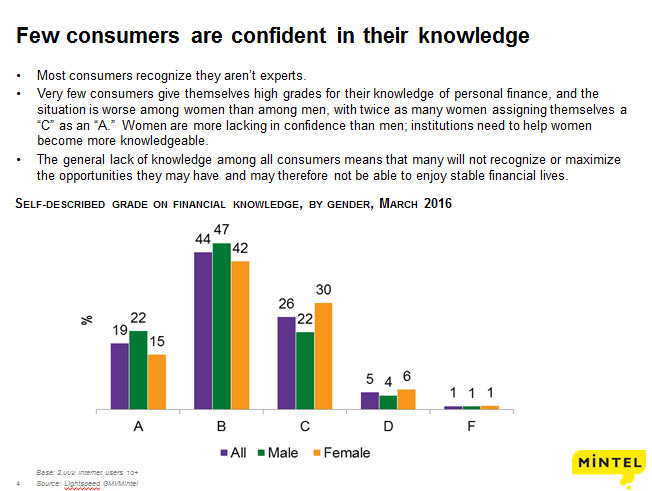
mintel-study

Having worked in the financial services industry for more than a decade, I can say with certainty I’m a bit of a personal finance geek. Learning about the latest products and economic shifts has been rolled into my job, and I’ve sadly seen the consequences of what happens to consumers when they make poor financial decisions.

Slumping credit scores. Delinquent payments. Repossessed vehicles. Hard times.

The good news? There are plenty of resources to help Americans learn. The challenge? Finding the right ways to capture mind share via the right mediums at the right time.

There is obviously a benefit to the consumer to be more financially literate, but financial institutions benefit as well when consumers are money smart. Individuals who understand financial products and how they can use them to achieve their goals are more likely to purchase those products throughout their financial lives.

So how can financial institutions help close the financial literacy gap?

Make online education and resources readily available.

Research shows more consumers would like to get information about finance through the use of online resources rather than seminars. This preference is likely due to the fact that online resources can be accessed on one’s own schedule and gives the user more control over the topics s/he wants to explore.

Provide parents resources to launch smart money talks with their kids.

Study after study reveals parents are one of the most powerful teachers in their kids’ lives – and this includes providing an education and modeling strong money management skills. Consider adding online education for kids – or partnering with a provider who has already built a money app for youngsters. Additionally, educate parents about when it might be time to help a child establish their first savings account. Advise them on ways to finance college. Talk about co-signing on vehicles. Explain the power of saving. Train up your next wave of customers and they will likely remain loyal to you.

Offer one-on-one credit education sessions.

A high-touch solution is sometimes the perfect opportunity to grow a customer in the right financial direction. Perhaps a low credit score prevents an individual from securing an ideal interest rate for an auto or home loan. Each person’s financial situation is different, and a one-on-one session with a trained agent can help them understand what is specifically contributing to their low score. With a few insights, a customer can determine if they need to pay down some debt, address a few late payments, or reduce their number of credit lines. Knowledge is power, and consumers will appreciate this service and personable touch.

Lenders have a vested interest to close the financial literacy gap, and while they can’t solve for everything, they can certainly make a difference with some basic steps and investments. If nothing else, April seems like a perfect time to evaluate what you’re doing and what resolutions you can make for the year ahead. Just as every saved penny counts, so does every effort to educate Americans on manning their money more effectively.


Related Posts

From Hybrids to Refinancing: Consumers are Finding New Roads to Vehicle Affordability

For today’s automotive consumers, considering a vehicle purchase isn’t just about the price they see on the window, it’s about finding the right combination of their vehicle preference and monthly payment. In fact, data from Experian Automotive’s State of the Automotive Finance Market Report: Q2 2026 highlighted how affordability continues to shape the automotive finance market. For instance, hybrids offered the lowest average new vehicle loan payment across all fuel types, coming in at $646 in Q2 2026, compared to electric vehicles (EVs) at $692, and gasoline-powered vehicles at $721. This led to considerable growth in new vehicle market share for hybrids this quarter, accounting for 16.80%, from 12.99% last year. While the automotive market continues to offer consumers an expanding mix of fuel types, the combination of growing hybrid share and comparatively lower monthly payments is something worth watching. Affordability isn’t just about what consumers drive, it’s how they finance it While hybrid vehicles are continuing to pave their way in the vehicle market, consumers who already have an auto loan are finding greater savings through refinancing. In the second quarter of 2026, automotive refinancing reached approximately 140,000 loans. More notably, the financial benefit associated with refinancing has grown. Consumers who refinanced this quarter reduced their average interest rate by more than 2.4%, with the average rate moving from 10.40% on the original loan to 7.97% on the refinanced loan. Those rate reductions translated into meaningful monthly savings, especially when refinancing through particular lenders. In Q2 2026, refinancing saved consumers an average of $83 per month, compared to an average monthly savings of $64 this time last year. However, credit unions delivered the largest average payment difference among lender types at $102 this quarter, followed by banks ($65), and finance companies ($38). It’s important for automotive professionals to acknowledge that affordability is not a single moment in the vehicle journey. It can influence the vehicle a consumer chooses, the financing they opt for during that transaction, and the decisions they make years after driving off the lot. Understanding and leveraging those different moments can help professionals identify opportunities to better serve consumers throughout the vehicle ownership lifecycle. To learn more about automotive finance trends, view the full State of the Automotive Finance Market Report: Q2 2026 presentation on demand.

August 27, 2026 by Melinda Zabritski
AI Agent Identity Verification: How to Verify AI Agents in Digital Transactions

AI agents are changing the way consumers interact with businesses online. Learn how you can establish greater confidence in AI transactions.

August 26, 2026 by Laura Burrows
Ask the Expert: Turning Insight into Advantage with Michelle Goeppner and David Elmore

What if some of your best potential borrowers are the ones your traditional credit strategy can't fully see? A credit score can tell lenders a lot about a consumer, but it doesn't always capture the full picture of how someone is managing their financial life. For consumers with nontraditional income patterns or limited credit histories, that incomplete view can mean missed opportunities. In this Ask the Expert session, David Elmore of Experian talks with Michelle Goeppner, Chief Lending Officer at Vantage West Credit Union, about how alternative data can provide additional context around consumer risk, uncover opportunities traditional data alone might miss and help lenders expand their reach without disrupting strategies that already work. Who could lenders be missing? That question is especially important when a consumer’s financial life doesn’t fit neatly into a traditional credit profile. Take gig workers. Someone driving for Uber or delivering for DoorDash likely has a different income pattern than a salaried employee — irregular, seasonal, spread across platforms. That doesn't mean they aren't reliably managing bills, rent and other obligations. It just means a traditional file may not show it. Goeppner has a name for the risk of overlooking that context: FOMM — Fear of Missing Members. You've heard of FOMO — Fear of Missing Out. I think about it as FOMM — Fear of Missing Members. Who are we leaving behind if we're not using it?Michelle Goeppner, Chief Lending Officer For credit unions especially, that's not just a data question — it's a mission question. A partial view of a member's finances can mean missing a member the institution exists to serve. The credit score alone doesn't tell you where someone's headed Traditional credit data is still  foundational to lending decisions. But alternative data — income, cash flow, payment behavior — adds a layer that a credit score alone can't provide. Goeppner illustrates the distinction with two consumers who have exactly the same credit score: I don't know if you're a 640 score on your way to 720 — or are you a 640 headed southwards to 580? It doesn't show me how you're managing your day-to-day financial lifeMichelle Goeppner, Chief Lending Officer Two borrowers can share the same score and be moving in opposite directions. Alternative data helps lenders tell the difference — and put that score in context rather than treating it as the whole story. Start small and layer it in Adopting alternative data doesn't mean overhauling an existing strategy. As Goeppner puts it, it's additive, not a replacement: It's not a rip and replace. You don't have to let go of your existing playbook. It's additive — you layer it in.Michelle Goeppner, Chief Lending Officer Her advice for getting started: Define the problem first. Are you trying to increase approvals, reach more underserved borrowers, or improve decisioning for a specific product? Test before you scale. Revisit loans you've already booked and ask whether alternative data would have changed the outcome — or pilot it on a single product before rolling it out further. Build in governance from day one. Document what changed, where the new data was used, and what results followed. As Goeppner puts it: “Crawl, walk, run. Slow and grow.” More loans without changing the risk profile For Vantage West, the value of that approach has shown up in its lending results. It has been an absolute game changer for us at Vantage West. We have been able to make more loans to our target members, our target segments, without changes to our risk profile.Michelle Goeppner, Chief Lending Officer That distinction matters. The goal isn't approving more loans for its own sake — it's having enough information to recognize good borrowers that traditional data alone would have missed. The result is a fuller picture of the people behind the credit file, and more confidence in deciding who a lender can serve. Explore alternative data with us Alternative data can help lenders add context to traditional credit information for a more complete view of consumers. Experian works with institutions of all sizes to incorporate additional consumer signals into existing lending strategies — strengthening decisioning, managing risk and identifying new opportunities for growth. Learn more Contact us About our experts Michelle Goeppner Chief Lending Officer, Vantage West Credit Union Michelle Goeppner is a dynamic financial services executive with over two decades of experience driving strategic growth, product innovation, and operational excellence across leading credit unions and financial institutions. Currently serving as the Chief Lending Officer at Vantage West Credit Union, Michelle leads the strategic vision for multi-billion-dollar consumer loan and deposit portfolios, as a member of the Executive Coalition. Her expertise spans consumer lending, product management, integrated marketing, and talent development, with a proven track record of leveraging fintech partnerships, automation, and data-driven strategies to optimize portfolio performance and member engagement. Throughout her career, Michelle has held pivotal leadership roles in organizations such as Alliant Credit Union and Discover Financial Services. She is recognized for her collaborative approach, detail-oriented execution, and commitment to developing future female leaders. Michelle’s contributions include founding Alliant’s Women’s Resource Group, serving on advisory councils and boards, and earning multiple industry awards for excellence and innovation. She holds an Executive Certification in Product Management from UC Berkeley, a Master of Science in Integrated Marketing Communications from Roosevelt University, and a Bachelor of Science in Marketing from Northern Illinois University. David Elmore Vice President of Fintech Sales, Experian David Elmore leads a team of fintech sales professionals at Experian focused on helping fintech organizations drive responsible, scalable growth through data-driven analytics and decisioning. With more than 20 years in financial services — a decade of it focused on fintech — he brings deep expertise in applying traditional and alternative data across the customer lifecycle. David and his team partner with fintech leaders to navigate opportunities across acquisition, underwriting, portfolio management, and collections, balancing innovation, risk, and trust.

August 26, 2026 by Julie Lee

Subscribe to our Newsletter

Enter your name and email for the latest updates.

This site is protected by reCAPTCHA and the Google Privacy Policy and Terms of Service apply.

Subscribe to our Newsletter

Don't miss out on the latest industry trends and insights!
Subscribe
