Tag: first party fraud

First-party fraud involves making financial commitments or using their own identity, a manipulated version of their own identity or a synthetic identity.

Podcast to discuss the emergence of synthetic identity fraud, its true financial impact and how organizations can begin to fight back.
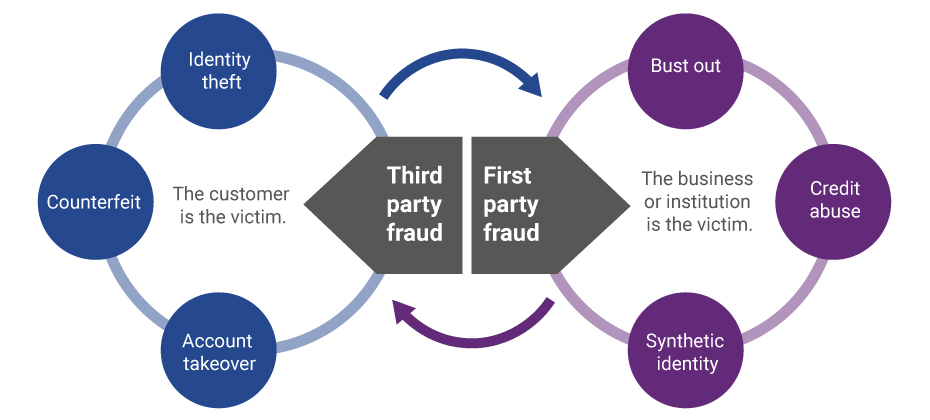
Third-party and first-party schemes are now interchangeable, and traditional fraud detection practices are less effective in fighting these evolving fraud types.

A synthetic identity epidemic is impacting all markets. Here are the three ways that synthetic identities are generally created

Florida, Delaware, Oregon and New York were the riskiest states for e-commerce fraud
Experian is recognized as a leading security solution provider for fraud and identity solutions in order to protect customers and financial institutions

Definition of first-party versus third-party fraud trends and shared actual case study of a first-party fraud scheme.

As the electronic signature industry matures and acceptance of e-signatures increases, so does the need for more robust, flexible options in authentication.

We all know that first party fraud is a problem, but learning how to manage through first party fraud is key to overcoming it

By: Kennis Wong Data is the very core of fraud detection. We are constantly seeking new and mining existing data sources that give us more insights into consumers’ fraud and identity theft risk. Here is a way to categorize the various data sources. Account level - When organizations detect fraud, naturally they leverage the data in-house. This type of data is usually from the individual account activities such as transactions, payments, locations or types of purchases, etc. For example, if there’s a purchase $5000 at a dry cleaner, the transaction itself is suspicious enough to raise a red flag. Customer level - Most of the times we want to see a bigger picture than only at the account level. If the customer also has other accounts with the organization, we want to see the status of those accounts as well. It’s not only important from a fraud detection perspective, but it’s also important from a customer relationship management perspective. Consumer level - As Experian Decision Analytics’ clients can attest, sometimes it’s not sufficient to look only at the data within an organization but also to look at all the financial relationships of the consumer. For example, in the situation of bust out fraud or first-party fraud, if you only look at the individual account, it wouldn’t be clear whether a consumer has truly committed the fraud. But when you look at the behavior of all the financial relationships, then the picture becomes clear. Identity level - Fraud detection can go into the identity level. What I mean is that we can tie a consumer’s individual identity elements with those of other consumers to discover hidden inconsistencies and relationships. For example, we can observe the use of the same SSN across different applications and see if the phones or addresses are the same. In the account management environment, when detecting existing account fraud or account takeover, this level of linkage is very useful as more data becomes available after the account is open. Loading...
Experian recently contributed to a TSYS whitepaper focused on the various threats associated with first party fraud. I think the paper does a good job at summarizing the problem, and points out some very important strategies that can be employed to help both prevent first party fraud losses and detect those already in an institution’s active and collections account populations. I’d urge you to have a look at this paper as you begin asking the right questions within your own organization. Watch here The bad news is that first party fraud may currently account for up to 20 percent of credit charge-offs. The good news is that scoring models (using a combination of credit attributes and identity element analysis) targeted at various first party fraud schemes such as Bust Out, Never Pay, and even Synthetic Identity are quite effective in all phases of the customer lifecycle. Appropriate implementation of these models, usually involving coordinated decisioning strategies across both fraud and credit policies, can stem many losses either at account acquisition, or at least early enough in an account management stage, to substantially reduce average fraud balances. The key is to prevent these accounts from ending up in collections queues where they’ll never have any chance of actually being collected upon. A traditional customer information program and identity theft prevention program (associated, for example with the Red Flags Rule) will often fail to identify first party fraud, as these are founded in identity element verification and validation, checks that often ‘pass’ when applied to first party fraudsters.
By: Kennis Wong As I said in my last post, when consumers and the media talk about fraud and fraud risk, they are usually referring to third-party frauds. When financial institutions or other organizations talk about fraud and fraud best practices, they usually refer to both first- and third-party frauds. The lesser-known fraud cousin, first-party fraud, does not involve stolen identities. As a result, first-party fraud is sometimes called victimless fraud. However, being victimless can’t be further from the truth. The true victims of these frauds are the financial institutions that lose millions of dollars to people who intentionally defraud the system. First-party frauds happen when someone uses his/her own identity or a fictitious identity to apply for credit without the intention to fulfill their payment obligation. As you can imagine, fraud detection of this type is very difficult. Since fraudsters are mostly who they say they are, you can’t check the inconsistencies of identities in their applications. The third-party fraud models and authentication tools will have no effect on first-party frauds. Moreover, the line between first-party fraud and regular credit risk is very fuzzy. According to Wikipedia, credit risk is the risk of loss due to a debtor's non-payment of a loan or other line of credit. Doesn’t the definition sound similar to first-party fraud? In practice, the distinction is even blurrier. That’s why many financial institutions are putting first-party frauds in the risk bucket. But there is one subtle difference: that is the intent of the debtor. Are the applicants planning not to pay when they apply or use the credit? If not, that’s first-party fraud. To effectively detect frauds of this type, fraud models need to look into the intention of the applicants.
By: Kennis Wong When consumers and the media talk about fraud and fraud risk, nine out of ten times they are referring to third-party frauds. When financial institutions or other organizations talk about fraud, fraud best practices, or their efforts to minimize fraud, they usually refer to both first- and third-party frauds. The difference between the two fraud types is huge. Third-party frauds happen when someone impersonates the genuine identity owner to apply for credit or use existing credit. When it’s discovered, the victim, or the genuine identity owner, may have some financial loss -- and a whole lot of trouble fixing the mess. Third-party frauds get most of the spotlight in newspaper reporting primarily because of large-scale identity data losses. These data losses may not result in frauds per se, but the perception is that these consumers are now more susceptible to third-party frauds. Financial institutions are getting increasingly sophisticated in using fraud models to detect third-party frauds at acquisition. In a nutshell, these fraud models are detecting frauds by looking at the likelihood of applicants being who they say they are. Institutions bounce the applicants’ identity information off of internal and external data sources such as: credit; known fraud; application; IP; device; employment; business relationship; DDA; demographic; auto; property; and public record. The risk-based approach takes into account the intricate similarities and discrepancies of each piece of data element. In my next blog entry, I’ll discuss first-party fraud.