Latest Posts

As the market finds its footing, evolving consumer demand is driving changes in new and used vehicle registrations. In response, manufacturers are balancing affordability and production efficiency to protect their market share. According to Experian’s Automotive Market Trends Report: Q4 2025, new vehicle registrations slightly decreased to 3.8 million, from 4 million this time last year. On the used side, registrations ticked up slightly year-over-year, going from 9 million to 9.1 million. With elevated new vehicle pricing and higher interest rates likely playing a role in new vehicle registrations dipping, buyers seem to be gravitating toward lower-cost alternatives in the used market. Familiar OEM leaders remain steady at the top of market share Despite shifts in vehicle registrations, leaders in new vehicle manufacturer market share have remained consistent. For instance, data through the fourth quarter of this year reveled General Motors (GM), Toyota, and Ford continue to hold the top three positions in new vehicle market share, with GM coming in at 17.4% share, followed by Toyota (16.5%), and Ford (12.6%). At the make level, Toyota held the top position for the fourth consecutive year in new vehicle market share, coming in at 14.1% through Q4 2025; they were followed by Ford (11.9%) and Chevrolet (11%). Sustained leadership in today’s market isn’t just about scale, it relies on how quickly manufacturers can respond and adapt to shifting consumer preferences and industry changes. Those that adapt their portfolios and go-to-market approaches will be best positioned not just to protect their share, but to grow it as the market continues to evolve. To learn more about vehicle market trends, view the full Automotive Market Trends Report: Q4 2025 presentation on demand.

A new reality for screening providers Everything about the candidate checked out. Their resume reflected the right experience. Their references confirmed it. The background screening process came back clean. From outside, there was no reason to hesitate. So, the company didn’t. But within weeks, small inconsistencies began to surface. The employee struggled in ways that didn’t match their credentials. Follow-up questions led to vague answers. Eventually, a deeper review uncovered the issue; this wasn’t just a case of exaggeration. It was candidate fraud. And increasingly, it’s not just individuals acting alone. In a widely reported scheme, foreign operatives posed as legitimate remote IT workers, using stolen identities and AI-assisted interviews to secure jobs at major Fortune 500 companies. Once hired, access was handed off, allowing bad actors to infiltrate corporate systems and generate millions in illicit revenue. In one case, a single individual funneled over $17 million to a foreign operation. These weren’t obvious scams. The candidates passed interviews. They cleared checks. And that’s exactly the point. For background screening and verification providers, this shift presents both a challenge and an opportunity. As candidate fraud becomes more sophisticated, your clients are no longer just looking to verify records – they’re looking to trust identity itself, and they’re looking to you to help them do it. The assumption that no longer holds For decades, hiring has relied on a simple premise: verify the records, resume, and you can trust the candidate. That model worked when identity was easier to validate in person. But in today’s digital-first hiring environment, identity can oftentimes be asserted, not proven. At the same time, identity-based fraud is accelerating. Synthetic identity fraud alone accounts for billions in annual losses, and employers are increasingly encountering candidates whose identities are far more difficult to validate than their resumes. This creates a critical disconnect: Organizations are still verifying records, but those records may be tied to identities that were never legitimate to begin with. Increasingly, they’re turning to their screening partners to close that gap. The reality of candidate fraud 31% of employers have interviewed candidates using a false identity Only 19% feel confident they can detect fraud in hiring 1 in 4 companies report losses of$50K+from fraudulent hires Why candidate fraud is getting harder to see The nature of candidate fraud has fundamentally changed. At one end of the spectrum, companies are still dealing with candidates who falsify resumes, costing businesses time and money when the truth comes to light later. But at the other end, the threat has escalated dramatically. Coordinated fraud rings are now using stolen identities and AI-assisted interviews to place individuals into remote roles, sometimes without ever revealing their identity. And this isn’t slowing down. According to Gartner, by 2028, 1 in 4 candidates could be fake, driven by AI, remote hiring, and identity manipulation. For screening providers, this introduces a new level of complexity. The challenge is no longer just delivering verified records; it’s helping clients surface risks that traditional screening processes were not designed to identify. What traditional screening still gets right None of this diminishes the importance of pre-employment screening. Verifying employment history, education, and background remains a critical part of responsible hiring, and it should. But even the most thorough screening process is designed to answer a specific question: Do the records align with the identity provided? What it does not answer is the question that matters most now: Is that identity real? That gap between record verification and identity validation is where modern fraud operates. And it represents an opportunity for screeners to expand their role from record validation to helping enable stronger identity confidence. The cost of believing everything is working When fraud moves through the hiring process undetected, the consequences aren’t always immediate, but they can be significant. There are financial risks, compliance exposure and potential access to sensitive systems. But there’s also a more subtle —and often overlooked — impact: The assumption that existing processes are working as intended. When fraudulent candidates pass through screening, it reinforces confidence in processes that may not be equipped for today’s threat landscape. Over time, that false sense of security can become a vulnerability. From screening provider to strategic partner As hiring evolves, so do expectations. Employers are no longer just looking for faster background checks - they’re looking for greater confidence in who they’re hiring. This shift creates an opportunity for screening providers to move upstream in the hiring process. By introducing identity verification earlier in the workflow, providers can help clients detect candidate fraud sooner, reduce downstream risk, and strengthen the integrity of hiring decisions. More importantly, it allows providers to differentiate their offerings in an increasingly competitive market, shifting from a transactional service to a more strategic capability. A shift in thinking: Identity before everything else To address modern candidate fraud, organizations don’t just need better tools; they need a different starting point. Instead of beginning with records, leading providers are beginning with identity. They are asking a more fundamental question earlier in the process: Is this person who they say they are? Is this person a real, consistent and verifiable person? When that foundation is established, everything that follows becomes more meaningful. Background checks become more reliable. Verification becomes more consistent. And the ability to detect candidate fraud improves, not because the process is longer, but because it’s more informed. In this model, identifying potential fraud becomes proactive rather than reactive. Why identity verification matters more now than ever The shift to remote and digital hiring hasn’t just changed how companies hire – it’s changed how fraud occurs. Today, a significant portion of fraudulent activity targets the employment process, making it a key point of exposure for identity misuse. In fact, 45% of all false document submissions now occur in the employment sector. In many cases, candidates who falsify information still progress through hiring workflows. A study revealed that 70% of candidates who falsify information still get hired. This reinforces today’s reality: Fraud is no longer slipping through the cracks; it’s moving through the front door. How Experian helps close the identity gap Experian® helps background screeners and verification providers bridge the gap between who a candidate claims to be and who they are. By combining identity verification, fraud detection, and verification solutions, Experian enables providers to enhance their existing solutions – without disrupting their workflows. This allows you to extend your value beyond traditional screening, help clients detect candidate fraud earlier, and strengthen confidence in hiring outcomes. The result is not just better screening, it’s a stronger strategic position in your clients’ hiring ecosystem, one that reduces risk while improving speed and confidence. Candidate fraud isn’t an edge case anymore. It reflects a broader shift in how identity works in a digital world. And while traditional screening remains essential, it may not be sufficient on its own. Because if identity is uncertain, every subsequent check is built on unstable ground. But when identity is established earlier in the process, everything that follows becomes more dependable. Don’t just verify the candidate records, verify the identityLearn how Experian helps screening providers embed identity verification at the start of the hiring journey to help detect candidate fraud earlier, reduce risk, and strengthen screening outcomes. Explore Experian’s Fraud Prevention Playbook for Pre-Employment Screening FAQs

Learn how offering personalized support in managing finances addresses financial stress and productivity challenges.

Model inventories are rapidly expanding. AI-enabled tools are entering workflows that were once deterministic and decisioning environments are more interconnected than ever. At the same time, regulatory scrutiny around model risk management continues to intensify. In many institutions, classification determines validation depth, monitoring intensity, and escalation pathways while informing board reporting. If classification is wrong, every downstream control is misaligned. And, in 2026, model classification is no longer just about assigning a tier, but rather about understanding data lineage, use case evolution, interdependencies, and governance accountability in a decentralized, AI-driven environment. We recently spoke with Mark Longman, Director of Analytics and Regulatory Technology, and here are some of his thoughts around five blind spots risk and compliance leaders should consider addressing now. 1. The “Set It and Forget It” Mentality The Blind Spot Model classification frameworks are often designed during a regulatory remediation effort or inventory modernization initiative. Once documented and approved, they can remain largely unchanged for years. However, model risk management is an ongoing process. “There’s really no sort of one and done when it comes to model risk management,” said Longman. Why It Matters Classification is not merely descriptive, it’s prescriptive. It drives the depth of validation, the frequency of monitoring, the intensity of governance oversight and the level of senior management visibility. As Longman notes, data fragmentation is compounding the challenge. “There’s data everywhere – internal, cloud, even shadow IT – and it’s tough to get a clear view into the inputs into the models,” he said. When inputs are unclear, tiering becomes inherently subjective and if classification frameworks are not reviewed regularly, governance intensity can become misaligned with real exposure. Therefore, static classification is a growing risk, especially in a world of rapidly expanding AI use cases. In a supervisory environment that continues to scrutinize model definitions, particularly as AI tools proliferate, a dynamic, periodically refreshed classification process can demonstrate institutional vigilance. 2. Assuming Third-Party Models Reduce Governance Accountability The Blind SpotThere is often an implicit belief that vendor-provided models carry less governance burden because they were developed externally. Why It Matters Vendor provided models continue to grow, particularly in AI-driven solutions, but supervisory expectations remain firm. “Third-party models do not diminish the responsibility of the institution for its governance and oversight of the model – whether it’s monitoring, ongoing validation, just evaluating model drift” Longman said. “The board and senior managers are responsible to make sure that these models are performing as expected and that includes third-party models.” Regulators consistently emphasize that institutions remain responsible for the outcomes produced by models used in their decisioning environments, regardless of origin. If a vendor model influences credit approvals, pricing, fraud decisions, or capital calculations, it directly affects customers, financial performance and compliance exposure. Treating third-party models as inherently lower risk can also distort internal tiering frameworks. When vendor models are under-classified, validation depth and monitoring rigor may be insufficient relative to their true impact. 3. Limited Situational Awareness of Model Interdependencies The Blind SpotModern decisioning environments are interconnected ecosystems. Forecasting models may influence reserve calculations. Marketing models may be repurposed across product lines. Data transformations may feed multiple downstream models simultaneously. Why It Matters Risk often flows across interdependencies. When upstream models degrade in performance or introduce bias, downstream models inherit that exposure. If multiple material decisions depend on the same data transformation or feature engineering process, concentration risk emerges. Without visibility into these dependencies, tiering assessments may underestimate cumulative risk, and monitoring frameworks may fail to detect systemic vulnerabilities. “There has to be a holistic view of what models are being used for – and really somebody to ensure there’s not that overlap across models,” Longman said. Supervisors are increasingly interested in understanding how model risk propagates through business processes. When institutions cannot articulate how models interact, it raises broader concerns about situational awareness and control effectiveness. Therefore, capturing interdependencies within the classification framework enhances more than documentation. It enables more accurate tiering, more targeted monitoring and more informed governance oversight. 4. Excluding Models Without Defensible Rationale The Blind SpotGray-area tools frequently sit outside formal inventories: rule-based engines, spreadsheet models, scenario calculators, heuristic decision aids, or emerging AI tools used for analysis and summarization. These tools may not neatly fit legacy definitions of a “model,” and so they are sometimes excluded without robust documentation. Why It Matters Regulatory definitions of “model” have broadened over time. What creates risk is the absence of defensible reasoning and documentation. Longman describes the risk clearly: “Some [teams] are deploying AI solutions that are sort of unbeknownst to the model risk management community – and almost creating what you might think of as a shadow model inventory.” Without visibility, institutions cannot confidently characterize use, trace inputs, or assign appropriate tiers, according to Longman. It also undermines the credibility of the official inventory during examinations. A well-governed program can articulate why certain tools fall outside model risk management scope, referencing documented criteria aligned with regulatory guidance. Without that evidence, exclusions can appear arbitrary, suggesting gaps in oversight. 5. Inconsistent or Subjective Classification Frameworks The Blind SpotAs inventories scale and governance teams expand, classification decisions are often distributed across reviewers. Over time, discrepancies can emerge. Why It Matters Inconsistency undermines both risk management and regulatory confidence. If two models with comparable use cases and impact profiles are assigned different tiers without clear justification, it signals that the framework is not being applied uniformly. AI adds even more complexity. When it comes to emerging AI model governance versus traditional model governance, there’s a lot to unpack, says Longman: “The AI models themselves are a lot more complicated than your traditional logistic or multiple regression models. The data, the prompting, you need to monitor the prompts that the LLMs for example are responding to and you need to make sure you can have what you may think of as prompt drift,” Longman said. As frameworks evolve, particularly to incorporate AI, automation, and new regulatory interpretations, institutions must ensure that changes are cascaded across the entire inventory. Partial updates or selective reclassification introduce fragmentation. Longman recommends formalizing classification through a structured decision tree embedded in policy to ensure consistent outcomes across business units. Beyond clear documentation, a strong classification program is applied consistently, measured objectively, and periodically reassessed across the full portfolio. BONUS – 6. Elevating Classification with Data-Level Visibility Some institutions are extending classification discipline beyond models to the data layer itself. Longman describes organizations that maintain not only a model inventory, but a data inventory, mapping variables to the models they influence. This approach allows institutions to quickly assess downstream effects when operational or environmental changes occur including system updates or even natural disasters affecting payment behavior. In an AI-driven environment, traceability may become a competitive differentiator. Conclusion Model classification is foundational. It determines how risk is measured, monitored, escalated, and reported. In a rapidly evolving regulatory and technological environment, it cannot remain static. Institutions that invest now in transparency, consistency, and data-level visibility will not only reduce supervisory friction – they will build a governance framework capable of supporting the next generation of AI-enabled decisioning. Learn more

Alternative fuel vehicles continued to gain momentum in the fourth quarter of 2025, driven by expiring electric vehicle (EV) tax credits and a growing preference for options that bridge the gap between full electric and traditional gasoline vehicles. According to Experian’s Automotive Consumer Trends Report: Q4 2025, alternative fuel vehicles accounted for 38.6% of new retail car registrations in the last 12 months, with 11% battery electric (BEV) and 27.6% hybrids and plug-in hybrids (PHEVs). This signals that the narrative about growth in consumer interest for alternative fuel is increasingly towards hybrids, not just full EVs. Taking a deeper dive, the Toyota Camry Hybrid led all alternative fuel car models, coming in 31.7% in Q4 2025. Rounding out the top five were Tesla Model 3 (19%), Honda Civic Hybrid (10.1%), Honda Accord Hybrid (9%), and Toyota Prius (5.3%). Interestingly, the Toyota Camry also stood out as the top model in both new and used car markets in Q4 2025, holding 12.2% of new car market share and 6.3% of used car market share. The Honda Civic ranked second in new car market share, coming in at 10.5% this quarter, while the Honda Accord secured the second spot in the used car market at 5.8%. The prominence of these vehicles leading both new and used car markets reflects a combination of strong new-vehicle sales and sustained demand in the secondary market. Data in the report also revealed strong loyalty within Toyota and Honda, with significant inflow between the two brands. For instance, 38.4% of Toyota Camry buyers replaced their vehicle with another Camry in Q4 2025, and 39.7% of Honda Civic buyers replaced it with another Civic. These trends reinforce the value of dealers monitoring evolving consumer preferences and aligning inventory with vehicles that offer fuel efficiency and flexible powertrain options as the market continues to shift. To learn more about car insights, view the full Automotive Consumer Trends Report: Q4 2025 presentation.

Discover how Experian’s Mortgage Loan Performance dataset reveals current second lien balances that materially impact MBS prepayment speeds, CLTV accuracy, and call protection. Learn why this new loan-level data meets the New, Material, and Significant criteria to move agency MBS markets and improve investor modeling precision.

As vehicle prices and interest rates continue to evolve, both consumers and lenders are recalibrating their approaches to affordability and long-term sustainability. This shift has resulted in the subprime segment growing to its largest share of total finance market for subprime in the fourth quarter since 2021. According to Experian’s State of the Automotive Finance Market Report: Q4 2025, subprime borrowers accounted for 15.31% of total vehicle financing, an increase from 14.54% in Q4 2024. To understand why the subprime space is evolving, we took a deeper dive into the affordability picture and how changes in pricing and interest rates are influencing both consumer decisions and lender strategies. In Q4 2025, the average loan amount for a new vehicle increased $1,882 from the prior year to $43,582, and the average interest rate for a new vehicle went from 6.34% last year to 6.37% this quarter. As a result, the average monthly payment increased from $746 to $767 in the same time frame. On the used side, the average loan amount increased $872 year-over-year, reaching $27,528 in Q4 2025. However, despite the average interest rate declining from 11.63% to 11.26% during the same time, the average monthly payment grew $9 from last year to $537 this quarter. These changes are prompting thoughtful adjustments across the automotive ecosystem. Consumers are comparing financing options more carefully and adjusting loan terms when necessary to prioritize the cost of ownership. Lenders are also focusing more on payment flexibility and how long-term borrowers are performing as they leverage it for central pillars of strategies to stay ahead of the ever-evolving market. To learn more about automotive finance trends, view the full State of the Automotive Finance Market Report: Q4 2025 presentation on demand.

The mortgage industry is adapting to a structural shift. Experian’s 2026 State of the U.S. Housing Market Report shows a market in transition. Conventional loans account for 72% of originations, FHA 17.5% and VA 10.8% with VA showing the strongest growth from 2023 to 2025. But origination mix only tells part of the story. Beneath it lies an arguably more consequential shift: borrower expectations, affordability pressures and regulatory changes are converging. On the regulatory front, the Homebuyers Privacy Protection Act (HPPA) may reduce mortgage trigger leads and limit broad competitive outreach. As competitive visibility narrows, the lender relationship becomes more central and important beyond the closing transaction. In this environment, lenders must provide value to win, and that increasingly means financial wellness. A growing trust gap Only 34% of first mortgage hard inquiries of first mortgage hard inquiries convert into funded originations, according to Experian. That means two-thirds of borrowers who initiate the process never close. External data confirms the trend as Mortgage Bankers Association reported retail mortgage pull-through rates declined to roughly 69% in early 2025 – the lowest in over a decade – and as low as 55% among depository lenders. While pull-through can be impacted by a number of factors not influenced by the lender, when borrowers abandon applications, it can be a biproduct of uncertainty – something that the lender can influence. This is where financial wellness becomes strategic and lenders can close the trust gap by providing proactive credit visibility and guidance before underwriting friction occurs. Read more in our white paper, “The New Unlock for Mortgage.” Affordability stress While rates have eased from their 2023 highs, they remain above 6%, sustaining the lock-in effect and limiting housing supply, according to Experian’s 2026 State of the U.S. Housing Market Report. Approximately 70% of homeowners are locked into sub-6% mortgages, according to Freddie Mac. Beyond mortgage rates, increases in property taxes and non-tax escrow amounts (i.e. insurance) increase affordability pressures for consumers. Financial wellness solutions that incorporate credit monitoring, budgeting insights and cashflow visibility help borrowers understand whether they are prepared. Opportunity among millennials and Gen Z Nearly 47% of U.S. renters expect to purchase a home within four years, rising to 67% within eight years, according to Experian. This signals the time to invest in financial wellness as a differentiator, and both a growth and retention driver, is now. Financial wellness as the new unlock for mortgage Financial wellness is not an ancillary service but the foundation upon which borrower confidence, long-term engagement, conversion and risk management connect. Lenders who embed solutions like credit education, score visibility, alerts, and identity protection directly into the consumer experience can differentiate themselves from the competition above and beyond rates alone. Read more in our white paper, “The New Unlock for Mortgage.” Learn more about Experian Mortgage
What do BNPL rules mean for mortgage credit scoring? As regulators push for greater transparency and alternative data reporting, lenders must adopt modern credit models that include rent, cash flow, and trended data. Learn how evolving BNPL guidance signals the future of mortgage underwriting and why forward-thinking lenders are modernizing scoring strategies now.
U.S. rental housing market outlook 2026: Analyze elevated mortgage rates, rental supply constraints, affordability pressure, and rising fraud risk. Discover how data analytics, rent reporting, and digital income and employment verification help property managers reduce risk, improve screening accuracy, and make smarter, faster leasing decisions.
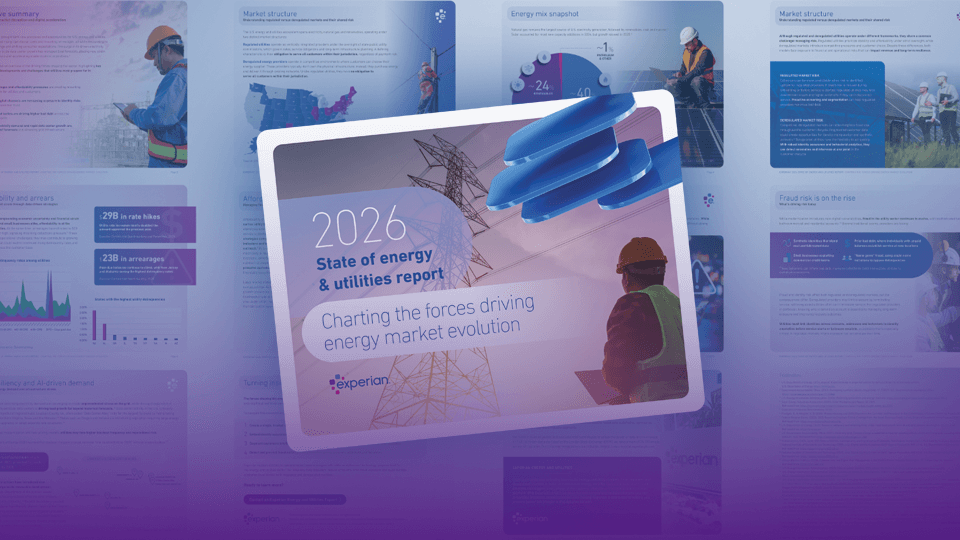
Explore energy and utilities industry trends 2026, focusing on digital services and evolving customer demands in the sector.

Explore the public sector trends for 2026 shaping digital services, workforce resilience, and citizen trust for better governance.
Experian Verify is redefining how lenders streamline income and employment verification; a value clearly reflected in Marcus Bontrager’s experience at Freedom Mortgage. With access to the second-largest instant payroll network in the U.S., Experian Verify connects lenders to millions of unique employer records, including those sourced through Experian Employer Services clients, delivering instant results at scale. This reach enables lenders to reduce manual processes, accelerate loan decisions, and enhance the borrower experience from the very first touchpoint. Unlike traditional verification providers, Experian Verify offers transparent, value-driven pricing: it charges only when a consumer is successfully verified, not simply when an employer record is found. As lenders navigate increasing compliance requirements and secondary market expectations, they can also rely on Experian Verify’s FCRA-compliant framework, fully supporting both Fannie Mae and Freddie Mac. Combined with Experian’s industry-leading data governance and quality standards, lenders gain a verification partner they can trust for accuracy, security, and long-term operational efficiency. Perhaps most importantly, Experian Verify delivers 100% U.S. workforce coverage through its flexible, automated waterfall: instant verification, consumer-permissioned verification, and research verification. This multilayered approach ensures lenders meet every borrower where they are, whether they’re connected to a large payroll provider, a smaller employer, or require additional document-based validation. As Marcus highlights in the video, this comprehensive and configurable design empowers lenders to build verification workflows that truly fit their business needs while enhancing speed, completeness, and borrower satisfaction. Explore Experian Verify
Fraud is evolving faster than ever, driven by digitalization, real-time payments and increasingly sophisticated scams. For Warren Jones and his team at Santander Bank, staying ahead requires more than tools. It requires the right partner. The partnership with Santander Bank began nearly a decade ago, during a period of rapid change in the fraud and banking landscape. Since then, the relationship has grown into a long-term collaboration focused on continuous improvement and innovation. Experian products helped Santander address one of its most pressing operational challenges: a high-volume manual review queue for new account applications. While the vast majority of alerts in the queue were fraudulent and ultimately declined, a small percentage represented legitimate customers whose account openings were delayed. This created inefficiencies for staff and a poor first impression of genuine applicants. We worked alongside Santander to tackle this challenge head-on, transforming how applications were reviewed, how fraud was detected and how legitimate customers were approved. In addition to fraud prevention, implementing Experian's Ascend PlatformTM, with its intuitive user experience and robust data environment, has unlocked additional value across the organization. The platform supports multiple use cases, enabling collaboration between fraud and marketing teams to align strategies based on actionable insights. Learn more about our Ascend Platform
Lenders who want to outperform peers in today’s housing market should embrace a data-driven playbook. These four strategic pillars—borrower insights, efficiency, geography, and refinance readiness—define the path forward.