Latest Posts

For lenders, mitigating first payment default requires data, advanced analytics, customer engagement, and agile risk management.

When equipped with the right data and strategies, mortgage lenders can drive growth by identifying and engaging first-time homebuyers.

As the evolution of the automotive industry continues to unfold, certain vehicles retain their prominence, offering not only versatility but adaptability. In particular, vans have long embodied myriad lifestyles and needs—painting an intriguing picture of consumer preferences and economic trends. For instance, data from Experian’s Automotive Consumer Trends Report: Q4 2023 found there are currently more than 18 million vans in operation in the United States. Furthermore, there were over 245,000 new van retail registrations in the last 12 months—with mini vans such as the Honda Odyssey accounting for 79.4% of new van retail registrations and full-size vans including the Mercedes-Benz Sprinter making up the remaining 20.5%. Diving into the details, Honda comprised 27.3% of the market share by make in Q4 2023, followed by Toyota (19.3%), KIA (16.7%), Chrysler (13.7%), and Mercedes-Benz (9.0%). When looking at the most sought after vans, the Honda Odyssey led the market share by model this quarter—coming in at 27.3%. The Toyota Sienna trailed behind at 19.3%, followed by KIA Carnival at 16.7%, Chrysler Pacifica (13.5%), and Mercedes-Benz Sprinter (9.3%). While understanding the broader trends in van registrations is important for automotive professionals, exploring the demographics more in depth will help tailor marketing strategies effectively and personalize guidance to those who are in the market for a vehicle. For example, Gen X made up the largest portion of retail van registrations in Q4 2023 at 36.0%, followed by Millennials at 27.6%, Boomers (25.3%), Gen Z (7.5%), and Silent (3.3%). In order to align their strategies with the needs and preferences of van buyers, professionals throughout the automotive industry should delve into the nuances of who is buying and the models they’re interested in. This will also enable them to sustain the foundation for success in the dynamic automotive landscape. To learn more about vans, view the full Automotive Consumer Trends Report: Q4 2023 presentation.

From consumers seeking versatility and additional cargo space to more models becoming available—a discernible trend the automotive industry has seen in recent years is the shift towards utility vehicles such as SUVs and crossover utility vehicles (CUVs). In fact, Experian’s Automotive Market Trends Report: Q4 2023 found that utility vehicles were a significant driver in new vehicle registrations, coming in at 57.3%, up from 56.2% through Q4 2022. Meanwhile, pickup trucks declined from 18.5% last year to 17.2% this quarter and sedans went from 17.1% to 16.5% in the same time frame. Optimizing vehicle maintenance post-manufacturer warranty Despite utility vehicles making up the majority of new vehicle registrations through Q4 2023, passenger vehicles (85.1%) and light trucks (82.7%) had the most vehicles that were outside of the general manufacturer warranty this quarter—mostly due to a high volume of registrations in previous years. By comparison, 67.1% of all utility vehicles were outside the general manufacturer warranty. Understanding the current status of these vehicles enables aftermarket professionals to tailor their service recommendations accordingly. Furthermore, it will be important to monitor this trend over the next few years as the vehicles that are currently under manufacturer warranty will likely need maintenance after it expires. !function(e,n,i,s){var d="InfogramEmbeds";var o=e.getElementsByTagName(n)[0];if(window[d]&&window[d].initialized)window[d].process&&window[d].process();else if(!e.getElementById(i)){var r=e.createElement(n);r.async=1,r.id=i,r.src=s,o.parentNode.insertBefore(r,o)}}(document,"script","infogram-async","https://e.infogram.com/js/dist/embed-loader-min.js"); Vehicle registrations and aftermarket sweet spot When looking at overall registration trends, new vehicles increased 12.5% from last year—reaching 15.3 million through Q4 2023 and used vehicles declined 1.5% year-over-year to 38.2 million this quarter. While monitoring vehicle registration trends helps aftermarket professionals properly assist consumers now and in the future, identifying and understanding the aftermarket “sweet spot” allows them to stay ahead of the curve and adapt to changes as the market continues to evolve. Vehicles in the sweet spot are generally between six- to 12-model-years-old and have aged out of general OEM manufacturer warranties for any repairs. Through Q4 2023, 35.5% of all vehicles in operation landed in the sweet spot, marking a 3.6% year-over-year increase. Though, the aftermarket sweet spot volume is expected to hit its peak in the next few months at nearly 116 million vehicles—considering the record high was 104 million through 2011 and the sweet spot volume reached 102.4 million through Q4 2023. As aftermarket professionals look for ways to reach the right audience, leveraging registration data and the types of vehicles entering the market enables them to adjust their marketing strategies accordingly and plan their services effectively. To learn more about vehicle market trends, view the full Automotive Market Trends Report: Q4 2023 presentation on demand.

Anti-money laundering and fraud prevention have historically been separated, but here's why that might not be a good idea.

As part of banks’ anti-money laundering (AML) programs, KYC in banking can help stop corruption, money laundering and terrorist financing. Creating and maintaining KYC programs is also important for regulatory compliance, reputation management and fraud prevention. The three components of KYC in banking programs Banks can largely determine how to set up their KYC and AML programs within the applicable regulatory guidelines. In the United States, KYC needs to happen when banks initially onboard a new customer. But it’s not a one-and-done event—ongoing customer and transaction monitoring is also important. 1. Customer Identification Program (CIP) Creating a robust Customer Identification Program (CIP) is an essential part of KYC. At a minimum, a bank’s CIP requires it to collect the following information from new customers: Name Date of birth Address Identification number, such as a Social Security number (SSN) or Employer Identification Number (EIN) Banks' CIPs also have to use risk-based procedures to verify customers’ identities and form a reasonable belief that they know the customer's true identity.1 This might involve comparing the information from the application to the customer’s government-issued ID, other identifying documents and authoritative data sources, such as credit bureau databases. Additionally, the bank's CIP will govern how the bank: Retains the customer’s identifying information Compares customer to government lists Provides customers with adequate notices Banks can create CIPs that meet all the requirements in various ways, and many use third-party solutions to quickly collect data, detect forged or falsified documents and verify the provided information. 2. Customer due diligence (CDD) CIP and CDD overlap, but the CIP primarily verifies a customer’s identity while customer due diligence (CDD) helps banks understand the risk that each customer poses. To do this, banks try to understand what various types of customers do, what those customers’ normal banking activity looks like, and in contrast, what could be unusual or suspicious activity. Financial institutions can use risk ratings and scores to evaluate customers and then use simplified, standard or enhanced due diligence (EDD) processes based on the results. For example, customers who might pose a greater risk of laundering money or financing terrorism may need to undergo additional screenings and clarify the source of their funds. 3. Ongoing monitoring Ongoing or continuous monitoring of customers’ identities and transactions is also important for staying compliant with AML regulations and stopping fraud. The monitoring can help banks spot a significant change in the identity of the customer, beneficial owner or account, which may require a new KYC check. Unusual transactions can also be a sign of money laundering or fraud, and they may require the bank to file a suspicious activity report (SAR). Why is KYC important in banking? Understanding and implementing KYC in banking processes can be important for several reasons: Regulatory compliance: Although the specific laws and rules can vary by country or region, many banks are required to have AML procedures, including KYC. The fines for violating AML regulations can be in the hundreds of millions— a few banks have been fined over $1 billion for lax AML enforcement and sanctions breaching. Reputation management: In some cases, enforcement actions and fines were headline news. Banks that don’t have robust KYC procedures in place risk losing their customers' trust and respect. Fraud prevention: In addition to the regulatory requirements, KYC policies and systems can also work alongside fraud management solutions for banks. Identity verification at onboarding can help banks identify synthetic identities attempting to open money mule accounts or take out loans. Ongoing monitoring can also be important for identifying long-term fraud schemes and large fraud rings. KYC in a digital-first world Modernizing KYC in banking is a key part of financial institutions’ digital transformation efforts. Part of that journey is updating the systems and tools in place to meet the expectations of customers and regulators. Experian’s 2025 U.S. Identity and Fraud Report shows four in 10 consumers considered abandoning a new account setup midway through the process – rising to 50% among high-income earners – highlighting growing expectations for seamless digital experiences. The survey wasn’t specific to financial services, but friction could be a problem for banks wanting to attract new account holders. Just as access to additional data sources and machine learning help automate underwriting, financial institutions can use technological advances to add an appropriate amount of friction based on various risk signals. Some of these can be run in the background, such as an electronic Consent Based Social Security Number Verification (eCBSV) check to verify the customer’s name, SSN and date of birth match the Social Security Administration’s records. Others may require more customer involvement, such as taking a selfie that’s then compared to the image on their photo ID — Experian CrossCore® Doc Capture enables this type of verification. Experian is a leader in identity and data management Our identity verification solutions use proprietary and third-party data to help banks manage their KYC procedures, including identity verification and Customer Identification Programs (CIP). As a global leader in identity management and fraud prevention, we combine advanced analytics, rich data assets, and innovative technology to deliver secure, seamless identity experiences. Our comprehensive identity ecosystem enables organizations to confidently verify, authenticate and manage customer identities across the lifecycle—reducing fraud risk, improving compliance and enhancing the customer experience.By bundling identity verification with fraud assessment, banks can stop fraudsters while quickly resolving identity discrepancies. The automated processes also allow you to offer a low-friction identity verification experience and use step-up authentications as needed. Explore identity solutions
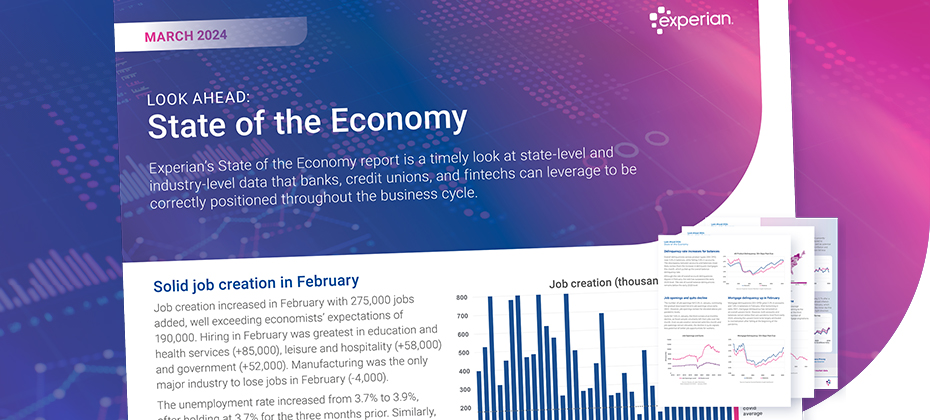
In March's State of the Economy report, we provide insights into consumer spending, the housing market, originations, and more.
Learn how an innovative income and employment verification solution like Experian Verify can help propel your business forward.

Property managers must leverage a solution that provides accurate, efficient, and compliant income and employment verification.

According to Experian’s State of the Automotive Finance Market Report: Q4 2023, EVs comprised 8.6% of total new retail transactions, an increase from 7.1% in Q4 2022.

Optimization modeling provides actionable insights that drive decisioning, allowing businesses to achieve their marketing and growth goals.

To better understand a consumer's credit behavior over time, financial institutions must leverage trended data.

Learn about the benefits of a fraud consortium and how Experian's solutions can help prevent fraud without inconveniencing consumers.

This article was updated on March 7, 2024. Like so many government agencies, the U.S. military is a source of many acronyms. Okay, maybe a few less, but there really is a host of abbreviations and acronyms attached to the military – and in the regulatory and compliance space, that includes SCRA and MLA. So, what is the difference between the two? And what do financial institutions need to know about them? Let’s break it down in this basic Q&A. SCRA and MLA: Who is covered and when are they covered? The Servicemember Civil Relief Act (SCRA) protects service members and their dependents (indirectly) on existing debts when the service member becomes active duty. In contrast, the Military Lending Act (MLA) protects service members, their spouses and/or covered dependents at point of origination if they are on active duty at that time. For example, if a service member opens an account with a financial institution and then becomes active military, SCRA protections will apply. On the other hand, if the service member is of active duty status when the service member or dependent is extended credit, then MLA protections will apply. Both SCRA and MLA protections cease to apply to a credit transaction when the service member ceases to be on active duty status. What is covered? MLA protections apply to all forms of payday loans, vehicle title loans, refund anticipation loans, deposit advance loans, installment loans, unsecured open-end lines of credit, and credit cards. However, MLA protections exclude loans secured by real estate and purchase-money loans, including a loan to finance the purchase of a vehicle. What are the interest rate limitations for SCRA and MLA? The SCRA caps interest rate charges, including late fees and other transaction fees, at 6 percent. The MLA limits interest rates and fees to 36 percent Military Annual Percentage Rate (MAPR). The MAPR is not just the interest rate on the loan, but also includes additional fees and charges including: Credit insurance premiums/fees Debt cancellation contract fees Debt suspension agreement fees and Fees associated with ancillary products. Although closed-end credit MAPR will be a one-time calculation, open-end credit transactions will need to be calculated for each covered billing cycle to affirm lender compliance with interest rate limitations. Are there any lender disclosure requirements? There is only one set of circumstances that triggers SCRA disclosures. The Department of Housing and Urban Development (HUD) requires that SCRA disclosures be provided by mortgage servicers on mortgages at 45 days of delinquency. This disclosure must be provided in written format only. For MLA compliance, financial institutions must provide the following disclosures: MAPR statement Payment obligation descriptions Other applicable Regulation Z disclosures. For MLA, it is also important to note that disclosures are required both orally and in a written format the borrower can keep. How Experian can help Experian's solutions help you comply with the Department of Defense's (DOD's) final amendment rule. We can access the DOD's database on your behalf to identify MLA-covered borrowers and provide a safe harbor for creditors ascertaining whether a consumer is covered by the final rule's protection. Visit us online to learn more about our SCRA and military lending act compliance solutions. Learn more

New account fraud can pose a serious risk to your business, and your current security methods might be hurting your customers' experience.