Mortgage Trends
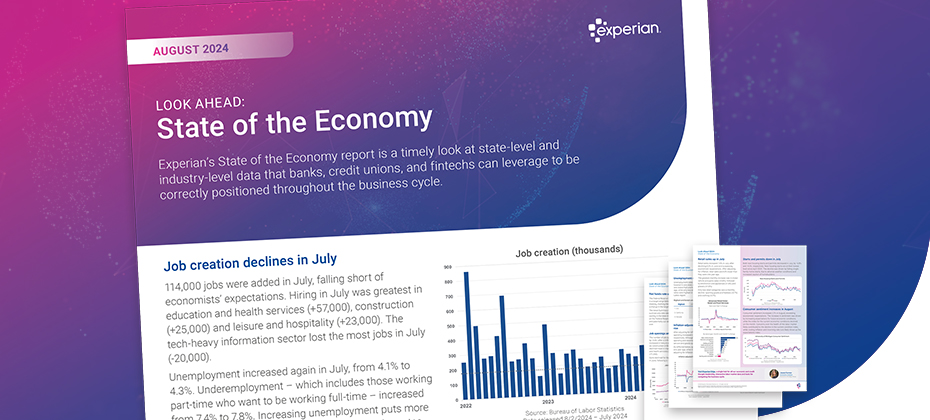
This series will dive into our monthly State of the Economy report, providing a snapshot of the top monthly economic and credit data for those in financial services to proactively shape their business strategies. The labor market has been a source of strength for the U.S. economy coming out of the pandemic, providing workers with stable employment and solid wages. However, the labor market has slowed in recent months, with lower-than-expected job creation and rising unemployment, causing weakening sentiment in the broader market. This has resulted in increased pressure on the Federal Reserve to begin cutting rates and places more importance on the incoming data between now and the September FOMC meeting. Data highlights from this month’s report include: Job creation declined in July, falling short of economists’ expectations. Unemployment increased from 4.1% to 4.3%. Inflation cooled again in July, with annual headline inflation easing from 3.0% to 2.9%. GDP picked up in Q2 to 2.8%, primarily driven by strong consumer spending. Check out our report for a deep dive into the rest of this month’s data, including the latest trends in originations, retail sales, and the new housing market. Download August's report To have a holistic view of our current environment, it’s important to view the economy from different angles and through different lenses. Download our latest macroeconomic forecasting report for our views on what's to come in the U.S. economy and listen to our latest Econ to Action podcast. For more economic trends and market insights, visit Experian Edge.

First-time homebuyers (FTHBs) represent a significant portion of the homebuying market across the United States, particularly in Texas where we see the largest proportion. While an overall diverse market segment, affordability is paramount to all. Experian Housing recently examined the mortgage landscape, looking at who is buying, where, and why, uncovering both expected and surprising insights. Texas at a glance Eight of the top ten fastest-growing US cities are in Texas. Lately, Texas business growth has included large employers, such as Amazon, Oracle, Caterpillar, Chevron, and Schwab, moving or expanding to the state. Looking for a more affordable life, consumers have also made the move. No state income tax, no corporate taxes, overall lower business taxes, business incentives, and a generally favorable cost of living make it very attractive to individuals and businesses. Recent research by Experian Housing revealed Texas accounts for the largest percentage of FTHBs in the US at nearly 10.5%, based on those getting a mortgage. Among these buyers, ~72% are Generation Y (Gen Y) and Generation Z (Gen Z), meaning they are in their early 40s and younger. Defining and measuring affordability Affordability often tips the scale for prospective first-time homebuyers, particularly younger buyers, deciding to rent or buy. Texas mortgage lenders familiar with the geography of their local markets will likely have an advantage with these consumers if they understand affordability from a citywide perspective and at a hyper-focused neighborhood or zip code level. What determines affordability? Affordability can be assessed through various metrics. For the purposes of this study, Experian Housing defined affordability by calculating the rent-to-mortgage ratio. This involves comparing monthly rent payments to monthly mortgage payments. A higher rent-to-mortgage ratio suggests renters may find mortgage payments more feasible, potentially making home buying a more appealing option. According to Experian’s latest 2023 rental market report, Gen Z and Gen Y made up nearly 70% of the U.S. rental sector. When considered with their first-time homebuyer numbers in Texas and across the U.S., their importance in defining the market trend stands out. The rent-to-mortgage analysis provides important insights into whether these buyers may look to buy now or continue renting. Texas by the numbers Experian Housing examined affordability at the city and more granular, localized levels. Among those analyzed for affordability, Experian findings included: Lubbock is the most affordable city with a rent-to-mortgage ratio of 67%. Following Lubbock were Fort Worth (64%), San Antonio (63%), andEl Paso (62%) are the next cities. Among metro areas, Houston (58%), Arlington (56%), Dallas (52%) and Austin (49%). In these cities, the low to high average current home sales price rankings tracked the rent-to-mortgage ratios except for El Paso, with the 2nd lowest average sales price, but coming in 4th in the affordability metric. Lubbock had the lowest average home sales price at $212,812. El Paso had the next lowest average sales price ($216,424), then San Antonio ($269,232) and Fort Worth ($312,579). Next came Houston ($317,882), Arlington ($345,077), Dallas ($402,830), and Austin ($598,431). Is the city center or are the suburbs more affordable? A look at the city level only tells part of the story. Examining the area by zip code reveals more insights into where loan officers might direct first-time buyer prospects. In general, based on the median rent-to-mortgage payment ratio, the farther away from the city center (outer suburbs), the more affordable buying is for first-time buyers. San Antonio proved to be the notable exception where prices trended higher in the suburbs. Mortgage lenders who are savvy about these inner-market differences, set themselves up for a greater likelihood of attracting first-time homebuyers and keeping them as loyal customers. For more information about the lending possibilities for first-time homebuyers, download our white paper and visit us online. Download white paper Learn more
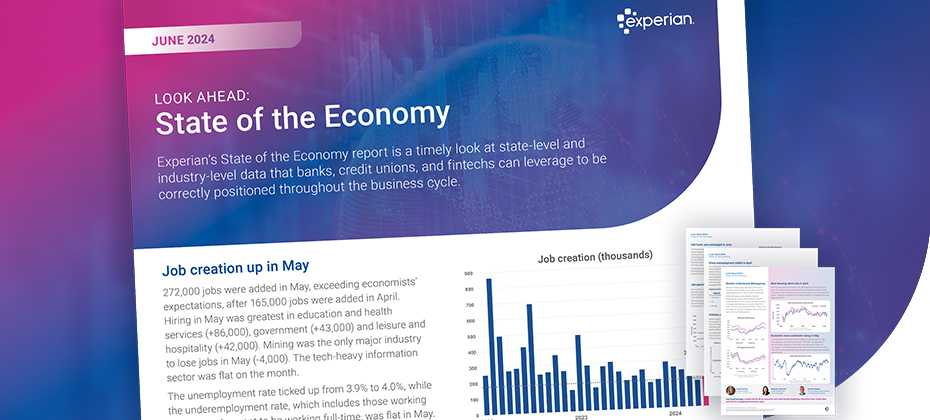
This series will dive into our monthly State of the Economy report, providing a snapshot of the top monthly economic and credit data for those in financial services to proactively shape their business strategies. During their June meeting, the Federal Reserve continued to hold rates steady and released an updated Summary of Economic Projections. In this update, the committee reduced 2024 rate cut projections from three to one and increased their year-end inflation expectations. Both of these updates were likely driven by a lack of downward progress in inflation in Q1. But as the Federal Reserve extends the period of restrictive rates, it places more weight on each monthly economic data release to inform the Fed’s next move. Data highlights from this month’s report include: Job creation exceeded economists’ expectations with 272,000 jobs added in May. Inflation cooled in May, with annual headline inflation down from 3.4% to 3.3% and annual core inflation down from 3.6% to 3.4%. Auto loan amounts decreased in Q1 as inventories continue to stabilize. Check out our report for a deep dive into the rest of this month’s data, including the latest trends in delinquencies, spending, and the new housing market. Download June's report To have a holistic view of our current environment, it’s important to view the economy from different angles and through different lenses. Watch our experts discuss the latest economic and credit trends in the recording of our latest macroeconomic forecasting webinar and listen to our latest Econ to Action podcast. For more economic trends and market insights, visit Experian Edge.

The Experian Vision conference is an annual event hosted by the leader in global information services. Vision 2024, held in Scottsdale, Arizona, from May 20-23, gathered industry leaders, data experts, and business professionals to discuss the latest trends and innovations in data and analytics. Aligned with the theme of “Powering Opportunities,” Vision 2024 featured breakout sessions offering attendees valuable insights and strategies for using data to drive business growth and success. Here are the highlights from three of the sessions focused on housing topics. Two industry experts, Sam Khater, Chief Economist at Freddie Mac and Susan Allen, SVP of Product, Experian Housing, engaged in a lively and thought-provoking discussion. The program covered the current state of the mortgage market. Susan and Sam took turns presenting their findings, exchanging ideas, and sharing their perspectives about where lenders could see opportunity in the current challenging mortgage market. They identified these current challenges and opportunities for lenders and borrowers. The economy continues to expand at a solid growth rate. Consumer spending remains firm, and the labor market is tight. The healthy economy is causing inflation and interest rates to remain higher for longer. Home purchase demand is coming off cyclical lows, but home sales remain low with mortgage rates remain above 7%. Inventory is improving modestly, but it remains very low due to chronic undersupply. The dynamic of low home sales, and even lower supply will continue to pressure home prices to increase, especially given many borrowers are moving to more affordable markets more frequently than in the past. There are 46 million likely qualified non-homeowner consumers, of which 7 million appear ready for first time homeownership. Although affordability remains a significant challenge, there are geographic regions where aspiring first-time homeowners are finding better success. Lenders are pursuing data-driven, nuanced approaches to identify and successfully reach these consumers. Three recognized industry professionals headlined this panel discussion. Eric Czajka, VP of Governance and Oversight at Rocket Companies, Experian Housing’s Susan Allen, and Product Manager for Experian Housing, Angad Paintal, shared their insights with a review of recent innovations from Rocket, including specific Experian solutions that are supporting Rocket’s consumer engagement strategy. Lenders in attendance also learned the next steps they can take to win borrowers that ready to consider a refinance. Experian showcased what’s possible with the combination of multiple data sources in a user-friendly interface to help lenders prepare for a rate reduction, including the potential triggers for conventional refinance, VA refinance and FHA refinances. Each segment needs to move 50 basis points to make the possibility of a refinance reasonable for the borrower. Vision 2024 continued with a casual conversation between Newrez COO Joshua Bishop and Chris Travis, Software Sales Expert at Experian. Participants experienced a glimpse into recent developments in mortgage technology from the Newrez leader and how these advancements reflect the industry. The program featured an exchange of questions and answers centered around three crucial topics that have significant implications for housing industry growth and development. These include economic uncertainty (interest rates, refinances, and delinquency trends), government regulations and policies (Basel III, CFPB) and technology (big data and generative AI). The key takeaway from this session was that the mortgage industry is undergoing a tech revolution. Lenders and servicers are utilizing predictive models to assess risk and personalize communication, while generative AI streamlines document processing and provides a cleaner experience for internal and external users alike. Deep analytical tools provide a clearer picture of borrower finances and hardship resolutions. This technological embrace is transforming the mortgage process, making it faster, more efficient, and more accessible. Be part of the future at Vision 2025 Vision 2024 was a resounding success, bringing together our valued clients to share innovative ideas and forge new connections. We were thrilled by the thought-provoking discussions and the collaborative spirit that permeated the event. As we look ahead to next year's conference, we eagerly anticipate even more groundbreaking conversations and opportunities for growth. Don't miss out - secure your spot now and be part of the future at Vision 2025. Register now

Mortgage lenders looking to attract first-time homebuyers must understand their needs, wants, and finances, especially as the economic environment and evolving generational trends shift. Understanding who this buyer segment is and what they buy unlocks growth potential for today’s attentive mortgage lenders. Financial diversity defines first-time homebuyers First-time homebuyers are searching for the attainable, which is not easy today. High interest rates, low housing inventory, and individual financial circumstances contribute to the hardships the housing market presents. Even with ups and downs and difficulties in the marketplace, first-time homebuyers continue to show their grit. Over two-thirds of first-time homebuyers have an annual household income over $90k, with 27% having household income over $180k. Additionally, Experian Housing research shows that 85% of first-time homebuyers have prime or super-prime credit scores. While credit and income play critical roles in evaluating borrower risk, they're not the only factors. The mortgage lending market is slowly leaning into the use of alternative credit data, such as rental payment information, to determine a borrower's creditworthiness. These changes are crucial in our industry's effort to support consumers on their journey towards homeownership. Financial realities impact property choices Experian Housing’s recent white paper looking at first-time purchasers shows over 85% buying single-family homes, with roughly 70% of these buyers belonging to Generation Y (Gen Y) and Generation Z (Gen Z). While starter homes suggest impermanence, Gen Y and Gen Z buying habits reflect their values and overall desire for stability. These motivated buyers that understand the economic woes, are adjusting and looking for options. More than three-fourths of first-time purchases are older homes, built before 2000. However, Experian’s same research showed sales of new construction homes (2021-2023) increased over the prior two years, particularly among first-time buyers. Builder credits and other incentives make new builds more appealing, and lenders leveraging their mortgage market expertise will be able to discuss options customized to the borrower, helping them make the decision best fitting their needs. Especially among younger generations, first-time homebuyers are considering different housing options in their path to homeownership. From multigenerational housing and co-owning a home with friends and family to smaller homes and moving further away for affordability reasons, options are on the table.1 Untapped potential for savvy lenders The modern mortgage landscape offers thoughtful lenders opportunities to drive growth. Diversity in the first-time homebuyer profiles means that lenders who distinguish themselves by tailoring their services to the borrower’s needs. This may include, but is certainly not limited to: Drawing on their knowledge of first-time homebuyer programs, grants and loans appropriate to the borrower. Improving their overall financial well-being with financial literacy education. Expertly guiding them through the complex lending process. Ensuring as swift and smooth a transaction as possible with timely and responsive communications. For more information about the lending possibilities for first-time homebuyers, download our white paper and visit us online. Download white paper Learn more 1 “Several Generations Under One Roof,” census.gov; “What to Know About Co-Buying A House,” myhome.freddiemac.com

In the previous episode of “The Chrisman Commentary” podcast, Joy Mina, Director of Product Commercialization at Experian, talked about the misconceptions associated with verifications and what organizations can do to enhance their strategies. In the latest episode, Experian's Ken Tromer and Jamie Norris discuss ways mortgage companies can optimize their business expenses and protect prospects. "The market has been asking for solutions to help with cost mitigation and lead protection for quite some time," said Jamie. "We've listened to the market and Power Profile Plus™ does just that." Listen to the full episode for all the details and learn more about Power Profile Plus™ for Mortgage. Listen to podcast Learn more
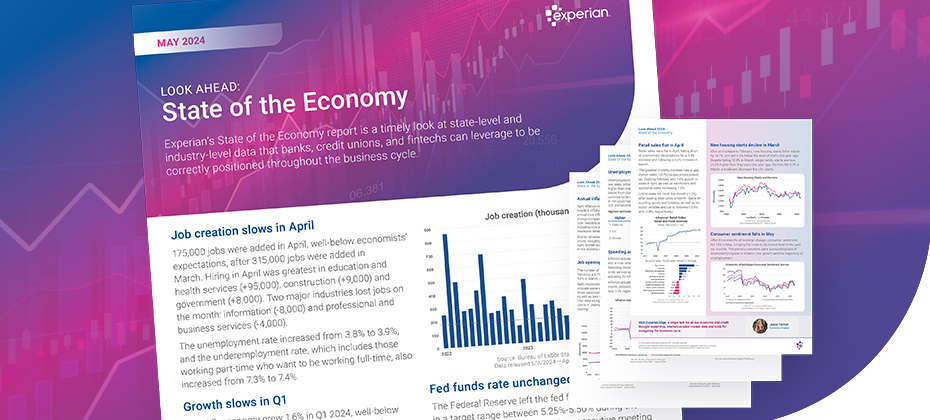
This series will dive into our monthly State of the Economy report, providing a snapshot of the top monthly economic and credit data for those in financial services to proactively shape their business strategies. After again announcing no change in the target fed funds rate during their May meeting, the Federal Reserve continues to face the decision of when to begin cutting rates. The economic data released this month only complicated this decision, as growth came in well-below expectations and the labor market seemed to ease on several fronts. However, there was only minimal downward progress in inflation, especially considering the high prices seen over the past few months. In this month’s report, we dive into the data developments that comprise this economic story. Data highlights from this month’s report include: Economic growth in Q1 came in at 1.6%, under economists’ expectations. Underlying components of consumer spending and business investment remained solid. Inflation cooled in April, with annual headline inflation down from 3.5% to 3.4% and annual core inflation down from 3.8% to 3.6%. Consumer sentiment fell 13% in May, due to stubborn inflation, low growth, and easing in the labor market. Check out our report for a deep dive into the rest of this month’s data, including the latest trends in job creation, spending, and the fed funds rate. Download May's State of the Economy report To have a holistic view of our current environment, it’s important to view the economy from different angles and through different lenses. Watch our team of experts discuss the latest economic and credit trends in the recording of our latest macroeconomic forecasting webinar, download our latest forecast scenario report, or listen to our latest Econ to Action podcast for views on the economic environment in different market segments. For more economic trends and market insights, visit Experian Edge.

Where in the U.S. would you guess first-time homebuyers are having the most success securing a mortgage? The answer may surprise you. While over one-third of first-time homebuyers reside in our most populous states, California, Texas, Florida, and New York, research from Experian Mortgage reveals they are having greater success securing a mortgage in more affordable locations, such as Minnesota, Iowa, and Indiana. Understanding who is buying properties around the nation and what drives their decision provides insight into where they are buying and why. This knowledge paves the way for mortgage lenders to create more targeted and effective marketing strategies to gain trust and win loyal borrowers. As discussed in a recent blog post on generational behaviors, Generation Z (Gen Z) and Generation Y (Gen Y) account for a sizeable majority of first-time homebuyers and nearly half of repeat buyers. Mortgage lenders who understand what motivates these young buyers and meet them where they are will be better positioned to win. Why understanding buyer traits and their motivations matters Nearly 70% of all renters are in their early 40s or younger. With rents up more than 30% since before the COVID-19 pandemic, many Americans yearn for the stability that homeownership brings to their financial well-being. Younger buyers are increasingly focusing on their overall financial health. Experian's survey of more than 2,000 millennial and Gen Z consumers across the United States revealed: ‘Better understanding personal finance’ is a goal for most consumers within both groups. Nearly 70% are actively searching for a trusted source for personal finance information. Over 30% of first-time homebuyers have a household income under $90,000 annually. They want to make decisions that align with their financial goals and position themselves well for the future, which is likely why we are seeing a higher concentration of first-time homebuyers converting in lower cost of living areas, such as the mid-west. Even for a mortgage lender outside of the geographically preferred states, those who understand their areas with minute specificity and know where opportunity and affordability meet will be best positioned for these buyers. Why strategically positioned lenders will win the day Affordability remains the operative word. The housing supply shortage heavily impacts affordability. A lack of new housing construction and limited existing home sale inventory contributed largely to the limited for sale stock. Lower interest rates can influence the affordability outlook, but rising inflation and the Federal Reserve not yet moving to lower rates has resulted in mortgage interest rates creeping upward this year.1 Additionally, overall economic indicators influence the housing market. While the Federal Reserve does not directly dictate mortgage interest rates, mortgage rates are influenced by the actions they take. Federal Reserve Chairman Jerome Powell’s recent remarks that the Fed will not likely lower rates until much later in the year due to inflation signals mortgage rates are unlikely to decrease soon.2 Mortgage lenders who dive into buyer behaviors, geographical nuances, and truly service these potential buyers will benefit. By employing market and buyer savvy strategies that resonate, you can drive both short and longer-term business growth. For more information about the lending possibilities for first-time homebuyers, read our latest white paper and visit us online. Download white paper Learn more 1 “Mortgage Rates Move Toward Seven Percent as Markets Digest Incoming Data,” freddiemac.com 2 “Federal Reserve Issues FOMC Statement,” March 20, 2024, federalreserve.gov
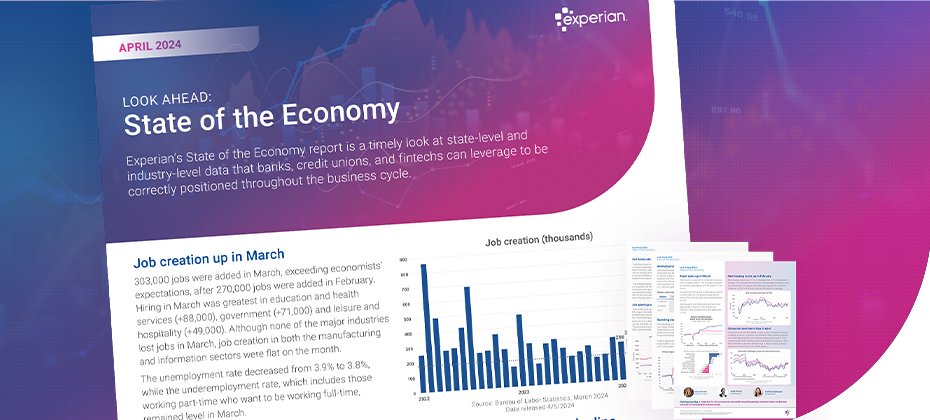
This series will dive into our monthly State of the Economy report, providing a snapshot of the top monthly economic and credit data for those in financial services to proactively shape their business strategies. During their March meeting, the Federal Reserve announced no change in the federal funds rate and released their updated Summary of Economic Projects for the remainder of 2024 and 2025. In response to slow but steady cooling inflation, they maintained projections for three rate cuts by the end of 2024. Additionally, they upgraded their growth projections and lowered their unemployment projections, signaling more optimism toward the U.S. economic trajectory. In this month's report, we dive into the data developments that are contributing to this economic story. Data highlights from this month's report include: The Federal Reserve held rates steady and maintained projections for three rate cuts by the end of the year. Inflation progress slowed, with annual headline inflation flat and annual core inflation ticking up from 3.2% to 3.5%. The median rent-to-income ratio increased 4.1% year-over-year to 37.9% nationally. Check out our report for a deep dive into the rest of April's data, including the latest trends in income, originations, and job creation. To have a holistic view of our current environment, we must understand our economic past, present, and future. Check out our annual chartbook for a comprehensive view of the past year and register for our upcoming macroeconomic forecasting webinar for a look at the year ahead. Download April's State of the Economy report Register for webinar For more economic trends and market insights, visit Experian Edge.

Click here to watch our recent webinar on first-time homebuyers. The younger generations comprise nearly 70% of first-time homebuyers, according to recent Experian Mortgage research. Understanding the generational traits of first-time homebuyers, particularly motivated younger generations, is critical to building highly targeted marketing strategies. Gen Z and Gen Y are essential in the first-time homebuyer market and represent close to 40% of repeat buyers, indicating they consider homeownership important beyond just their first purchase. Generation Y borrowers lead the pack Generation Y borrowers see homeownership as part of the American Dream but have waited longer than previous generations to purchase their first home.1 Additionally, as digital natives, they have grown up in a world with online resources and digital tools, making the home buying process more convenient for them. They can effortlessly research homes, compare mortgage rates, and even complete paperwork without leaving their home – a time and cost-saving advantage. With their desire for stability and their technological proficiency, it comes as no surprise that Gen Y borrowers are at the forefront of the homebuying market, accounting for 52% of all first-time buyers. Keep your eye on the next wave: Generation Z borrowers Although Generation Z is the youngest group with both young adults and those entering adulthood, they should not be overlooked in the real estate market. Despite their age, Gen Z possesses characteristics and tendencies that make them legitimate potential first-time homebuyers. Having grown up in an era characterized by technical advancements and economic instability, Gen Z has observed various challenges, such as the impact of the 2008 financial crisis on their families. They have also witnessed their parents and older siblings navigating student loan debt and a volatile job market. As a result, Gen Z individuals tend to approach life decisions with a cautious mindset. However, it is important to note that Gen Z is a generation known for their ambition and determination. They have an entrepreneurial spirit. A strong desire for stability. According to a recent survey conducted by Chase2, homeownership holds an important place in the dreams of nearly 90% of Generation Z individuals. This unwavering aspiration for owning a home and increasing purchasing power establishes Generation Z as a significant influence in the real estate market. Market to each generation where they are most comfortable, for Y and Z it is online and on the go To get the attention of these younger generations, mortgage lenders must understand that for these groups, digital technology is the norm, integrated into all aspects of their lives. They rely heavily on social media, online reviews, and mobile apps for research and communication. Therefore, it is crucial for lenders to implement a marketing strategy that encompasses social media platforms and personalized email, and, increasingly, text communications, to resonate with the tech savvy nature of these generations. That said, there is nuance in every population, and we see this when observing communication preferences across generations. We know, for example, that first-time homebuyers are considerably more likely than the general public to respond to e-mail offers. Understanding communication preferences for each prospect is important for tailoring your omni-channel marketing approach. Growing up in a world where technology is constantly advancing, Generations Y and Z are accustomed to having immediate access to information and services at their fingertips. As a result, they expect an efficient mortgage lending process that uses online, smartphone-enabled tools and platforms. They count on the ability to complete applications and paperwork online, receive updates and notifications via email or text, and have access to resources and tools to track and manage their mortgage journey. Lenders embracing these realities about Gen Y and Gen Z and connecting with them where they are, will be better positioned to serve this demographic and grow their own business. For more information about the lending possibilities for first-time homebuyers, download our latest white paper. Download white paper 1 “Bank of America’s 2023 Homebuyer Insights Report Explores How Hopeful Buyers are Forging Ahead,” bankofamerica.com. 2 “Millennial and Gen Z Adults Still See American Dream Within Reach Despite Challenges,” chase.com.

In the previous episode of “The Chrisman Commentary” podcast, Joy Mina, Director of Product Commercialization at Experian, talked about the benefits of a waterfall strategy for income and employment verification. In the latest episode, Joy explores common misconceptions around verifications, such as how a lender needs to put a provider with the most records first in their waterfall. "While that might feel like a sure-fire way to cut costs, it isn't necessarily the most effective," said Joy. "Instead of comparing records, I would really encourage lenders to focus on a provider's total cost to verify a consumer." Listen to the full episode to learn about more misconceptions associated with verifications and what you can do to enhance your strategies. Listen to podcast Learn more

Current economic conditions present genuine challenges for mortgage lenders. In this environment, first-time homebuyers offer exciting, perhaps unexpected, business growth potential. Market uncertainties have kept potential borrowers anxious and on the sidelines. The Federal Reserve's recent announcement that interest rates will remain steady for now has added to borrower anxiety. First-time homebuyers are no exception. They are concerned about the “right” time to jump in, buy a home, and own a mortgage. Despite worries over high interest rates and low inventory, many first-time homebuyers are tired of waiting for rates to drop and inventory to blossom. First-time buyers are eager to explore all avenues necessary to achieve homeownership. They show a willingness to be flexible when it comes to finding a house, considering options like a fixer upper or expanding their search to more affordable locations. The desire to escape the uncertainty and financial burden of renting is a strong driving force for first-time buyers. They see homeownership as a way to establish stability and build equity for their future. Despite the obstacles renters face in the competitive housing market, these potential buyers are motivated. Lenders who take time to understand who these buyers are and what matters to them will be ahead of the game. Notwithstanding stubbornly high interest rates, first-time homebuyers historically have shown remarkable resilience amid market fluctuations. According to a recent deep dive by Experian Mortgage experts into the buying patterns of first-time homebuyers, this group made 35-48% of all new purchases and 8-12% of all refinances between July 2022 and September 2023. First-time buyers represent both immediate potential and long-term client opportunities. How can lenders attract first-time homebuyers and drive growth from this market? The first-time homebuyer market largely consists of individuals in their early 40s and younger, also known as Gen Y and Gen Z. Rising costs of renting a home frustrate these individuals who are trying to save money for a down payment on a house and ultimately, buy their dream home. They want to settle down and look ahead to the future. For mortgage lenders who focus on understanding this younger first-time buyer market and developing targeted business strategies to attract them, great growth potential exists. Often, younger people feel locked out of buying opportunities, which creates uncertainty and apprehension about entering the market. This presents mortgage industry professionals with an incredible opportunity to show their value and grow their client base. To attract this market segment, lenders must adapt. Lenders must develop a comprehensive picture of this younger generation. Who are they? How do they shop? Where do they want to live? What is their financial situation? What are their financial and personal goals? Acknowledging difficulties in the housing market and showing them a well-conceived path forward to home ownership will win the day for the lender and the buyer. As interest rates are poised to decrease in 2024-2025, there is potential for a surge in demand from first-time homebuyers. Lenders should prepare for these potential buyers, now. It is crucial to reevaluate how to approach first-time buyers to identify new opportunities for expansion. Experian Mortgage examined first-time homebuyer trends to pinpoint prospects with good credit and provide analysis on potential areas of opportunity. For more information about the lending possibilities for first-time homebuyers, download our white paper. Download white paper

In an era where record-breaking home prices and skyrocketing interest rates define the mortgage landscape, borrowers find themselves sidelined by prohibitive costs. With the purchase market at a standstill, mortgage lenders are grappling with how to sustain and grow their businesses. Navigating these turbulent waters requires innovative solutions that address the current market dynamics and pave the way for a more resilient and adaptive future. Today, I’m sitting down with Ivan Ahmed, Director of Product Management for Experian’s Property Data solutions, to learn more about Experian’s Residential Property Attributes™, a new and exciting dataset that can significantly enhance mortgage marketing and mortgage lead generation strategies and drive business growth for lenders, particularly during these challenging times. Question 1: Ivan, can you provide a brief overview of Residential Property Attributes and its relevance in today’s mortgage lending landscape? Answer 1: Absolutely. Residential Property Attributes is our latest product innovation designed to revolutionize how mortgage lenders approach marketing and growth decisions. It’s a robust dataset containing nearly 300 attributes that seamlessly integrates borrower property and tradeline information, providing a more holistic view of a borrower’s financial situation. This powerful dataset empowers lenders to make well-informed, impactful marketing decisions by refining campaign segmentation and targeting. Our attributes group into five categories: Question 2: As a data-focused company, we frequently discuss the importance of leveraging data and analytics to enhance marketing performance with clients. Considering other data providers that offer property data analytics or credit behavior data, what makes our capabilities distinct? Answer 2: The defining feature of Residential Property Attributes is its integration with borrower tradeline data. Many lenders today focus primarily on credit behavior, but we consider property data analytics, a critical aspect, equally important. By merging these two components, we present lenders with a thorough and accurate understanding of their target borrowers. This combination is revolutionary for marketing leaders looking to boost campaign performance and return on investment (ROI). Consider this scenario: On paper, two borrowers may seem homogenous, with similar credit scores, payment histories, and debt-to-income ratios. However, when you incorporate property-level insights, a striking disparity in their overall financial situations emerges. This level of insight prevents possible misdirection in marketing efforts. Question 3: Could you share more about the practical benefits of Residential Property Attributes, especially regarding enhancing marketing performance? Answer 3: Residential Property Attributes is instrumental in amplifying performance. It enables precise audience segmentation, allowing lenders to tailor marketing campaigns to address specific borrower needs. Here are a few examples: Lenders can identify borrowers with over $100k in tappable equity and high-interest personal loans and credit card debt. These borrowers are ideal for a cash-out refinance campaign aimed at debt consolidation. They can use a similar approach for Home Equity Line of Credit (HELOC) or Reverse Mortgage campaigns. Another instance is the utilization of property listings data. This identifies borrowers who are actively selling their properties and may need a new mortgage loan. This insight, coupled with credit-based 'in the market' propensity scores, enables lenders to pinpoint highly motivated borrowers. Such personalization improves engagement and enhances the borrower experience. The result is a marketing campaign that resonates with the audience, thus yielding higher response rates and conversions. The integrated view provided by Residential Property Attributes is the secret ingredient enabling lenders to maximize ROI by optimizing their marketing journey at every step. Taking action As we traverse today's complex mortgage landscape, it's clear that conventional methods fall short. As we face unprecedented challenges, adopting a holistic view of borrowers via Residential Property Attributes is not an option but a necessity. It's more than a tool; it's a compass guiding lenders towards more informed, resilient, and successful futures in the ever-changing world of mortgage lending. Learn more about Residential Property Attributes

Signing new residents is not just about offering the right apartment home at the right price. Granted, that's obviously a huge part of the equation, but operators also need to provide prospective residents with a seamless shopping and leasing experience. If potential renters encounter any friction or hardships during this time, they are likely to take their home search elsewhere. Today's prospective renters want to be able to tour and gather information about apartments on their own time, and they want a quick "yes" or "no" after completing their lease application. With that in mind, automated income and employment verification - among other tools and solutions like self-guided and virtual tools, chatbots, and automated form fills, is one of the main features and technologies operators should consider implementing if they haven't already done so, to ensure we are meeting the renter where they are. Automated verification of identity, income, assets and employment For leasing managers, automated technology eliminates the need to manually collect the documents required to verify a prospect's self-reported information, which can be a tremendously time-consuming task that extends the overall leasing timeline and increases the exposure due to unoccupied units. Automated verification also reduces the opportunity for bad-faith applicants to submit fraudulent documents related to their financials or employment history. The best part about verification is the variety of options available; leasing managers can pick and choose verification options which meet their needs without breaking the tenant screening budget. Experian has multiple verification solutions and use cases to compare which one may work best for your community. The Experian difference To learn more about our suite of rental property solutions and ways we support the tenant screening process with data-driven insights, and verifications, please visit us at www.experian.com/rental. This article was originally published on MFI. Read more on MFI for a detailed look at additional tools and technologies operators should consider.

In today’s age, where speed and convenience are paramount, lenders must transform their digital income verification experience to meet customer expectations. Leveraging the benefits of instant verification is crucial to delivering a seamless experience. However, there are situations where instant verification may not be available or unable to verify customers. This is where the value of incorporating user-permissioned verification into your workflow becomes evident. Let’s explore the advantages of using a combination of instant and permissioned verification and how they can synergistically enhance coverage, reduce costs, improve efficiency, and deliver an exceptional customer experience. Instant verification: The epitome of efficiency and experience Instant verification technology enables lenders to access real-time customer data, making it the pinnacle of verification efficiency. Its ability to deliver immediate insights facilitates quick decision-making, ensuring a seamless and frictionless experience for lenders and customers. There are several benefits to streamlining your verification process, including: Speed and efficiency: Eliminate the time-consuming process of manually gathering and analyzing data to expedite loan approvals and reduce customer waiting times. Enhanced user experience: With real-time results, customers can complete their applications quickly and effortlessly, leading to increased satisfaction and higher conversion rates. Reduced risk: Assess applicant information promptly, maintaining the security and integrity of lending processes. Permissioned verification: Expanding coverage and engaging customers While instant verification technology offers numerous advantages, it may not always be available or suitable for every customer. This is where permissioned verification plays a vital role. By integrating permissioned verification into the verification workflow, lenders can expand coverage and keep customers engaged in a digital channel, reducing abandonment rates. The benefits of leveraging permissioned verification include: Convenience and speed: By granting permissioned access, customers avoid the hassle of uploading or submitting documents manually. This saves time and effort, resulting in a faster verification process. Increased coverage and reduced abandonment: Permissioned verification ensures a higher coverage rate by minimizing the potential for customer abandonment during the application process. Since the information is retrieved seamlessly, customers are more likely to complete the application without frustration. Privacy and control: Customers retain control over their data by explicitly granting permission for access. This enhances transparency and empowers individuals to manage their financial information securely. Creating a verification "waterfall" for optimal results To harness the combined power of instant and permissioned verification, lenders can establish a verification "waterfall" approach. This approach involves a cascading verification process where instant verification is the first step, followed by permissioned verification if instant verification is not available or unable to verify the customer. Example of Experian Verify’s automated verification waterfall. There are numerous advantages to adopting a “waterfall” approach, including: Cost efficiency: Lenders who prioritize instant verification save on operational costs associated with manual verification processes. The seamless transition to permissioned verification reduces the need for manual intervention, minimizing expenses and improving efficiency. Improved verification success rate: A verification waterfall ensures that alternative verification methods are readily available if the initial instant verification is unsuccessful. This increases the overall success rate of verifying customer data and reduces the likelihood of losing potential borrowers. Enhanced customer experience: The combination of instant and permissioned verification creates a streamlined and frictionless customer experience. Customers can progress seamlessly through the verification process, reducing frustration and increasing satisfaction levels. Propelling your business forward In the dynamic landscape of lending, a combination of instant and permissioned verification technologies provides significant value to lenders and customers. While instant verification delivers unparalleled efficiency and experience, incorporating permissioned verification ensures expanded coverage, reduced abandonment rates, and a seamless digital journey for customers. By implementing a verification "waterfall" approach, lenders can optimize verification processes, reduce costs, improve efficiency, and ultimately deliver an exceptional customer experience. Learn more about our solutions The advantages of instant and permissioned verification *This article leverages/includes content created by an AI language model and is intended to provide general information.