Data & Analytics

In this article...Recent trends in credit card debtThe rising tide of delinquenciesWhat is credit limit optimization?Benefits of credit limit optimizationEconomic indicators and CLO ImpactEnhanced profitability and risk mitigation This post was originally published on our Global Insights Blog. As credit card issuers grow, the size of their customer base expands, bringing both opportunities and challenges. One of the most critical challenges is managing growth while controlling default rates. Credit limit optimization (CLO) has emerged as a vital tool for banks and credit lenders to achieve this balance. By leveraging machine learning models and mathematical optimization, CLO enables lenders to tailor credit limits to individual customers, enhancing profitability while mitigating risk. Recent trends in credit card debt To understand the significance of CLO, it is essential to consider the current economic landscape. The first quarter of 2024 saw total household debt in the U.S. rise by $184 billion, reaching $17.69 trillion. While credit card balances declined slightly (a reflection of seasonal factors and consumer spending patterns), they remain a substantial component of household liabilities, with total credit card debt standing at approximately $1.26 trillion in early 2024. On average, American households hold around $10,479 in credit card debt, which is down from previous years but still significant. The average APR for credit cards in the first quarter of 2024 was 21.59%.* The rising tide of delinquencies In the first quarter of 2024, about 8.9% (annualized) of credit card balances transitioned into delinquency. This trend underscores the need for credit card issuers to adopt more sophisticated methods to assess credit risk and adjust credit limits accordingly. The rising rate of credit card delinquencies is a key driver behind the adoption of CLO strategies. What is credit limit optimization? Credit limit optimization uses advanced analytics to assess individual customers’ creditworthiness. By analyzing various data points, including payment history, income levels, spending patterns, and economic indicators, these tools can recommend optimal credit limits that maximize customer spending potential while minimizing the risk of default, all within the constraints set by the business in terms of its appetite for risk and capacity. For instance, a customer with a strong payment history and stable income might receive a higher credit limit, encouraging more spending and enhancing the lender’s revenue through interest and interchange fees. Conversely, customers showing signs of financial stress might see their credit limit reduced to prevent them from accumulating unmanageable debt. Benefits of credit limit optimization Improved profitability – By setting credit limits reflecting customers’ credit risk and spending potential, lenders can increase their revenue through higher interest and fee income. Reduced default rates – Lenders can significantly reduce the incidence of bad debt by identifying customers at risk of default and adjusting their credit limits accordingly. Improved customer satisfaction – Personalized credit limits can improve customer satisfaction, as customers are more likely to receive credit that matches their needs and financial situation. Regulatory compliance – CLO can help lenders comply with regulatory requirements by ensuring that credit limits are set based on objective, data-driven criteria. Economic indicators and CLO Impact Several economic indicators provide context for the importance of CLO in the current market. For instance, the Federal Reserve reported that in 2023, fewer than half of adult credit cardholders carried a balance on their cards, down from previous years. This indicates a more cautious approach to credit use among consumers, likely influenced by economic uncertainty and rising interest rates. Moreover, the disparity in credit card debt across different states highlights the varying economic conditions and the need for tailored credit strategies. States like New Jersey have some of the highest average credit card debts, while states like Mississippi have the lowest. This regional variation underscores lenders’ need to adopt flexible, data-driven approaches to credit limit setting. Enhanced profitability and risk mitigation Credit limit optimization is critical for credit card issuers aiming to balance growth and risk management. As economic conditions evolve and consumer behaviors shift, the ability to set personalized credit limits will become increasingly important. By leveraging advanced analytics and machine learning, CLO enhances profitability and contributes to a more stable and resilient financial system. One such solution is Experian’s Ascend Intelligence Services™ Limit, which provides an optimized strategy designed to enhance the precision and effectiveness of credit limit assignments. Ascend Intelligence Services™ Limit combines best-in-class bureau data with machine learning to simulate the impact of different credit limits in real time. This capability allows lenders to quickly test and refine their credit limit strategies without the lengthy trial-and-error period traditionally required. Ascend Intelligence Services Limit enables lenders to set credit limits that align with their business objectives and risk tolerance. By providing insights into the likelihood of default and potential revenue for each credit limit scenario, Ascend Intelligence Services Limit helps design optimal limit strategies. This not only maximizes revenue but also minimizes the risk of defaults by ensuring credit limits are appropriate for each customer’s financial situation. In a landscape marked by rising delinquencies and varying regional debt levels, the strategic use of CLO like Ascend Intelligence Services Limit represents a forward-thinking approach to credit management, benefiting both lenders and consumers. Learn More * HOUSEHOLD DEBT AND CREDIT REPORT (Q1 2024) – Federal Reserve Bank of New York
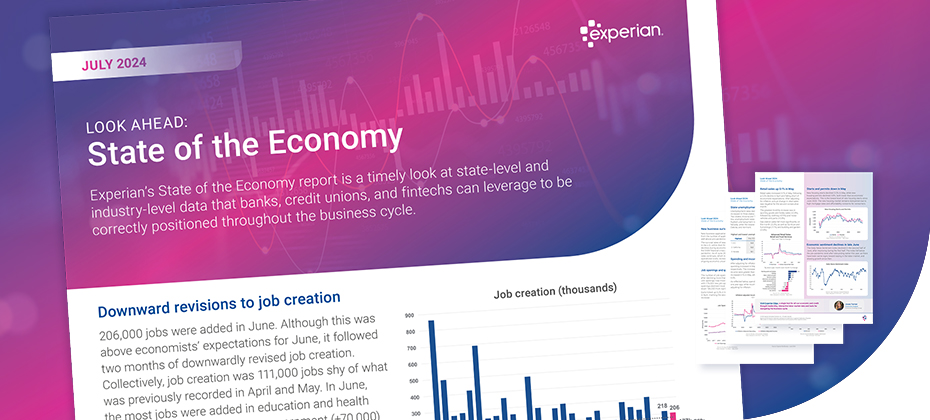
Check out July's report for a deep dive into the latest market trends, including those around job openings and bankcard delinquency rates.

Open Banking use cases are extensive and will continue to expand as access to permissioned data becomes more common. Learn more.

Learn how leveraging credit attributes can help you reduce your risk exposure, prioritize accounts, and modify your pre-collections strategy.

Ensuring fair lending practices while leveraging machine learning models is crucial for organizations committed to ethical and compliant operations.
Learn how Experian Verify™ can help mortgage companies optimize their business expenses and protect qualified prospects.

Experian’s award-winning platform now brings together market-leading data, generative AI and cutting-edge machine learning solutions.

“Learn how to learn.” One of Zack Kass’, AI futurist and one of the keynote speakers at Vision 2024, takeaways readily embodies a sentiment most of us share — particularly here at Vision. Jennifer Schulz, CEO of Experian, North America, talked about AI and transformative technologies of past and present as she kicked off Vision 2024, the 40th Vision. Keynote speaker: Dr. Mohamed El-Erian Dr. Mohamed El-Erian, President of Queens’ College, Cambridge and Chief Economic Advisor at Allianz, returned to the Vision stage to discuss the labor market, “sticky” inflation and the health of consumers. He emphasized the need to embrace and learn how to talk to AI engines and that AI can facilitate content, creation, collaboration and community Keynote speaker: Zack Kass Zack Kass, AI futurist and former Head of Go-To-Market at OpenAI, spoke about the future of work and life and artificial general intelligence. He said AI is aiding in our entering of a superlinear trajectory and compared the thresholds of technology versus those of society. Sessions – Day 1 highlights The conference hall was buzzing with conversations, discussions and thought leadership. Some themes definitely rose to the top — the increasing proliferation of fraud and how to combat it without diminishing the customer experience, leveraging AI and transformative technology in decisioning and how Experian is pioneering the GenAI era in finance and technology. Transformative technologiesAI and emerging technologies are reshaping the finance sector and it's the responsibility of today's industry leaders to equip themselves with cutting-edge strategies and a comprehensive understanding to master the rapidly evolving landscape. That said, transformation is a journey and aligning with a partner that's agile and innovative is critical. Holistic fraud decisioningGenerative AI, a resurgence of bank branch transactions, synthetic identity and pig butchering are all fraud trends that today's organizations must be acutely aware of and armed to protect their businesses and customers against. Leveraging a holistic fraud decisioning strategy is important in finding the balance between customer experience and mitigating fraud. Unlocking cashflow to grow, protect and reduce riskCash flow data can be used not only across the lending lifecycle, but also as part of assessing existing portfolio opportunities. Incorporating consumer-permissioned data into models and processes powers predicatbility and can further assess risk and help score more consumers. Navigating the economyAmid a slowing economy, consumers and businesses continue to struggle with higher interest rates, tighter credit conditions and rising delinquencies, creating a challenging environment for lenders. Experian's experts outlined their latest economic forecasts and provided actionable insights into key consumer and commercial credit trends. More insights from Vision to come. Follow @ExperianVision and @ExperianInsights to see more of the action.

Learn about the misconceptions of income and employment verifications and what lenders can do to improve their strategies.

For lenders, mitigating first payment default requires data, advanced analytics, customer engagement, and agile risk management.

When equipped with the right data and strategies, mortgage lenders can drive growth by identifying and engaging first-time homebuyers.
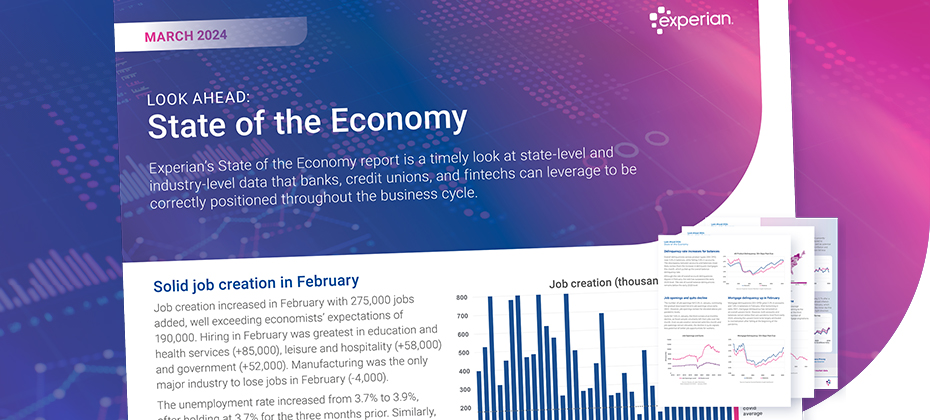
In March's State of the Economy report, we provide insights into consumer spending, the housing market, originations, and more.

Learn how an innovative income and employment verification solution like Experian Verify can help propel your business forward.

Optimization modeling provides actionable insights that drive decisioning, allowing businesses to achieve their marketing and growth goals.

To better understand a consumer's credit behavior over time, financial institutions must leverage trended data.