Tag: alternative credit data

Identity intelligence and alternative data can help lenders validate consumers and support more informed decisions across the customer lifecycle.

Start with a simple question Credit prescreen is an important tool in many lenders’ growth strategies. But the precision of any prescreen strategy depends on the data behind it. What financial behavior might traditional credit data alone not reveal? With Clarity data now available for Instant Prescreen decisioning, lenders can bring alternative credit insights into their targeting strategy, helping them identify prospects who may align with their established criteria, refine targeting strategies and explore additional acquisition opportunities while maintaining control over their risk thresholds. Additional insights alongside traditional credit data For many consumers, a traditional credit file tells a rich and reliable story. But it doesn't always tell the whole story. Consumers may also be using alternative financial products, such as small-dollar installment loans, single-payment loans, auto title loans or rent-to-own agreements and building payment histories that provide additional signals about their financial behavior. For lenders, those unseen signals can represent untapped opportunities. With more than 60 million unique subprime identities, Clarity's database helps lenders gain a more complete view of their applicant pool. Clarity data adds another dimension to that view, providing alternative credit insights that can help lenders better understand consumers whose financial behavior may not be fully represented by traditional credit data alone. How Clarity data sharpens instant prescreen decisioning Clarity provides specialty alternative credit data, with insights into subprime and near-prime consumer activity that may not appear in traditional credit files. And because Clarity is part of Experian, those insights can now be brought directly into Instant Prescreen decisioning. That means lenders can incorporate additional attributes and scores into their credit decisioning strategies without managing a separate data feed or stitching together disconnected sources. It has quickly become a visibility gap lenders can't ignore. Additional data may help support more granular segmentation and targeting strategies. Lenders remain in control of their criteria and risk thresholds while gaining additional information to inform their prescreen strategies. When considered alongside traditional credit data, alternative credit insights can support several aspects of prescreen decisioning: Identify more opportunities: Surface qualified prospects who may be harder to identify using traditional credit data alone. Refine targeting: Add alternative credit insights to help differentiate consumers with greater precision. Inform offer strategies: Use a broader view of financial behavior to help align consumers with appropriate offers. Expand intelligently: Explore incremental audience opportunities while maintaining control over your established risk criteria. Simplify execution: Access Experian and Clarity insights within a connected Instant Prescreen decisioning environment. See more opportunity in your prescreen strategy Growth doesn’t always require looking for an entirely new audience. Sometimes, it starts with seeing more in the audience already in front of you. By bringing Clarity data into Instant Prescreen, lenders can add another layer of insight to their decisioning, helping identify incremental opportunities, refine targeting and support acquisition decision processes across a broader range of consumers. Explore prescreen solutions

What if some of your best potential borrowers are the ones your traditional credit strategy can't fully see? A credit score can tell lenders a lot about a consumer, but it doesn't always capture the full picture of how someone is managing their financial life. For consumers with nontraditional income patterns or limited credit histories, that incomplete view can mean missed opportunities. In this Ask the Expert session, David Elmore of Experian talks with Michelle Goeppner, Chief Lending Officer at Vantage West Credit Union, about how alternative data can provide additional context around consumer risk, uncover opportunities traditional data alone might miss and help lenders expand their reach without disrupting strategies that already work. Who could lenders be missing? That question is especially important when a consumer’s financial life doesn’t fit neatly into a traditional credit profile. Take gig workers. Someone driving for Uber or delivering for DoorDash likely has a different income pattern than a salaried employee — irregular, seasonal, spread across platforms. That doesn't mean they aren't reliably managing bills, rent and other obligations. It just means a traditional file may not show it. Goeppner has a name for the risk of overlooking that context: FOMM — Fear of Missing Members. You've heard of FOMO — Fear of Missing Out. I think about it as FOMM — Fear of Missing Members. Who are we leaving behind if we're not using it?Michelle Goeppner, Chief Lending Officer For credit unions especially, that's not just a data question — it's a mission question. A partial view of a member's finances can mean missing a member the institution exists to serve. The credit score alone doesn't tell you where someone's headed Traditional credit data is still foundational to lending decisions. But alternative data — income, cash flow, payment behavior — adds a layer that a credit score alone can't provide. Goeppner illustrates the distinction with two consumers who have exactly the same credit score: I don't know if you're a 640 score on your way to 720 — or are you a 640 headed southwards to 580? It doesn't show me how you're managing your day-to-day financial lifeMichelle Goeppner, Chief Lending Officer Two borrowers can share the same score and be moving in opposite directions. Alternative data helps lenders tell the difference — and put that score in context rather than treating it as the whole story. Start small and layer it in Adopting alternative data doesn't mean overhauling an existing strategy. As Goeppner puts it, it's additive, not a replacement: It's not a rip and replace. You don't have to let go of your existing playbook. It's additive — you layer it in.Michelle Goeppner, Chief Lending Officer Her advice for getting started: Define the problem first. Are you trying to increase approvals, reach more underserved borrowers, or improve decisioning for a specific product? Test before you scale. Revisit loans you've already booked and ask whether alternative data would have changed the outcome — or pilot it on a single product before rolling it out further. Build in governance from day one. Document what changed, where the new data was used, and what results followed. As Goeppner puts it: “Crawl, walk, run. Slow and grow.” More loans without changing the risk profile For Vantage West, the value of that approach has shown up in its lending results. It has been an absolute game changer for us at Vantage West. We have been able to make more loans to our target members, our target segments, without changes to our risk profile.Michelle Goeppner, Chief Lending Officer That distinction matters. The goal isn't approving more loans for its own sake — it's having enough information to recognize good borrowers that traditional data alone would have missed. The result is a fuller picture of the people behind the credit file, and more confidence in deciding who a lender can serve. Explore alternative data with us Alternative data can help lenders add context to traditional credit information for a more complete view of consumers. Experian works with institutions of all sizes to incorporate additional consumer signals into existing lending strategies — strengthening decisioning, managing risk and identifying new opportunities for growth. Learn more Contact us About our experts Michelle Goeppner Chief Lending Officer, Vantage West Credit Union Michelle Goeppner is a dynamic financial services executive with over two decades of experience driving strategic growth, product innovation, and operational excellence across leading credit unions and financial institutions. Currently serving as the Chief Lending Officer at Vantage West Credit Union, Michelle leads the strategic vision for multi-billion-dollar consumer loan and deposit portfolios, as a member of the Executive Coalition. Her expertise spans consumer lending, product management, integrated marketing, and talent development, with a proven track record of leveraging fintech partnerships, automation, and data-driven strategies to optimize portfolio performance and member engagement. Throughout her career, Michelle has held pivotal leadership roles in organizations such as Alliant Credit Union and Discover Financial Services. She is recognized for her collaborative approach, detail-oriented execution, and commitment to developing future female leaders. Michelle’s contributions include founding Alliant’s Women’s Resource Group, serving on advisory councils and boards, and earning multiple industry awards for excellence and innovation. She holds an Executive Certification in Product Management from UC Berkeley, a Master of Science in Integrated Marketing Communications from Roosevelt University, and a Bachelor of Science in Marketing from Northern Illinois University. David Elmore Vice President of Fintech Sales, Experian David Elmore leads a team of fintech sales professionals at Experian focused on helping fintech organizations drive responsible, scalable growth through data-driven analytics and decisioning. With more than 20 years in financial services — a decade of it focused on fintech — he brings deep expertise in applying traditional and alternative data across the customer lifecycle. David and his team partner with fintech leaders to navigate opportunities across acquisition, underwriting, portfolio management, and collections, balancing innovation, risk, and trust.

A visibility gap lenders can't afford to ignore Alternative data is often associated with thin-file or credit invisible consumers. But its value extends far beyond those segments. Experian's Clarity Services database includes approximately one in five credit-active consumers, including one in four consumers with prime-and-above credit profiles. That means lenders may be missing important signals, not only for emerging borrowers, but also for applicants who appear well qualified using traditional bureau data alone. Consider two consumers with the same credit score. Based on traditional credit data, they may appear equally creditworthy. But when Clarity data is added, one consumer may demonstrate stable repayment behavior while another shows recent defaults on alternative finance products. The credit score hasn't changed, but the decisioning context has. That's where alternative data creates value: helping lenders distinguish between consumers who look similar on paper but represent very different levels of risk and opportunity. In this Ask the Expert session, Experian’s Julius Heim, Vice President of Analytics Product Build, Innovation and Scores, and Natasha Madan, Senior Director, Analytics Consulting, explain how different alternative data assets solve different business challenges and why the greatest return comes from using them together throughout the credit lifecycle. What that visibility gap is really costing lenders Better visibility matters because every lending decision carries consequences. Without alternative data, lenders may approve applicants whose repayment behavior suggests elevated risk but isn't reflected in a traditional credit file. Without cash flow insights, they may decline consumers who appear thin file on bureau data despite demonstrating strong income and responsible financial management. The result is a two-sided cost: avoidable bad debt on one side and missed growth opportunities on the other. But ROI extends beyond approvals alone. It also appears through stronger marketing strategies, improved conversion, reduced friction and more precise risk segmentation throughout the lending lifecycle. "ROI can mean many things ... marketing to the right people, achieving better approval rates, reducing risk, getting less friction and overall profitability."Julius Heim, Vice President of Analytics Product Build, Innovation and Scores Where alternative data creates ROI Improve approval strategies Use additional consumer signals to recover creditworthy applicants while avoiding unnecessary declines. Reduce portfolio risk Identify elevated repayment risk earlier through enhanced visibility beyond traditional bureau data. Improve portfolio performance Increase conversion, reduce friction and strengthen profitability across the credit lifecycle. Different data. Different jobs. Not all alternative data solves the same problem. Clarity Services can help lenders strengthen decisions early in the customer journey. It provides additional visibility during prospecting and acquisition, helping identify potential risk before an application moves through the underwriting process. Cash flow insights can provide value in a different way. When traditional credit information offers part of the picture, consumer-permissioned cash flow data can provide greater insight into income, spending patterns and financial capacity. That makes it especially valuable as a second look during underwriting. Together, these complementary data assets help lenders improve decisioning throughout the credit lifecycle. They can support acquisition, underwriting, account management and collections while building on the trusted foundation of traditional bureau data. Research also continues to demonstrate measurable lift when cash flow insights are combined with traditional credit information. "I recently did a study with a client where we actually saw a 20% lift in KS [Kolmogorov-Smirnov] above and beyond credit bureau data. Again, the bureau data itself was very predictive. But even from the cash flow data, we still got a 20% lift, which is an amazing stat." Julius Heim, Vice President of Analytics Product Build, Innovation and Scores The greatest value comes from using these data sources together for a more holistic consumer view. Start with proof, then build Adopting alternative data doesn't have to begin with a large transformation. A practical first step is a data study. By comparing current decision strategies with enhanced data, lenders can identify where additional visibility creates measurable lift within their own portfolios. This approach allows institutions to validate results before making broader operational changes. Every lender has different workflows, technology environments and business priorities. A flexible implementation strategy helps organizations incorporate new data in ways that support existing processes rather than disrupting them. Three ways to get started Run a data study Benchmark current decision strategies and quantify potential lift. Start simple Begin with targeted data attributes or proven scores before expanding to more advanced use cases. Build with confidence Scale implementation based on measured business outcomes and organizational priorities. This approach allows lenders to validate results, build confidence and expand their strategy over time. Explore alternative data with a trusted partner Every lending decision benefits from better consumer insight. Experian helps lenders combine trusted credit data with alternative data, cash flow insights and advanced analytics to strengthen decisioning, improve portfolio performance and uncover new opportunities for growth. Whether you're evaluating alternative data for the first time or expanding an existing strategy, Experian can help you identify where additional consumer insight can create measurable business value. Learn more Contact us About our experts Julius Heim Vice President of Analytics Product Build, Innovation and Scores, Experian Julius Heim works at the intersection of financial services, analytics and innovation. He focuses on leveraging data to drive smarter decision-making and support more inclusive financial ecosystems. Julius brings a practical perspective on how organizations can translate insights into real-world impact, with particular interest in emerging trends across fintech, credit, and the use of alternative data, such as cash-flow data, across the credit lifecycle. Previously, he served as Head of Analytics on the lender side and held roles in insurance analytics earlier in his career. Natasha Madan Senior Director, Analytics Consulting, Experian Natasha Madan partners with lenders to drive smarter, data-driven credit and risk decisions. She specializes in leveraging alternative data and advanced analytics to help organizations improve portfolio performance, optimize customer acquisition, and expand responsible access to credit. During her 15 years at Experian, Natasha has held leadership roles spanning data analytics, product analytics and consulting, giving her a broad perspective of how data can be leverage to solve complex business challenges. She has worked with a diverse range of lenders – including banks, credit unions, fintechs and specialty finance companies to develop analytics strategies that optimize customer acquisition, underwriting and portfolio management. Natasha is passionate about helping organizations unlock the full potential of data to improve both business outcomes and consumer financial inclusion.
Consumer visibility is changing Roughly 45 million Americans, or 1 in 5 consumers, are considered credit invisible or unscoreable.[1] They’re working, paying bills and participating in the economy, yet many are not fully visible during the lending process. That creates both a visibility challenge and a growth opportunity for lenders. In this Ask the Expert session, Corliss Hill, Senior Director, Inclusion and Belonging at Experian, joins Dr. Vaneesha Dutra, Endowed Professor of Finance at Morehouse College, to discuss how evolving consumer behaviors are reshaping conversations around financial inclusion and lending decisions. For lenders, visibility matters because confident decisions depend on reliable context and insight. Broader consumer signals can help institutions better understand repayment behaviors, financial stability and consumer capacity. “The benefit of banks using alternative data is that they capture a very significant and new consumer base. That's 20% of the population, 45 million Americans.”Dr. Vaneesha Dutra, Endowed Professor of Finance A more complete understanding of today’s consumers Today’s consumers often manage obligations across a wide range of payment types and financial channels, creating additional signals through cash flow activity, recurring payments and consumer-permissioned financial data. Rent, utilities, subscriptions and mobile phone payments can all provide meaningful insight into how consumers manage their financial lives. What’s changing isn’t the need for risk assessment. It’s the amount of consumer behavior lenders can now evaluate. For example, a consumer experiencing temporary financial disruption may fall behind on certain obligations while continuing to consistently pay rent, utilities and phone bills. Those recurring payment behaviors can provide important context into financial priorities and stability. “These are consumers that pay rent on time every month, pay utilities every month on time and meet many other financial obligations in a timely manner.”Dr. Vaneesha Dutra, Endowed Professor of Finance From visibility to more-informed decisioning Broader consumer insights may help lenders move from limited visibility to more informed decisioning. The conversation shifts when lenders move from asking: “Should we take a risk on this consumer?” to: “Do we have enough information to fully understand this consumer?” That broader context can help institutions: Strengthen risk assessment. Identify financially active consumers with strong repayment behaviors. Support more informed lending strategies. Alternative data isn’t about replacing established credit approaches. It’s about helping lenders build on trusted credit foundations with additional context and insight. Responsible lending starts with better context For lenders, the path forward is practical and actionable. As lenders evaluate broader consumer behaviors, three priorities become increasingly important: Modernize data strategies Incorporate broader consumer signals alongside existing credit data to create a more holistic view of repayment behavior and financial stability. Engage consumers earlier Earlier intervention may help lenders better support consumers before financial challenges become more severe. Create pathways to financial access Smaller lending opportunities can help consumers establish stronger financial profiles and demonstrate positive repayment behaviors over time. The institutions that lead will be the ones that can combine strong risk practices with a broader understanding of consumer behavior. Whitepaper: Bridging the credit divide: income, risk and inclusion in consumer finance Building on the themes discussed in this Ask the Expert session, Dr. Dutra explores how demographic shifts, evolving borrower behaviors and broader consumer visibility are reshaping lending strategies and what they mean for lenders seeking to balance growth, risk management and financial inclusion. Download whitepaper Explore alternative data with Experian Experian can help lenders combine broader consumer insights with trusted credit data to strengthen decisioning, improve risk assessment and support more-informed lending strategies. With solutions spanning identity, cash flow and advanced analytics, lenders can gain a more complete view of consumer behavior and expand access to credit with greater confidence. Learn more Watch episode 1 About our experts Corliss Hill Senior Director, Belonging Business Partner, Experian Corliss Hill is a collaborative leader well-versed in working with executive stakeholders, crossfunctional teams, external partners and community organizations to design and deliver initiatives and programs that create sustainable impact. With over 25 years of extensive experience in multicultural marketing, communications, PR and inclusion and belonging initiatives, she is dedicated to advancing equitable access to financial. Her mission is to drive impactful marketing initiatives that foster meaningful change and address systemic barriers to inclusion and the communities they serve.Hill has been a part of the Experian family since 2021, and resides in Atlanta with her daughter who is a rising 11-year-old entrepreneur. Vaneesha Dutra, Ph.D. Endowed Professor of Finance and Associate Dean, Morehouse College Vaneesha Dutra, Ph.D., serves as Associate Dean in the Division of Business and Economics. With more than 20 years of experience spanning higher education, banking and real estate, Dr. Dutra’s work focuses on the racial and gender wealth gap, financial literacy and financial decision-making. She is an active researcher and consultant whose work has earned numerous grants and fellowships, including serving as the inaugural Tracy A. Pruitt Visiting Research Faculty Fellow at the Wharton School of Business. Dr. Dutra has also been named a Research Faculty Fellow for both the Center for Black Entrepreneurship and the PNC Bank Center for Entrepreneurship. [1] Consumer Financial Protection Bureau, Expanding access to credit.

In this first episode of Ask the Expert, Experian's Jeff Hops, Senior Director of Data Platform and Product, and Erin Haselkorn, Senior Director of Analyst Relations, explore how broader data and new signals can help lenders better understand today’s consumers, while maintaining responsible decisioning. Lending is changing Interest rates, regulation, embedded finance and AI are reshaping the lending landscape. Consumer behavior is evolving just as quickly. But the core job hasn’t changed. Lenders are still making decisions about people they don’t fully know, and that makes data more important than ever. "There are periods where nothing changes, and periods where it seems like everything changes. We’re in the latter … but the core premise hasn’t changed. You’re still trying to lend to somebody you don’t know."Jeff Hops, Senior Director of Data Platform and Product To make those decisions with confidence, lenders need a strong foundation of identity, history and reliable signals. In a period of rapid change, the quality and completeness of that data become even more critical. A more complex view of today’s consumer What has changed is the consumer. Traditional credit data is foundational but can be further enhanced with visibility on how people earn, manage and move money. Income may come from multiple sources, and financial activity often spans bank accounts, applications (apps) and digital channels. Cash flow data, for example, can provide a clearer view of what’s actually coming into a consumer’s account, beyond what traditional records may show.These additional signals can help lenders better understand: Income variability across multiple earning sources Current financial behavior through cash flow activity Digital and identity-linked activity across channels These signals don’t replace traditional data; they expand it. The result is a more complete and current view of the consumer. From exploration to real-world application The conversation around broader data signals has moved beyond theory. Lenders are no longer just asking whether these signals are useful. They’re asking where, how and under what governance they can be applied across the lending lifecycle. Lenders are actively researching, testing and implementing new data sources across the lending lifecycle. What was once experimental is now operational. Institutions are progressing through a clear path: Research Understanding available signals and use cases Testing Evaluating performance in controlled environments Implementation Applying insights in production Today, alternative data is being used in areas like analytics, channel scoring and decisioning, often within governed environments that allow for safe testing and validation. AI may accelerate this shift by helping institutions identify patterns at scale, but its value depends on the strength of the underlying data: quality, governance, context and clear business use cases. More signal, more responsibility As data availability expands, lenders have access to more granular insights than ever before. That creates opportunity, but also responsibility. The institutions that lead won’t be the ones that use the most data. They’ll be the ones that know which signals to use, how to validate them and how to apply them in ways that are fair, explainable and aligned to consumer outcomes. “Institutions can unlock more granular and powerful decisions, but they have to do it responsibly.”Erin Haselkorn, Senior Director, Analyst Relations The future of lending will be shaped not just by how much data is available, but by how thoughtfully it’s applied. Keeping the consumer at the center of decisioning is essential to building trust and long-term success. Explore alternative data with us A more complete understanding of today’s consumers starts with better data. We help lenders responsibly incorporate broader data signals and advanced analytics into decisioning strategies, enhancing visibility into today’s consumers while strengthening risk assessment and expanding access to credit. Let’s work together to build more confident, more responsible lending decisions. Learn more Contact us About our experts Jeff Hops Senior Director, Data Platform and Product, Experian Jeff Hops is a Senior Director in Experian’s Financial Services and Data business with over eight years of experience driving innovation in credit and data solutions. He has led product development for Experian’s Credit Report and played a key role in launching Ascend Identity Platform™, a leading identity resolution platform. Erin Haselkorn Senior Director, Analyst Relations, Experian Erin Haselkorn is responsible for analyst relations for Experian. She has developed an understanding of key marketing trends across a broad range of verticals. Her market research around data strategy, AI, fraud, identity and data management, paired with her broad Experian product knowledge, gives her a unique understanding of business automation and data trends. Erin is a frequent spokesperson and guest blogger.

Since 1996, The Internal Revenue Service (IRS) has issued more than 27 million individual taxpayer identification numbers (ITINs) – a 9-digit number used by individuals who are required to file or report taxes in the United States but are not eligible to obtain a Social Security number (SSN). Across the country, ITIN holders are actively contributing to their communities and the U.S. financial system. They pay bills, build businesses, contribute billions in taxes and manage their finances responsibly. Yet despite their clear engagement, many remain underrepresented within traditional lending models. Lenders have a meaningful opportunity to bridge the gap between intention and impact. By rethinking how ITIN consumers are evaluated and supported, financial institutions can: Reduce barriers that have historically held capable borrowers back Build products that reflect real borrower needs Foster trust and strengthen community relationships Drive sustainable, responsible growth Our latest white paper takes a more holistic look at ITIN consumers, highlighting their credit behaviors, performance patterns and long-term growth potential. The findings reveal a population that is not only financially engaged, but also demonstrating signs of ongoing stability and mobility. A few takeaways include: ITIN holders maintain a lower debt-to-income ratio than SSN consumers. ITIN holders exhibit fewer derogatory accounts (180–400 days past due). After 12 months, 76.9% of ITIN holders remained current on trades, a rate 15% higher than SSN consumers. With deeper insight into this segment, lenders can make more informed, inclusive decisions. Read the full white paper to uncover the trends and opportunities shaping the future of ITIN lending. Download white paper

Unlock the future of fintech by exploring how alternative data is reshaping decision-making and growth strategies.
Learn how alternative data enhances credit decisioning by giving lenders deeper visibility into consumer financial behavior and improving access to credit for more consumers.
Learn how Experian's Credit + Cashflow Score leads to a 40% improvement in predictive accuracy compared with conventional credit models.

Fintech analytics transforms fragmented data into real-time decisioning power, helping lenders manage risk and earn consumer trust.

Today’s BNPL consumers are showing signs of financial responsibility, offering lenders new opportunities to empower financial futures.

Download our infographic to learn how cashflow underwriting is reshaping lending — and how you can lead the change.

As financial behavior becomes more dynamic, real-time data is emerging as a powerful tool in reshaping how lenders assess risk.
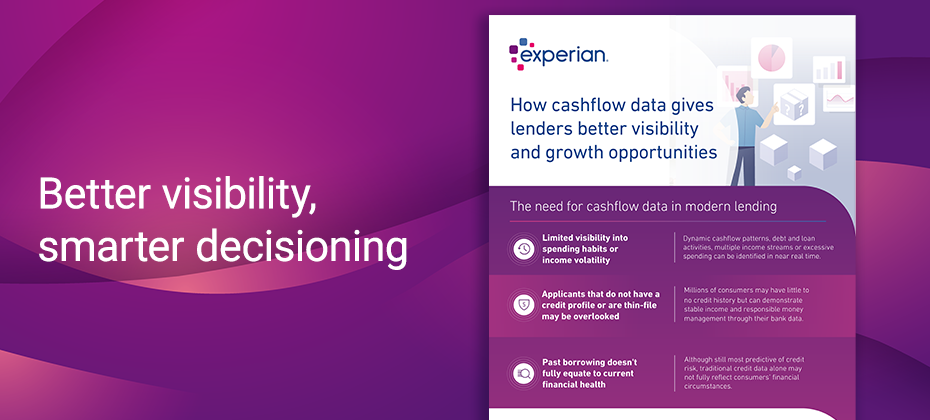
Discover how cashflow data empowers lenders to gain behavioral insights into consumers, expand market reach and make more precise decisions.