One Score. The Whole Story.

Updated: November 9, 2026 by Zohreen Ismail 3 min read November 25, 2025

At A Glance

Introducing Experian Credit + Cashflow Score, our most advanced credit decisioning model yet, integrating unparalleled data to expand credit access and empower consumers.

Every credit decision relies on data, but traditional credit information may capture only part of a consumer’s financial story. Some of that story is reflected in credit reports, the loans repaid, the cards managed, and the steady progress toward financial goals. Others live quietly in bank statements and transaction histories, like the rent paid on time, the savings set aside, and the bills managed responsibly.

Yet for millions of consumers, that second story has rarely been part of the credit conversation.

Expanding the credit conversation can give lenders and financial institutions an edge, helping them separate genuine risk from missed opportunity. In a lending environment defined by volatility and evolving consumer habits, having a more complete picture of each applicant can help make the difference between sustainable growth and risk management.

At the same time, open-banking frameworks and consumer-permissioned data have made it possible to understand financial health more clearly than traditional models. That’s where Experian’s Credit + Cashflow Score comes in.

A unified view of credit and cash flow 

The Credit + Cashflow Score is the first-of-its-kind model combining multiple data sources into a single score. Based on our pre-production analytics, early results demonstrate a 40% improvement in predictive accuracy compared with conventional credit models.

It unites our proprietary and industry-leading credit data, alternative credit insights, 24 months of trended behavior, and consumer-permissioned cashflow information into a single score ranging from 300 to 850.* This goes beyond cashflow-augmented models that rely primarily on transaction data layered over credit files.

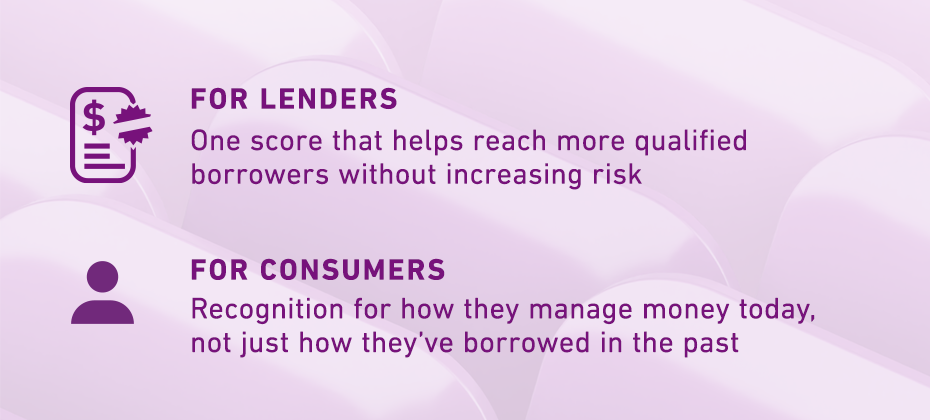
The result is a data-rich assessment of creditworthiness that allows lenders to strengthen portfolio performance, maintain disciplined risk management, and help identify qualified borrowers that traditional credit models might overlook.
Better risk control and stronger growth 

Today’s lending landscape is being reshaped by rising interest rates, increased capital costs, and heightened regulatory oversight. These pressures are prompting institutions to tighten underwriting standards and reassess risk strategies as they navigate an uncertain economy. At the same time, competition for qualified borrowers continues to intensify, creating pressure to drive sustainable growth without compromising credit quality.

Meanwhile, on the consumer side, people are earning income through gig work or multiple income streams and using alternative financial products. According to our recent market estimates, 62 million U.S. consumers are thin-file or credit-invisible1. This is making it harder for lenders to assess true financial capacity using credit data alone.

Traditional credit scores continue to remain important, but they can potentially miss key indicators of stability and affordability that appear only in transactional data. The Credit + Cashflow Score bridges that gap, helping enable lenders to expand approvals responsibly while maintaining disciplined risk management.

See what’s next 

As credit markets continue to evolve, lenders are looking for new ways to balance growth with risk. Having the whole financial picture may allow organizations to grow stronger portfolios, reach more qualified borrowers, and bring financial opportunity to more people.

Partner with Experian to leverage decades of credit expertise, the nation’s largest alternative credit bureau, and industry-leading open-banking solutions to help lenders innovate responsibly.

The Credit + Cashflow Score is built to deliver measurable performance lift, model transparency, and ease of integration through the Experian Ascend Platform.

* New score available in pre-production for analytics 
1https://www.experian.com/thought-leadership/business/the-roi-of-alternative-data 

Related Posts

How GenAI Fraud Bots Fly Under the Radar (and How to Ground Them Before It’s Too Late)

Today’s AI-powered fraud bots are exceptionally good at mimicking human behavior. Learn why a modern defense strategy is key.

November 18, 2026 by Laura Burrows
What Is Incident Response? Key Steps, Planning and Best Practices

Learn what incident response is, the key steps in the process and how to build and test an incident response plan for a data breach.

November 17, 2026 by Laura Burrows
Rethinking Charged-Off Portfolio Prioritization

Experian’s new Recovery Scores model turns portfolio intelligence into more focused recovery strategies, helping organizations improve returns, direct effort and accelerate speed to cash. The challenge isn’t simply working more accounts. Whether a debt buyer is evaluating an acquisition, an agency is deciding where to assign collector time or a lender is managing its own post-charge-off accounts, the question is similar: How can limited capacity be directed toward accounts with the greatest potential for recovery? Prioritizing accounts mainly by age, balance or when they were last worked may not show which ones are most likely to generate a recovery. With the new Recovery Scores model, organizations can rank charged-off accounts by expected collectability, providing a consistent signal to inform placement strategy and treatment decisions across the recovery lifecycle. Make collector capacity a strategic resource Working every account with the same level of attention isn’t always practical. The more useful question is: Where should teams focus first to protect speed to cash? Our model performance analysis found: 80% of recovered dollars come from the top 40% of accounts worked. The value isn’t simply a better ranking. It’s how organizations can use it for collections optimization. Score bands can inform different strategies for placement, outsourcing, auction and legal channel treatment rather than applying the same approach across an entire portfolio. For debt buyers: The scores can inform acquisition pricing and how a newly purchased portfolio is divided across internal collections, legal channels and resale. Expected collectability can shape debt portfolio analysis, including how a portfolio is valued and segmented before collection work begins. For agencies: Score bands can help teams focus collector resources on accounts with stronger recovery potential. For first-party lenders: Managing recovery internally, the scores provide another signal to help structure decisions about which accounts to work and in what order. Look beyond collectability alone Prioritization rarely comes down to a single variable. Consider two accounts that both rank highly for expected collectability, but one has a substantially larger balance. Their recovery likelihood may be similar, but the potential dollars recovered are not. The Recovery Scores model uses debt collections analytics by combining Experian’s bureau-based score with current balance information. This helps organizations consider both the likelihood of recovery and the potential dollars at stake, while sensitive balance information remains within the organization’s working environment. Monitor accounts as they change The first decision about an account is rarely the last. Teams continually make choices about treatment, placement and resource allocation as accounts move through the recovery process. Recovery Scores is also available as a trigger. When underlying information changes, teams can receive an update and reconsider an account’s placement without waiting for the next portfolio-wide re-score. An account that shows lower recovery potential today may have a different recovery outlook later. Turn recovery potential into a portfolio strategy When portfolios contain more accounts than teams can work at once, the question isn’t simply, “How many accounts can we work?” It is, “Where can our resources have the greatest impact?” The latest Recovery Scores model helps organizations sharpen placement and treatment decisions. It gives debt buyers a way to price and segment portfolios with greater confidence and gives lenders another tool to direct limited collector time across their own post-charge-off portfolios. Learn more about Experian Recovery Scores

November 10, 2026 by Zohreen Ismail

Subscribe to our Newsletter

Enter your name and email for the latest updates.

This site is protected by reCAPTCHA and the Google Privacy Policy and Terms of Service apply.

Subscribe to our Newsletter

Don't miss out on the latest industry trends and insights!
Subscribe