Search Results for: synthetic id

Sophisticated criminals work hard to create convincing, verifiable personas they can use to commit fraud. Here are the 3 main ways fraudsters manufacture synthetic IDs:


A synthetic identity epidemic is impacting all markets. Here are the three ways that synthetic identities are generally created

Synthetic identity fraud is an epidemic that does more than negatively affect portfolio performance. It can hurt your reputation as a trusted organization.

Synthetic ID fraud is a growing problem driven by an online and mobile-driven market, along with an increase in data breaches and dark web sharing.

Fraudsters combine and manipulate real consumer data with fictitious demographic information to create a “new” or “synthetic” identities.

As we prepare to attend next week’s FS-ISAC & BITS Summit we know that the financial services industry is abuzz about massive losses from the ever-evolving attack vectors including DDoS, Malware, Data Breaches, Synthetic Identities, etc. Specifically, the recent $200 million (and counting) in losses tied to a sophisticated card fraud scheme involving thousands of fraudulent applications submitted over several years using synthetic identities. While the massive scale and effectiveness of the attack seems to suggest a novel approach or gap in existing fraud prevention controls, the fact of the matter is that many of the perpetrators could have been detected at account opening, long before they had an opportunity to cause financial losses. Synthetic identities have been a headache for financial institutions for years, but only recently have criminal rings begun to exploit this attack vector at such a large scale. The greatest challenge with synthetic identities is that traditional account opening processes focus on identity verification compliance around the USA PATRIOT Act and FACT Act Red Flags guidance, risk management using credit bureau scores, and fraud detection using known fraudulent data points. A synthetic identity ring simply sidesteps those controls by using new false identities created with data that could be legitimate, have no established credit history, or slightly manipulate elements of data from individuals with excellent credit scores. The goal is to avoid detection by “blending in” with the thousands of credit card, bank account, and loan applications submitted each day where individuals do not have a credit history, where minor typos cause identity verification false positives, or where addresses and other personal data does not align with credit reports. Small business accounts are an even easier target, as third-party data sources to verify their authenticity are sparse even though the financial stakes are higher with large lines of credit, multiple signors, and complex (sometimes international) transactions. Detecting these tactics is nearly impossible in a channel where anonymity is king — and many rings have become experts on gaming the system, especially as institutions continue to migrate the bulk of their originations to the online channel and the account opening process becomes increasingly faceless. While the solutions described above play a critical role in meeting compliance and risk management objectives, they unfortunately often fall short when it comes to detecting synthetic identities. Identity verification vendors were quick to point the finger at lapses in financial institutions’ internal and third-party behavioral and transactional monitoring solutions when the recent $200 million attack hit the headlines, but these same providers’ failure to deploy device intelligence alongside traditional controls likely led to the fraudulent accounts being opened in the first place. With synthetic identities, elements of legitimate creditworthy consumers are often paired with other invalid or fictitious applicant data so fraud investigators cannot rely on simply verifying data against a credit report or public data source. In many cases, the device used to submit an application may be the only common element used to link and identify other seemingly unrelated applications. Several financial institutions have already demonstrated success at leveraging device intelligence along with a powerful risk engine and integrated link analysis tools to pinpoint these complex attacks. In fact, one example alone spanned hundreds of applications and represented millions of dollars in fraud saves at a top bank. The recent synthetic ring comprising over 7,000 false identities and 25,000 fraudulent cards may be an extreme example of the potential scope of this problem; however, the attack vector will only continue to grow until device intelligence becomes an integrated component of all online account opening decisions across the industry. Even though most institutions are satisfying Red Flags guidance, organizations failing to institute advanced account opening controls such as complex device intelligence can expect to see more attacks and will likely struggle with higher monetary losses from accounts that never should have been booked.

AI agents are changing the way consumers interact with businesses online. Learn how you can establish greater confidence in AI transactions.
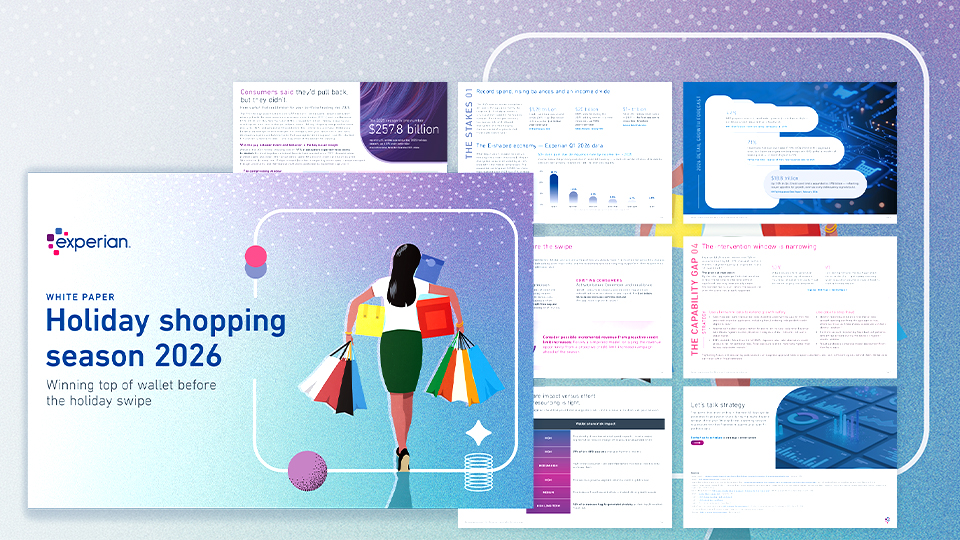
Every year, consumers say they'll spend less during the holidays. Every year, many do the opposite. Ahead of the 2025 holiday shopping season, 57% of consumers told Deloitte they expected the economy to weaken, the most pessimistic outlook recorded in the survey's history. Planned holiday spending was down 10%. Yet by the end of the season, online holiday sales reached a record $257.8 billion, up 6.8% year over year. Credit card balances climbed to $1.28 trillion, and Buy Now, Pay Later (BNPL) financing surpassed $20 billion during the holiday period. For lenders, the takeaway is to identify and engage the right consumers before the holidays were best equipped to capture that spending while effectively managing risk. As the 2026 holiday season approaches, Experian's latest market insights suggest that while credit performance appears relatively stable at the portfolio level, important shifts beneath the surface are changing how lenders should evaluate both opportunity and risk. Holiday shopping season 2026 Winning top of wallet before the holiday swipe Download the white paper now Holiday lending decisions happen long before the holidays It’s been observed that the holiday shopping season has expanded – beginning before Black Friday – over recent years. While Cyber Week continues to generate headlines, holiday spending is becoming more distributed throughout the quarter. For lenders, that means strategies must be in place before peak shopping begins. Credit line increases, portfolio reviews, acquisition strategies and risk segmentation completed in late summer often determine how much holiday spending an institution can safely capture. At the same time, early signs of credit deterioration are emerging faster than traditional portfolio metrics suggest reinforcing the importance of identifying emerging portfolio risk early rather than relying solely on broad portfolio performance indicators. Income is becoming a stronger predictor of credit performance One of the most notable shifts in today's lending environment is the growing relationship between income and future credit performance. Experian's data suggests the market is becoming increasingly polarized. The population earning more than $250,000 annually has more than doubled since 2023, but more than one-quarter of those consumers have since moved into lower income brackets, often following retirement or job loss. Meanwhile, consumers earning less than $50,000 annually show relatively little income mobility, with approximately 85% remaining in the same income band year-over-year. These trends highlight an important reality: a credit score alone may no longer provide a complete picture of borrower risk. Four priorities before peak holiday spending With only a short window before holiday borrowing accelerates, lenders have an opportunity to strengthen both growth and risk strategies. Key areas of focus include: Refine acquisition strategies Move beyond score-only targeting by incorporating verified income, cash flow and existing credit relationships to identify qualified borrowers. Optimize existing portfolios Identify customers demonstrating positive credit migration and proactively evaluate opportunities to increase credit lines before peak spending begins. Monitor emerging credit risks Use early-stage delinquency indicators and behavioral signals to identify potential performance issues before losses accelerate. Strengthen fraud management and prevention Seasonal account openings and increased transaction volumes create greater fraud exposure. Identity verification, synthetic identity detection and dormant account monitoring remain critical during high-volume acquisition periods. Preparing for the holiday shopping season ahead The 2025 holiday season demonstrated that consumer spending decisions don't always align with consumer sentiment. How does that translate for the 2026 shopping season? For lenders, success will depend less on reacting to spending trends in November and more on making informed credit decisions months earlier. As consumer financial behavior continues to evolve, combining traditional credit data with income, cash flow and alternative data can provide a more complete understanding of both opportunity and risk. Institutions that incorporate these broader insights into acquisition, portfolio management and fraud strategies will be better positioned to grow responsibly during one of the year's most active lending periods. Ready to learn more? Access the full white paper

The why behind Experian's acquisition of AtData What happens when a comprehensive email intelligence database joins a global leader in data, analytics and fraud prevention? The acquisition of AtData adds 25+ years of building a complete view of email as an identity signal. Financial institutions can recognize, engage and protect customers unlocking a new standard for the way their teams work and the customer experience. That's what Experian's acquisition of AtData delivers. How we got here Not all email addresses tell the same story. Some are newly created. Some exhibit bot-like patterns. Some are inconsistent with every other signal you have about that person. Imagine a real customer. You have a job. You shop online. You have a primary email from your employer, a personal Gmail you've used for 15 years, and an old Yahoo address you still use for shopping because you've been using it since college. You're an engaged customer who interacts with brands, makes purchases and pays bills on time. But each system sees a different version of you. When you apply for credit, the lender sees one email. When you shop, the retailer sees another. When you sign up for a service, you might use the third. For financial institutions: You slow down the approval process to manually verify identity or approve applicants without the full picture. For retailers: You can't tell which version of "customer" is the most engaged, so you either over-mail or under-serve. For fraud systems: Sees a new account created under one email and flags it as suspicious because it doesn't have the history. This was the original problem AtData was built to solve in 1999. Twenty-five years later, that problem didn’t go away, it became more complex. Email fragmentation and device sharing are more common, and identity theft is more sophisticated. Capabilities that now work together Experian has built sophisticated identity and fraud solutions backed by consumer data resources and decades of expertise in credit and risk. AtData brought the ability to assess whether an email address is trustworthy, reachable and consistent—at scale, in real time. Experian is now making email intelligence foundational, not optional. This matters for: Fraud prevention and risk management: Distinguishing a returning customer from a new threat. Knowing whether an email is newly created, exhibiting bot-like patterns or inconsistent with other identities is crucial. Compliance: Building audit trails that can explain identity decisions. Email data history and behavioral signals create the documentation needed to defend your decisions. Credit: Verifying identity in a world where traditional signals are shifting. Email signals provide a persistent, durable identifier that confirms who someone actually is. Marketing: Reaching the right person across email, mail and digital channels. Email intelligence reveals which addresses are actively engaged and reachable. Research shows email remains one of the highest-ROI marketing channels outperforming paid search and social advertising1. The problem every marketer faces: You end up burning budget on addresses that bounce, are unmonitored or are associated with users who never open mail. For credit marketing specifically, email enables faster, more targeted delivery of firm offers across channels, something that's increasingly important in a post-cookie world. "Email is a persistent identifier in a fragmented world. It's what connects a person's postal address, phones, devices, behaviors—the full picture of who they are. By embedding that into our infrastructure, we're not just adding another data point. We're fundamentally improving how businesses understand who their customers are."- Ashley Knight, Senior Vice President, Financial Services and Data Why now? AI is reshaping how decisions are made in every industry. Models are getting faster, more automated and more embedded in core workflows. But AI is only as effective as the data behind it. Fragmented data + fast models = faster, larger-scale misclassifications. In an era of synthetic identities, AI agents, deepfakes and AI-generated activity, the value of durable, persistent, real-world data signals has increased dramatically. Deloitte’s Center for Financial Services projects that generative AI could drive fraud losses in the U.S. up to $40 billion by 2027, a 32% growth rate since 2023. And email sits at the center of it with business email compromise already being one of the most common and costly fraud types. People change phones, move homes and swap devices, but they often hold onto their email for years. That's the signal that protects your business, and the one we've built into the core of how we help you make decisions with confidence. View the press release here

Explore key findings and insights from our newly released 2026 U.S. Identity and Fraud Report. Read more now!

A new reality for screening providers Everything about the candidate checked out. Their resume reflected the right experience. Their references confirmed it. The background screening process came back clean. From outside, there was no reason to hesitate. So, the company didn’t. But within weeks, small inconsistencies began to surface. The employee struggled in ways that didn’t match their credentials. Follow-up questions led to vague answers. Eventually, a deeper review uncovered the issue; this wasn’t just a case of exaggeration. It was candidate fraud. And increasingly, it’s not just individuals acting alone. In a widely reported scheme, foreign operatives posed as legitimate remote IT workers, using stolen identities and AI-assisted interviews to secure jobs at major Fortune 500 companies. Once hired, access was handed off, allowing bad actors to infiltrate corporate systems and generate millions in illicit revenue. In one case, a single individual funneled over $17 million to a foreign operation. These weren’t obvious scams. The candidates passed interviews. They cleared checks. And that’s exactly the point. For background screening and verification providers, this shift presents both a challenge and an opportunity. As candidate fraud becomes more sophisticated, your clients are no longer just looking to verify records – they’re looking to trust identity itself, and they’re looking to you to help them do it. The assumption that no longer holds For decades, hiring has relied on a simple premise: verify the records, resume, and you can trust the candidate. That model worked when identity was easier to validate in person. But in today’s digital-first hiring environment, identity can oftentimes be asserted, not proven. At the same time, identity-based fraud is accelerating. Synthetic identity fraud alone accounts for billions in annual losses, and employers are increasingly encountering candidates whose identities are far more difficult to validate than their resumes. This creates a critical disconnect: Organizations are still verifying records, but those records may be tied to identities that were never legitimate to begin with. Increasingly, they’re turning to their screening partners to close that gap. The reality of candidate fraud 31% of employers have interviewed candidates using a false identity Only 19% feel confident they can detect fraud in hiring 1 in 4 companies report losses of$50K+from fraudulent hires Why candidate fraud is getting harder to see The nature of candidate fraud has fundamentally changed. At one end of the spectrum, companies are still dealing with candidates who falsify resumes, costing businesses time and money when the truth comes to light later. But at the other end, the threat has escalated dramatically. Coordinated fraud rings are now using stolen identities and AI-assisted interviews to place individuals into remote roles, sometimes without ever revealing their identity. And this isn’t slowing down. According to Gartner, by 2028, 1 in 4 candidates could be fake, driven by AI, remote hiring, and identity manipulation. For screening providers, this introduces a new level of complexity. The challenge is no longer just delivering verified records; it’s helping clients surface risks that traditional screening processes were not designed to identify. What traditional screening still gets right None of this diminishes the importance of pre-employment screening. Verifying employment history, education, and background remains a critical part of responsible hiring, and it should. But even the most thorough screening process is designed to answer a specific question: Do the records align with the identity provided? What it does not answer is the question that matters most now: Is that identity real? That gap between record verification and identity validation is where modern fraud operates. And it represents an opportunity for screeners to expand their role from record validation to helping enable stronger identity confidence. The cost of believing everything is working When fraud moves through the hiring process undetected, the consequences aren’t always immediate, but they can be significant. There are financial risks, compliance exposure and potential access to sensitive systems. But there’s also a more subtle —and often overlooked — impact: The assumption that existing processes are working as intended. When fraudulent candidates pass through screening, it reinforces confidence in processes that may not be equipped for today’s threat landscape. Over time, that false sense of security can become a vulnerability. From screening provider to strategic partner As hiring evolves, so do expectations. Employers are no longer just looking for faster background checks - they’re looking for greater confidence in who they’re hiring. This shift creates an opportunity for screening providers to move upstream in the hiring process. By introducing identity verification earlier in the workflow, providers can help clients detect candidate fraud sooner, reduce downstream risk, and strengthen the integrity of hiring decisions. More importantly, it allows providers to differentiate their offerings in an increasingly competitive market, shifting from a transactional service to a more strategic capability. A shift in thinking: Identity before everything else To address modern candidate fraud, organizations don’t just need better tools; they need a different starting point. Instead of beginning with records, leading providers are beginning with identity. They are asking a more fundamental question earlier in the process: Is this person who they say they are? Is this person a real, consistent and verifiable person? When that foundation is established, everything that follows becomes more meaningful. Background checks become more reliable. Verification becomes more consistent. And the ability to detect candidate fraud improves, not because the process is longer, but because it’s more informed. In this model, identifying potential fraud becomes proactive rather than reactive. Why identity verification matters more now than ever The shift to remote and digital hiring hasn’t just changed how companies hire – it’s changed how fraud occurs. Today, a significant portion of fraudulent activity targets the employment process, making it a key point of exposure for identity misuse. In fact, 45% of all false document submissions now occur in the employment sector. In many cases, candidates who falsify information still progress through hiring workflows. A study revealed that 70% of candidates who falsify information still get hired. This reinforces today’s reality: Fraud is no longer slipping through the cracks; it’s moving through the front door. How Experian helps close the identity gap Experian® helps background screeners and verification providers bridge the gap between who a candidate claims to be and who they are. By combining identity verification, fraud detection, and verification solutions, Experian enables providers to enhance their existing solutions – without disrupting their workflows. This allows you to extend your value beyond traditional screening, help clients detect candidate fraud earlier, and strengthen confidence in hiring outcomes. The result is not just better screening, it’s a stronger strategic position in your clients’ hiring ecosystem, one that reduces risk while improving speed and confidence. Candidate fraud isn’t an edge case anymore. It reflects a broader shift in how identity works in a digital world. And while traditional screening remains essential, it may not be sufficient on its own. Because if identity is uncertain, every subsequent check is built on unstable ground. But when identity is established earlier in the process, everything that follows becomes more dependable. Don’t just verify the candidate records, verify the identityLearn how Experian helps screening providers embed identity verification at the start of the hiring journey to help detect candidate fraud earlier, reduce risk, and strengthen screening outcomes. Explore Experian’s Fraud Prevention Playbook for Pre-Employment Screening FAQs

For many banks, first-party fraud has become a silent drain on profitability. On paper, it often looks like classic credit risk: an account books, goes delinquent, and ultimately charges off. But a growing share of those early charge-offs is driven by something else entirely: customers who never intended to pay you back. That distinction matters. When first-party fraud is misclassified as credit risk, banks risk overstating credit loss, understating fraud exposure, and missing opportunities to intervene earlier. In our recent Consumer Banker Association (CBA) partner webinar, “Fraud or Financial Distress? How to Differentiate Fraud and Credit Risk Early,” Experian shared new data and analytics to help fraud, risk and collections leaders see this problem more clearly. This post summarizes key themes from the webinar and points you to the full report and on-demand webinar for deeper insight. Why first-party fraud is a growing issue for banks Banks are seeing rising early losses, especially in digital channels. But those losses do not always behave like traditional credit deterioration. Several trends are contributing: More accounts opened and funded digitally Increased use of synthetic or manipulated identities Economic pressure on consumers and small businesses More sophisticated misuse of legitimate credentials When these patterns are lumped into credit risk, banks can experience: Inflation of credit loss estimates and reserves Underinvestment in fraud controls and analytics Blurred visibility into what is truly driving performance Treating first-party fraud as a distinct problem is the first step toward solving it. First-payment default: a clearer view of intent Traditional credit models are designed to answer, “Can this customer pay?” and “How likely are they to roll into delinquency over time?” They are not designed to answer, “Did this customer ever intend to pay?” To help banks get closer to that question, Experian uses first-payment default (FPD) as a key indicator. At a high level, FPD focuses on accounts that become seriously delinquent early in their lifecycle and do not meaningfully recover. The principle is straightforward: A legitimate borrower under stress is more likely to miss payments later, with periods of cure and relapse. A first-party fraudster is more likely to default quickly and never get back on track. By focusing on FPD patterns, banks can start to separate cases that look like genuine financial distress from those that are more consistent with deceptive intent. The full report explains how FPD is defined, how it varies by product, and how it can be used to sharpen bank fraud and credit strategies. Beyond FPD: building a richer fraud signal FPD alone is not enough to classify first-party fraud. In practice, leading banks are layering FPD with behavioral, application and identity indicators to build a more reliable picture. At a conceptual level, these indicators can include: Early delinquency and straight-roll behavior Utilization and credit mix that do not align with stated profile Unusual income, employment, or application characteristics High-risk channels, devices, or locations at application Patterns of disputes or behaviors that suggest abuse The power comes from how these signals interact, not from any one data point. The report and webinar walk through how these indicators can be combined into fraud analytics and how they perform across key banking products. Why it matters across fraud, credit and collections Getting first-party fraud right is not just about fraud loss. It impacts multiple parts of the bank. Fraud strategy Well-defined quantification of first-party fraud helps fraud leaders make the case for investments in identity verification, device intelligence, and other early lifecycle controls, especially in digital account opening and digital lending. Credit risk and capital planning When fraud and credit losses are blended, credit models and reserves can be distorted. Separating first-party fraud provides risk teams a cleaner view of true credit performance and supports better capital planning. Collections and customer treatment Customers in genuine financial distress need different treatment paths than those who never intended to pay. Better segmentation supports more appropriate outreach, hardship programs, and collections strategies, while reserving firmer actions for abuse. Executive and board reporting Leadership teams increasingly want to understand what portion of loss is being driven by fraud versus credit. Credible data improves discussions around risk appetite and return on capital. What leading banks are doing differently In our work with financial institutions, several common practices have emerged among banks that are getting ahead of first-party fraud: 1. Defining first-party fraud explicitly They establish clear definitions and tracking for first-party fraud across key products instead of leaving it buried in credit loss categories. 2. Embedding FPD segmentation into analytics They use FPD-based views in their monitoring and reporting, particularly in the first 6–12 months on book, to better understand early loss behavior. 3. Unifying fraud and credit decisioning Rather than separate strategies that may conflict, they adopt a more unified decisioning framework that considers both fraud and credit risk when approving accounts, setting limits and managing exposure. 4. Leveraging identity and device data They bring in noncredit data — identity risk, device intelligence, application behavior — to complement traditional credit information and strengthen models. 5. Benchmarking performance against peers They use external benchmarks for first-party fraud loss rates and incident sizes to calibrate their risk posture and investment decisions. The post is meant as a high-level overview. The real value for your teams will be in the detailed benchmarks, charts and examples in the full report and the discussion in the webinar. If your teams are asking whether rising early losses are driven by fraud or financial distress, this is the moment to look deeper at first-party fraud. Download the report: “First-party fraud: The most common culprit” Explore detailed benchmarks for first-party fraud across banking products, see how first-payment default and other indicators are defined and applied, and review examples you can bring into your own internal discussions. Download the report Watch the on-demand CBA webinar: “Fraud or Financial Distress? How to Differentiate Fraud and Credit Risk Early” Hear Experian experts walk through real bank scenarios, FPD analytics and practical steps for integrating first-party fraud intelligence into your fraud, credit, and collections strategies. Watch the webinar First-party fraud is likely already embedded in your early credit losses. With the right analytics and definitions, banks can uncover the true drivers, reduce hidden fraud exposure, and better support customers facing genuine financial hardship.
Explore how Experian Verify™ uses multi-layered identity pinning to enhance data accuracy and fight synthetic fraud in today’s evolving verification landscape. Learn why dual PIN validation is becoming essential for secure, real-time income and employment verification.
In today’s showrooms, fraud doesn’t walk in wearing an obvious disguise. It looks like a “perfect” deal: Clean driver’s license Solid story Willing to sign anything … and then the payments never show up. Your team is stuck in the middle: protect the store from fraud and keep the buying experience fast and friendly. That’s exactly what Fraud Protect™ is built to do—a web-based Experian solution that helps automotive dealers quickly verify customer identities and detect fraud risk right from their CRM, on the customer’s own phone. How Fraud Protect makes identity verification quick and easy Fraud Protect is designed to slide into the process you already use, not blow it up. Here’s the actual flow. 1. Launch from your CRM The dealer starts everything from the CRM: Your team sends the customer a secure link directly from your CRM via SMS or email. The customer opens that link on their own mobile device and completes the flow on their phone. No special hardware. No juggling devices at the desk. 2. License authentication Next, the customer authenticates their driver’s license: They scan their license using their phone camera. The image is securely captured and processed in the background to ensure the license complies with standards. This kicks off document checks and helps anchor the identity to a real-world credential, without unsecured paper or digital copies, creating additional dealership risk! 3. Selfie capture for biometric match Then Fraud Protect confirms the person matches the document: The customer takes a selfie on their phone. Fraud Protect performs a biometric match between the selfie and the license image. If someone is trying to use a stolen or borrowed ID, this is where things start to fall apart for them. 4. One-time passcode (OTP) verification Fraud Protect also validates digital contact points if a heightened risk of third-party fraud is determined : A one-time passcode is sent to confirm the customer’s mobile phone number. The customer enters that OTP, proving they control those channels. Now you’ve tied a face, an ID, and real contact points together. 5. Identity verification & results into the CRM Behind the scenes, Fraud Protect: Runs the collected data through Experian’s fraud and identity analytics, including historical identity information and credit usage patterns. Identifies potential risks tied to that identity. Sends clear, easy-to-read results back into the dealer’s CRM—icons, scores and flags your team can actually act on. Dealerships never leave their system of record; they just see a clean signal on whether to proceed, step up, or take a harder look. What’s powering all this under the hood Fraud Protect sits on Experian’s proven fraud and identity stack: Precise ID® – Experian’s identity risk and fraud platform, using machine learning to detect first-party, third-party and synthetic identity fraud. Datos Insights named Experian’s First Party Fraud Scores a Silver Medalist for Best First-Party Fraud Innovation in its 2025 Impact Awards CrossCore® – Experian’s fraud and identity orchestration platform, recognized by KuppingerCole as an Overall, Product, Innovation and Market Leader in Fraud Reduction Intelligence Platforms. These aren’t just our claims. The superiority of Experian’s fraud prevention capabilities has been recognized by reputable industry experts, such as Datos Insights, Juniper Research, KuppingerCole, and others—proof that the analytics you rely on have been tested and validated outside of your four walls. What this actually means for dealers Boil it down, Fraud Protect gives you: Streamlined identity proofing : Customers complete license scan, selfie and OTP verification on their own phone via a secure link from your CRM—no clunky hardware, no awkward workflows. And it works well in-person or remote. Stronger fraud detection up front: Identity, device and contact points are tied together and evaluated using Experian’s fraud analytics, helping you spot high-risk identities before the deal advances. Simple, actionable results for your team: Instead of raw data, users see clear scores, icons and flags in the CRM, so they know when to green-light, step up verification or escalate friction. Documented protection: Creates a consistent, documented identity verification trail that helps show lenders you’ve met your obligations to appropriately verify customers—supporting a stronger fraud mitigation posture and helping reduce fraud-related charge-offs and disputes. You get more confidence in the deals you say “yes” to, and a better footing when questions come up later. When to put Fraud Protect on the table Fraud Protect is worth a serious look if you’re seeing: More ID-related issues or suspicious stories at the desk Growth in remote, digital or hybrid deals where you can’t rely on in-person cues Pressure from lenders or OEMs to tighten identity verification and fraud controls Increasing lender chargebacks or funding challenges tied to suspected fraud or identity concerns Lack of clear criteria for determining which deals to scrutinize more closely and which to fast-track Internal concern about first-party or synthetic fraud sneaking through as “good” deals In those scenarios, Fraud Protect gives you a way to upgrade your identity verification to something lenders recognize and customers are already used to from other digital experiences. Explore Fraud Protect: https://www.experian.com/automotive/fraud