Search Results for: synthetic id
So many insights and learnings to report after the first full day of 2017 Vision sessions. From the musings shared by tech engineer and pioneer Steve Wozniak, to a panel of technology thought leaders, to countless breakout sessions on a wide array of business topics … here’s a look at our top 10 from the day. A mortgage process for the digital age. At last. In his opening remarks, Experian President of Credit Services Alex Lintner asked the audience to imagine a world when applying for a mortgage simply required a few clicks or swipes. Instead of being sent home to collect a hundred pieces of paper to verify employment, income and assets, a consumer could click on a link and provide a few credentials to verify everything digitally. Finally, lenders can make this a reality, and soon it will be the only way consumers expect to go through the mortgage process. The global and U.S. economies are stable. In fact, they are strong. As Experian Vice President of Analytics Michele Raneri notes, “the fundamentals and technicals look really solid across the countries.” While many were worried a year ago that Brexit would turn the economy upside down, it appears everything is good. Consumer confidence is high. The Dow Jones Index is high. The U.S. unemployment rate is at 4.7%. Home prices are up year-over-year. While there has been a great deal of change in the world – politically and beyond – the economy is holding strong. The rise of the micropreneur. This term is not officially in the dictionary … but it will be. What is it? A micropreneur is a business with 0 to 4 employees bringing in no more than $200k in annual revenue. But the real story is that numbers show microbusiness are improving on many fronts when it comes to contribution to the economy and overall performance compared to other small businesses. Keep an eye on these budding business people. Fraud is running fierce. Synthetic identity losses are estimated in the hundreds of millions annually, with 50% year-over year growth. Criminals are now trying to use credit cleaners to get tradelines removed from used Synthetic IDs. Oh, and it is essential for businesses to ready themselves for “Dark Web” threats. Experts advise to harden your defenses (and play offense) to keep pace with the criminal underground. As soon as you think you’ve protected everything, the criminals will find a gap. The cloud is cool and so are APIs. A panel of thought leaders took to the main stage to discuss the latest trends in tech. Experian Global CIO Barry Libenson said, “The cloud has changed the way we deliver services to our customers and clients, making it seamless and elastic.” Combine that with API, and the goal is to ultimately make all Experian data available to its customers. Experian President of Decision Analytics Steve Platt added, “We are enabling you to tap into what you need, when you need it.” No need to “rip and replace” all your tech. Expect more regulation – and less. A panel of regulatory experts addressed the fast-changing regulatory environment. With the new Trump administration settling in, and calls for change to Dodd-Frank and the Consumer Financial Protection Bureau (CFPB), it’s too soon to tell what will unfold in 2017. CFPB Director Richard Cordray may be making a run for governor of Ohio, so he could be transitioning out sooner than the scheduled close of his July 2018 term. The auto market continues to cruise. Experian’s auto expert, Malinda Zabritski, revealed the latest and greatest stats pertaining to the auto market. A few numbers to blow your mind … U.S. passenger cars and light trucks surpassed 17 million units for the second consecutive year Most new vehicle buyers in the U.S. are 45 years of age or older Crossover and sport utility vehicles remain popular, accounting for 40% of the market in 2016 – this is also driving up finance payments since these vehicles are more expensive. There are signs the auto market is beginning to soften, but interest rates are still low, and leasing is hot. Defining alternative data. As more in the industry discuss the need for alternative data to decision, it often gets labeled as something radical. But in reality, alternative data should be simple. Experian Sr. Director of Government Affairs Liz Oesterle defined it as “getting more financial data in the system that is predicted, validated and can be disputed.” #DeathtoPasswords – could it be a reality? It’s no secret we live in a digital world where we are increasingly relying on apps and websites to manage our lives, but let’s throw out some numbers to quantify the shift. In 2013, the average U.S. consumer had 26 online accounts. By 2015, that number increased to 118 online accounts. By 2020, the average person will have 207 online accounts. When you think about this number, and the passwords associated with these accounts, it is clear a change needs to be made to managing our lives online. Experian Vice President David Britton addressed his session, introducing the concept of creating an “ultimate consumer identity profile,” where multi-source data will be brought together to identify someone. It’s coming, and all of us managing dozens of passwords can’t wait. “The Woz.” I guess you needed to be there, but let’s just say he was honest, opinionated and notes that while he loves tech, he loves it even more when it enables us to live in the “human world.” Too much wonderful content to share, but more to come tomorrow …

Experian’s annual Vision Conference, a four-day event designed to bring business leaders together to discuss the latest ideas and solutions surrounding targeting new markets, growing customer bases and profitability, reducing fraud and more, begins Sunday evening in Orlando, Florida. Over the course of the week, a total of 65 sessions will touch on newsworthy and breaking trends. Attendees will discover: The latest generational insights – including a first look at the coming-of-age Gen Z crowd – regarding credit scores, spend patterns and digital behaviors Multiple presentations on the economy, the mortgage market, student lending, small business forecasts and new developments in online marketplace lending Deep dives on fraud in relation to the epidemic of synthetic IDs, Know Your Customer (KYC) compliance strategies, maturing your organization to defeat fraud, and the dark web Regulatory round-ups touching on everything from the Military Lending Act (MLA), the Telephone Consumer Protection Act (TCPA), Current Expected Credit Loss (CECL) and what is emerging from the new administration Best-in-class sessions on data and analytics, modeling, virtual collections, trended data and credit marketing Intel on the state of commercial lending, the rise of the mircopreneur and the business credit profile across various life stages. Beyond a jam-packed schedule of breakout sessions, the conference will additionally host a series of general session speakers sure to educate and entertain. On Monday, Steve Wozniak, also known as “The Woz” takes the stage to talk about his experiences as co-founder of Apple Computer Inc. and his years in the emerging technology space. Diane Swonk, CEO of DS Economics, will address the crowd on Tuesday to provide details and analysis on the state of the global and U.S. economies. Finally, legendary quarterback and recent Super Bowl MVP and winner Tom Brady will speak on Wednesday to close out the event. Conference attendees can follow everything utilizing their Experian Vision app. Hot stats, pictures and event news will also be shared on multiple social handles using #ExperianVision.
It’s impossible to capture all of the insights and learnings of 36 breakout sessions and several keynote addresses in one post, but let’s summarize a few of the highlights from the first day of Vision 2016. 1. Who better to speak about the state of our country, specifically some of the threats we are facing than Leon Panetta, former Secretary of Defense and Director of the CIA. While we are at a critical crossroads in the United States, there is room for optimism and his hope that we can be an America in Renaissance. 2. Alex Lintner, Experian President of Consumer Information Services, conveyed how the consumer world has evolved, in large part due to technology: 67 percent of consumers made purchases across multiple channels in the last six months. More than 88M U.S. consumers use their smartphone to do some form of banking. 68 percent of Millennials believe within five years the way we access money will be totally different. 3. Peter Renton of Lend Academy spoke on the future of Online Marketplace Lending, revealing: Banks are recognizing that this industry provides them with a great opportunity and many are partnering with Online Marketplace Lenders to enter the space. Millennials are not the largest consumers in this space today, but they will be in the future. Sustained growth will be key for this industry. The largest platforms have everything they need in place to endure – even through an economic downturn.In other words, Online Marketplace Lenders are here to stay. 4. Tom King, Experian’s Chief Information Security Officer, addressed the crowds on how the world of information security is growing increasingly complex. There are 1.9 million records compromised every day, and sadly that number is expected to rise. What can businesses do? “We need to make it easier to make the bad guys go somewhere else,” says King. 5. Look at how the housing market has changed from just a few years ago: Inventory continues to be extraordinarily lean. Why? New home building continues to run at recession levels. And, 8.5 percent of homeowners are still underwater on their mortgage, preventing them from placing it on the market. In the world of single-family home originations, 2016 projections show that there will be more purchases, less refinancing and less volume. We may see further growth in HELOC’s. With a dwindling number of mortgages benefiting from refinancing, and with rising interest rates, a HELOC may potentially be the cheapest and easiest way to tap equity. 6. As organizations balance business needs with increasing fraud threats, the important thing to remember is that the customer experience will trump everything else. Top fraud threats in 2015 included: Card Not Present (CNP) First Party Fraud/Synthetic ID Application Fraud Mobile Payment/Deposit Fraud Cross-Channel FraudSo what do the experts believe is essential to fraud prevention in the future? Big Data with smart analytics. 7. The need for Identity Relationship Management can be seen by the dichotomy of “99 percent of companies think having a clear picture of their customers is important for their business; yet only 24 percent actually think they achieve this ideal.” Connecting identities throughout the customer lifecycle is critical to bridging this gap. 8. New technologies continue to bring new challenges to fraud prevention. We’ve seen that post-EMV fraud is moving “upstream” as fraudsters: Apply for new credit cards using stolen ID’s. Provision stolen cards into mobile wallet. Gain access to accounts to make purchases.Then, fraudsters are open to use these new cards everywhere. 9. Several speakers addressed the ever-changing regulatory environment. The Telephone Consumer Protection Act (TCPA) litigation is up 30 percent since the last year. Regulators are increasingly taking notice of Online Marketplace Lenders. It’s critical to consider regulatory requirements when building risk models and implementing business policies. 10. Hispanics and Millennials are a force to be reckoned with, so pay attention: Millennials will be 81 million strong by 2036, and Hispanics are projected to be 133 million strong by 2050. Significant factors for home purchase likelihood for both groups include VantageScore® credit score, age, student debt, credit card debt, auto loans, income, marital status and housing prices. More great insights from Vision coming your way tomorrow!

We all know that first party fraud is a problem, but learning how to manage through first party fraud is key to overcoming it

Some of the third party fraud scenarios that are often top of mind with our customers: identity theft; synthetic identities; and account takeover.
The term “risk-based authentication” means many things to many institutions. Some use the term to review to their processes; others, to their various service providers. I’d like to establish the working definition of risk-based authentication for this discussion calling it: “Holistic assessment of a consumer and transaction with the end goal of applying the right authentication and decisioning treatment at the right time.” Now, that “holistic assessment” thing is certainly where the rubber meets the road, right? One can arguably approach risk-based authentication from two directions. First, a risk assessment can be based upon the type of products or services potentially being accessed and/or utilized (example: line of credit) by a customer. Second, a risk assessment can be based upon the authentication profile of the customer (example: ability to verify identifying information). I would argue that both approaches have merit, and that a best practice is to merge both into a process that looks at each customer and transaction as unique and therefore worthy of distinctively defined treatment. In this posting, and in speaking as a provider of consumer and commercial authentication products and services, I want to first define four key elements of a well-balanced risk based authentication tool: data, detailed and granular results, analytics, and decisioning. 1. Data: Broad-reaching and accurately reported data assets that span multiple sources providing far reaching and comprehensive opportunities to positively verify consumer identities and identity elements. 2. Detailed and granular results: Authentication summary and detailed-level outcomes that portray the amount of verification achieved across identity elements (such as name, address, Social Security number, date of birth, and phone) deliver a breadth of information and allow positive reconciliation of high-risk fraud and/or compliance conditions. Specific results can be used in manual or automated decisioning policies as well as scoring models, 3. Analytics: Scoring models designed to consistently reflect overall confidence in consumer authentication as well as fraud-risk associated with identity theft, synthetic identities, and first party fraud. This allows institutions to establish consistent and objective score-driven policies to authenticate consumers and reconcile high-risk conditions. Use of scores also reduces false positive ratios associated with single or grouped binary rules. Additionally, scores provide internal and external examiners with a measurable tool for incorporation into both written and operational fraud and compliance programs, 4. Decisioning: Flexibly defined data and operationally-driven decisioning strategies that can be applied to the gathering, authentication, and level of acceptance or denial of consumer identity information. This affords institutions an opportunity to employ consistent policies for detecting high-risk conditions, reconcile those terms that can be changed, and ultimately determine the response to consumer authentication results – whether it be acceptance, denial of business or somewhere in between (e.g., further authentication treatments). In my next posting, I’ll talk more specifically about the value propositions of risk-based authentication, and identify some best practices to keep in mind.
By: Heather Grover In my previous blog, I covered top of mind issues that our clients are challenged with related to their risk based authentication efforts and fraud account management. My goal in this blog is to share many of the specific fraud trends we have seen in recent months, as well as those that you – our clients and the industry as a whole – are experiencing. Management of risk and strategies to minimize fraud is on your mind. 1. Migration of fraud from Internet to call centers - and back again. Channel specific fraud is nothing new. Criminals prefer non-face-to-face channels because they can preserve anonymity, while increasing their number of attempts. The Internet has been long considered a risky channel, because many organizations have built defenses around transaction velocity checks, IP address matching and other tools. Once fraudsters were unable to pass through this channel, the call center became the new target, and path of least resistance. Not surprisingly, once the industry began to address the call center, fraud began to migrate, yet again. Increasingly we hear that the interception and compromise of online credentials due to keystroke loggers and other malware is on the rise. 2. Small business fraud on the rise. As the industry has built defenses in their consumer business, fraudsters have again migrated -- this time to commercial products. Historically, small business has not been a target for fraud, which is changing. We see and hear that, while similar to consumer fraud in many ways, small business fraud is often more difficult to detect many times due to “shell businesses” that are established. 3. Synthetic ID becoming less of an issue. As lenders tighten their criteria, not only are they turning down those less likely to pay, but their higher standards are likely affecting Synthetic ID fraud, which many times creates identities with similar characteristics that mirror “thin file” consumers. 4. Family fraud continues. We have seen consumers using the identities of members of their family in an attempt to gain and draw down credit. These occurrences are nothing new, but sadly this continues in the current economic environment. Desperate parents use their children’s identities to apply for new credit, or other family may use an elderly person’s dormant accounts with a goal of finding a short term lifeline in a bad credit situation. 5. Fraud increasing from specific geographic regions. Some areas are notorious for perpetrating fraud – not too long ago it was Nigeria and Russia. We have seen and are hearing that the new hot spots are Vietnam and other Eastern Europe countries that neighbor Russia. 6. Falsely claiming fraud. There has been an increase of consumers who claim fraud to avoid an account going into delinquency. Given the poor state of many consumers credit status, this pattern is not unexpected. The challenge many clients face is the limited ability to detect this occurrence. As a result, many clients are seeing an increase in fraud rates. This misclassification is masking what should be bad debt.

Customer acquisition strategies are constantly evolving toward more precise targeting. From a marketing lens, you can track every step, optimize communication channels and still miss the person most likely to convert. Attribution can tell us which channels work and automation can make marketing spend more efficient. But both assume we know who is actually on the other end. Financial institutions are learning that finding audiences and targeting them is no longer the biggest challenge. As acquisition optimization marketing becomes more sophisticated, teams can measure and act on more signals than before. What they can't always know is whether the person on the receiving end is real. Customer acquisition has evolved into an identity problem. The challenge is not that every questionable signal represents malicious activity. It's that acquisition systems must make increasingly intelligent decisions with an imperfect understanding of who they're actually engaging. When identities are fragmented, duplicated, temporary or synthetic, optimization becomes a question of trust as much as targeting. When your signals don't reliably identify customers The customer journey often includes searching, filling out a form, creating an account, requesting a quote and subscribing. All of these signals work well when identity is relatively stable. However, financial institutions are finding that these signals are becoming less reliable. A single person can operate across multiple personas, devices, browsers, aliases, accounts and intermediaries while several apparent “people” may actually represent one underlying actor. Financial instituions are finding: Fragmented customer signals Difficulty distinguishing an old account from a new one Different digital pathways associated with the same individual Signals that are generated by automation Real customers getting flagged because signals are too thin to evaluate confidently Legacy signals continue to be challenged Marketing has historically treated intent as a valuable signal because intent was relatively difficult to produce. A search required human intent. A form required someone to fill it out. An inquiry implied a meaningful amount of human effort. Financial institutions are already combating AI-enabled fraud, and now marketing teams are starting to face it on a massive scale. AI can mimic human behavior by researching products, comparing prices, filling out forms, creating accounts and signing up for services. A valid email address is no longer enough. Marketers need to know: How long has it existed? How recently has it been active? Does its activity appear consistent or suddenly anomalous? Has it gone dormant and returned? Is it associated with patterns that suggest stability or unusual behavior? How to build on your strongest signal Email remains one of the most persistent identifiers in digital commerce, following people across devices, platforms, transactions, subscriptions, accounts and years of activity. For over two decades, this has shaped how AtData thinks about identity. Now, as part of Experian, it’s shaping how an entire platform and team approach identity. A marketer doesn’t need every prospect to have existed online for twenty years. But understanding whether a newly acquired prospect has meaningful identity context can dramatically improve the quality of the decision being made around it. Better identity intelligence can help organizations reduce unnecessary friction by improving their ability to recognize legitimate customers. With a strong identity foundation, marketing teams can better address: Which audiences are more likely to convert? Which leads are high quality? Which channels are driving incremental growth? What do the best prospects look like? The value isn't simply having an email address. It's understanding the history and behavioral context associated with it. That context can provide a stronger digital identity signal, helping marketers understand how long they have been active, whether its behavior is consistent with that of a real person and whether current activity aligns with past patterns. It continues to be one of the most persistent identifiers in digital commerce. An infrastructure built for what's coming The acquisition of AtData by Experian reflects a fundamental shift in how identity infrastructure needs to work. Experian's scale and decisioning capabilities, combined with AtData's real-time email intelligence, create a strong platform. Read more about the why behind the acquisition and see how email works as an identity anchor for fraud prevention. Contact us to learn about our customer acquisition solutions

Discover why Experian’s unified fraud prevention platform, backed by decades of data stewardship and AI innovation, is the trusted choice for enterprises seeking scalable, compliant, and transparent identity verification solutions.

Fraudsters have evolved their techniques to capitalize on homeowners and lenders by shifting their focus from home purchases to HELOC fraud.

The Fed launched FedNow, a new instant payment service. While it offers advantages, there's concerns that fraudsters may exploit it with fraud schemes.

According to research, only 15% of American consumers have swapped out their go-to credit card in the past year. Here's how to keep your card top of mind.
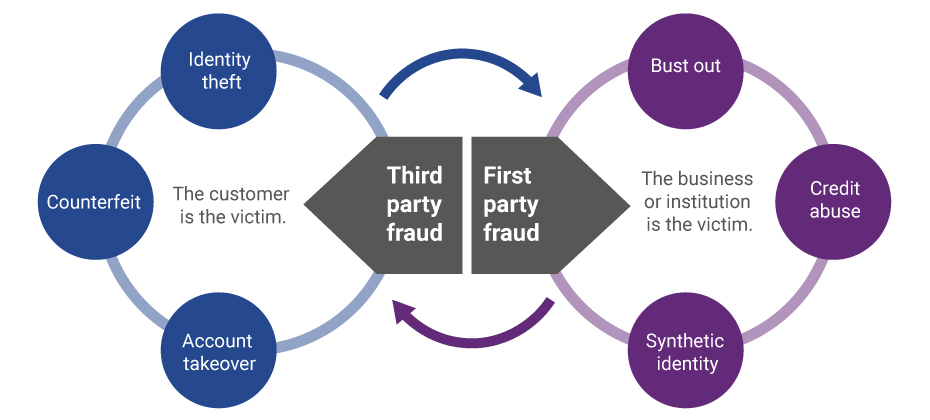
Third-party and first-party schemes are now interchangeable, and traditional fraud detection practices are less effective in fighting these evolving fraud types.

Definition of first-party versus third-party fraud trends and shared actual case study of a first-party fraud scheme.

I recently facilitated a Webinar looking at myths and truths in the market regarding the EMV shift and what it means for both merchants and issuers.