Loading...

Immunity in the Housing Market

by Joseph Mayans 3 min read May 28, 2020

Rays of hope are beginning to shine in the economy that suggest the U.S. may have moved beyond the most acute phase of the economic crisis. The housing sector, in particular, looks poised to regain momentum and perhaps lead the path towards stabilization in the second half of 2020.

A “V-Shaped” rebound in mortgage applications
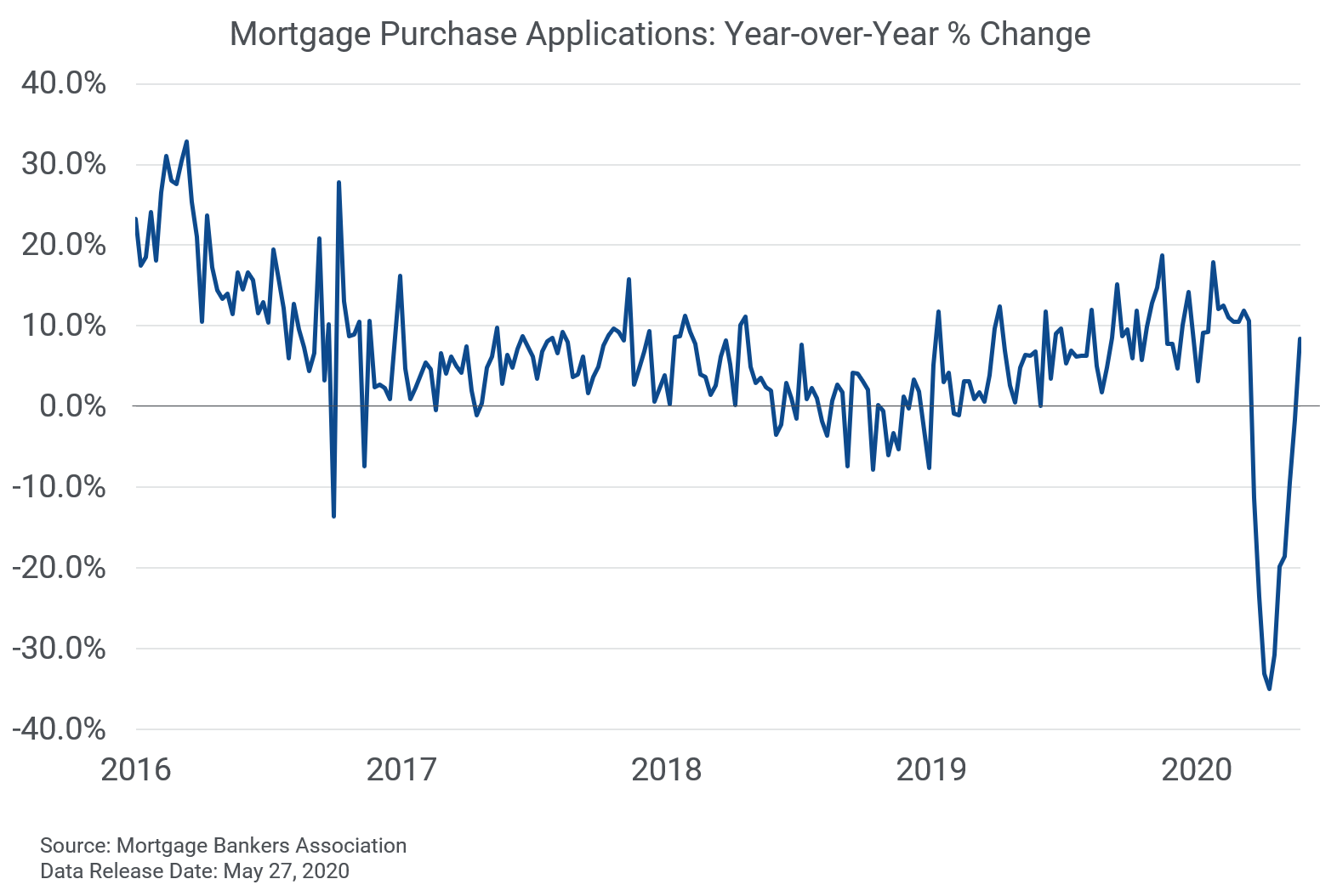
Despite record levels of unemployment and widespread economic uncertainty, homebuyers have returned to the market with conviction. After shelter-in-place restrictions curtailed open-house visits and crimped buyer demand in early April, applications to purchase a home have risen for six consecutive weeks, according to the Mortgage Bankers Association. The latest data for the week of May 22nd, indicate that purchase applications were 9% higher than during the same period in 2019. If this trend continues, it will show that significant pent-up demand exists in the housing market that may be able to offset some of the lost spring buying season.

April new home sales far exceed expectations

After declining by 13.7% in March, new home sales rose a modest 0.6% in April. While this was only a slight gain, it was considerably above economists’ projections of a fall of 20% and may mark the turning point in the downtrend.

Since the recording of new home sales data occurs when the purchase contract is signed or a deposit is accepted – and is typically for a house that hasn’t been built yet or is currently under construction – it provides a gauge of how buyers feel about their future economic prospects. Building a home also requires hiring new construction workers, buying building supplies, and supporting a host of ancillary industries, thus making it an indicator of further economic activity.

Some of the increase in demand for new homes may have been driven by coronavirus quirks. The number of existing homes on the market is at record lows and many people may have been reluctant to put their home up for sale and have buyers tour as health concerns remain. Buyers, as well, may have preferred to steer clear of occupied homes or were unable to make in-person visits due to shelter-in-place restrictions. This lack of options for home buyers, coupled with record-low mortgage rates, likely drove sales of new homes higher.

However, for the same reasons why new home sales rose, pending sales for existing homes fell sharply. In April, the National Association of Realtors reported that sales declined by 21.8%, which is the largest drop in ten years.

Home prices continue to gain ground
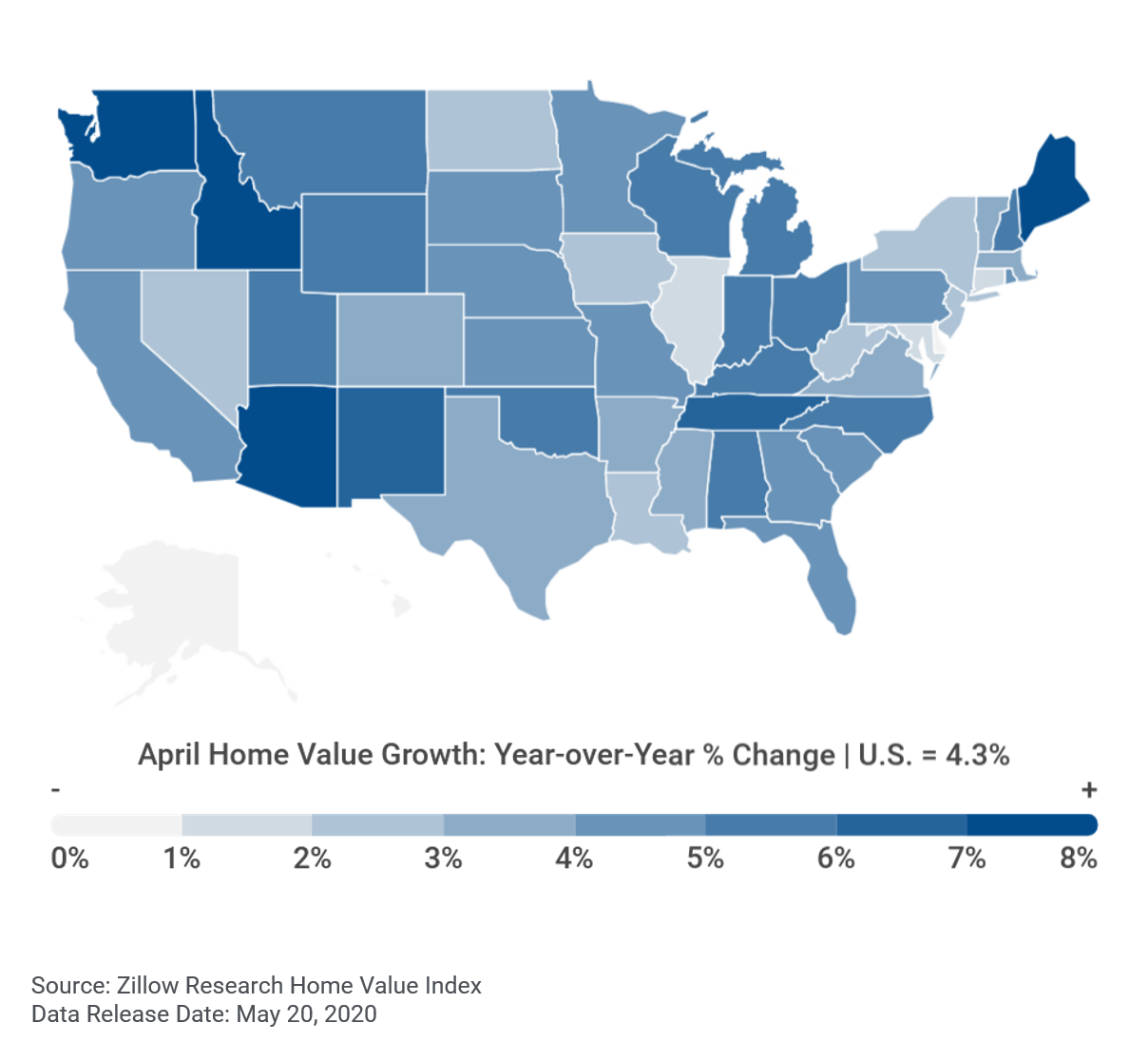
Even with shelter-in-place restrictions dampening buyer demand in early April, home values have continued to rise. This is because the supply of homes on the market also contracted, resulting in a simultaneous drop of demand and supply.  According to Zillow Research, the total inventory of homes for sale is down roughly 20% from this time last year. With fewer competing homes on the market, sellers have been reluctant to slash prices and are betting that the lack of options and low mortgage rates will keep buyers on the hook.

In April, U.S. home values rose 4.3% from the year before. The states with the strongest growth were Idaho (9.8%), Arizona (8.5%), Maine (7.6%), and Washington (7.4%). It will be interesting to see if this pattern of growth changes as newly implemented work from home policies may shift where people prefer to live and work.

Why it matters

The housing market has an outsized influence on the overall direction of the U.S. economy. Housing is not only is a big contributor to economic growth, but many owners have a large portion of their wealth tied up in their home. If the housing market can find its footing in the second half of 2020, then it could set the stage for an eventual economic recovery.


Learn more

Related Posts

Lenders who want to outperform peers in today’s housing market should embrace a data-driven playbook. These four strategic pillars—borrower insights, efficiency, geography, and refinance readiness—define the path forward. 

by Ivan Ahmed 3 min read February 18, 2026

As the U.S. housing market enters a new phase, the 2026 State of the U.S. Housing Market Report from Experian provides a data-driven overview for lenders, servicers, and property managers. This article synthesizes findings related to mortgage originations, affordability pressures, home equity utilization, credit risk, and generational sentiment, with implications for lender strategy in 2026 (Experian, 2026).  Mortgage market in flux: Opportunity amid transition  The mortgage market presents mixed signals. Rate moderation in late 2025 contributed to renewed demand, while the product mix continued to evolve. Conventional loans remained dominant at approximately 72% of originations, yet Veterans Affairs (VA) loans experienced the highest growth between 2023 and 2025, reaching 10.8% market share (Experian, 2026).  At the same time, second mortgages and home equity lines of credit (HELOCs) gained momentum as homeowners sought liquidity without refinancing out of historically low interest rates. This trend reflects growing demand for equity-based solutions that preserve favorable first-mortgage terms (Experian, 2026).   Pull-through challenges: Only 34% of inquiries become loans  Conversion efficiency remains a key challenge. Only 34% of first-mortgage hard credit inquiries resulted in a completed mortgage origination, highlighting friction between borrower interest and loan fulfillment (Experian, 2026).  Consumer research reinforces this gap. In an Experian survey, 50% of respondents reported that understanding what they could qualify for would be the most helpful step in their homeownership journey, suggesting that improved prequalification tools could materially increase pull-through rates (Experian, 2026).   Affordability pressure goes beyond the mortgage  Between 2021 and 2025, property taxes increased by 15.2%, while non-tax escrow costs—primarily homeowners' insurance—rose by 67.4% nationwide (Experian, 2026).  State-level variation further complicates affordability assessments. Florida recorded the highest average non-tax escrow expenses at $430 per month largely due to sharp increase in home insurance costs. California, by contrast, exhibited the highest average property tax burden at $626, largely driven by elevated home values despite lower statutory tax rates (Experian, 2026). These dynamics underscore the importance of holistic cost modeling, particularly for first-time buyers.   Home equity: A lender’s growth frontier  Home equity remains a significant growth opportunity. An estimated 96.2 million consumers reside in owner-occupied homes, with substantial portions owning their homes outright or holding more than 20% equity (Experian, 2026). HELOC usage is increasing, particularly among younger borrowers, 50% of whom utilize more than 60% of their available HELOC credit, compared with 36% of older borrowers (Experian, 2026).  Market share shifts are also notable. Fintech lenders experienced a 140.2% increase in HELOC originations from 2023 to 2025, significantly outpacing banks and credit unions. These gains suggest that digital-first experiences and streamlined workflows are increasingly decisive factors for borrowers (Experian, 2026).   Risk and resilience: What credit and property data reveal  Overall delinquency rates eased slightly; however, near-prime and prime borrowers demonstrated early signs of stress, particularly within first-mortgage portfolios (Experian, 2026).  Property-level risk is also intensifying. Flood exposure increased by 3.7% nationally, with 26.4% of Florida homes identified as at risk. Rising exposure has contributed to escalating insurance costs, further affecting affordability and credit performance (Experian, 2026).  From a credit hierarchy perspective, secured debt—especially mortgages and auto loans—continued to show the lowest delinquency rates. In contrast, student loans and credit cards exhibited higher delinquency risk, particularly among financially constrained renters and homeowners (Experian, 2026).   Generational optimism versus macroeconomic constraints  Despite affordability headwinds, consumer optimism persists. Approximately 47% of renters believe they will be ready to purchase a home within four years, increasing to 67% within eight years (Experian, 2026).  Structural constraints remain significant. Roughly 70% of homeowners hold mortgage rates below 6%, contributing to limited housing inventory as current owners remain rate-locked. With 30-year mortgage rates still above that level and a softening labor market, even modest increases in unemployment could further pressure affordability (Experian, 2026).   Implications for lenders  Experian’s analysis highlights several strategic priorities for housing industry stakeholders:  Expand access to credit. Incorporate alternative data sources, such as cash-flow analytics and rental payment history, to responsibly extend credit to underserved but qualified borrowers (Experian, 2026).  Capitalize on equity demand. Develop HELOC offerings that are fast, flexible, and digitally enabled to meet the needs of equity-rich, rate-locked homeowners (Experian, 2026).  Enhance risk precision. Integrate credit, property, and behavioral data to identify emerging risk early, particularly among near-prime segments, and to support more accurate pricing and portfolio management (Experian, 2026).   Conclusion  The 2026 housing market reflects a complex interplay of macroeconomic pressure, shifting borrower behavior, and growing reliance on home equity solutions. Agility and data-driven decision-making will be essential for lenders navigating this environment. The 2026 State of the U.S. Housing Market Report offers critical insight to support growth while managing risk in an evolving landscape (Experian, 2026).  📘 Access the full report here: Experian 2026 State of the U.S. Housing Market Report  References  Experian. (2026). 2026 state of the U.S. housing market report. Experian.     

by Upavan Gupta 3 min read February 9, 2026

%%excerpt%% %%page%% Tenant screening fraud is rising fast. Discover how income verification tools, Experian income verification, and AI-powered document upload strengthen fraud detection and streamline employment checks.

by Kim Agaton 3 min read September 8, 2025