Fraud & Identity
Learn what a TOAD attack is and effective measures you can take to safeguard your organization. Read more!

“Learn how to learn.” One of Zack Kass’, AI futurist and one of the keynote speakers at Vision 2024, takeaways readily embodies a sentiment most of us share — particularly here at Vision. Jennifer Schulz, CEO of Experian, North America, talked about AI and transformative technologies of past and present as she kicked off Vision 2024, the 40th Vision. Keynote speaker: Dr. Mohamed El-Erian Dr. Mohamed El-Erian, President of Queens’ College, Cambridge and Chief Economic Advisor at Allianz, returned to the Vision stage to discuss the labor market, “sticky” inflation and the health of consumers. He emphasized the need to embrace and learn how to talk to AI engines and that AI can facilitate content, creation, collaboration and community Keynote speaker: Zack Kass Zack Kass, AI futurist and former Head of Go-To-Market at OpenAI, spoke about the future of work and life and artificial general intelligence. He said AI is aiding in our entering of a superlinear trajectory and compared the thresholds of technology versus those of society. Sessions – Day 1 highlights The conference hall was buzzing with conversations, discussions and thought leadership. Some themes definitely rose to the top — the increasing proliferation of fraud and how to combat it without diminishing the customer experience, leveraging AI and transformative technology in decisioning and how Experian is pioneering the GenAI era in finance and technology. Transformative technologiesAI and emerging technologies are reshaping the finance sector and it's the responsibility of today's industry leaders to equip themselves with cutting-edge strategies and a comprehensive understanding to master the rapidly evolving landscape. That said, transformation is a journey and aligning with a partner that's agile and innovative is critical. Holistic fraud decisioningGenerative AI, a resurgence of bank branch transactions, synthetic identity and pig butchering are all fraud trends that today's organizations must be acutely aware of and armed to protect their businesses and customers against. Leveraging a holistic fraud decisioning strategy is important in finding the balance between customer experience and mitigating fraud. Unlocking cashflow to grow, protect and reduce riskCash flow data can be used not only across the lending lifecycle, but also as part of assessing existing portfolio opportunities. Incorporating consumer-permissioned data into models and processes powers predicatbility and can further assess risk and help score more consumers. Navigating the economyAmid a slowing economy, consumers and businesses continue to struggle with higher interest rates, tighter credit conditions and rising delinquencies, creating a challenging environment for lenders. Experian's experts outlined their latest economic forecasts and provided actionable insights into key consumer and commercial credit trends. More insights from Vision to come. Follow @ExperianVision and @ExperianInsights to see more of the action.

Preventing chargeback fraud is critical to protecting your organization. Learn how you can leverage fraud prevention solutions. Read more!

The world of finance can be a dangerous place, where cunning schemes lurk in the shadows, ready to pounce on unsuspecting victims. In the ever-evolving landscape of financial crime, the insidious ‘pig butchering’ scam has emerged as a significant threat, targeting both financial institutions and their clients. What is a ‘pig butchering’ scam? ‘Pig butchering’ scams are named after the practice of farmers fattening up their livestock before “butchering” them. This comparison describes the core of ‘pig butchering’ scams, where criminals entice victims to participate in investment schemes and cryptocurrency fraud. Originating in Southeast Asia and now rampant in the United States, these scams often start with online interactions via social media or dating applications. Scammers build trust with the victim, eventually gaining access to their online accounts. They "fatten the pig" by enticing more cryptocurrency investments and then make off with their ill-gotten gains. The repercussions are staggering, with reported losses exceeding $3.5 billion in 2023 alone according to an AP News article, and around 40,000 victims in the United States, including cases of losses as massive as $4 million. The real-life impact The story of “RB,” a San Francisco man who engaged with a scammer named "Janey Lee," serves as a stark warning. Through social media, Janey orchestrated an elaborate scheme, promising "RB” substantial returns in cryptocurrency investment. Seduced by false promises, “RB” emptied his life savings into the scam, only to be rescued by a Federal Bureau of Investigation (FBI) intervention, narrowly avoiding financial ruin.1 Malicious actors are improving their targeting skills, and often pursue executives and victims with a large sum of money, such as C-level officials from financial institutions. This past February, a $50 million pig slaughtering fraud incident caused the CEO of a local bank in Kansas to lose all his funds and the bank to collapse a few months later. FinCEN's vigilance and updates The Financial Crimes Enforcement Network (FinCEN) remains vigilant, issuing advisories to financial institutions to combat ‘pig butchering’ scams. Their latest advisory highlights evolving scam tactics, including aggressive promotions, using money mules for illegal fund transfers, and leveraging new financial products like decentralized finance (DeFi) platforms to obfuscate transactions. FinCEN also warns about red flags such as large and sudden investments from older customers, quick fund withdrawals after big deposits, and the frequent use of coins or mixers that hide transactions. Financial institutions are encouraged to: Report any suspicious activities by using specific terms like "pig butchering fraud advisory" in their reports to make analysis and response easier. File suspicious activity reports (SARs) using the key term “FIN-2023-PIGBUTCHERING.” Guide potential victims to report to the FBI’s IC3 or the Security and Exchange Commission (SEC’s) reporting system. A call to action for financial institutions The fight against ‘pig butchering’ scams requires proactive measures from financial institutions: Enhance fraud detection and anti-money laundering (AML) programs: Implement robust systems compliant with regulatory guidelines, conduct thorough customer enhanced due diligence, and leverage fraud detection software to spot anomalies and red flags., and leverage fraud detection software to spot anomalies and red flags. Leverage data analytics: Utilize data analytics tools to monitor customer behavior, identify irregular patterns, and swiftly detect potential ‘pig butchering’ activities. Employee training: Educate employees on scam risks, fraud detection techniques, and FinCEN red flags to empower them as the first line of defense., and FinCEN red flags to empower them as the first line of defense. Community education: Educate customers on recognizing and avoiding investment scams, promoting awareness, and safeguarding their assets. Navigating challenges with effective solutions ‘Pig butchering’ scams cause not only money losses but also personal troubles and reputational harm. Awareness, learning, and cooperation are essential in protecting from these complex financial fraudsters, securing the safety and confidence of your institutions and stakeholders. By combining the best data with our automated identification verification processes, you can protect your business and onboard new talents efficiently. Our industry-leading solutions employ device recognition, behavioral biometrics, machine learning, and global fraud databases to spot and block suspicious activity before it becomes a problem. Learn more 1San Francisco Chronical (2023). Crypto Texting Scam *This article includes content created by an AI language model and is intended to provide general information.

AML transaction monitoring stands as a crucial barrier against financial crimes, which ensures the integrity of financial systems worldwide.

Anti-money laundering and fraud prevention have historically been separated, but here's why that might not be a good idea.

As part of banks’ anti-money laundering (AML) programs, KYC in banking can help stop corruption, money laundering and terrorist financing. Creating and maintaining KYC programs is also important for regulatory compliance, reputation management and fraud prevention. The three components of KYC in banking programs Banks can largely determine how to set up their KYC and AML programs within the applicable regulatory guidelines. In the United States, KYC needs to happen when banks initially onboard a new customer. But it’s not a one-and-done event—ongoing customer and transaction monitoring is also important. 1. Customer Identification Program (CIP) Creating a robust Customer Identification Program (CIP) is an essential part of KYC. At a minimum, a bank’s CIP requires it to collect the following information from new customers: Name Date of birth Address Identification number, such as a Social Security number (SSN) or Employer Identification Number (EIN) Banks' CIPs also have to use risk-based procedures to verify customers’ identities and form a reasonable belief that they know the customer's true identity.1 This might involve comparing the information from the application to the customer’s government-issued ID, other identifying documents and authoritative data sources, such as credit bureau databases. Additionally, the bank's CIP will govern how the bank: Retains the customer’s identifying information Compares customer to government lists Provides customers with adequate notices Banks can create CIPs that meet all the requirements in various ways, and many use third-party solutions to quickly collect data, detect forged or falsified documents and verify the provided information. 2. Customer due diligence (CDD) CIP and CDD overlap, but the CIP primarily verifies a customer’s identity while customer due diligence (CDD) helps banks understand the risk that each customer poses. To do this, banks try to understand what various types of customers do, what those customers’ normal banking activity looks like, and in contrast, what could be unusual or suspicious activity. Financial institutions can use risk ratings and scores to evaluate customers and then use simplified, standard or enhanced due diligence (EDD) processes based on the results. For example, customers who might pose a greater risk of laundering money or financing terrorism may need to undergo additional screenings and clarify the source of their funds. 3. Ongoing monitoring Ongoing or continuous monitoring of customers’ identities and transactions is also important for staying compliant with AML regulations and stopping fraud. The monitoring can help banks spot a significant change in the identity of the customer, beneficial owner or account, which may require a new KYC check. Unusual transactions can also be a sign of money laundering or fraud, and they may require the bank to file a suspicious activity report (SAR). Why is KYC important in banking? Understanding and implementing KYC in banking processes can be important for several reasons: Regulatory compliance: Although the specific laws and rules can vary by country or region, many banks are required to have AML procedures, including KYC. The fines for violating AML regulations can be in the hundreds of millions— a few banks have been fined over $1 billion for lax AML enforcement and sanctions breaching. Reputation management: In some cases, enforcement actions and fines were headline news. Banks that don’t have robust KYC procedures in place risk losing their customers' trust and respect. Fraud prevention: In addition to the regulatory requirements, KYC policies and systems can also work alongside fraud management solutions for banks. Identity verification at onboarding can help banks identify synthetic identities attempting to open money mule accounts or take out loans. Ongoing monitoring can also be important for identifying long-term fraud schemes and large fraud rings. KYC in a digital-first world Modernizing KYC in banking is a key part of financial institutions’ digital transformation efforts. Part of that journey is updating the systems and tools in place to meet the expectations of customers and regulators. Experian’s 2025 U.S. Identity and Fraud Report shows four in 10 consumers considered abandoning a new account setup midway through the process – rising to 50% among high-income earners – highlighting growing expectations for seamless digital experiences. The survey wasn’t specific to financial services, but friction could be a problem for banks wanting to attract new account holders. Just as access to additional data sources and machine learning help automate underwriting, financial institutions can use technological advances to add an appropriate amount of friction based on various risk signals. Some of these can be run in the background, such as an electronic Consent Based Social Security Number Verification (eCBSV) check to verify the customer’s name, SSN and date of birth match the Social Security Administration’s records. Others may require more customer involvement, such as taking a selfie that’s then compared to the image on their photo ID — Experian CrossCore® Doc Capture enables this type of verification. Experian is a leader in identity and data management Our identity verification solutions use proprietary and third-party data to help banks manage their KYC procedures, including identity verification and Customer Identification Programs (CIP). As a global leader in identity management and fraud prevention, we combine advanced analytics, rich data assets, and innovative technology to deliver secure, seamless identity experiences. Our comprehensive identity ecosystem enables organizations to confidently verify, authenticate and manage customer identities across the lifecycle—reducing fraud risk, improving compliance and enhancing the customer experience.By bundling identity verification with fraud assessment, banks can stop fraudsters while quickly resolving identity discrepancies. The automated processes also allow you to offer a low-friction identity verification experience and use step-up authentications as needed. Explore identity solutions

Property managers must leverage a solution that provides accurate, efficient, and compliant income and employment verification.

Learn about the benefits of a fraud consortium and how Experian's solutions can help prevent fraud without inconveniencing consumers.

New account fraud can pose a serious risk to your business, and your current security methods might be hurting your customers' experience.

A multilayered defense can help detect and prevent synthetic ID fraud, one of the fastest-growing types of fraud. Read more!

Seamless financial services onboarding requires organizations to enhance their identity verification methods.

Almost every business that has an online presence will have to face and counter bot attacks. Read more to learn how.

To combat auto loan fraud and protect profitability, auto lenders can leverage fintech advancements, machine learning and advanced analytics.
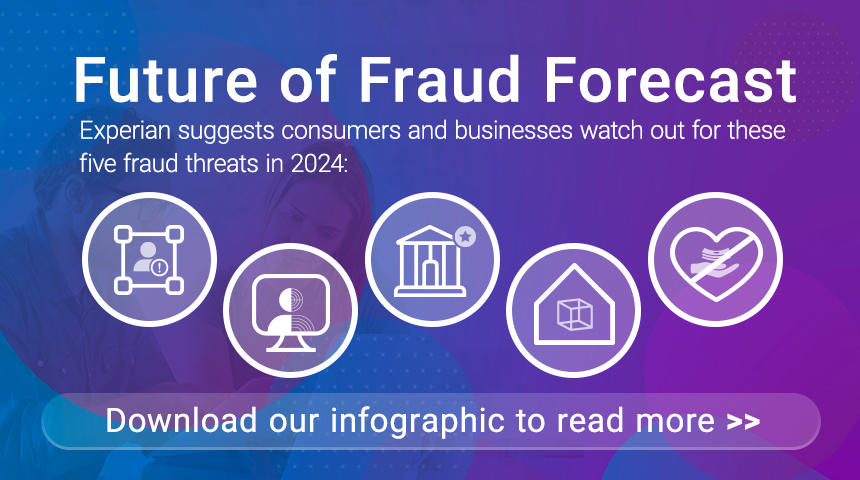
Spoiler alert: Gen AI is everywhere, including the top of Experian’s list of fraud trends 2024. “The speed and complexity of fraud attacks due to new technology and sophisticated fraudsters is leaving both businesses and consumers at risk in 2024,” said Kathleen Peters, chief innovation officer at Experian Decision Analytics in North America. “At Experian, we’re constantly innovating to deliver data-driven solutions to help our customers fight fraud and to protect the consumers they serve.” To deter fraudulent activity in 2024, businesses and consumers must get tactical for their fraud fighting strategies. And for businesses, the need for more sophisticated fraud protection solutions leveraging data and technology is greater than ever before. Experian suggests consumers and businesses watch out for these big five rounding out our fraud trends 2024. Generative AI: Generative AI accelerates DIY fraud: Experian predicts fraudsters will use generative AI to accelerate “do-it-yourself” fraud ranging from deepfake content – think emails, voice and video – as well as code creation to set up scam websites. A previous blog post of ours highlighted four types of generative AI used for fraud, including fraud automation at scale, text content generation, image and video manipulation and human voice generation. The way around it? Fight AI fraud with AI as part of a multilayered fraud prevention solution. Fraud at bank branches: Bank branches are making a comeback. A growing number of consumers prefer visiting bank branches in person to open new accounts or get financial advice with the intent to conduct safer transactions. However, face-to-face verification is not flawless and is still susceptible to human error or oversight. According to an Experian report, 85% of consumers report physical biometrics as the most trusted and secure authentication method they’ve recently encountered, but the measure is only currently used by 32% of businesses to detect and protect against fraud. Retailers, beware: Not all returns are as they appear. Experian predicts an uptick in cases where customers claim to return their purchases, only for the business to receive an empty box in return. Businesses must be vigilant with their fraud strategy in order to mitigate risk of lost goods and revenue. Synthetic identity fraud will surge: Pandemic-born synthetic identities may have been dormant, but now have a few years of history, making it easier to elude detection leading to fraudsters using those dormant accounts to “bust out” over the next year. Cause-related and investment deception: Fraudsters are employing new methods that strike an emotional response from consumers with cause-related asks to gain access to consumers’ personal information. Experian predicts that these deceptive cause-related methods will surge in 2024 and beyond. How businesses and consumers feel about fraud in 2024 According to an Experian report, over half of consumers feel they’re more of a fraud target than a year ago and nearly 70% of businesses report that fraud losses have increased in recent years. Business are facing mounting challenges – from first-party fraud and credit washing to synthetic identity and the yet-to-be-known impacts generative AI may have on fraud schemes. Synthetic identity fraud has been mentioned in multiple Experian Fraud Forecasts and the threat is ever growing. As technology continues to enhance consumers’ connectedness, it also heightens the stakes for various fraud attacks. As highlighted by this list of fraud trends 2024, the ways that fraudsters are looking to deceive is increasing from all angles. “Now more than ever, businesses need to implement a multilayered approach to their identity verification and fraud prevention strategies that leverages the latest technology available,” said Peters. Consumers are increasingly at risk from sophisticated fraud schemes. Increases in direct deposit account and check fraud, as well as advanced technologies like deepfakes and AI-generated phishing emails, put consumers in a precarious position. The call to action for consumers is to remain vigilant of seemingly authentic interactions. Experian can help with your fraud strategy To learn more about Experian’s fraud prevention solutions, please visit https://www.experian.com/business/solutions/fraud-management. Download infographic Watch Future of Fraud webinar