
Unlocking the Power of Fraud Consortiums

by Alex Lvoff 4 min read March 11, 2024

In the ever-expanding financial crime landscape, envision the most recent perpetrator targeting your organization. Did you catch them? Could you recover the stolen funds? Now, picture that same individual attempting to replicate their scheme at another establishment, only to be thwarted by an advanced system flagging their activity. The reason? Both companies are part of an anti-fraud data consortium, safeguarding financial institutions (FIs) from recurring fraud.

In the relentless battle against fraud and financial crime, FIs find themselves at a significant disadvantage due to stringent regulations governing their operations. Criminals, however, operate without boundaries, collaborating across jurisdictions and international borders. Recognizing the need to level the playing field, FIs are increasingly turning to collaborative solutions, such as participation in fraud consortiums, to enhance their anti-fraud and Anti-Money Laundering (AML) efforts.

Understanding consortium data for fraud prevention

A fraud consortium is a strategic alliance of financial institutions and service providers united in the common goal of comprehensively understanding and combatting fraud.

As online transactions surge, so does the risk of fraudulent activities. However, according to Experian’s 2023 U.S. Identity and Fraud Report, 55% of U.S. consumers reported setting up a new account in the last six months despite concerns around fraud and online security. The highest account openings were reported for streaming services (43%), social media sites and applications (40%), and payment system providers (39%).

Organizations grappling with fraud turn to consortium data as a robust defense mechanism against evolving fraud strategies. Consortium data for fraud prevention involves sharing transaction data and information among a coalition of similar businesses. This collaborative approach empowers companies with enhanced data analytics and insights, bolstering their ability to combat fraudulent activities effectively.

The logic is simple: the more transaction data available for analysis by artificial-intelligence-powered systems, the more adept they become at detecting and preventing fraud by identifying patterns and anomalies.

Advantages of data consortiums for fraud and AML teams

Participation in an anti-fraud data consortium provides numerous advantages for a financial institution’s risk management team. Key benefits include:

  1. Case management resolution: Members can exchange detailed case studies, sharing insights on how they responded to specific suspicious activities and financial crime incidents. This collaborative approach facilitates the development of best practices for incident handling.
  2. Perpetrator IDs: Identifying repeat offenders becomes more efficient as consortium members share data on suspicious activities. Recognizing patterns in names, addresses, device fingerprints, and other identifiers enables proactive prevention of financial crimes.
  3. Fraud trends: Consortium members can collectively analyze and share data on the frequency of various fraud attempts, allowing for the calibration of anti-fraud systems to effectively combat prevalent types of fraud.
  4. Regulatory changes: Staying ahead of evolving financial regulations is critical. Consortiums enable FIs to promptly share updates on regulatory changes, ensuring quick modifications to anti-fraud/AML systems for ongoing compliance.

Who should join a fraud consortium?

A fraud consortium can benefit any organization that faces fraud risks and challenges, especially in the financial industry. However, some organizations may benefit more, depending on their size, type, and fraud exposure. Some of the organizations that should consider joining a fraud consortium are:

  • Financial institutions: Banks, credit unions, and other financial institutions are prime targets for fraudsters, who use various methods such as identity theft, account takeover, card fraud, wire fraud, and loan fraud to steal money and information from them.
  • Fintech companies: Fintech companies are innovative and disruptive players in the financial industry, who offer new and alternative products and services such as digital payments, peer-to-peer lending, crowdfunding, and robot-advisors.
  • Online merchants: Online merchants are vulnerable to fraudsters, who use various methods such as card-not-present fraud, friendly fraud, and chargeback fraud to exploit their online transactions and payment systems.

Why partner with Experian?

What companies need is a consortium that allows FIs to collaboratively research anti-fraud and AML information, eliminating the need for redundant individual efforts. This approach promotes tighter standardization of anti-crime procedures, expedited deployment of effective anti-fraud/AML solutions, and a proactive focus on preventing financial crime rather than reacting to its aftermath.

Experian Hunter is a sophisticated global application fraud and risk management solution. It leverages detection rules to screen incoming application data for identifying and preventing fraudulent activities.
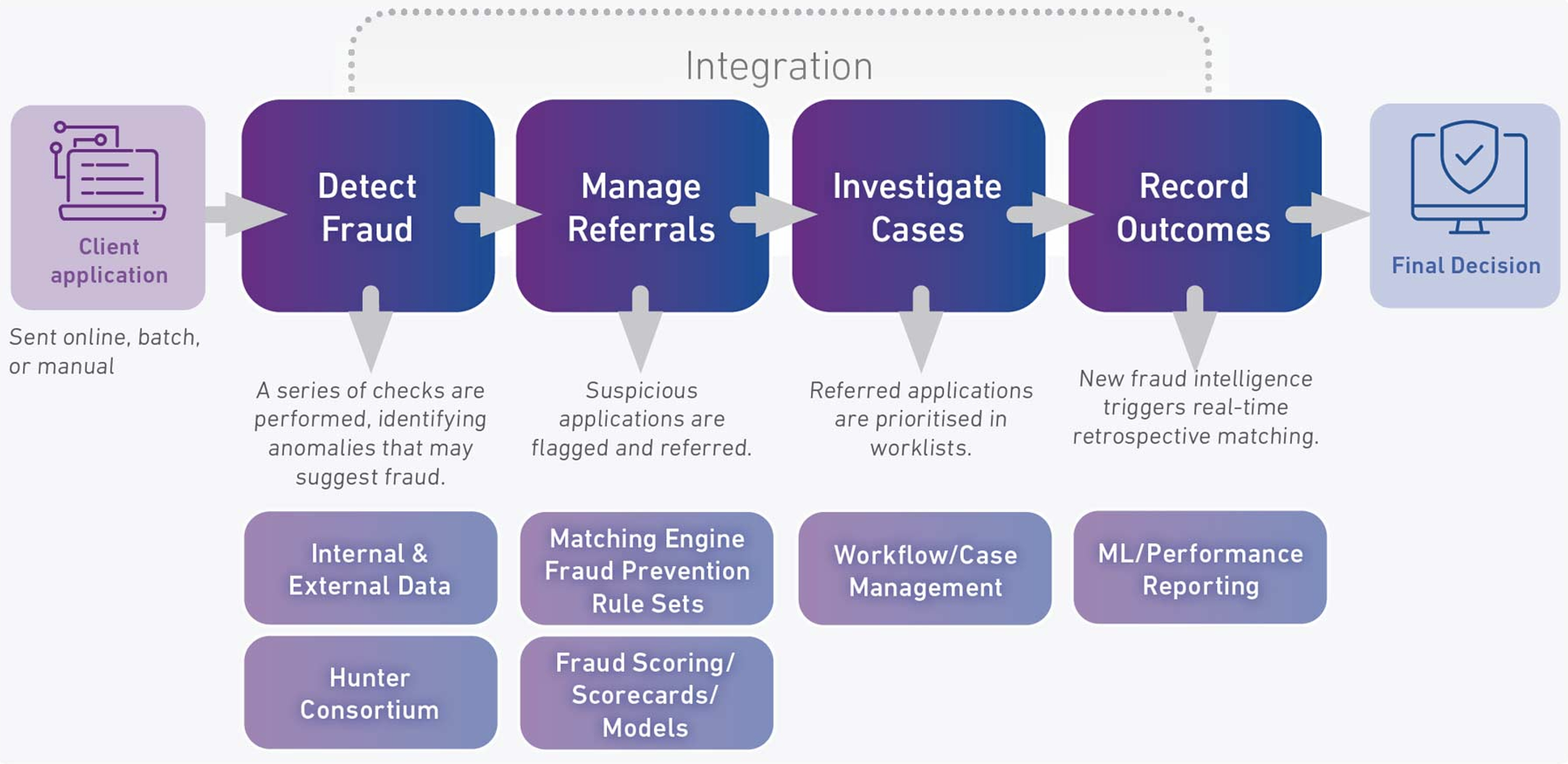
It matches incoming application data against multiple internal and external data sources, shared fraud databases and dedicated watch lists. It uses client-flexible matching rules to crossmatch data sources for highlighting data anomalies and velocity attempts. In addition, it looks for connections to previous suspected and known fraudulent applications. Hunter generates a fraud score to indicate a fraud risk level used to prioritize referrals. Suspicious applications are moved into the case management tool for further investigation.

Overall, Hunter prevents application fraud by highlighting suspicious applications, allowing you to investigate and prevent fraud without inconveniencing genuine customers.

To learn more about our fraud management solutions, visit us online or request a call.

Learn more

This article includes content created by an AI language model and is intended to provide general information.


Related Posts

Fuel Type Choices Continue to Reshape Vehicle Registration Trends

Electric vehicle (EV) registration growth has become a common topic of discussion throughout the automotive industry for the last few years, but the bigger story may lie in what consumers are choosing when they return to market for their next vehicle. According to Experian’s Automotive Market Trends Report: Q1 2026, the bulk of EV owners (72.6%) purchased another EV, while 17.7% replaced their EV with a gas-powered vehicle and 5.6% switched to a hybrid this quarter. A similar trend was seen in hybrid owners, as 54.9% remained loyal to the fuel type through the quarter, while 32.7% replaced their hybrid with a gas-powered vehicle and 7.5% switched to an EV. Notably, 78.2% of consumers with gas-powered vehicles stayed with the same fuel type, with 5.6% swapping their gas vehicle for a hybrid and only 4.5% transitioning to an EV through Q1 2026. These purchase styles suggest that while most consumers are not making a direct leap from gasoline to fully electric vehicles, some are beginning their electrified journey through hybrid ownership. At the same time, the high rate of fuel-type loyalty across all powertrain categories highlights the importance of the ownership experience. Consumers who are satisfied with their current vehicle can often be inclined to remain with the same segment rather than exploring alternative fuel types. New vehicle registration trends reflect changing consumer preferences Looking at the new vehicle registration data from a broader level, gas-powered vehicles experienced a slight uptick, coming in at 69.5% through Q1 2026, from 67.3% last year. Meanwhile, hybrids continue to grow, going from 12.1% to 13.5% year-over-year while EVs steadily decline from 7.8% last year to 5.6% this quarter. As consumers weigh their next vehicle purchase, many seem to be sticking with the standard gas-powered choice, and others are finding a happy medium in hybrid vehicles. And while EVs receive much of the industry’s attention, buyers are exploring alternatives that allow them to adopt the electrified vehicles incrementally rather than all at once. To learn more about vehicle market trends, view the full Automotive Market Trends Report: Q1 2026 presentation on demand.

Published: June 12, 2026 by John Howard
Rewriting the Road Ahead with Longer Loan Terms and Increased Refinancing Options

The automotive market is entering a new phase defined not just by what consumers are buying, but by how they’re choosing to finance it. According to Experian Automotive’s State of the Automotive Finance Market Report: Q1 2026, nearly one-third (35.55%) of all new vehicle loans now stretch more than six years, up from 30.83% in Q1 2025. Similarly on the used side, 31.54% of loans extended more than six years, an increase from 28.60% last year. The shift highlights why affordability is reshaping how consumers are financing their vehicles, particularly in larger and higher-priced vehicles. Refinancing gains traction as interest rates stabilize In addition to longer-term loans, consumers are becoming increasingly deliberate with their financing decisions and managing monthly payments as refinancing activity has gained momentum. For instance, consumers who refinanced this quarter lowered their interest rate by 2.2% and saved an average of $81 on their monthly payment. Credit unions, in particular, continued to play a major role in helping consumers secure more affordable payment options. In Q1 2025, credit unions accounted for the lion’s share of automotive refinancing at 63.43%, from 62.31% a year ago. By comparison, banks went from 23.51% to 22.59% year-over-year. Furthermore, those who refinanced with a credit union saved an average of $101 this quarter, whereas those who refinanced with banks saved $60. Expanding credit access through flexible financing Another notable trend this quarter was the incessant growth in subprime financing as credit accessibility across the market continues to increase. In the first quarter of this year, subprime borrowers made up 15.75% of total vehicle financing, from 14.40% last year. For new vehicles in particular, the subprime market went from 5.61% to 6.88% year-over-year, while subprime in used vehicle financing grew to 20.60% this quarter, from 19.36% a year ago. Increased activity in the subprime segment highlights continued confidence in the automotive market and underscores the importance of expanded financing options. As consumers seek greater flexibility with financing decisions that fit their lifestyle, lenders and dealers have the opportunity to approach them with more personalized solutions. These trends are helping keep both new and used vehicle markets moving forward, while creating new opportunities for consumers to manage payments and purchase confidently. To learn more about automotive finance trends, view the full State of the Automotive Finance Market Report: Q1 2026 presentation on demand.

Published: June 2, 2026 by Melinda Zabritski
Staying Competitive After Trigger Leads Evolve: A Roadmap For Lenders

Trigger leads have long been the preferred solution for identifying high-intent mortgage borrowers. But with the implementation of the Homebuyers Privacy Protection Act (HPPA), which introduces new limitations and consumer protections around trigger leads, that playbook will need to shift. Now, lenders are quickly facing a pivotal shift in how they discover, engage, and convert prospective borrowers into customers. The industry now stands at a crossroads. Lenders who adapt early—leaning into predictive tools, consent-based engagement, and smarter prescreening—will redefine borrower acquisition in a more privacy-centric era.  HPPA: A structural change to mortgage marketing  The HPPA amends the Fair Credit Reporting Act by significantly restricting the use of mortgage inquiries for prescreen purposes. As of March 5, 2026, credit bureaus may only provide or utilize mortgage inquiries to:  End users with explicit borrower consent  The originator of the consumer’s current mortgage  The servicer of the consumer’s current mortgage  An insured depository institution or credit union where the consumer has an existing account  While these exemptions may provide continuity for banks and credit unions, many mortgage brokers and nonbank lenders will need to overhaul their prescreen practices—or risk being cut off entirely from a previously high-performing acquisition channel.  Why this isn’t just a compliance shift—It’s a strategic recalibration  Mortgage triggers in prescreen allow lenders to react instantly to consumer intent. Lenders rely on a prompt and convincing narrative to entice applicants to switch lenders. Mortgage inquiry triggers are effective and were, therefore, a prospecting strategy for many lenders. Recent legislative changes significantly restrict the availability of these inquiry triggers, and impacted lenders are focusing on a more intentional prospecting strategy to compete.   Without these mortgage triggers in prescreen, lenders need to ask:  Who are we trying to reach?  What early signals can we act on?  How do we earn permission and attention before a mortgage inquiry ever happens?  Transforming the funnel: From reaction to anticipation  The shift in mortgage inquiry-based prescreen isn’t the end of high-intent lead targeting. It’s the beginning of a more strategic and intentional approach—one that leverages earlier indicators of mortgage readiness and focuses on building relationships, not just closing transactions.  Here’s where the momentum is evolving, creating a new and smarter funnel:  Prescreen marketing: Using credit and behavioral attributes to help identify consumers who meet specific lending criteria before they signal active intent.  Predictive modeling: Leveraging propensity scores or custom models to prioritize outreach based on conversion likelihood.  Consent-based engagement: Implementing compliant mechanisms to capture and manage borrower opt-ins at scale.  The power of predictive modeling  According to recent industry interviews, propensity modeling is emerging as one of the most effective replacements for trigger-based prescreen. These models analyze hundreds of credit attributes—such as utilization, account mix, account age, and depth—to help identify consumers statistically more likely to seek a mortgage.  For lenders just beginning to use predictive modeling, off-the-shelf models can be a quick way to identify potential borrowers. For example, when layering propensity scores on top of credit eligibility, which can improve borrower targeting, many lenders see an increase in open mortgage loan rates.  Meanwhile, custom-built models, which analyze a lender’s own campaign performance over time, offer the highest level of precise targeting. These models isolate the attributes most predictive of conversions within a specific product mix—optimizing not just volume, but fit.  Speed without traditional triggers? It’s possible  One of the biggest concerns among lenders is maintaining the speed historically enabled by trigger leads. But that concern may be overblown.  Self-service prescreen platforms now allow marketers to generate qualified lead lists in as little as 24 hours, enabling rapid response during rate drops, competitive shifts, or seasonal demand spikes.   For those new to prescreening, batch campaigns still offer value, especially with analyst support.   Don’t overlook retention  In an era of intense acquisition competition, retention becomes a key differentiator.  Lenders who monitor property status, cash flow, and consumer credit behavior can proactively identify when an existing borrower is likely to list, refinance, or exit. Armed with that intelligence, lenders can re-engage with the borrower at the right moment—sometimes before a competitor is considered or contacted.  This level of behavioral intelligence may soon separate proactive lenders from reactive ones.  Actions instead of reactions  The evolution of trigger-based prescreen doesn’t just require new tools; it demands new thinking. Lenders should begin by auditing their current pipelines and determining:  What percentage of our acquisition is dependent on triggers?  What share of our book falls under the HPPA exemptions?  How will we scale compliant opt-in collection?  Are our current prescreen or modeling capabilities future-ready?  Those who answer these questions today—and act on them—won’t just be in compliance with the new laws, they’ll lead in a transformed market. Lenders should also be asking:   Do we have the infrastructure to collect and act on borrower consent?  Are our acquisition teams equipped to run prescreen campaigns — both batch and self-service?  What predictive models are we using (or could we use) to prioritize leads?  Are we proactively monitoring our portfolio to catch retention risks early?  How are we preparing our sales teams for longer, more consultative buying journeys?  Conclusion  The HPPA signals a shift away from relying on passive, inquiry-based prescreen acquisition and the beginning of smarter, more strategic engagement with potential borrowers. Lenders who embrace this transition early will find themselves not just compliant, but competitive—with deeper borrower insights, better conversion rates, and stronger long-term customer relationships.  The market is moving. The only question is: will you lead the change or chase it?  Citation  Experian. (2025, November). Interview: How the Homebuyers Privacy Protection Act is reshaping mortgage marketing—and what lenders should do now [transcript]. Experian Mortgage Insights. Insights based on lender feedback, campaign performance data, and analysis of prescreen marketing strategies and predictive modeling outcomes were gathered from Experian client engagements and internal mortgage analytics between May and October 2025. Homebuyers Privacy Protection Act timeline and legal context referenced from legislation signed September 5, 2025, with implementation beginning March 5, 2026.   

Published: April 22, 2026 by Ivan Ahmed

Request More Information

Subscribe to our Housing Blog

Enter your name and email for the latest updates.

This site is protected by reCAPTCHA and the Google Privacy Policy and Terms of Service apply.

Subscribe to the Housing Blog

Receive updates from Experian Housing
Subscribe