Data & Analytics

With today's digital identity, how do you know you’re interacting with a legitimate individual rather than an imposter?

Many institutions take a “leap of faith” when it comes to developing prospecting strategies as it pertains to credit marketing. How can a data-driven approach help?

Historical data that illustrates lower credit card use and increases in payments is key to finding consumers whose credit trajectory is improving.

Student loan debt — outstanding debt grew 21 percent since 2013 to reach a high of $1.49 trillion in the fourth quarter of 2016.

Synthetic identity fraud is an epidemic that does more than negatively affect portfolio performance. It can hurt your reputation as a trusted organization.

The final day of Vision 2017 brought a seasoned group of speakers to discuss a wide range of topics. In just a few short hours, attendees dove into a first look at Gen Z and their use of credit, ecommerce fraud, the latest in retail, the state of small business and leadership. Move over Millennials – Gen Z is coming of credit age Experian Analytics leaders Kelley Motley and Natasha Madan gave audience members an exclusive look at how the first wave of Gen Z is handling and managing credit. Granted most of this generation is still under the age of 18, so the analysis focused on those between the ages of 18 to 20. Yes, Millennials are still the dominant generation in the credit world today, standing strong at 61 million individuals. But it’s important to note Gen Z is sized at 86 million, so as they age, they’ll be the largest generation yet. A few stats to note about those Gen Z individuals managing credit today: Their average debt is $12,679, compared to younger Millennials (21 to 27) who have $65,473 in debt and older Millennials (28 to 34) who sport $121,460. Given their young age, most of Gen Z is considered thin-file (less than 5 tradelines) Average Gen Z income is $33,000, and average debt-to-income is low at 5.7%. New bankcard balances are averaging around $1,574. As they age, acquire mortgages and vehicles, their debt and tradelines will grow. In the meantime, the speakers provided audience members a few tips. Message with authenticity. Think long-term with this group. Maintain their technological expectations. Build trust and provide financial education. State of business credit and more on the economy Moody’s Cris deRitis reiterated the U.S. economy is looking good. He quoted unemployment at 4.5%, stating “full employment is here.” Since the recession, he said we’ve added 15 million jobs, noting we lost 8 million during the recession. The great news is that the U.S. continues to add about 200,000 jobs a month, and that job growth is broad-based. Small business loans are up 10% year-to-date vs. last year. While there has been a tremendous amount of buzz around small business, he adds that most job creation has come from mid0size business (50 to 499 employees). The case for layered fraud systems Experian speaker John Sarreal shared a case study that revealed by layering on fraud products and orchestrating collaboration, a business can go from a string 75% fraud detection rate to almost 90%. Additionally, he commented that Experian is working to leverage dark web data to mine for breached identity data. More connections for financial services companies to make with mobile and social Facebook speaker Olivia Basu reinforced the need for all companies to be thinking about mobile. “Mobile is not about to happen,” she said. “Mobile is now. Mobile is everything. You look at the first half of 2017 and we’re seeing 40% of all purchases are happening on mobile devices.” Her challenge to financial services companies is to make marketing personal again, and of course leverage the right channels. Experian Sr. Director of Credit Marketing Scott Gordon commented on Experian’s ability to reach consumers accurately – whether that be through direct or digital delivery channels. A great deal of focus has been around person-based marketing vs. leveraging the cookie. -- The Vision conference was capped off with a keynote speech from legendary quarterback and Super Bowl MVP Tom Brady. He chatted about the details of this past season, and specifically the comeback Super Bowl win in February 2017. He additionally talked about leadership and what that means to creating a winning team and organization. -- Multiple keynote speeches, 65 breakout sessions, and hours of networking designed to help all attendees ready themselves for growing profits and customers, step up to digital, regulatory and fraud challenges, and capture the latest data insights. Learn more about Experian’s annual Vision conference.

Risk analysts are insatiable consumers of big data who require better intelligence to develop market insights, evaluate risk and confirm business strategies. While every credit decision, risk assessment model or marketing forecast improves when it is based on better, faster and more current data, leveraging large data sets can be challenging and unproductive. That’s why Experian added a new functionality to its Analytical Sandbox, giving clients the flexibility they need to analyze big data efficiently. Experian’s Analytical Sandbox now utilizes H2O –an open source machine learning and deep learning platform that can model and predict with high accuracy billions of rows of high-dimensional data from multiple sources in various formats. Through machine learning and advanced predictive modeling, the platform enables Experian to better provide on-demand data insights that empowers analysts with high-quality intelligence to inform regional trends, provide consumer transactional insight or expose marketing opportunities. As a hosted service, Sandbox is offered as a plug-and-play, meaning no internal development is required. Clients can instantly access the data through a secure Web interface on their desktop, giving users access to powerful artificial and business intelligence tools from their own familiar applications. No special training is required. “AI monetizes data,” said SriSatish Ambati, CEO of H2O.ai. “Our partnership with Experian democratizes and delivers AI to the wider community of financial and risk analysts. Experian's analytics sandbox can now model and predict with high accuracy billions of rows of high-dimensional data in mere seconds.” Through H2O and the Experian Sandbox, machine learning and predictive analytics are giving risk managers from financial institutions of all sizes the ability to incorporate machine learning models into their own big data processing systems.
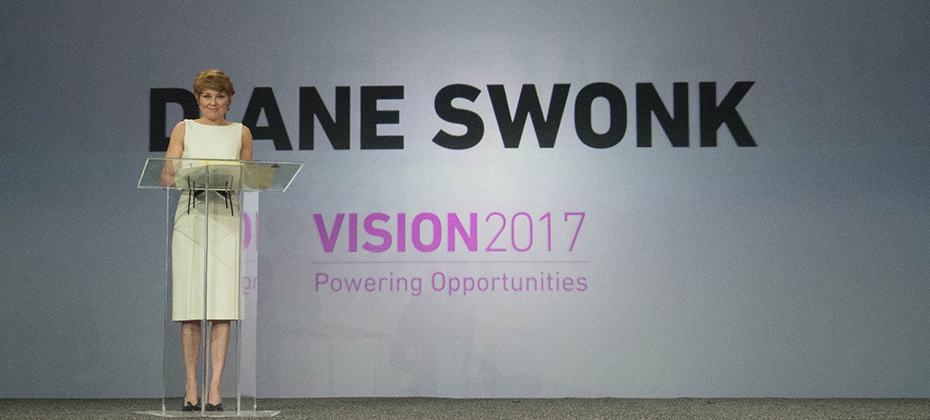
In just a few short hours, Vision attendees immersed themselves into the depths of the economy, risk models, specialty finance data, credit invisibles, student loan data, online marketplace lending and more. The morning kicked off with one of the most respected and trusted macroeconomists in the U.S., Diane Swonk. With a rap sheet filled with advising central banks and multinational companies, Swonk treated a packed house to a look back on what has transpired in the U.S. economy since the Great Recession, as well as launching into current state and speculating on the months ahead. She described the past decade not as “lost, but rather lagging.” She went onto to say this past year was transitional, and while markets slowed slightly during the months leading up the U.S. presidential election, good things are happening: We’ve finally broken out of the 2% wage rut Recruiting on college campuses has picked up The labor force is growing Debt-to-income levels have returned to where they were prerecession and Investment is coming back. “I believe we’ll see growth over 2% this year,” said Swonk. Still, change is underway. She commented on how the way U.S. consumer spending is changing, and of course we’re seeing a restructuring in the retail space. While JC Penney announces store closings, you simultaneously see Amazon moving from “click to brick,” dabbling in the opening of some actual storefronts. Globally, she said the economy is the strongest it has been in eight years. She closed by noting there is a great deal of political change and unrest in the world today, but says, “Never underestimate our abilities when we tap our human capital.” -- More than 100 attendees filled a room to hear about the current trends and the future of online lending with featured guests from Oliver Wyman, Marlette Funding and Lending USA. While speakers commented on the “hiccup” in the space last year with some layoffs and mergers, volume has continued to double every year for the past several years with roughly $40 billion in cumulative originations today. Panelists discussed the use of alternative data to decision, channel bias, the importance of partnerships and how the market will see fewer and fewer players offering just one product specialty. “It is expensive to acquire customers, so you don’t just want to have one product to sell, but rather a range,” said Sharat Shankar of Lending USA. -- The numbers in the student lending universe are astounding. In a session focused on the U.S. student loan market, new Experian data reveals there is $1.49 billion in total student loan outstandings. In fact, total outstandings have grown 21% over the past four years, while the number of trades have only grown 4%. Costs are skyrocketing. The average balance per trade has grown 17% over the past four years. “We don’t ration education in this country,” said Joe DePaulo of College Ave. Student Loans. “We give everyone access to liquidity when it comes to federal student loans – and it’s not like that in other countries.” While DePaulo notes the access is great, offering many students the opportunity to obtain higher education, he says the problem is with disclosures. Guardians are often the individuals filling out the FAFSA, but the students inherit the loans. Students, he says, rarely understand how much their monthly payment will ultimately be after graduation. For every $10,000 in student loans, he says that will generally equate to a $100 monthly payment. -- Tomorrow, Vision attendees will be treated to more breakout sessions and a concluding keynote with legendary quarterback Tom Brady.
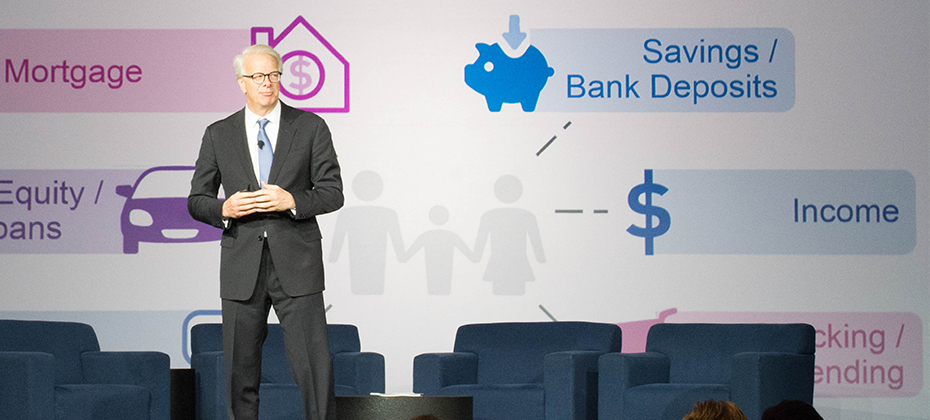
So many insights and learnings to report after the first full day of 2017 Vision sessions. From the musings shared by tech engineer and pioneer Steve Wozniak, to a panel of technology thought leaders, to countless breakout sessions on a wide array of business topics … here’s a look at our top 10 from the day. A mortgage process for the digital age. At last. In his opening remarks, Experian President of Credit Services Alex Lintner asked the audience to imagine a world when applying for a mortgage simply required a few clicks or swipes. Instead of being sent home to collect a hundred pieces of paper to verify employment, income and assets, a consumer could click on a link and provide a few credentials to verify everything digitally. Finally, lenders can make this a reality, and soon it will be the only way consumers expect to go through the mortgage process. The global and U.S. economies are stable. In fact, they are strong. As Experian Vice President of Analytics Michele Raneri notes, “the fundamentals and technicals look really solid across the countries.” While many were worried a year ago that Brexit would turn the economy upside down, it appears everything is good. Consumer confidence is high. The Dow Jones Index is high. The U.S. unemployment rate is at 4.7%. Home prices are up year-over-year. While there has been a great deal of change in the world – politically and beyond – the economy is holding strong. The rise of the micropreneur. This term is not officially in the dictionary … but it will be. What is it? A micropreneur is a business with 0 to 4 employees bringing in no more than $200k in annual revenue. But the real story is that numbers show microbusiness are improving on many fronts when it comes to contribution to the economy and overall performance compared to other small businesses. Keep an eye on these budding business people. Fraud is running fierce. Synthetic identity losses are estimated in the hundreds of millions annually, with 50% year-over year growth. Criminals are now trying to use credit cleaners to get tradelines removed from used Synthetic IDs. Oh, and it is essential for businesses to ready themselves for “Dark Web” threats. Experts advise to harden your defenses (and play offense) to keep pace with the criminal underground. As soon as you think you’ve protected everything, the criminals will find a gap. The cloud is cool and so are APIs. A panel of thought leaders took to the main stage to discuss the latest trends in tech. Experian Global CIO Barry Libenson said, “The cloud has changed the way we deliver services to our customers and clients, making it seamless and elastic.” Combine that with API, and the goal is to ultimately make all Experian data available to its customers. Experian President of Decision Analytics Steve Platt added, “We are enabling you to tap into what you need, when you need it.” No need to “rip and replace” all your tech. Expect more regulation – and less. A panel of regulatory experts addressed the fast-changing regulatory environment. With the new Trump administration settling in, and calls for change to Dodd-Frank and the Consumer Financial Protection Bureau (CFPB), it’s too soon to tell what will unfold in 2017. CFPB Director Richard Cordray may be making a run for governor of Ohio, so he could be transitioning out sooner than the scheduled close of his July 2018 term. The auto market continues to cruise. Experian’s auto expert, Malinda Zabritski, revealed the latest and greatest stats pertaining to the auto market. A few numbers to blow your mind … U.S. passenger cars and light trucks surpassed 17 million units for the second consecutive year Most new vehicle buyers in the U.S. are 45 years of age or older Crossover and sport utility vehicles remain popular, accounting for 40% of the market in 2016 – this is also driving up finance payments since these vehicles are more expensive. There are signs the auto market is beginning to soften, but interest rates are still low, and leasing is hot. Defining alternative data. As more in the industry discuss the need for alternative data to decision, it often gets labeled as something radical. But in reality, alternative data should be simple. Experian Sr. Director of Government Affairs Liz Oesterle defined it as “getting more financial data in the system that is predicted, validated and can be disputed.” #DeathtoPasswords – could it be a reality? It’s no secret we live in a digital world where we are increasingly relying on apps and websites to manage our lives, but let’s throw out some numbers to quantify the shift. In 2013, the average U.S. consumer had 26 online accounts. By 2015, that number increased to 118 online accounts. By 2020, the average person will have 207 online accounts. When you think about this number, and the passwords associated with these accounts, it is clear a change needs to be made to managing our lives online. Experian Vice President David Britton addressed his session, introducing the concept of creating an “ultimate consumer identity profile,” where multi-source data will be brought together to identify someone. It’s coming, and all of us managing dozens of passwords can’t wait. “The Woz.” I guess you needed to be there, but let’s just say he was honest, opinionated and notes that while he loves tech, he loves it even more when it enables us to live in the “human world.” Too much wonderful content to share, but more to come tomorrow …

Experian recently acquired a minority stake in Finicity, a leading financial data aggregator enabling innovation in the FinTech industry through its modern RESTful API and Finicity Aggregation Platform. Steve Smith—chairman, CEO and co-founder of Finicity—has a passion and experience in developing innovative and disruptive technology, products and services that leads to efficiency for markets and, ultimately, improvements for consumers. Here he shares his thoughts about disruptive technology in the lending space and its benefits to lenders and consumers. Q: Finicity has said its objective is to take a loan application approval from weeks to minutes using its technology. That sounds pretty great, but how is that possible? How does this play out behind the scenes? A: Well, we’re living in a world where we, as consumers, expect very user-friendly experiences and we expect things to happen at digital speeds. The loan process is no exception. To deliver the experience consumers are expecting requires us to leverage the technology trends of digitization, mobility and big data. Finicity plays a foundational role by leveraging thousands of digital connections across financial institutions to aggregate consumer-permissioned account data. Once we have this data, we’re able to deliver real-time insights into an individual's financial health. This financial health assessment includes income and assets, two critical components to the loan approval process. All that’s required is the borrower to permission use of the data. Once that’s done, we’re able to gather all appropriate data across multiple accounts, rapidly analyze it and send a verification report to the lender. No papers. No multiple requests. No questions on the validity of the data. All done in minutes, not weeks. Q: This is very disruptive technology. What are the benefits for lenders? Consumers? A: Well, as we discussed, one of the major benefits is the speed to a loan. Furthermore, this reduces cost for the lender by maximizing loan officer’s time, while also freeing up loan capital as they can move through loans more quickly with a higher quality assessment. Another benefit for lenders is reduced fraud. Our information on income and assets is coming from real-time bank validated information. This eliminates the possibility of altered data. For consumers, it’s a dramatically simplified process. No need to chase down multiple documents. There are virtually no second requests for information, which we often see in the process. And they’re always in control of their information. All in all, it’s a dramatically better experience for both the lender and the borrower. Q: What sets this solution apart from others in the market? A: A few things set Finicity apart in delivering the quality of insights required. First, we are an industry leader in the number of financial institutions we connect with, ensuring broader access for more customers. Second, 95 percent of our integrations provide access to formatted data, something that’s critical to credit decisioning solutions. In these cases, we’re not screen scraping. This enhances our ability to collect bank validated transactions; we provide the financial institution transaction ID. This provides assurance of data quality. Finally, is our ability to categorize and analyze the transactions. This allows us to identify income streams and assets. Through this process, we’re also able to flag unusual transactions, like large deposits, that may skew actual assets. Q: The future of financial technology is still evolving. What lies ahead? A: We’re very excited about the future of financial technology and the impact that aggregation will have. Whether it’s financial management, digital payments or credit decisioning, real-time data will improve the experiences and the outcomes. As we’re talking about lending, this is one of the spaces that could see significant disruption. Our ability to generate a richer view of an individual’s or organization’s financial health will more accurately determine their ability to repay a loan. This will be a great benefit for those that have thin file or no credit history. We see a world where suitability for a loan will be driven by their actual financial life independent of their use of credit. One of the largest markets in the US is millennials. However, for consumers under 30, two-thirds have subprime or non-prime credit scores and one-third of millennials don't have any credit history. This is just one group underserved because legacy models don’t leverage the full extent of data available. Q: Is there anything else you can tell us about Finicity and its role changing customer experiences across financial service? A: For us, it all comes down to one thing: enabling individuals and organizations to have the information and insights they need to make smarter financial decisions. The data is there. We’re helping to unlock the potential of that data by working with innovative partners like Experian. To learn more about Experian and Finicity's account aggregation solutions, visit www.experian.com/finicity

Reactivation campaigns make economic sense. They build on a brand’s previous investments, targeting customers who are aware of & previously engaged w/brand

There has been a lot of discussion around the auto loan market regarding delinquency rates in the past year. It is a topic Experian is asked about frequently from clients in regard to what particular economic market behaviors mean for the overall consumer lending. To understand this issue more clearly, I ran a deeper dive on the data from our Q3 Experian-Oliver Wyman Market Intelligence report. There are some interesting, and perhaps concerning, trends in the data for automotive loans and leases. Want Insights on the latest consumer credit trends? Register for our 2016 year-end review webinar. Register now Auto loan delinquency rates are at their highest mark since 2008 The findings indicate that the performance of the most recent loans opened from Q4 2015 are now performing as poorly as the loans from the credit crisis back in 2008. In fact, you have to go back to 2008, and in some cases, 2007, to see loan default rates as poorly as the Q4 2015 auto loans originated in the last year. Below we have the auto loan vintage performance for loans originated in Q4 of the last 8 years — going back to 2008. The lines on the chart each represent 60 days late or more (60+) delinquency rates over specific time period grades. For these charts, I analyzed the first three, six, and nine months from the loan origination date. As you can see, the rates of delinquency have steadily increased in recent years, with the increase in the Q4 2015 loans opened equaling or even surpassing 2008 levels. The above chart reflects all credit grades, so one might think that this change is a result of the change in the credit origination mix. By digging a little deeper into the data, we can control for the VantageScore® credit score at the loan opening, or origination date, and review performance by looking at two different score segments separately. Is there concern for Superprime and Prime consumers auto loans? In the chart immediately below, the same analysis as above has been conducted, but only for trades originated by Superprime and Prime consumers at the time of origination. You can see that although the trend is not as pronounced as when all grades are considered, even these tiers of consumers are showing significant increases in their 60+ days past due (DPD) rates in recent vintages. Separately, looking at the Subprime and Deep Subprime segments, you can really see the dramatic changes that have occurred in the performance of recent auto vintages. Holding score segments constant, the data indicates a rate of credit deterioration in the Subprime and Deep Subprime segments that we have not observed since at least 2008 — back to when we started tracking this data. What’s concerning here is not only the absolute values of the vintage delinquencies but also the trend, which is moving upward for all three time periods. Where does the risk fall? Now that we see the evidence of the deterioration of credit performance across the credit spectrum, one might ask – who is bearing the risk in these recent vintages? Taking a closer look at the chart below, you can see the significant increase in the volumes of loans across lender type, but particularly interesting to me is the increase in 2016 for the Captive Auto lenders and Credit Unions, who are hitting highs in their lending volumes in recent quarters. If the above trend holds and the trajectory continues, this suggests exposure issues for those lenders with higher volumes in recent months. What does this mean for your business? Speak to Experian's global consulting practice to learn more. Learn more Just to be thorough, let's continue and look at the relative amounts of loans going to the different score segments by each of the lender types. Comparing the lender type and the score segments (below) reveals that finance lenders have a greater than average exposure to the Subprime and Deep Subprime segments. To summarize, although auto lending has recently been viewed as a segment where loan performance is good, relative to historical levels, I believe, the above data signals a striking change in that perspective. Recent loan performance has weakened to a point where comparing the 2008 vintage with 2015 vintage, one might not be able to distinguish between the two. // <![CDATA[ var elems={'winWidth':window.innerWidth,'winTol':600,'rotTol':800,'hgtTol':1500}, updRes=function(){var xAxislabelSize=function(){if(elems.winWidth<elems.winTol){return'12px'}else{return'14px'}},xAxislabelRotation=function(){if(elems.winWidth<elems.rotTol){return-90}else{return 0}},seriesLabelSize=function(){if(elems.winWidth<elems.winTol){return'12px'}else{return'16px'}},legenLabelSize=function(){if(elems.winWidth<elems.winTol){return'12px'}else{return'16px'}},chartHeight=function(){if(elems.winWidth<elems.rotTol){return 600}else{return 400}},labelInside=function(){if(elems.winWidth<elems.rotTol){return false}else{return true}},chartStack=function(){if(elems.winWidth<elems.rotTol){return null}else{return'normal'}};this.sourceRef=function(){return['Source: Experian.com']};this.seriesColor=function(){return['#982881','#0d6eb6','#26478D','#d72b80','#575756','#b02383']};this.chartFontFamily=function(){return'"Roboto",Helvetica,Arial,sans-serif'};this.xAxislabelSize=function(){return xAxislabelSize()};this.xAxislabelOverflow=function(){return'none'};this.xAxislabelRotation=function(){return xAxislabelRotation()};this.seriesLabelSize=function(){return seriesLabelSize()};this.legenLabelSize=function(){return legenLabelSize()};this.chartHeight=function(){return chartHeight()};this.labelInside=function(){return labelInside()};this.chartStack=function(){return chartStack()}}(), updY=function(chart){var points=chart.series[0].points;for(var i=0;i elems.rotTol){if(thisWidth<20){var y=points[i].dataLabel.y;y-=10;points[i].dataLabel.css({color:'#575756'}).attr({y:y-thisWidth})}}}},updX=function(chart){var points=chart.series[0].points;for(var i=0;i elems.rotTol){if(thisWidth

consumers who owned a Certified Pre-Owned (CPO) used vehicle are most loyal to the original vehicle manufacturer when purchasing another CPO used vehicle

2017 is expected to bring some big changes. But what do those changes mean for the financial services space? Here are 3 trends and twists Experian expects to occur over the next 12 months:

Experian integrated Cloudera Enterprise onto its cloud environment so clients can make innovative decisions in milliseconds with data as the core technology.