AI & Innovation

From science fiction-worthy image generators to automated underwriting, artificial intelligence (AI), big data sets and advances in computing power are transforming how we play and work. While the focus in the lending space has often been on improving the AI models that analyze data, the data that feeds into the models is just as important. Enter: data-centric AI. What is a data-centric AI? Dr. Andrew Ng, a leader in the AI field, advocates for data-centric AI and is often credited with coining the term. According to Dr. Ng, data-centric AI is, ‘the discipline of systematically engineering the data used to build an AI system.’1 To break down the definition, think of AI systems as a combination of code and data. The code is the model or algorithm that analyzes data to produce a result. The data is the information you use to train the model or later feed into the model to request a result. Traditional approaches to AI focus on the code — the models. Multiple organizations download and use the same data sets to create and improve models. But today, continued focus on model development may offer a limited return in certain industries and use cases. A data-centric AI approach focuses on developing tools and practices that improve the data. You may still need to pay attention to model development but no longer treat the data as constant. Instead, you try to improve a model's performance by increasing data quality. This can be achieved in different ways, such as using more consistent labeling, removing noisy data and collecting additional data.2 Data-centric AI isn't just about improving data quality when you build a model — it's also part of the ongoing iterative process. The data-focused approach should continue during post-deployment model monitoring and maintenance. Data-centric AI in lending Organizations in multiple industries are exploring how a data-centric approach can help them improve model performance, fairness and business outcomes. For example, lenders that take a data-centric approach to underwriting may be able to expand their lending universe, drive growth and fulfill financial inclusion goals without taking on additional risk. Conventional credit scoring models have been trained on consumer credit bureau data for decades. New versions of these models might offer increased performance because they incorporate changes in the economic landscape, consumer behavior and advances in analytics. And some new models are built with a more data-centric approach that considers additional data points from the existing data sets — such as trended data — to score consumers more accurately. However, they still solely rely on credit bureau data. Explainability and transparency are essential components of responsible AI and machine learning (a type of AI) in underwriting. Organizations need to be able to explain how their models come to decisions and ensure they are behaving as expected. Model developers and lenders that use AI to build credit risk models can incorporate new high-quality data to supplement existing data sets. Alternative credit data can include information from alternative financial services, public records, consumer-permissioned data, and buy now, pay later (BNPL) data that lenders can use in compliance with the Fair Credit Reporting Act (FCRA).* The resulting AI-driven models may more accurately predict credit risk — decreasing lenders' losses. The models can also use alternative credit data to score consumers that conventional models can't score. Infographic: From initial strategy to results — with stops at verification, decisioning and approval — see how customers travel across an Automated Loan Underwriting Journey. Business benefit of using data-centric AI models Financial services organizations can benefit from using a data-centric AI approach to create models across the customer lifecycle. That may be why about 70 percent of businesses frequently discuss using advanced analytics and AI within underwriting and collections.3 Many have gone a step further and implemented AI. Underwriting is one of the main applications for machine learning models today, and lenders are using machine learning to:4 More accurately assess credit risk models. Decrease model development, deployment and recalibration timelines. Incorporate more alternative credit data into credit decisioning. AI analytics solutions may also increase customer lifetime value by helping lenders manage credit lines, increase retention, cross-sell products and improve collection efforts. Additionally, data-centric AI can assist with fraud detection and prevention. Case study: Learn how Atlas Credit, a small-dollar lender, used a machine learning model and loan automation to nearly doubled its loan approval rates while decreasing its credit risk losses. How Experian helps clients leverage data-centric AI for better business outcomes During a presentation in 2021, Dr. Ng used the 80-20 rule and cooking as an analogy to explain why the shift to data-centric AI makes sense.5 You might be able to make an okay meal with old or low-quality ingredients. However, if you source and prepare high-quality ingredients, you're already 80% of the way toward making a great meal. Your data is the primary ingredient for your model — do you want to use old and low-quality data? Experian has provided organizations with high-quality consumer and business credit solutions for decades, and our industry-leading data sources, models and analytics allow you to build models and make confident decisions. If you need a sous-chef, Experian offers services and has data professionals who can help you create AI-powered predictive analytics models using bureau data, alternative data and your in-house data. Learn more about our AI analytics solutions and how you can get started today. 1DataCentricAI. (2023). Data-Centric AI.2Exchange.scale (2021). The Data-Centric AI Approach With Andrew Ng.3Experian (2021). Global Insights Report September/October 2021.4FinRegLab (2021). The Use of Machine Learning for Credit Underwriting: Market & Data Science Context. 5YouTube (2021). A Chat with Andrew on MLOps: From Model-Centric to Data-Centric AI *Disclaimer: When we refer to “Alternative Credit Data," this refers to the use of alternative data and its appropriate use in consumer credit lending decisions, as regulated by the Fair Credit Reporting Act. Hence, the term “Expanded FCRA Data" may also apply in this instance and both can be used interchangeably.

Digital transformation in banking reshapes processes, boosts innovation, and delivers personalized experiences to modern financial consumers.

To ensure that decisions are accurate and accountability is maintained, financial institutions must accelerate model velocity.

Learn how AI analytics helps lenders improve their underwriting.

Innovation and inspiration took center stage at Day 2 of Vision. Jennifer Schulz, CEO of Experian, North America opened the day with a look ahead at some of the solutions that are powering opportunities today and tomorrow. Sitting down with Robert Boxberger, President, Decision Analytics, and Scott Brown, President, Consumer Information Services, the group discussed key priorities for business innovation and the need to challenge the status quo. AI came up for discussion – as was no surprise – and while AI isn’t new, the newest versions are transformative. Whether it’s building a model a mile up (mid-flight), or continuously asking if solutions are “first, best or only,” innovation is part of Experian’s DNA as evidenced by two demos that took place on the main stage. Demo: Fraud Sandbox Fraud moves fast. A demo of the Fraud Sandbox showed the audience the importance of looking at consumer insights to pull back fraud signals. By leveraging the right fraud platform, you can turn insight into action. Working only with internal data is limiting, making it hard to detect fraud clusters and organizations open themselves up to millions of dollars in fraud; with external data it's easier to spot multiple uses of same information in multiple applications. Demo: Ascend Ops Ascend Ops connects data across different parts of the business and automates the process of model deployment so you can spend less time deploying and more time testing in market. Keynote: Alexis Ohanian Alexis Ohanian credits his success to a series of very fortunate events. The son and grandson of immigrants, Ohanian saw hustle, self-reliance and grit in his parents that he hopes his own children have. The innovator talked about how important timing is for entrepreneurs, discussing early ideas, starting Reddit and what he looks for in backing startups via his venture capitalist firm Seven Seven Six – named after 776 BCE, the year of the first Olympics. Ohanian also talked about the need to lean into AI – that it can make lean teams more efficient when you can automate to accomplish more, faster. It also enables humans to do work that is creative, strategic and empathetic, with a better quality of life. And to round it out, the self-proclaimed “business dad” talked about how having a bigger why – in the form of children – makes him better at his job. Keynote: Michael Strahan Michael Strahan shared a number of gridiron glory stories, the mental muscle it takes to get into the zone on game day, and the rolodex of injuries he had over the years – and how it taught him to look at people as individuals; an education in sociology. From his father he learned to talk about “when” rather than “if” and he’s developed a “keep going” mentality when it comes to everything he does. From clothing lines and skincare to management and production, Strahan says he’s committed to continuing to say yes and not be afraid of trying anything. Session highlights – day 2 Identity and fraud trends Current considerations that are top of mind for organizations include the speed of change, regulatory landscape, technology and the number of people online. Fraudsters are evolving faster than ever and are returning to the basics – think DDA fraud, check fraud and check washing. It is imperative to balance security with convenience and seamlessness as consumer expectations aren’t waning; therefore, it’s the business’ responsibility to meet and exceed customer expectations and to ultimately protect customers. Consumer credit trends and innovation Retailers and tech titans are pushing further into financial services. What separates them from the industry? People rave about brands more so than they do banks. The session delineated that digital transformation is not the digitization of what institutions were already doing. It requires a new way of thinking. Consumer privacy In 2023, 26 states have introduced comprehensive privacy legislation. It’s top of mind for consumers and top of mind for the government. Experian approaches privacy with strategies focused on security, accuracy, fairness, transparency and inclusion. Operational efficiency A panel of financial institutions experts discussed how they use analytics for operational efficiency. They talked about how they prioritize, the importance of the regulatory wrapper, and what differentiated their methods to reach success and make an impact. Fraud Organizations must consider the risks and rewards of their actions. It is critical to use analytics to stay agile and leverage owned and external data to make smart, fast and safe decisions. The action items for today’s organizations? Model, test, scale, repeat – scale your model based on your growth goals and expectations, and truly know your customer at every point of the interaction. That’s a wrap on Vision 2023. We can’t wait to build on this momentum and see the conversations we have in store next year!

To increase efficiency and digital customer acquisition, forward-thinking lenders are seeking flexible technologies that enable automated decisioning.

With the right technologies and solutions, rental housing operators can manage risk and create better experiences for prospective renters.

Lenders are increasingly using artificial intelligence (AI) and machine learning (ML) throughout the customer lifecycle and access to these advanced tools is expanding.

Experian recently announced Experian Identity and published an advertorial in American Banker outlining the integrated approach to identity that recognizes the full breadth of the company’s authoritative data solutions that help businesses better connect with their consumers in more personalized, meaningful and secure ways. The efforts address the rapidly changing definition and landscape of identity and take on the importance and needs for identity which span across the entire customer journey. From marketing to a specific consumer’s needs, to facilitating a friction-right customer experience, to protecting personal information. As such, there’s a gap for single-partner providers to help businesses navigate this change, while also putting the needs of the consumer first. “Identity data sets are constantly growing with inputs from new interactions. Many future sources of data have yet to be even conceived or developed,” said Kathleen Peters, Chief Innovation Officer, Experian Decision Analytics. “Staying ahead of the identity market curve is vital, and it requires building and continually evolving an enterprise-scale identity solution that interconnects with your own unique data and systems to create attribute-rich profiles of your customers that work across any identity application. That’s Experian Identity.” Experian Identity underscores the need businesses have to respond to increasing identity needs with interconnected, scalable technology, products and services that optimize the consumer experience. While the integrated approach announcement is new, the capability is not. Experian has been trusted for decades to secure individuals’ identity around the most important decisions in their lives – think purchasing a car or home, being identified at the doctor’s office, and more. As such, consumers remain at the center of every action. Experian Identity offers identity resolution, verification, authentication and protection, and fraud management solutions that include first- and third-party fraud, account takeover, credit card verification, identity resolution and restoration, risk-based authentication, synthetic identity protection and more. Additionally, we’ve included a special blog post introducing Experian’s identity capabilities from Kathleen Peters on the Experian Global News Blog and additional coverage. Stay tuned for more updates. Experian Global News Blog - Making Identities Personal: Experian Helps Businesses Build Consumer Trust American Banker – Making Identities Personal: Building Trust and Differentiating Your Brand Experian White Paper - Making Identities Personal For more information about Experian Identity, visit www.experian.com/identity-solutions.

“I saw an opportunity to create change instead of asking for it.” Day 2 was charged up with new technology; new ideas; and new, clearer visions of where we can drive change across our industries. Jeff Softley, President, Direct to Consumer, Experian Consumer Services, illustrated how the consumer is at the center of Experian’s business with countless statistics and how our consumer advocacy drives our focus, growth and mission. Wil Lewis, Global Chief of Diversity, Equity and Inclusion; Hiq Lee, President of Business Information Services; and Alex Lintner, Group President, Consumer Information Services, engaged in a panel discussion centered on reimagining inclusion. Keynote: Allyson Felix Allyson Felix, five-time Olympian and most decorated Track & Field athlete, kicked off the day with an inspiring keynote touching on her athletic career, taking challenges head-on and using our platforms to make an impact. Felix, who is racing in the first race of her final season this weekend, is a tireless advocate, life-long learner, who seeks to empower others. “We can all start where we are,” she said. “Small things turn into big things.” Day 2 session highlights From the breakout sessions, the theme of disruption was evident. We dove into how prescreen and prequalification have evolved, a demand that many must adapt to deliver in the post-pandemic world. Financial inclusion was a topic covered across the board, as were the strategies to be enacted to bolster these financial inclusion drivers. One such area addressed was how the rapidly growing buy now, pay later industry advances financial access and inclusion efforts. And speaking of evolution, retention must evolve as well — we heard how retention, recapture and risk strategies are transforming, particularly in the mortgage servicing space. Rapid Model Development and Deployment - Feedback from businesses reflects organizations’ desires for flexible deployment options, flexible integration with existing tech stacks, open source technology and the ability to incorporate multiple data providers. Today’s solutions address that feedback as well as solve for the most rampant market challenges in new, innovative ways. Strategy optimization with Artificial Intelligence and Machine Learning - Over 50% of financial institutions surveyed are using AI/ML in at least one department. Challenges include data management, operation, evolving the analytics program. ML/AI starts with proper data management. For optimization, templatizing ML frameworks is a necessity. ID Verification, Authentication and Fraud - There were $56B in identity fraud losses in 2020, $13B of which were traditional identity fraud losses and $43B related to identity fraud scams. Leveraging strategies is necessary to maintain the critical balance required for identity verification and fraud – mitigating losses and risk exposure, drive optimal customer experience, maintain regulatory compliance. Maximizing Customer Value - The monthly data refresh is a thing of the past. When reimagining account review for risk and marketing purposes, remaining agile is key with increased data freshness for operational efficiency. Keynote: Ashton Kutcher The energy, insights and ideas have been reverberating throughout the venue for the past 48 hours, which set the stage for Ashton Kutcher’s closing keynote. The Chicago Bears fan talked about his career, how hard work wasn’t an option when he was growing up and how part of his assessment process for potential investments – determining whether they create efficiencies in the market – he sometimes thinks of a long-standing, personal benchmark – the air nailer. He talked about his philanthropy efforts, the mission behind his company Thorn, and the ability for people to impact change and achieve "a sense of agency" over the outcome of the future. “That’s the human spirit. That’s the spark that exists – that people understand that you can sit in despair, or you can do something,” he said. It has been an amazing two days – we can’t wait for Vision 2023!

Experian’s in-person Vision conference returns next Monday, April 11 in Los Angeles, Calif. The event is known for premier thought leadership, net-new insights and the latest and greatest in technology, innovation and data science. This year’s agenda promises to have intentional discussions around tomorrow’s trending topics including financial inclusion, buy now pay later, open banking, the future of fraud, alternative data strategies, and much more. A few spotlight sessions include: Top trends including the future application of the cloud and emerging technologies, emerging regulatory legislation and the broader implications and opportunities of DeFi. A deep dive into strategies around the targeting/marketing revolution and how to deliver in the post-COVID-19 market environments and bolster financial inclusion decisions. An introduction to Experian’s Buy Now Pay Later BureauTM, the industry’s first and only solution designed to address the needs of consumers, BNPL providers, financial institutions and regulators alike. A roundup of sessions addressing innovation in action spanning from real-time verifications, to data-driven automation, and unified platforms from data to deployment to decisioning. Several sessions highlighting future-looking strategies and solutions that leverage alternative data that can increase conversion rates while concurrently reducing risk. Multiple sessions centered on the rapidly changing identity environment and combatting emerging fraud threats. The event will also include a Tech Showcase, where attendees can get a taste of tomorrow today with more than 20 demos and the latest innovations at their fingertips. And, as always, the event features marquee keynote speakers sure to inspire. This year’s featured speakers are Dr. Mohamed A. El-Erian, President of Queens’ College, Cambridge, Chief Economic Advisor at Allianz, and Former CEO and Co-Chief Investment Officer of PIMCO; Allyson Felix, Olympic Gold Medalist, co-founder of Saysh, a footwear and lifestyle brand for women, and Right to Play and Play Works ambassador; and the closing keynote will feature actor, investor, entrepreneur and philanthropist, Ashton Kutcher. Stay tuned for additional highlights and insights on our social media platforms throughout the course of the conference. Follow Experian Insights on Twitter and LinkedIn.
Experian’s Ascend Intelligence Service platform has been named “Best Consumer Lending Product” in the sixth annual FinTech Breakthrough Awards.

In today’s evolving and competitive market, the stakes are high to deliver both quantity and quality. That is, to deliver growth goals while increasing customer satisfaction. OneAZ Credit Union is the second largest credit union in Arizona, serving over 157,000 members across 21 branches. Wanting to fund more loans faster and offer a better member experience through their existing loan origination system (LOS), OneAZ looked to improve their decisioning system and long-standing underwriting criteria. They partnered with Experian to create an automated underwriting strategy to meet their aggressive approval rate and loss rate goals. By implementing an integrated decisioning system, OneAZ had flexible access to data credit attributes and scores, resulting in increased automation through their existing LOS – meaning they didn’t have to completely overhaul their decisioning systems. Additionally, they leveraged software that enabled champion/challenger strategies and the flexibility to manage their decision criteria. Within one month of implementation, OneAZ saw a 26% increase in loan funding rates and a 25% decrease in manual reviews. They can now pivot quickly to respond to continuously evolving conditions. “The speed at which we can return a decision and our better understanding of future performance has really propelled us in being able to better serve our members,” said John Schooner, VP Credit Risk Management at OneAZ. Read our case study for more insight on how automation and Experian Decisioning can move the needle for your organization, including: Streamlined strategy development and execution to minimize costly customizations and coding Comprehensive data assets across multiple sources to ensure ID verification and a holistic view of your prospect Proactive monitoring and real-time visibility to challenge and rapidly adjust strategies as needed Download the full case study

As credit volumes recover from lows observed in 2021, lenders face new challenges – from increasing demand in customer expectations, to heightened competition, market volatility and a fierce war on talent. Many lenders have incorporated the foundational elements of credit analytics and seen significant initial returns. Now, it’s time for lenders to unlock even greater growth opportunities and operational efficiencies by exploring AI-powered solutions. Experian presented on a recent webinar hosted by Lendit Fintech, where Srikanth Geedipali, Senior Vice President of Global Analytics and AI for Experian, joined a panel of industry experts with representation from OPY and Citibank, to speak on how lenders can differentiate themselves by unlocking the power of advanced technologies such as AI and ML to address these emerging challenges. Watch the full webinar, NextGen Applications of AI in the Credit Lifecycle, and learn more about: Emerging trends in the AI/ML space that will drive innovation and differentiated solutions Use-cases for AI/ML across the lending lifecycle and how to leverage MLOps to industrialize analytics and improve speed and agility of decision-making How advanced technologies have driven impact for lenders of all sizes This webinar is a part of Lendit Fintech’s webinar series. To learn more about how leveraging AI/ML can help optimize your lending strategies, contact us today. Learn more about Ascend Intelligence Services
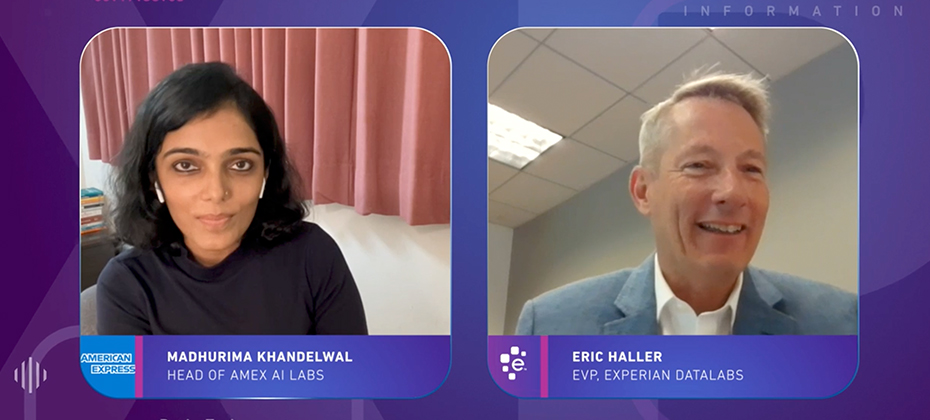
Chatbots, reduction of manual processes and explainability were all hot topics in a recent discussion between two leading data leaders.