
Loading...

Zoom in on Geographic Data to Inform Strategy

by Melinda Zabritski 2 min read June 10, 2021

Woman standing in a car dealership

Data is one of the most powerful tools that lenders and dealers can use to inform their decision making. Looking at trends on a national level is informative, but it can be even more impactful when analyzed at the regional level. When combined, a comprehensive view of data can make all the difference for lenders and dealers when making decisions for their businesses.

New and Used Financing See a Shift in Q1

On a national level, one standout year-over-year change is the breakdown of new and used financing. According to the Q1 2021 State of the Automotive Finance Market report, new vehicles represent a larger portion of the total finance market, increasing from 38.24% in Q1 2020 to 43.20% in 2021. Meanwhile, used financing decreased from 61.76% to 56.80% in the same period.

Loans Remain Most Popular New Vehicle Finance Option

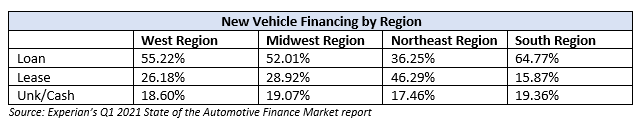
With overall financing on new vehicles increasing across the country, it’s important to dig into what that looks like on a regional level. Across most regions, loans were the preferred method of financing for new vehicles, however, the Northeast saw heavy leasing activity with 46.29% of new vehicles being leased in Q1 2021. Both lenders and dealers can leverage this data to inform expectations and build strategies that address their business on a location-by-location basis.
Regional Differences in Types of Vehicles Financed

Similar to the financing options, there were also regional differences when it came to the types of new and used vehicles financed. For instance, the Ford F150 was the top financed new vehicle in the Midwest (3.54%) and South (3.10%), while the Toyota RAV4 took the top spot in the West (3.48%) and the Honda CR-V led in the Northeast (3.55%).

Looking at used vehicles, we saw similar trends in vehicle popularity, with the Ford F150 landing as the top financed vehicle in the West (3.00%), Midwest (4.08%) and South (3.78%) regions, while the Toyota RAV4 lead the Northeast region (2.52%).

Average Credit Scores Increase Year-Over-Year

On a national level, both new and used vehicle credit scores increased compared to last year. The average new credit score across the country increased six points from 728 in 2020 to 734 this year. Looking regionally, the Midwest generally had a higher credit score, while the South had the lowest.

Meanwhile, the average national used credit score saw an increase of eight points, from 655 to 663 in the same time frame. The Midwest region again led with the highest credit scores, and the South with the lowest.

There is an abundance of valuable data lenders and dealers can leverage when strategizing for their businesses. Looking at data on a national level provides an overall view of the auto finance market, but it doesn’t necessarily tell the whole story. Digging into the data on a regional level, however, can help lenders and dealers identify what is working in some areas, what might not be working in others, and how they can adjust their strategies to maximize their goals, wherever they may be located.

Learn more by watching Experian’s full Q1 2021 State of the Automotive Finance Market report.

Related Posts

The automotive market is entering a new phase defined not just by what consumers are buying, but by how they’re choosing to finance it. According to Experian Automotive’s State of the Automotive Finance Market Report: Q1 2026, nearly one-third (35.55%) of all new vehicle loans now stretch more than six years, up from 30.83% in Q1 2025. Similarly on the used side, 31.54% of loans extended more than six years, an increase from 28.60% last year. The shift highlights why affordability is reshaping how consumers are financing their vehicles, particularly in larger and higher-priced vehicles. Refinancing gains traction as interest rates stabilize In addition to longer-term loans, consumers are becoming increasingly deliberate with their financing decisions and managing monthly payments as refinancing activity has gained momentum. For instance, consumers who refinanced this quarter lowered their interest rate by 2.2% and saved an average of $81 on their monthly payment. Credit unions, in particular, continued to play a major role in helping consumers secure more affordable payment options. In Q1 2025, credit unions accounted for the lion’s share of automotive refinancing at 63.43%, from 62.31% a year ago. By comparison, banks went from 23.51% to 22.59% year-over-year. Furthermore, those who refinanced with a credit union saved an average of $101 this quarter, whereas those who refinanced with banks saved $60. Expanding credit access through flexible financing Another notable trend this quarter was the incessant growth in subprime financing as credit accessibility across the market continues to increase. In the first quarter of this year, subprime borrowers made up 15.75% of total vehicle financing, from 14.40% last year. For new vehicles in particular, the subprime market went from 5.61% to 6.88% year-over-year, while subprime in used vehicle financing grew to 20.60% this quarter, from 19.36% a year ago. Increased activity in the subprime segment highlights continued confidence in the automotive market and underscores the importance of expanded financing options. As consumers seek greater flexibility with financing decisions that fit their lifestyle, lenders and dealers have the opportunity to approach them with more personalized solutions. These trends are helping keep both new and used vehicle markets moving forward, while creating new opportunities for consumers to manage payments and purchase confidently. To learn more about automotive finance trends, view the full State of the Automotive Finance Market Report: Q1 2026 presentation on demand.

by Melinda Zabritski 2 min read June 2, 2026

  As vehicle prices and interest rates continue to evolve, both consumers and lenders are recalibrating their approaches to affordability and long-term sustainability. This shift has resulted in the subprime segment growing to its largest share of total finance market for subprime in the fourth quarter since 2021. According to Experian’s State of the Automotive Finance Market Report: Q4 2025, subprime borrowers accounted for 15.31% of total vehicle financing, an increase from 14.54% in Q4 2024. To understand why the subprime space is evolving, we took a deeper dive into the affordability picture and how changes in pricing and interest rates are influencing both consumer decisions and lender strategies. In Q4 2025, the average loan amount for a new vehicle increased $1,882 from the prior year to $43,582, and the average interest rate for a new vehicle went from 6.34% last year to 6.37% this quarter. As a result, the average monthly payment increased from $746 to $767 in the same time frame. On the used side, the average loan amount increased $872 year-over-year, reaching $27,528 in Q4 2025. However, despite the average interest rate declining from 11.63% to 11.26% during the same time, the average monthly payment grew $9 from last year to $537 this quarter. These changes are prompting thoughtful adjustments across the automotive ecosystem. Consumers are comparing financing options more carefully and adjusting loan terms when necessary to prioritize the cost of ownership. Lenders are also focusing more on payment flexibility and how long-term borrowers are performing as they leverage it for central pillars of strategies to stay ahead of the ever-evolving market. To learn more about automotive finance trends, view the full State of the Automotive Finance Market Report: Q4 2025 presentation on demand.

by Melinda Zabritski 2 min read March 5, 2026

Many across the industry have been waiting to learn how EV activity has changed now that the EV tax credit has been eliminated. According to Experian’s State of the Automotive Finance Market Report: Q3 2025, the EV market saw a sharp uptick in transactions as many locked in these benefits before they disappeared, though it remains to be seen what the market will look like in the fourth quarter. With the EV market expanding and more models entering the lineup, shoppers also benefited from various options across a wider range of price points within their budget. Even so, many opted to lease a new EV rather than purchase it. More than 56% of consumers leased an EV in Q3 2025, up from 46.43% last year. The gap between the number of EV leases and purchases reflects several underlying factors, one of them being this option likely offered lower upfront costs and monthly payments. For instance, the average monthly payment for a lease was $172 lower than a loan for an EV in Q3 2025. Where EV performance stands in the broader market When looking at the data from a larger perspective, EVs made up 25.31% of the total new lease market, compared to 17.69% a year ago. The alternative fuel type also comprised four of the top ten leased models, with Tesla Model Y (4.35%) and Tesla Model 3 (2.58%) as the top two. They were followed by the Honda Prologue (1.78%) as the fifth most leased model and the Hyundai IONIQ 5 (1.49%) as the ninth. EVs making up nearly half of the top ten leased models in the overall market underscores how quickly consumer preferences can shift and how incentives play a role in purchasing behavior. Consumers’ comfort with EV technology continuing to grow paired with the steady expansion of compelling models across segments also highlights the momentum that is being brought to the overall automotive industry. As the market continues to move forward, the interplay of expiring incentives, more model availability, and a strong desire for leasing shows how EVs have steadily become a more prominent consideration. Leveraging these insights will help automotive professionals best position themselves to support consumers navigating an increasingly dynamic landscape. To learn more about EVs and other automotive finance trends, view the full State of the Automotive Finance Market Report: Q3 2025 presentation on demand.

by Melinda Zabritski 2 min read December 4, 2025

Subscribe to our Auto blog

Enter your name and email for the latest updates.

This site is protected by reCAPTCHA and the Google Privacy Policy and Terms of Service apply.