
Loading...

Managing Attributes Across the Attribute Life Cycle

by Kelly Nguyen 3 min read August 27, 2019

Many companies rely on attributes for decisioning but lack the resources needed to invest in developing, managing, and updating the attributes themselves. Experian is there to guide you every step of the way with our Attribute Toolbox – our source independent solution that provides maximum flexibility and multiple data sources you can use in the calculation and management of attributes.

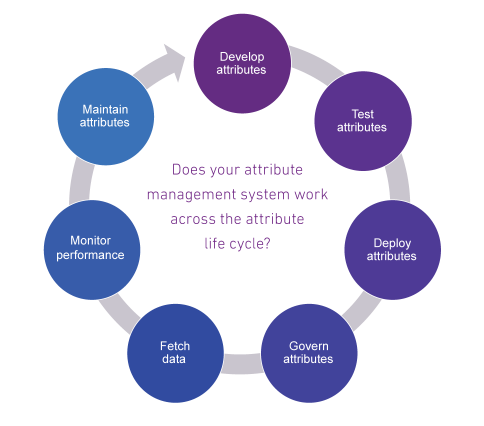
To create and manage our attributes, Experian has established development principles and created a set methodology to ensure that our attribute management system works across the attribute life cycle.

Here’s how it works:

Develop Attributes

The attribute development process includes: discovery, exploratory data analysis, filter leveling, and the development of attributes. When we create attributes, Experian takes great care to ensure that we:

  • Analyze the available data elements and how they are populated (the frequencies of fields).
  • Determine a “sensible” definition of the attribute.
  • Evaluate attribute frequencies.
  • Review consumer credit reports, where possible.
  • Refine the definition and assess more frequencies and examples.

Test Attributes

Before implementing, Experian performs an internal audit of filters and attributes. Defining, coding and auditing filters is 80% of the attribute development process. The main objective of the auditing process is to ensure both programming and logical accuracy. This involves electronic and manual auditing and requires a thorough review of all data elements used in development.

Deploy Attributes

Deployment is very similar to attribute testing. However, in this case, the primary objective of the deployment audit is to ensure both the programming and logical accuracy of the output is executing correctly on various platforms. We aim to maintain consistency among various business lines and products, between batch and online environments across the life cycle, and wherever your models are deployed: on premises, in the cloud, and off-site in your partners’ systems.

Govern Attributes

Experian places a robust attribute governance process in place to ensure that our attributes remains up-to-date and on track with internal and external compliance regulations and audits. New learnings, industry and regulatory changes can lead to updated attributes or new attributes over time. Because attributes are ever-changing, we take great care to expand, update and add new attributes over time based on three types of external changes: economic, bureau, and reporting changes.
Fetch Data

While we gather the data, we ensure that you can integrate a variety of external data sources, including: consumer bureau, business, fraud, and other data sources.

Attributes need to be:

  • Highly accurate.
  • Suitable for use across the Customer Life Cycle.
  • Suitable for use in credit decisioning and model development.
  • Available and consistent across multiple platforms.
  • Supportive and adaptable to ever-evolving regulatory considerations.
  • Thoroughly documented and monitored.

Monitor Performance

We generate attribute distribution reports and can perform custom validations using data from credit reporting agencies (CRAs) and other data providers. This is based on monthly monitoring to ensure continued integrity and stability to stand up to regulatory scrutiny and compliance regulations. Variations that exceed predetermined thresholds are identified, quantified, and explained. If new fields or data values within existing fields are announced, we assess the impact and important of these values on attributes – to determine if revisions are needed.

Maintain Attributes

Credit bureau data updates, new attributes in response to market needs, compliance requirements, corrections in logic where errors are identified or improvements to logic often lead to new version releases of attributes. With each new version release, Experian takes care to conduct thorough analyses comparing the previous and current set of attributes. We also make sure to create detailed documentation on what’s changed between versions, the rationale for changes and the impact on existing attributes.

Experian Attributes are the key to unlocking consistent, enhanced and more profitable decisions. Our data analysts and statisticians have helped hundreds of clients build custom attributes and custom models to solve their business problems.

Our Attribute Toolbox makes it easier to deploy and manage attributes across the customer lifecycle. We give companies the power to code, manage, test, and deploy all types of attributes, including: Premier AttributesSM, Trended 3DTM, and custom attributes – without relying on a third-party.

We do the heavy lifting so that you don’t have to.

Learn More

Related Posts

Lending hasn’t slowed down—but many decisioning processes have. Applications are coming in faster. Fraud is becoming more sophisticated. Borrowers expect near-instant responses. And yet, inside many organizations, decisions are still being made across fragmented systems, manual reviews, and rigid strategies that weren’t designed and aren’t optimized for today’s environment. That broadening gap isn’t just an operational issue but often stems from a lack of innovation as well. And it’s quietly costing lenders growth, efficiency, and competitive position. When decisioning falls behind, some symptoms are easy to recognize, like applications taking days to process, teams overloaded with manual reviews, and credit and fraud decisions happening in separate platforms. Others are not as obvious, but arguably more impactful, slipping bottom lines and fraud and therefore losses lurking in lenders’ portfolios. The root issue is a fragmented infrastructure. Experian has reported that while 79% of financial institutions surveyed globally want fewer vendors or more unified approaches, they typically use eight or more tools across credit, fraud and compliance. As most decisioning environments cannot integrate data, adapt strategies, and execute decisions in real time, lenders often have to make tradeoffs. Speed vs. accuracy; growth vs. risk; and automation vs. control are just some. Meanwhile, the market has moved on. Leading lenders are no longer optimizing individual steps. They’re rethinking decisioning as a connected, intelligent system. Gaps forming from status quo in 8 key decision areas Across the lending lifecycle, there are eight critical moments where decisioning can either accelerate growth or create friction. Pre-qualification: Pre-qualification should expand your funnel with confidence. But limited data access and static criteria often result in overly conservative targeting or missed opportunities. Additionally, the delay in acting on a pre-qualification funnel highlights a key area for opportunity among many lenders. Instant credit decisions: Customers expect real-time outcomes. When decisions rely on manual intervention or fragmented inputs, speed and conversions suffer. Prescreen and targeting: Disconnected data and rigid segmentation can lead to poorly aligned offers, reducing response rates and wasting acquisition spend. Credit line management: Without dynamic strategies, credit lines may be too restrictive (limiting growth) or too aggressive (increasing risk). Early delinquency management: Missed early signals and delayed interventions make it harder to prevent accounts from deteriorating. Mid- and late-stage delinquency: Strategies that don’t adapt to evolving borrower behavior reduce recovery effectiveness and increase losses. Collections and recovery: Manual, one-size-fits-all approaches limit recovery rates and increase operational cost. Ongoing strategy optimization: Perhaps the most overlooked gap: many lenders lack the ability to continuously test, learn, and refine decision strategies as conditions change. What these gaps are really costing you Individually, each of these breakdowns may seem manageable. Together, they can create systemic drag on performance. That shows up in four critical ways: Missed growth opportunities: Good borrowers are declined, abandoned, or never targeted in the first place. Credit offers fail to align with actual borrower potential. Higher operational costs: Manual reviews and disconnected workflows consume time and resources that could be spent on higher-value work. Increased fraud exposure and friction: Fraud is proliferating and becoming more expensive to manage. The Federal Trade Commission reported $12.5B were lost to fraud in the U.S. in 2024, a 25% increase over the prior year. For many financial institutions, the first reaction is often to add more steps to the decisioning process, which can impact good borrowers. Increased competitive pressure: Fintechs and modern lenders are focused on delivering faster, more personalized experiences, capturing share while traditional processes lag behind. 80% of banks and credit unions plan to increase their technology spending in 2026, yet many continue to fall short on planned system deployments, according to Cornerstone Advisors’ annual “What’s Going On in Banking” research report. What innovative decisioning leaders are doing differently Leading lenders are changing how decisions are made, creating a competitive advantage. Instead of stitching together point solutions, they’re adopting a more integrated approach that brings together: Comprehensive data – including both credit and fraud insights Optimized decision strategies – designed to balance growth and risk Real-time execution – enabling faster, more consistent outcomes Continuous optimization – adapting to changing market conditions Strategic partnerships – leveraging third-party industry expertise to augment their own This shift eliminates the need for tradeoffs and instead allows lenders to increase approvals while maintaining control, reducing manual effort while improving consistency, and responding faster without sacrificing confidence. The stakes are high and the competition for consumers is even higher, particularly against a backdrop of ever-evolving fraud risks, continuously increasing consumer expectations for seamless, digital-first experiences and often limited resources. Nearly half of banks and 59% of credit unions have already deployed generative AI, with more investing now, according to the Cornerstone Advisors’ report. Closing the innovation gap requires a more fundamental shift toward decisioning systems that are connected, scalable, and built for continuous change. A new foundation for decisioning This is where platforms like Experian Decisioning are changing the landscape. By bringing together credit and fraud insights, decision strategies, and a flexible technology architecture, lenders can move beyond fragmented processes and build a more unified, intelligent decisioning approach. One that fits within existing systems but also evolves with your needs. Where to start Impactful change doesn’t need to be an overhaul of everything at once for most organizations. The first step is understanding where your biggest gaps exist, and which decision areas are creating the most friction or missed opportunity. Once you can see where decisioning is not optimized, you can begin to redesign it in a way that’s faster and more adept for what lending has become. By making better decisions, faster, and with greater confidence, lenders can process applications more efficiently and also break away from the pack by leveraging decisioning as a strategic advantage. Learn more

by Stefani Wendel 3 min read March 26, 2026

Learn how GenAI is reshaping financial services from customer engagement to compliance, leading to improved decisions and operations.

by Masood Akhtar 3 min read December 4, 2024

Reject inferencing techniques unlock a more comprehensive view of your applicant pool for more informed underwriting decisions. 

by Julie Lee 3 min read September 17, 2024