NA – North America
News about Experian North America:
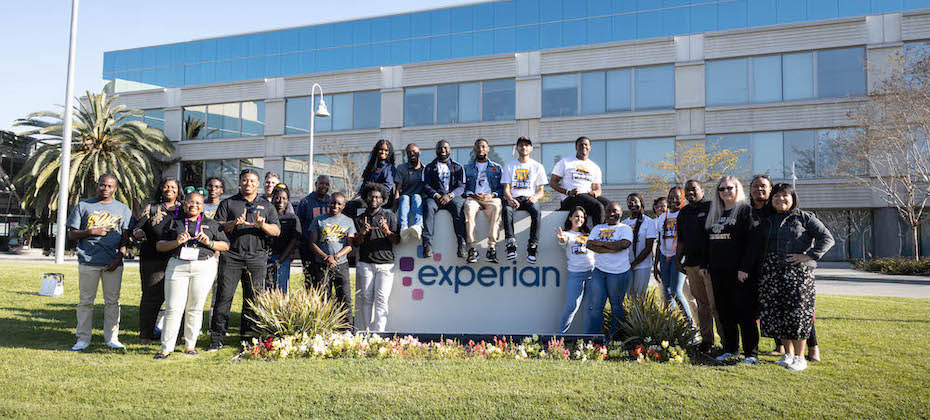
Experian research shows more than a quarter of Black and Hispanic consumers are invisible to the credit market, compared to 16% of Asian and White consumers. This is a significant gap that all of us can improve. At our North American headquarters, a group of young scholars took the lead on finding solutions. Four teams representing Historically Black Colleges and Universities (HBCUs) visited our campus and shared their creativity and personal stories with us in the finale of the inaugural #IYKYK Hackathon. The Hackathon was the culmination of a six-month Center for Financial Advancement® Credit Academy, created in partnership with HomeFree-USA. Through live sessions with Experian credit education experts and self-paced content, more than 250 scholars from 14 HBCUs learned about credit, financial tools, and how to build generational wealth through steps like homeownership. The teams from Alabama State University, Fisk University, Morgan State University and Shaw University made it to the finals and presented their ideas for the next best credit education program for their peers. Left to right, top to bottom: Fisk University, Morgan State University, Shaw University and Alabama State University In addition to their presentations, what was also impressive was the inclusivity in participation. Just at the finals alone, these student leaders represented six countries, eight different languages, the LGBTQ+ community, different faiths, and more. The “Credit Stingers” from Alabama State University took home the prize, a $40,000 scholarship for their idea of a gamified app called “Credit Rush.” In order to overcome obstacles, students watch a video or take a quiz about credit in order to advance to higher levels. Other features of “Credit Rush” include the “Hive,” a library of credit education materials, chat, daily calendar functions and more. The “Credit Stingers” from Alabama State University took home the prize, a $40,000 scholarship for their idea of a gamified app called “Credit Rush.” Many of the student leaders are already putting what they’ve learned into practice. They shared how they’ve been able to rent their own apartments for the first time, help their recently immigrated family members establish their credit identities, and make decisions that will help them eventually buy a home. They showed immense passion. They are committed to being knowledge ambassadors, sharing information about credit with their classmates, families and friends, making their communities the true winners of this program.

Our people play a vital role in innovating new ways to better serve our customers, developing new technologies that advance inclusion and financial growth for consumers while helping other team members along the way. Our purpose-driven culture is clearly changing the game. Recognized by Fortune as one of America’s Most Innovative Companies, we’re pioneering innovations to help consumers navigate the complicated road to financial freedom. First, there’s Experian Boost™, our innovative product that allows people to improve credit scores by adding payment records to their profiles of previously untracked expenses such as utilities, mobile phone payments and streaming services. And now we’ve created a way to get rent payment histories into credit reports as well. We also changed the game with our new Experian Go™ product that enables those with no credit history to create a credit report. This program opens the front door to the financial ecosystem for millions of consumers by helping them establish their financial identity and move from credit invisible to scoreable. These products are just a few examples of how our company culture embraces change and enables us to innovate. We focus on problems that need to be solved and put the energy and resources behind developing solutions that solve them. And the industry recognition continues, which represents a validation of the culture of innovation we’ve built, with feedback coming from our employees, customers, and other industry experts. Other wins include: The 2023 BIG Innovation Awards that recognized the company for delivering innovative products, such as Experian Go™, that help consumers thrive financially Experian Boost™ was selected for Fast Company’s 2022 World Changing Ideas Awards. We were named a Great Place to Work’s Best Workplaces for Parents in 2022 and Top 30 Employer for Working Families in 2022. These are merely steps in our journey. Stay tuned for what’s next.

Experian’s culture of innovation continues to be a remarkable differentiator for our people, products and solutions. Our innovation is driven by the confluence of data with creative, critical thinking that enables each worker and the company as a whole to tackle complex problems. Our capability to collect, analyze and employ data lies at the very heart of our business at Experian. We go to extraordinary lengths to ensure that our sources, models, and processes are unimpeachable. Given Experian’s decades-long background in curating massive amounts of data, knowing the proper questions to ask regarding how to collect, analyze, and manage data is vital. Answering those questions lies at the heart of an article that recently appeared in the HBR (Harvard Business Review) Guide to Critical Thinking book to help business leaders navigate their most challenging issues. The article highlights Experian Boost and our work in the cloud as key innovations that help our customers, and poses four critical questions that businesses must ask themselves about their use of data to ensure positive outcomes: 1. How was the data sourced?The quality and care with which data is collected varies widely. Poor-quality data, or data used in the wrong context, can actually be worse than no data at all. Managers shouldn’t just assume their data is accurate and of good quality. Auditing data transactions is becoming as common as auditing financial transactions. 2. How was the data analyzed?Even when data is accurate and well maintained, the quality of analytic models can vary widely. Errors and lapses are relatively common and can lead to serious consequences. At Experian, we constantly scrutinize our models to ensure they achieve their specific objectives and their output reflects the real world. 3. What doesn’t the data tell us?Data models are a lot like humans: they tend to base judgments on the most readily available information — sometimes, the data you don’t have can affect decision making as much as the data you possess. And human designers often pass it on to automated systems. In the article, Experian Boost is cited as an example of adding key data to a credit history to help “thin-file” consumers raise their scores to help qualify them to buy a car, rent an apartment, or get a credit card. 4. How can we gain full advantage from the data? For example, by using it to redesign products, services or business models.Companies have learned how data can help run business more efficiently by automating processes, predicting when machines need maintenance, and improving customer service. Real opportunities come when data enables a company to completely re-imagine its business. We’ve leveraged the cloud to shift from only delivering processed data in credit reports to a service that gives our customers near real-time access to far more granular data. That may seem like a subtle transition, but it’s become one of the fastest-growing parts of Experian’s business. Check out the full article, “Data-Driven Decisions Start with These 4 Questions,” written by Eric Haller, Executive Vice President and General Manager, Identity, Fraud & DataLabs at Experian, and Greg Satell, an international keynote speaker, adviser and bestselling author.

Healthcare providers are struggling to address the high volume of insurance claims denials. It’s one of the top contributors to wasted dollars to the tune of more than $250 billion per year, according to industry reports. A denied claim means healthcare providers, like hospitals, are not getting reimbursed for care, leaving much-needed funds on the table. The cause of a denied claim is often due to incorrect data. The result? An endless cycle of submissions and resubmissions, which not only affects providers’ financial stability, but also puts pressure on the issue of staffing shortages with rounds of rework. You could even argue patients experience pains with this administrative burden, as inefficiencies could result in higher out-of-pocket costs. It’s no surprise that reducing claim denials is at the top of many healthcare leaders’ wish lists. In fact, a recent Experian Health survey among healthcare executives found that 72 percent said reducing denials was their highest priority. Experian Health aims to simplify the administrative aspects of healthcare and we recognize the claims process is currently one of the most challenging for providers. From the perils experienced with manual data entry to payer codes changing frequently to the decentralization of data and lack of staffing, the industry must adopt new ways to tackle the claims denial conundrum. We believe the solution involves tapping into the benefits of using artificial intelligence and are proud to announce the launch of AI Advantage™, an artificial intelligence engine in our #1 KLAS ranked ClaimSource® suite. With two new claim reimbursement products for the pre- and post-submission process, AI Advantage - Predictive Denials™ and AI Advantage - Denial Triage™, these products offer real-time intelligence and predictive modeling to prevent avoidable denials and prioritize re-submissions, leading to greater efficiencies and faster recouped revenue. This is an example of how Experian Health is using AI, analyzing and processing data and information in ways others can’t to solve problems. The next frontier in healthcare is upon us and the industry must embrace the technologies that make administrative processes faster and more efficient to allow providers to be more financially solvent and, most importantly, be in a better position to focus on patient care. For more information about AI Advantage, click here.

Today we released our annual Future of Fraud Forecast to help consumers and businesses stay one step ahead of emerging fraud trends and scams. Here’s what we expect in 2023: Fake texts from the boss: Given the prevalence of remote work, Experian predicts there’ll be a sharp rise in employer text fraud. This occurs when the “boss” texts the employee to buy gift cards using a bogus reason, and then asks the employee to email the gift card numbers and codes. Fraudsters then use the gift cards, leaving the employee and/or the company with the expense.Beware of fake job postings and mule schemes: Amid uncertain economic conditions, Experian predicts fraudsters will create fake remote job postings, specifically designed to lure consumers into applying for the job and providing private details like a social security number and date of birth on a fake employment application. The job never materializes, and the fraudsters use the information provided to commit identity theft. Experian also predicts that consumers could fall prey to mule recruiting schemes. This happens when people sign up for work from home jobs and unintentionally act as a re-shipper of stolen goods or help move money through their personal bank accounts on behalf of fraudsters.Frankenstein shoppers spell trouble for retailers: Synthetic identity fraud is the fastest growing financial crime in the United States, according to The Federal Reserve. This type of fraud involves a fraudster creating a synthetic or “Frankenstein” identity by combining real and false information and opening and building up lines of credit, eventually maxing out their credit limit and never paying it back. Experian predicts a new version of this fraud could result in major losses for retailers in the coming year. Fraudsters can create online shopper profiles using synthetic identities so that the fake shopper’s legitimacy is created to outsmart retailers’ fraud controls. As the shopper’s profile matures, criminals add stolen payment cards to the accounts. When the fraud eventually occurs, a single synthetic identity will have multiple credit lines to burn through across retailers.Social media shopping fraud: Experian predicts in-app social commerce fraud could result in millions of dollars in losses. These apps are designed to make shopping easy, intuitive and compelling for consumers to make purchases without leaving the app. This means legitimate brands are racing to make social commerce a part of their sales strategy. However, social commerce currently has very few identity verification and fraud detection controls in place, making the retailers that sell on these platforms easy targets for a surge in fraudulent purchases.Peer-to-peer payment problems: Consumers love the convenience of peer-to-peer payments and usage continues to grow. Fraudsters also love peer-to-peer payment methods because they’re an instantaneous and irreversible way to move money, enabling fraudsters to get cash with less work and more profit. Experian predicts fraudsters will gain even more unauthorized access to peer-to-peer payments by using multiple social engineering techniques. Consumers will be duped into buying fake items, sending the money to fraudsters and then never receiving their orders. They’ll also be tricked into giving their account credentials, enabling fraudsters to send cash to themselves. Experian is at the forefront of fraud prevention and identity verification. We offer a full suite of automated tools that harness data and analytics to prevent fraud and mitigate losses. Learn more about Experian’s fraud prevention tools here.

Dr. Martin Luther King, Jr. spoke often about “the beloved community.” To be of service to all and unite us in the act of giving back. This encapsulates what Experian stands for: to create a better tomorrow for all. We’re proud that today, across Experian North America, our teammates will be participating in volunteer opportunities in-person and virtually to address needs in their communities; everything from career development, recording audio books for children, and creating Martin Luther King, Jr. fact cards in braille. One project that we’re particularly looking forward to is helping to design free budget templates for consumers in underserved communities. Financial literacy and equitable access to financial tools and resources lead to economic empowerment. We’ve been able to bring our message to live events like the National Urban League, and support young athletes and their families at the Allen Iverson Roundball Classic as its exclusive financial literacy partner. To further our support of Dr. King’s mission, Experian has also made a donation to the King Center for Non-violent Social Change. We’re proud Experian supports today’s National Day of Service and hope you’re able to make an impact in your communities on this day, and every day.

We’re thrilled to announce that Experian North America has been recognized as a Top Workplace by the Orange County Register for the 10th consecutive year, with an additional “Excellence Award” for our work / life flexibility. This honor is a testament to our innovative employee culture, and keeping connected, engaged and energized as a hybrid workforce. This Orange County Register award recognition is based on the results of confidential employee surveys that assess the performance of hundreds of successful companies throughout our community. We recognize that our employees are the driving force behind our decade-long achievement as a Top Workplace. Our talented team is dedicated to both their own growth and pushing us forward, and we’re grateful for all they do to make Experian such a great place to work. Employee collaboration from our hackathons and company-wide product overviews have sparked remarkable innovations, such as Experian Go and Experian Boost. These products are especially helpful to members of diverse backgrounds and low-income households. Our Mental Health First-Aiders program is another example of employees coming together to support each other. Our commitment to creating a supportive, purpose-driven culture is reflected in multiple awards from authoritative sources such as Great Places to Work. Not only was Experian listed among the "Best Workplaces for Parents," we’re also honored to be included on their list of "Best Workplaces for Millennials." Additionally, we’re passionate about giving back to the communities in which we work and live. We take pride in our company’s numerous contributions to organizations focused on the well-being of people from a diverse array of backgrounds. From creating the Experian Volunteer Leadership Network to our financial support of community organizations such as Ascend, National Urban league, HomeFree-USA and the Pathways Forward Initiative, we’re dedicated to helping people in need. We believe all these factors have led to our success as a company and a desirable place for people to build thriving careers. We’re honored that leading organizations like the Orange County Register and Great Places to Work recognize our efforts to make the world a better place. We want to make sure that we continue to innovate; that our products and services are first-best-and-only in their respective industries; and that we take very good care of our constituents.

Home ownership has been found to be one of the greatest drivers of generational wealth, but the dream of owning a home can seem out of reach for millions of Americans. At Experian Mortgage, we believe our commitment to diversity, equity and inclusion, and leveraging the power of data, analytics and technology creates a better tomorrow for all. Our team is 100% committed to helping expand homeownership opportunities to populations traditionally left out of the market. For me personally, diversity, equity and inclusion – in all regards – is a personal passion. That’s why it’s especially thrilling and humbling to receive the Mortgage Bankers Association (MBA) 2022 Residential Diversity, Equity and Inclusion (DEI) Leadership Award in the Market Outreach Strategies Non-lender category. Diversity, equity and inclusion is more than just a program for us. It drives our company’s mission of financial inclusion. We are proud to partner with nonprofit organizations including HomeFree-USA, the Urban Institute, UnidosUS and the National Urban League to break down barriers to homeownership through financial and credit education. Through our United for Financial Health program, we established the Home Preservation Grant to assist Black and African American homeowners at risk of losing their homes due to the negative impact of COVID-19. To date, homeowners in Atlanta, Chicago and the greater Washington, D.C. areas have benefitted. As a member of the MBA, Experian enthusiastically signed the Home for All Pledge, furthering its commitment to be a champion for change in addressing the barriers to sustainable housing for persons and communities of color. Additionally, several members of the Experian Mortgage team participate in the Housing Affordability Convergence in support of MBA’s initiative to facilitate new solutions to the nation’s rental and housing affordability challenges. For Experian Mortgage to be recognized by the MBA for our market outreach efforts is tremendously rewarding. It helps confirm we’re on the right track and we still have more to do. We look forward to providing partnership and support to clients and the industry to join us in our mission of financial inclusion. Click here to learn more about our commitment to diversity, equity and inclusion.

For all of the ways money – and access to it – affects our lives, it’s unfortunate that it is not discussed regularly with young people. Sadly, when it is discussed, it’s often in response to highly emotional financial stress or difficulty rather than as a positive learning opportunity. Establishing a positive, fact-driven relationship with money early in life can be a critical factor in future success. Equitable access to financial tools and resources to create a better tomorrow can help everyone achieve their life’s goals. That’s why we’re proud to announce the launch of the Center for Financial Advancement® (CFA) Credit Academy. CFA is a key initiative of HomeFree-USA, and we’ve been partnering with the organization to provide complementary training to their housing counselors on financial and credit education information and resources. This new six-month program is for 250 scholars from 14 Historically Black Colleges and Universities (HBCUs). My colleagues on Experian’s Credit Education team are leading the program to help scholars gain an understanding of credit and its importance. The hope is they’ll become knowledge ambassadors for their peers, family and their communities. Experian research shows there are 28 million US consumers who are unable to participate in the mainstream financial ecosystem today because they don’t have a financial identity. Credit invisibility more frequently impacts underserved communities with 26% of Hispanic consumers and 28% of Black consumers unscoreable or invisible compared to 16% of White and Asian consumers. That can make homeownership, the greatest driver of generational wealth, an even bigger challenge for underserved communities. Ensuring these students are aware, informed and visible within the credit ecosystem will help them access more equitable lending when they’re ready to take steps to buy a car, own a home, and build generational wealth. In addition to live sessions and self-paced content, the CFA Credit Academy culminates with a hackathon competition in April, challenging all students to form teams of four at participating HBCUs to build the next best credit education program for their peers. The winning team will earn a $40,000 scholarship, sponsored by Experian. We can’t wait to see what the scholars come up with, and we look forward to sharing their ideas. To learn more about Experian’s work in diverse communities: visit www.experian.com/diversity.