NA – North America
News about Experian North America:

What if one of the biggest opportunities for mortgage lenders isn't just identifying more qualified borrowers, but reaching the consumers who don't yet believe they could become one? I recently joined the Chrisman Commentary Daily Mortgage News podcast to talk about Experian's latest research on prospective homebuyers and what it means for mortgage lenders. We covered a lot of ground, from modern credit scoring and expanded data to the next generation of homebuyers. But one finding in particular has stayed with me. Our research found that more than one-third of consumers (34%) have delayed exploring homeownership because they assumed their credit history or credit score wouldn't qualify them[1]. Think about what that means. These aren't necessarily consumers who applied for a mortgage and were turned down. Some are taking themselves out of the equation before a lender ever has the opportunity to evaluate them. For an industry focused on identifying and reaching the next generation of homebuyers, I believe that's an important challenge. And an opportunity. Engage before the application It nearly goes without saying that there are, of course, very real economic barriers to homeownership today. Affordability, home prices, interest rates and saving enough for a down payment continue to weigh on prospective buyers. But there are other barriers we can do more about. Buying a home is complicated, particularly for someone who has never been through the process. Consumers may not know what they can afford, what credit score they need, what information a lender will consider or even whether homeownership is realistically within reach. When consumers don't have that information, assumptions can fill the gap. That's why I believe our industry has an opportunity to engage prospective homebuyers much earlier in their journey. The mortgage relationship shouldn't begin when someone is ready to submit an application. Reaching consumers earlier gives lenders an opportunity to help them understand where they stand today and, if they're not quite ready, what they can do to get there. That might mean helping someone better understand their credit profile. It could mean identifying actions that could improve their financial readiness. Or it could simply mean helping a prospective buyer understand that they may be closer to homeownership than they thought. A more informed consumer can become a more confident and better-prepared prospective borrower. Better information can change the journey This becomes even more important as the information available to understand consumers continues to evolve. We've talked a lot recently about the mortgage industry's transition to modern credit scoring and the opportunity to incorporate a more complete picture of consumers' financial lives. That's important. But better data and modern scores are most powerful when we think about how they can improve the entire homebuying journey, not just the decision that happens at the end of it. At Experian, we already engage with millions of consumers directly through tools and resources designed to help them understand and improve their financial health. We also help lenders bring personalized credit insights into their own digital experiences. Our acquisition of Own Up earlier this year adds another important dimension to that work by bringing us closer to consumers as they navigate the homebuying journey. For me, that's where the opportunity gets particularly exciting. We’re at a point now where we can bring together better data, modern credit scoring, personalized education and earlier engagement to create a more connected path to homeownership. Don't underestimate the next generation of homebuyers Despite today's affordability challenges, consumers haven't given up on homeownership. Our research found that nearly half of Gen Z consumers expect to be in a position to buy a home within the next four years. Younger consumers are interested. They're engaged. And they're paying attention to how lenders evaluate them. The question for our industry is whether we're engaging them early enough. If a prospective homebuyer assumes they won't qualify and never raises their hand, lenders may never know that opportunity existed. But if we can reach that person earlier, help them understand where they stand and give them a clearer roadmap for moving forward, the outcome could look very different. That's what makes me optimistic about where the mortgage industry is headed. We have more tools than ever to make the homebuying journey work better for consumers and lenders alike. The opportunity now is bringing those pieces together so fewer people count themselves out before they begin. I talked more about that opportunity, the shift to modern credit scoring and what our latest research means for lenders in my recent conversation with Robbie Chrisman on the Daily Mortgage News podcast. Listen to the full conversation here: https://chrismancommentary.com/podcast/8-26-26/ [1] Methodology: Experian commissioned Atomik Research to conduct an online survey of 2,000 adults age 18+ in the United States. The margin of error for the overall sample is +/- 2.2 percentage points with a confidence level of 95 percent. Fieldwork took place between July 16 and July 21, 2026.
There’s a fundamental shift happening in the digital economy. For decades, the internet connected people to information. Then it connected people to businesses. Today, we're entering a new era where technology is beginning to act on our behalf, helping us search, shop, compare options and make decisions faster than ever before. Our latest Experian Identity & Fraud Report found that nearly one-third of consumers are already using AI tools to support online browsing and shopping, while another 23% are open to doing so. Consumers are embracing AI's convenience and efficiency in ways that would have been difficult to imagine just a few years ago. Yet beneath that enthusiasm lies an important reality: trust hasn't kept pace. The trust gap The findings from our report reveal what I believe is one of the defining challenges of the next few years. People are comfortable using AI to help them browse or gather information, but when it comes to major decisions, confidence drops dramatically. Only 21% of consumers are comfortable relying on AI for travel purchases, and just 17% trust AI with financial decisions. That gap between AI adoption and AI trust matters. In fact, it may become the single most important factor determining which organizations thrive in the future. Fraud concerns remain high The new report also found: Nearly one in five consumers experienced financial losses from online fraud in the past year, while an additional 15% reported fraud attempts that were successfully prevented. More than 70% of fraud victims said the experience left them feeling more vulnerable online. Businesses identified AI-generated phishing attacks as their top AI-related fraud concern, followed by AI-assisted first-party fraud, document forgery, automated bot attacks and deepfake voice scams. Eighty percent of organizations report using machine learning or generative AI as part of their fraud management and prevention strategies. Seventy-one percent of consumers say it is important for businesses to accurately recognize them online. Eighty-four percent are willing to complete additional security steps when necessary to help prevent fraud. As AI continues to transform digital experiences, businesses face a unique challenge. The same technologies helping organizations improve efficiency and customer experiences are also being used by fraudsters to create more sophisticated attacks. The good news is that companies are responding by leveraging AI-powered fraud prevention, identity verification and risk management tools to detect anomalies and stop fraud faster than ever before. Convenience will be a key driver Looking ahead, organizations must prepare for what I often describe as a "human-not-present" era, where AI agents increasingly help consumers research, shop and even transact on their behalf. In this environment, businesses will need confidence not only in the identities of consumers but also in the digital agents acting for them. Consumers have made their expectations clear: they want security and convenience, not one at the expense of the other. The organizations that can deliver both through transparent, seamless and trusted experiences will be best positioned to succeed. The future of AI is incredibly promising. But its success will depend on something fundamentally human: confidence. The companies that earn and maintain that confidence will be the ones that lead the next generation of digital commerce. To learn more about the findings from Experian's 2026 Identity and Fraud Report and emerging fraud trends shaping the digital economy, watch our webinar: 2026 Fraud Trends: Navigating AI and the Future of Digital Trust

For decades, the path to homeownership has largely been evaluated through the lens of a credit model built for a different era. That’s changing now. The Federal Housing Finance Agency's decision to approve more modern mortgage credit scoring models, including VantageScore 4.0, marks an important milestone for the industry. For the first time, mortgage lenders have a path to use credit scores that can incorporate more comprehensive consumer data, including positive rental payment histories and other eligible payment information to better assess creditworthiness. Consumers expect a more complete financial picture Recently, much of the conversation around modern credit scoring has focused on implementation and operational readiness. While those are important, another critical point is coming into view: consumers increasingly expect lenders to use scores that leverage better data to understand their financial readiness—and they're willing to reward those that do. Experian’s latest research reinforces this shift: The broader market is willing to walk away. Overall, one-third (33%) of consumers claim they would actively seek out a new lender if they learned their current one relied only on older approaches. Awareness is growing rapidly. More than four in ten consumers (41%) are already aware that mortgage lenders are transitioning to newer models that incorporate rent and utility payments. Younger homebuyers are paying close attention. Nearly two-thirds (62%) of Gen Zers over 18 are aware mortgage lenders are gaining access to more modern credit scores and three in four (76%) say the type of credit scoring model a mortgage lender uses would influence whether they would stay with that lender or consider another option. These findings should matter to every mortgage lender. Consumers rightfully want to know lenders are using modern scores that use broader data and many say they'll actively choose lenders that use them. The power of expanded data At Experian, we often say that better data creates better outcomes. That has been true throughout our history and it’s why we've consistently invested in helping consumers build and demonstrate their complete financial picture. It’s what led us to launch Experian Boost®, helping millions of consumers add eligible utility, telecom and streaming payment history to their Experian credit file. It drove us to become the first credit reporting agency to incorporate positive rental payment history into consumer credit reports. Today, Experian maintains the industry's largest repository of rental data, recently surpassing 50 million lease records. Now, for the first time, the modern credit scoring models approved for mortgage lending are capable of making greater use of this richer picture. And the opportunity is significant. Independent research from VantageScore found VantageScore 4.0 can identify nearly five million additional mortgage-ready consumers compared with legacy mortgage scoring approaches, representing an estimated $1 trillion in potential mortgage originations. The path forward For years, the industry has talked about modernizing mortgage credit. Today, consumer demand is making it an operational mandate. Consumers expect lending decisions to reflect their complete financial picture, they’re willing to walk away from organizations that don’t adapt. Lenders that embrace this shift won't just be adopting new technology—they'll be better positioned to serve the next generation of homebuyers. We're ready to help our clients make the most of this moment - with the data, insights and expertise to responsibly expand access to homeownership. Methodology: Experian commissioned Atomik Research to conduct an online survey of 2,000 adults age 18+ in the United States. The margin of error for the overall sample is +/- 2.2 percentage points with a confidence level of 95 percent. Fieldwork took place between July 16 and July 21, 2026.

Recently, I had the opportunity to sit down with Congresswoman Young Kim (CA-40), co-chair of the Financial Literacy and Wealth Creation Caucus, to talk about something that affects millions of people every day: financial access. In that conversation, one thing became clear: broadening access to financial resources starts with equipping people with financial knowledge. When people understand how the financial system works, including how lending decisions are made and what options are available, they’re better positioned to make informed choices and plan for the future. But that’s not always easy. Families today are navigating real affordability pressures, from everyday expenses to finding fair and affordable financial options. And as we discussed, many consumers learn by doing, often making decisions without fully understanding the long-term impact. I’ve seen that firsthand, and it reinforces why access to clear, timely information is so important. That’s why financial literacy isn’t just important, it’s foundational. It also has to be practical. Effective financial education starts with meeting consumers where they are. Every person begins their financial journey in a different place, and the right tools at the right time can make a meaningful difference, whether someone is building credit, managing expenses, or planning for the future. We also discussed the need to modernize how we think about financial data. Today, many consumers demonstrate responsible financial behavior every day, such as paying rent, utilities, and other recurring bills, but not all of that activity is reflected in traditional systems. Expanding the way we look at financial behavior can help create a more complete picture — one that allows more consumers to access the financial tools and opportunities they need to move forward. If there’s one takeaway from our conversation, it’s this: talking about money matters. Too often, those conversations are avoided. But when we normalize them, we help people build confidence, ask better questions, and make more informed decisions. At Experian, we’re focused on helping make those conversations easier, helping more people feel informed, supported, and equipped to move forward with confidence.

Trust is foundational to everything we do at Experian. It’s how we build products people rely on, how we serve clients and consumers, and how we work together every day. That focus makes this year’s recognition from Fortune’s 100 Best Companies to Work For List even more meaningful. For 2026, Experian soared to ranking No. 38—our highest placement ever and a more than 20‑spot jump from last year. This marks our seventh consecutive year on the list. What makes this honor especially significant is how it’s earned. The ranking is based entirely on employee feedback from the Great Place to Work survey. Our people told us they feel welcomed, trusted to do their jobs, respected for who they are, and valued for the impact they make. They shared that Experian is a place where people can be themselves and count on one another. That internal trust matters externally. When employees trust their workplace, they do their best work. That translates directly into the trust our consumers and clients place in us—to handle data responsibly, deliver insights with integrity, and help people and businesses move forward with confidence. Our way of working has earned Experian the 2026 BIG Innovation Award for its AI-powered Experian-Assistant for Model Risk management, Top Score in the 2026 Equality 100, Best Place to Work for Disability Inclusion, and as one of the 25 World’s Best Workplaces™ 2025. This recognition reflects the culture our teams continue to build across North America—one grounded in trust, accountability, and purpose. We’re proud of the progress we’ve made, and we know there’s always room to go further. Thank you to everyone who places their trust in Experian. We don’t take it lightly. Learn more in the Experian 2025 Power of YOU Reports: English | Portuguese | Spanish

We believe financial decisions should feel empowering, not overwhelming. Choosing how to protect your family, planning your next move, building your future, these are personal milestones. Yet too often, the tools meant to help consumers navigate them create friction instead of clarity. We are changing that. Our Consumer-First AI strategy starts with a simple belief: technology should make life easier for people. We’re building AI-powered experiences that meet consumers where they are, cut through complexity, and provide guidance that feels intuitive, supportive, and genuinely helpful. Reimagining Insurance Shopping Through Conversation One example is the launch of our Experian Insurance Marketplace, a leading platform to find and compare auto insurance rates[i], within ChatGPT. Shopping for insurance has long been a frustrating process. Consumers jump from site to site, repeatedly entering information and trying to decode policy differences, often still unsure if they found the right coverage at the right price. Now the experience can begin with a simple question inside ChatGPT. Consumers now can start their journey with Experian and compare estimated rates from more than 35 leading insurance carriers in our network, receive clear coverage explanations, ask follow-up questions in real time, and seamlessly transition into the Experian experience to explore personalized savings and switch carriers. What once took hours across multiple websites can now begin in one guided interaction. Powered by Experian’s Innovation Engine This experience is powered by Experian’s Insurance Marketplace platform and built on years of data expertise, advanced analytics, and strong carrier relationships. It reflects our ability to combine trusted data with emerging AI to create entirely new consumer experiences. For example, consumers can start with a ZIP code to explore price comparisons and, if they choose transition securely to Experian’s website for a personalized quote. This is Consumer-First AI in action. It is not technology for its own sake, but innovation designed to make life easier, build confidence, and give people greater control over their financial journey. Just the Beginning Experian has long helped people build credit, protect their identity, and improve their financial health. Bringing other capabilities, we offer like insurance into conversational AI is a natural extension of that mission. Insurance is only the start in seeing Experian via other platforms. As AI becomes a bigger part of our financial lives, we will continue expanding solutions both within our ecosystem and in other properties like ChatGPT that simplify complex moments and deliver smarter, more personalized guidance wherever consumers are or prefer to engage. Because at Experian, we are committed to being your BFF, your Big Financial Friend, showing up with trusted guidance, practical tools, and support exactly when it matters most. To explore the Experian Insurance Marketplace within ChatGPT or learn more, visit www.experian.com/insurance Insurance products are offered through Gabi Personal Insurance Agency, Inc., d/b/a Experian Insurance Services, a licensed insurance agency. Availability and savings vary by state. Savings are not guaranteed. For license information, visit https://www.experian.com/help/insurance-licenses-disclosure/ [i] Results will vary and some may not see savings.
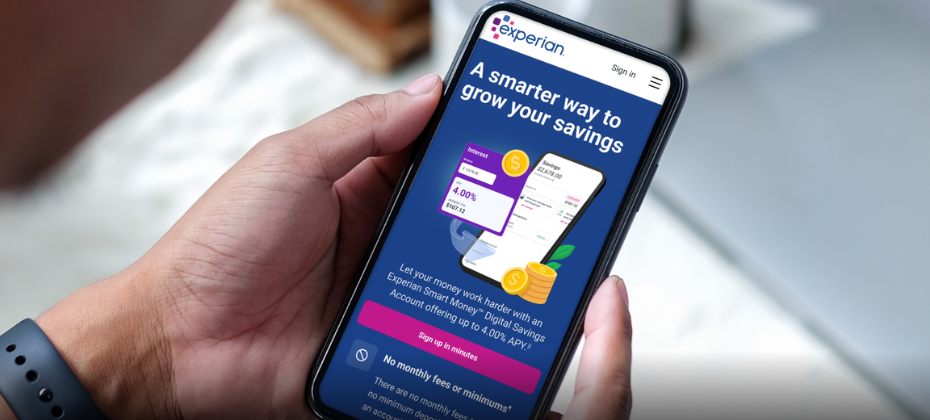
We’re starting the year strong by reaffirming our promise to empower consumers on their financial journeys. At Experian, everything we do is driven by our mission to bring Financial Power to All™—helping people not only understand where they stand but confidently move forward. That’s why I’m pleased to introduce the new high-yield Experian Smart Money™ Digital Savings Account[1], designed to make saving effortless, accessible, and more meaningful than ever before. This new offering is more than just a savings account—it represents an important evolution in how Experian supports financial progress. For years, we’ve helped tens of millions of consumers monitor their credit, improve their credit scores, and protect their identities. Now, by adding a high-yield digital savings account to our existing suite of financial health tools, we’re able to anchor that progress to something tangible: real balances and real momentum. With the ability to save built directly into the Experian ecosystem, members can track their savings growth alongside credit improvements, creating a clearer picture of their overall financial health. Positive financial behaviors—like paying down debt, making on-time payments, or improving utilization—can now be experienced in parallel with cash accumulation and stronger financial resilience, all in one trusted place. The Experian Smart Money™ Digital Savings Account offers up to 4.00% variable Annual Percentage Yield[2] (APY), which is nearly 10 times the national average savings rate[3], with no minimum balance or direct deposit requirement. It’s seamlessly integrated into the Experian membership experience, making it easier for consumers to take action the moment insight appears. This launch builds on the success of our Experian Smart Money™ Digital Checking Account & Debit Card introduced in 2023 and reflects our continued commitment to creating products that meet consumers wherever they are on their financial journey. We believe saving is a foundational financial behavior—and one that plays a powerful, often underappreciated role in credit outcomes. Strong credit health isn’t just about borrowing; it’s closely tied to liquidity, cash flow stability, and financial resilience. Having accessible savings can help consumers stay current on bills during income disruptions, build buffers that reduce reliance on higher-cost credit, and create flexibility that can support long-term credit improvement. In this way, a high-yield digital savings account becomes more than a place to store money—it becomes a practical tool for building healthier financial habits. Whether it’s emergency savings, goal-based saving, or smoothing cash flow, an Experian Smart Money Digital Savings Account enables consumers to turn good intentions into consistent action. This launch also reflects our broader evolution beyond a traditional credit bureau. Today, Experian membership provides access to credit monitoring and improvement tools, identity protection, a credit card marketplace, auto insurance comparison shopping, and personalized guidance through our AI-powered virtual assistant, EVA. Adding a high-yield digital savings account allows us to take the next step with our members—bridging the gap between insight and action. Instead of stopping at “here’s where you stand,” Experian can now help consumers actively build positive financial momentum. We’re extending our role as consumers’ BFF—Big Financial Friend—by making it easier to save, plan, and grow within the same ecosystem they already trust. By innovating and delivering products that truly make a difference in people’s everyday financial lives, we’re continuing to advance our mission and help consumers turn knowledge into progress. Learn more at experian.com/smartmoney. [1] The Experian Smart Money™ Debit Card is issued by Community Federal Savings Bank (CFSB), pursuant to a license from Mastercard International. Banking services provided by CFSB, Member FDIC. Experian is a Program Manager, not a bank. See Experian.com/legal. [2] The Annual Percentage Yield (APY) is 2.00%, 3.00% or 4.00% as of today’s date based on the Experian membership status. The APY may change at any time before or after your account is opened. Changes to the Experian membership can impact the APY, interest rate, and features. The interest rate and APY may be lower during membership trial periods. No minimum deposit to open account. Balance must be at least $0.01 to earn APY. Learn more. [3] As of Dec. 15, 2025, the national average rate for savings accounts was 0.39%, according to the FDIC.
Editor's Note (February 2026): Since the publication of this post, Experian communicated to its mortgage partners a new strategic pricing structure designed to bring more value to the industry. Our commitment to transparency in mortgage credit reporting pricing remains unchanged. Recent developments in the pricing of credit solutions for the mortgage industry have raised concerns about rising costs negatively impacting financial institutions and ultimately home buyers. We understand why lenders and trade groups are frustrated and we share in the concern. The system is complex yet there are also blatant attempts by some to take advantage of that complexity by spreading misinformation that makes it difficult to understand the drivers of cost and their implications. Here are the facts: Fact #1: Experian is not increasing the price of its credit reports for mortgage. In fact, the price of an Experian credit report for mortgage in 2026 will be exactly the same compared to 2025. Any accusations that we are raising the price of our credit reports by 50% are simply false. Fact #2: We made a marginal adjustment to the price of our data being used for processing scores in 2026. This reflects increasing complexity in consumer support, continued investments in data security, data accuracy, and regulatory compliance. This includes efforts to include more modern data sources, such as rent, utilities, buy now, pay later, short-term loans and cashflow advancements, among other sources, to more accurately reflect a consumer’s history and use of emerging financial utilities. Fact #3: National credit bureaus do not determine the price of tri-merge credit reports. The cost of these reports are based on a combination of inputs priced independently by multiple parties. Credit bureaus – Experian being one – make up only a portion of that equation. Tri-merge providers contract directly with originators, that pricing reflects our data usage/services, score algorithm costs and fees for services the reseller themselves provide. Sometimes those combined costs are reflected as “credit reports”, which is at best an oversimplification, at worst a misrepresentation. Experian is committed to transparency in our pricing. Fact #4: In October, FICO increased its royalty fees for its credit score from $4.95 to $10, an increase of approximately $5 per borrower, essentially doubling the cost of the FICO credit score in tri-merge credit reports. FICO also introduced their direct license program, which introduces unnecessary technological, operational and regulatory complexity for lenders and other market participants (including Experian), placing an even greater financial burden on the industry and inevitably, consumers. Mortgage decisions and credit scores are only as impactful and informed as the data that powers them. And simply put, scores do not exist without credit data powered by the credit bureaus. Credit reporting agencies like Experian operate under rigorous regulatory oversight, unlike score providers like FICO, because the accuracy, security, and fairness of the data we power is critical to the health of the U.S. financial system. Our costs reflect that responsibility, and the continued investments we are making to ensure data accuracy, security, and regulatory compliance to drive value for lenders and consumers alike. We share in the overall goal of making homeownership more accessible and affordable, but that can only happen through pricing transparency and collaboration, not deception and rhetoric. I’ve been in this industry for more than two decades, and I believe our industry only moves forward when it moves together. It’s time we focus on fairness and innovation to make meaningful progress toward a more efficient, inclusive, and sustainable mortgage ecosystem that brings financial power to all.

Experian is a cornerstone of the U.S. housing finance system, empowering millions of consumers to achieve the dream of homeownership and enabling lenders to make safe, sound, and inclusive credit decisions. At the heart of every credit score is data - and there is no FICO score without credit bureau data. Our information powers the accuracy, reliability, and fairness of scores across the market. FICO is now proposing an aggressive strategy to restructure distribution in order to push through an unprecedented price increase for its own benefit. The new direct licensing model introduces unnecessary technological, operational, and regulatory complexity for lenders and other market participants - complexity that ultimately increases costs and risks for the housing ecosystem. On pricing, the math speaks for itself. FICO has now more than doubled its fee from $4.95 to $10, and it’s an even worse increase under the proposal for a $33 closing fee. Make no mistake, this will place an even greater financial burden on the industry, that will inevitably be passed to consumers. Experian has long supported the industry’s evolution toward more modern, inclusive, and efficient credit solutions. We have a track record of partnering with lenders, agencies, and regulators to ensure innovation strengthens - not hinders - the system. FICO’s actions only underscore the need for alternatives that deliver value, not additional burden. As a result, we are committed to accelerating the adoption of VantageScore - an innovative, proven, and cost-effective solution that better serves both lenders and consumers. We remain confident in our position, our client partnerships, and our ability to deliver solutions that balance affordability, fairness, and accuracy. Experian will continue to work with the industry to drive innovation, empower consumers, and strengthen the housing finance system for the future.