Tag: portfolio management

Customers rarely announce their departure. Instead, they quietly reduce engagement, move deposits and explore competing offers. By the time attrition shows up in reporting, competitors may have already captured meaningful wallet share. For lenders, the risk isn’t just lost accounts, it’s silent revenue erosion within relationships that still appear intact. The hidden risk in your portfolio Today’s consumers often hold less than half of their deposits or loans with a single provider. At the same time: Competition for prime borrowers continues to intensify. Cross-sell remains one of the most effective and efficient growth strategies available. Even small improvements in retention can drive outsized profitability gains. The opportunity is real, but only if you can see momentum early and act before competitors do. From static reviews to strategic signals Traditional monthly and quarterly reviews confirm what has already happened, but they rarely surface early indicators like emerging behavioral shifts or improving credit capacity. Modern portfolio management requires continuous visibility into behavioral signals, trended credit data and event-based triggers that highlight change as it happens. When you can see momentum forming, you can act with precision, intervene before balances leave, engage customers as capacity strengthens, and activate compliant prescreen cross-sell campaigns at the right moment. Our new interactive strategic snapshot outlines the modern approach to portfolio management, one that connects ongoing account review with timely, event-based signals, helping you protect, retain and grow high-value customers. Download it now to see how to turn early signals into stronger customer lifetime value. Read the snapshot

Discover how cashflow data empowers lenders to unlock new growth opportunities and manage risk more effectively.
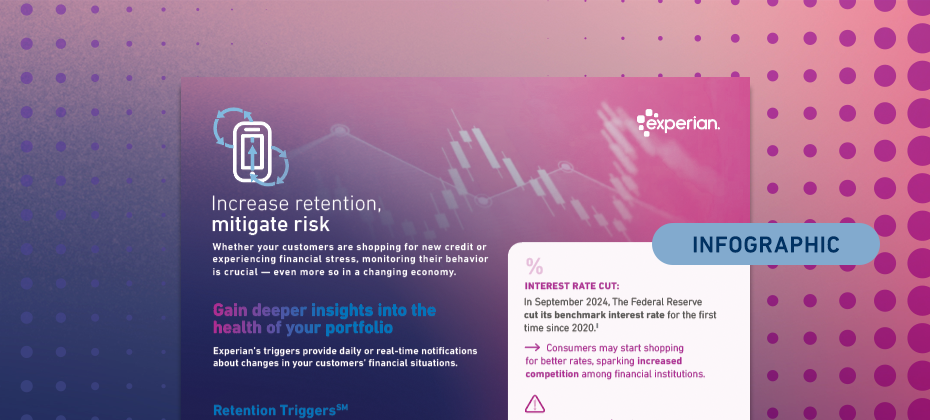
Whether consumers are shopping for new credit or experiencing financial stress, monitoring their behavior is crucial — even more so in an ever-changing economy. Our latest infographic explores economic trends impacting consumers’ financial behaviors and how Experian’s Risk and Retention TriggersSM enable lenders to detect early signs of risk or churn. Key highlights include: Credit card balances climbed to $1.17 trillion in Q3 2024. As prices of goods and services remain elevated, consumers may continue to experience financial stress, potentially leading to higher delinquency rates. Increasing customer retention rates by 5% can boost profits by 25% to 95%. View the infographic to learn how Risk and Retention Triggers can help you advance your portfolio management strategy. Access infographic

Consumers' financial behaviors are constantly changing. Event triggers enable lenders to quickly respond before their portfolio takes a hit.

Learn how leveraging credit attributes can help you reduce your risk exposure, prioritize accounts, and modify your pre-collections strategy.

As digital borrowing continues to gain prominence, fintech lenders must leverage data and analytics to fuel growth while mitigating risk.

Automate your credit limit management process to better serve your customers and quickly respond to the volatile market.

To accelerate growth while proactively identifying risk, you’ll need a well-informed portfolio risk management strategy.

Student loan borrowers may face new challenges and fears once payments resume. Learn about the implications and how loan servicers and lenders can respond.

View our interactive e-book for the latest economic and consumer trends and learn how to set your portfolio up to succeed in any economic cycle.

There are many ways to promote a more equitable society - including financial inclusion or reducing the racial wealth gap for underserved communities.

As financial institutions navigate COVID-19’s economic impact, the best credit portfolio management practices are fundamental.

Experian anticipates a tsunami of synthetic identity fraud ahead of the SSA rollout of electronic Consent Based Social Security Number Verification (eCBSV).

Account management is a critical strategy during any type of economy (pro-cycle, counter-cycle, cycle neutral), but especially now.

We’ve entered a new era of loss forecasting. Previously built models are no longer sufficient for the changes in economic conditions due to COVID-19.