Tag: consumer credit card behaviors
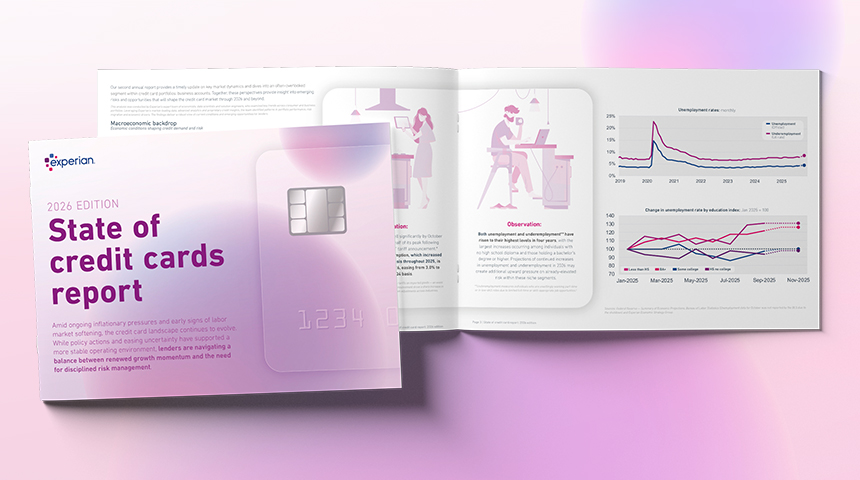
Growth, risk and the rise of "hidden" business accounts As inflation remains elevated and early signs of labor market cooling emerge, the credit card landscape is entering its next phase. Over the past few weeks, policy actions and discussions around potential interest-rate caps have driven increased uncertainty across the credit card industry and broader global markets. Lenders face a careful balancing act: capturing growth opportunities while maintaining disciplined risk oversight. Our second annual State of Credit Cards Report explores the macroeconomic forces influencing the market, key shifts in originations and delinquency trends, and lender mix. New this year, the report also digs into an often‑overlooked segment: business accounts hidden inside consumer credit card portfolios. Additionally, the report offers actionable strategies to help lenders segment risk and drive disciplined growth more effectively. Key insights include: 30+ DPD delinquency rates remained above pre-pandemic levels in 2025, underscoring the need for disciplined asset‑quality monitoring. Fintechs continue to gain ground, posting a 71% YOY increase in account originations. Business accounts masked in the consumer credit card universe represent roughly 14% of balances and are more than 50% larger than the business card universe — a material segment with distinct risk and profitability dynamics that many lenders are not explicitly managing today. The report also outlines practical strategies to: Identify and segment business behavior within consumer portfolios. Align underwriting and account management with actual usage patterns. Capture targeted growth while protecting long‑term portfolio performance. Ready to dive deeper? Download the full 2026 State of Credit Cards Report to uncover insights that can help your organization manage risk more precisely and grow with confidence. Download report

The credit card market is rapidly evolving, driven by technological advancements, economic volatility, and changing consumer behaviors. Our new 2025 State of Credit Card Report provides an in-depth analysis of the credit card landscape and strategy considerations for financial institutions. Findings include: Credit card debt reached an all-time high of $1.17 trillion in Q3 2024. About 19 million U.S. households were considered underbanked in 2023. Bot-led fraud attacks doubled from January to June 2024. Read the full report for critical insights and strategies to navigate a shifting market. Access report

Are You #TeamTrended or #TeamAlternative? There’s no such thing as too much data, but when put head to head, differences between the data sets are apparent. Which team are you on? Here’s what we know: With the entry and incorporation of alternative credit data into the data arena, traditional credit data is no longer the sole determinant for credit worthiness, granting more people credit access. Built for the factors influencing financial health today, alternative credit data essentially fills the gaps of the traditional credit file, including alternative financial services data, rental payments, asset ownership, utility payments, full file public records, and consumer-permissioned data – all FCRA-regulated data. Watch this video to see more: Trended data, on the other hand shows actual, historical credit data. It provides key balance and payment data for the previous 24 months to allow lenders to leverage behavior trends to determine how individuals are utilizing their credit. Different splices of that information reveal particular behavior patterns, empowering lenders to then act on that behavior. Insights include a consumer’s spend on all general purpose credit and charge cards and predictive metrics that identify consumers who will be in the market for a specific type of credit product. In the head-to-head between alternative credit data and trended data, both have clear advantages. You need both on your roster to supplement traditional credit data and elevate your game to the next level when it comes to your data universe. Compared to the traditional credit file, alternative credit data can reveal information differentiating two consumers. In the examples below, both consumers have moderate limits and have making timely credit card payments according to their traditional credit reports. However, alternative data gives insight into their alternative financial services information. In Example 1, Robert Smith is currently past due on his personal loan, whereas Michelle Lee in Example 2 is current on her personal loan, indicating she may be the consumer with stronger creditworthiness. Similarly, trended data reveals that all credit scores are not created equal. Here is an example of how trended data can differentiate two consumers with the same score. Different historical trends can show completely different trajectories between seemingly similar consumers. While the traditional credit score is a reliable indication of a consumer’s creditworthiness, it does not offer the full picture. What insights are you missing out on? Go to Infographic Get Started Today

The winter holiday festivities are underway, and when it comes to the local malls, the holiday spending spirit seems to have already been in place for weeks. The season for swiping (credit cards) has begun. Before many of them set out with holiday gift lists in tow, they may be setting their sights on new lines of credit – by adding to their artillery of plastic. With 477.6 million existing credit card accounts, what do these consumers look like? While we can all agree that the meaning behind winter holiday celebrations is not the act of spending and giving material gifts, the two have come to be synonymous. This year is anticipated to be no different. When asked to describe their anticipated spending for the holidays this year, a recent Mintel survey said 56% of respondents planned to spend the same amount as they did last year. Nearly a quarter of respondents (23%) said they planned to spend more than they did last year. The uptick in spending as the year rounds out is no news flash. It is engrained within the fiscal landscape of each year, arguably its own tradition. According to a recent Experian consumer survey, Americans plan to spend an average of almost $850 on holiday gifts this year. Given what we know of consumers – and ourselves – as increased spending is upon us, credit card openings and usage are also on the rise. In order to capitalize on fulfilling your consumers needs during this bustling time filled with shopping bags and loaded online carts, it’s important to know what consumers look for in a credit card. Want to attract those holiday shoppers? The key to getting your plastic in their wallet is rewards, rewards, rewards. 58% of consumers will select a credit card for its rewards – including cash back, gas rewards, and retail gift cards – according to recent Experian consumer survey research. Is your credit card program stacked with rewards-ready options? Now what? Go where your consumers are – and for many of them that means online. While traditional retailers are still preferred destinations for holiday shopping, online is increasingly becoming a preferred way of shopping. 90% of consumers plan to do holiday shopping online, according to a Mintel study. Online shopping trends and online credit card applications trends seem to go hand in hand, according to Mintel and Experian data. Whether your consumers are looking for deals, that adrenaline rush of waiting until the last minute, or a trip to just get away from it all, credit cards can help them get there. And while the hustle and bustle of the holidays are ramping up, following the holidays quickly comes the new year – another close to 12 months of consumer spending (not just the dollars spent during this festive season). Consumer behavior across the entire year can be the key to enhancing your marketing and account management strategies. By knowing how much your consumers spend on all the plastic in their wallets – think bank cards too – you can offer customized reward programs, create strategies to maximize wallet share and retain profitable customers. Learn more about the first commercially-available spend algorithm built from credit data and tap into your wallet share for each consumer. 1Mintel Comperemedia 2Experian consumer survey research

Early reports suggest the 2017 holiday season was a good one for retailers. Consumers were in the mood to spend, and as such, Americans’ total credit card debt continued to climb. Americans planned to spend $862 on gifts for the season, a huge jump from the $752 they planned on spending in 2016. And the numbers were significantly higher than their estimate in any November since 2007 -- just before the 2007-2009 recession. 29% of Americans said they planned to spend more than $1,000. What does this mean for card portfolios? Well, business is booming, but they should also prepare for the time of year when consumers are most apt to seek out debt consolidation and transfer options. A recent NerdWallet analysis revealed the average household that’s carrying credit card debt has a balance of roughly $15,654. Dig deeper into retail card specifically and reports indicate Americans are carrying $1,841 in retail debt. “There is seasonality to consumer credit card behavior,” said Denise McKendall, a credit card and trended data specialist for Experian. “As we roll into the late winter months and early spring, consumers often seek ways to transfer card debt to lower interest rate options, consolidate debt from multiple cards and perhaps even pull out personal loans. This makes it an ideal time for card portfolio managers to leverage data to anticipate consumer behaviors and be able to offer the best rates and options to retain cardholders and grow.” Card portfolio managers should consider these questions: What is my portfolio risk? Did some of my consumers overextend themselves? Do I have collections triggers on my accounts to mitigate risk and manage delinquencies? Which consumers in my portfolio will be looking to consolidate debt? Should I reassess credit line limits? Which of my consumers show a high propensity to make a balance transfer? Do I have opportunities to grow my portfolio by offering attractive rates to new customers? Which customers will leave after low introductory rates expire? Can I use this time of year to become the first credit card consumers’ consistently use, rather than the second or third card they pull from wallet? At first glance, it might appear challenging to answer many of these questions, but with the right data and analytics, a card manager can easily establish a game plan to conquest new business, mitigate risk and retain existing, high-value consumers. The robust holiday season was a boom for the economy. Now card companies need to ready themselves for the aftermath.