
Prepping for Post-Holiday Credit Trends and Behaviors

by Kerry Rivera 2 min read December 3, 2015

post-holiday-credit

This month, it’s all about parties and gift giving and holiday traditions. Fast forward a month, however, and consumers will be in a different place.

Today, they are spending. In a few weeks, the focus will be on paying down bills, or perhaps seeking solutions to consolidate or transfer balances.

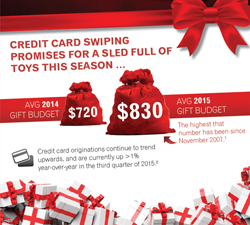
The good news for the economy is consumers are expected to spend more this holiday season – $830 on average, a huge jump from last year’s $720. Total retail is expected to increase 5.6 percent, while ecommerce (thanks Amazon Prime) should rise 13.9 percent.

Credit card originations are also trending up more than 1 percent year-over-year as of the end of the third quarter of 2015.balance-transfer-holiday-infographic-email
So what does this mean for lenders?

Card utilization is peaking, creating the perfect scenario for many consumers to seek balance transfers, consolidate debt and search for competitive rates, especially if they’ve been leveraging high-interest cards.

A recent analysis by NerdWallet revealed consumers are more interested in shopping with store credit cards than with traditional cards this season, putting them at particular risk of sky-high rates. A deeper look at utilization revealed super-prime consumers use less than 6 percent of their available credit limits, while consumers in the deep-subprime tier use nearly every dollar allotted.

“Consumers spend billions during the holidays on high-interest credit cards,” said Kyle Matthies, Experian product manager. “Many of them have excellent credit, but struggle juggling multiple payments, which can lead to delinquencies. Credit card consolidation can provide relief by lowering interest rates and simplifying repayment.”

Card issuers that remain passive during this window may find their portfolios at-risk as customers take advantage of seasonal offers.

Competitors who capitalize on this peak season of balance transfers will likely be mailing out offers to acquire and grow their card portfolio, as well as protect their current card base.

“As banks and credit unions finish out the calendar year, they might seek one last marketing push, so a balance-transfer campaign might be the ideal play,” said Matthies. “Still, to avoid blowing the budget, it helps to leverage data to know exactly who to target – both within and outside the card portfolio.”

Specific models and/or tools can identify who to try to retain, as well as provide insights on whom to conquest from the outside. An index can additionally offer guidance on when to lower APRs, sweeten rewards and increase credit limits for specific consumers.

The post-holiday balance-transfer wave is coming. The question is which lenders will be best prepared to protect and grow their respective card portfolios.


Related Posts

Explore how Experian Verify™ and Mezzo’s Centro orchestration engine are helping mortgage lenders modernize income and employment verification, reduce workflow complexity, and make faster, more confident lending decisions at scale.

Published: July 1, 2026 by Lizel Ferrer
Used EV Growth Signals a New Phase of Consumer Purchasing Behavior

The electric vehicle (EV) revolution isn’t slowing down, it’s changing lanes. While recent conversations have seemingly focused on softening demand for new EVs, the used segment has been gaining momentum. According to Experian Automotive’s 2025 EV Year in Review Report, new retail individual EV registrations fell 35.9% year-over-year. Meanwhile, the used retail individual EV registrations grew 25.4% from a year ago. As affordability and growing model availability reshapes consumer behavior, buyers are increasingly turning to pre-owned EVs, which has shown an interesting market divergence that is redefining how consumers are adopting this segment and what it can mean for automakers, dealers, and the overall industry. Key players behind rising used EV demand Notably, Tesla accounted for over half (60.5%) of used retail individual EV registrations in 2025, followed by Chevrolet at 6.4% and Nissan (5.5%). Diving a bit deeper, Tesla made up the top three models of the used individual registrations last year, with the Model 3 coming in at 27.2%, Model Y at 21.7%, and Model S (6.6%). The Chevrolet Bolt EV followed at 4.8% and the Nissan Leaf was at 4%. Tesla’s position as the leading make in the used EV market is a natural extension of its long-standing dominance in new EV sales. The brand’s leadership over the years created a large fleet of vehicles that are now entering the pre-owned market. What the used EV boom means for automotive professionals The growing demand for used EVs can present more opportunities for automotive professionals. Dealers that provide a healthy supply of pre-owned EVs can increase accessibility and play a role in adoption for consumers who are actively looking to purchase, while marketers can emphasize value and ownership benefits. As the market continues to evolve, automotive professionals who understand and respond to these changing dynamics will be best positioned to capitalize on the expanding pool of used EV shoppers. To learn more about EV insights, visit Experian Automotive’s EV Resource Center.

Published: June 30, 2026 by Kirsten Von Busch
How Terrace Finance Uses NeuroID to Respond to Fraud Faster and Smarter

Learn how Terrace Finance used NeuroID behavioral analytics to detect fraud faster, respond to attacks, and strengthen risk management.

Published: June 29, 2026 by Scarlet.Nickel@experian.com