
Loading...

Personal Loans: Fueled by Fintech

by Stefani Wendel 1 min read October 9, 2018

Unsecured lending is increasing. And everyone wants in.

Not only are the number of personal loans increasing, but the share of those loans originated by fintech companies is increasing.

According to Experian statistics, in August 2015, 890 new trades were originated by fintechs (or 21% of all personal loans). Two years later, in August 2017, 1.1 million trades belonged to fintechs (making up 36% of trades). This increase is consistent over time even though the spread of average loan amount between traditional loans and fintech is tightening.

While convenience and the ability to apply online are key, interest rates are the number one factor in choosing a lender. Although average interest rates for traditional loans have stabilized, fintech interest rates continue to shift higher – and yet, the upward momentum in fintech loan origination continues.

So, who are the consumers taking these loans?

A common misconception about fintechs is that their association with market disruption, innovation and technology means that they appeal vastly to the Millennial masses. But that’s not necessarily the case.
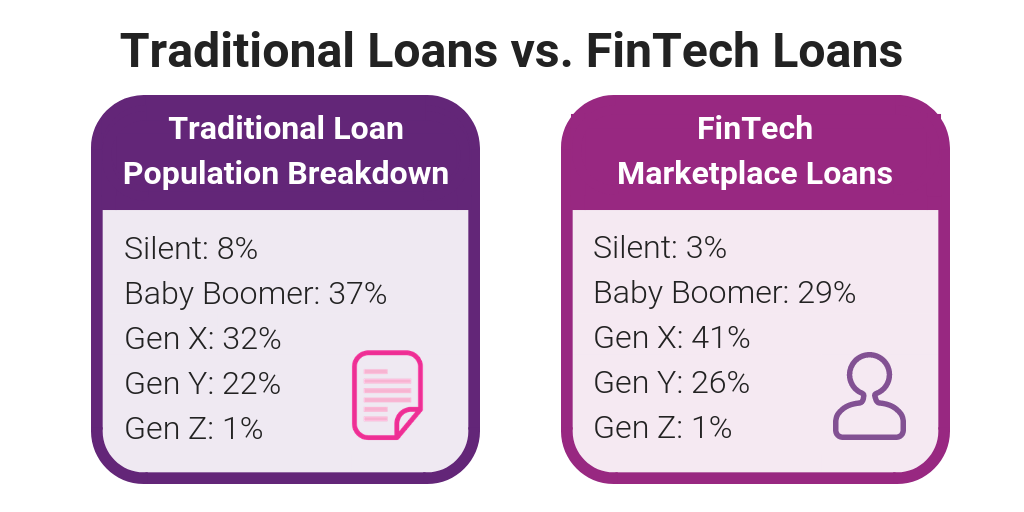
Boomers represent the second largest group utilizing fintech Marketplace loans and, interestingly, Boomers’ average loan amount is higher than any other generational group – 85.9% higher, in fact, from their Millennial counterparts.

The reality is the personal loan market is fast-paced and consumers across the generational spectrum appear eager to adopt convenience-based, technology-driven online lending methods – something to the tune of $35.7 million in trades.

For more lending insights and statistics, download Experian’s Q2 2018 Personal Loans Infographic here.

Learn More About Online Marketplace Lending Download Lending Insights

Related Posts

Growth, risk and the rise of "hidden" business accounts As inflation remains elevated and early signs of labor market cooling emerge, the credit card landscape is entering its next phase. Over the past few weeks, policy actions and discussions around potential interest-rate caps have driven increased uncertainty across the credit card industry and broader global markets. Lenders face a careful balancing act: capturing growth opportunities while maintaining disciplined risk oversight. Our second annual State of Credit Cards Report explores the macroeconomic forces influencing the market, key shifts in originations and delinquency trends, and lender mix. New this year, the report also digs into an often‑overlooked segment: business accounts hidden inside consumer credit card portfolios. Additionally, the report offers actionable strategies to help lenders segment risk and drive disciplined growth more effectively. Key insights include: 30+ DPD delinquency rates remained above pre-pandemic levels in 2025, underscoring the need for disciplined asset‑quality monitoring. Fintechs continue to gain ground, posting a 71% YOY increase in account originations.  Business accounts masked in the consumer credit card universe represent roughly 14% of balances and are more than 50% larger than the business card universe — a material segment with distinct risk and profitability dynamics that many lenders are not explicitly managing today. The report also outlines practical strategies to: Identify and segment business behavior within consumer portfolios. Align underwriting and account management with actual usage patterns. Capture targeted growth while protecting long‑term portfolio performance. Ready to dive deeper? Download the full 2026 State of Credit Cards Report to uncover insights that can help your organization manage risk more precisely and grow with confidence. Download report

by Theresa Nguyen 1 min read February 2, 2026

Unlock the future of fintech by exploring how alternative data is reshaping decision-making and growth strategies.

by Laura Burrows 1 min read January 12, 2026

Fintech analytics transforms fragmented data into real-time decisioning power, helping lenders manage risk and earn consumer trust.

by Brittany Ennis 1 min read October 28, 2025