Uncategorized

Lending hasn’t slowed down—but many decisioning processes have. Applications are coming in faster. Fraud is becoming more sophisticated. Borrowers expect near-instant responses. And yet, inside many organizations, decisions are still being made across fragmented systems, manual reviews, and rigid strategies that weren’t designed and aren’t optimized for today’s environment. That broadening gap isn’t just an operational issue but often stems from a lack of innovation as well. And it’s quietly costing lenders growth, efficiency, and competitive position. When decisioning falls behind, some symptoms are easy to recognize, like applications taking days to process, teams overloaded with manual reviews, and credit and fraud decisions happening in separate platforms. Others are not as obvious, but arguably more impactful, slipping bottom lines and fraud and therefore losses lurking in lenders’ portfolios. The root issue is a fragmented infrastructure. Experian has reported that while 79% of financial institutions surveyed globally want fewer vendors or more unified approaches, they typically use eight or more tools across credit, fraud and compliance. As most decisioning environments cannot integrate data, adapt strategies, and execute decisions in real time, lenders often have to make tradeoffs. Speed vs. accuracy; growth vs. risk; and automation vs. control are just some. Meanwhile, the market has moved on. Leading lenders are no longer optimizing individual steps. They’re rethinking decisioning as a connected, intelligent system. Gaps forming from status quo in 8 key decision areas Across the lending lifecycle, there are eight critical moments where decisioning can either accelerate growth or create friction. Pre-qualification: Pre-qualification should expand your funnel with confidence. But limited data access and static criteria often result in overly conservative targeting or missed opportunities. Additionally, the delay in acting on a pre-qualification funnel highlights a key area for opportunity among many lenders. Instant credit decisions: Customers expect real-time outcomes. When decisions rely on manual intervention or fragmented inputs, speed and conversions suffer. Prescreen and targeting: Disconnected data and rigid segmentation can lead to poorly aligned offers, reducing response rates and wasting acquisition spend. Credit line management: Without dynamic strategies, credit lines may be too restrictive (limiting growth) or too aggressive (increasing risk). Early delinquency management: Missed early signals and delayed interventions make it harder to prevent accounts from deteriorating. Mid- and late-stage delinquency: Strategies that don’t adapt to evolving borrower behavior reduce recovery effectiveness and increase losses. Collections and recovery: Manual, one-size-fits-all approaches limit recovery rates and increase operational cost. Ongoing strategy optimization: Perhaps the most overlooked gap: many lenders lack the ability to continuously test, learn, and refine decision strategies as conditions change. What these gaps are really costing you Individually, each of these breakdowns may seem manageable. Together, they can create systemic drag on performance. That shows up in four critical ways: Missed growth opportunities: Good borrowers are declined, abandoned, or never targeted in the first place. Credit offers fail to align with actual borrower potential. Higher operational costs: Manual reviews and disconnected workflows consume time and resources that could be spent on higher-value work. Increased fraud exposure and friction: Fraud is proliferating and becoming more expensive to manage. The Federal Trade Commission reported $12.5B were lost to fraud in the U.S. in 2024, a 25% increase over the prior year. For many financial institutions, the first reaction is often to add more steps to the decisioning process, which can impact good borrowers. Increased competitive pressure: Fintechs and modern lenders are focused on delivering faster, more personalized experiences, capturing share while traditional processes lag behind. 80% of banks and credit unions plan to increase their technology spending in 2026, yet many continue to fall short on planned system deployments, according to Cornerstone Advisors’ annual “What’s Going On in Banking” research report. What innovative decisioning leaders are doing differently Leading lenders are changing how decisions are made, creating a competitive advantage. Instead of stitching together point solutions, they’re adopting a more integrated approach that brings together: Comprehensive data – including both credit and fraud insights Optimized decision strategies – designed to balance growth and risk Real-time execution – enabling faster, more consistent outcomes Continuous optimization – adapting to changing market conditions Strategic partnerships – leveraging third-party industry expertise to augment their own This shift eliminates the need for tradeoffs and instead allows lenders to increase approvals while maintaining control, reducing manual effort while improving consistency, and responding faster without sacrificing confidence. The stakes are high and the competition for consumers is even higher, particularly against a backdrop of ever-evolving fraud risks, continuously increasing consumer expectations for seamless, digital-first experiences and often limited resources. Nearly half of banks and 59% of credit unions have already deployed generative AI, with more investing now, according to the Cornerstone Advisors’ report. Closing the innovation gap requires a more fundamental shift toward decisioning systems that are connected, scalable, and built for continuous change. A new foundation for decisioning This is where platforms like Experian Decisioning are changing the landscape. By bringing together credit and fraud insights, decision strategies, and a flexible technology architecture, lenders can move beyond fragmented processes and build a more unified, intelligent decisioning approach. One that fits within existing systems but also evolves with your needs. Where to start Impactful change doesn’t need to be an overhaul of everything at once for most organizations. The first step is understanding where your biggest gaps exist, and which decision areas are creating the most friction or missed opportunity. Once you can see where decisioning is not optimized, you can begin to redesign it in a way that’s faster and more adept for what lending has become. By making better decisions, faster, and with greater confidence, lenders can process applications more efficiently and also break away from the pack by leveraging decisioning as a strategic advantage. Learn more

Model inventories are rapidly expanding. AI-enabled tools are entering workflows that were once deterministic and decisioning environments are more interconnected than ever. At the same time, regulatory scrutiny around model risk management continues to intensify. In many institutions, classification determines validation depth, monitoring intensity, and escalation pathways while informing board reporting. If classification is wrong, every downstream control is misaligned. And, in 2026, model classification is no longer just about assigning a tier, but rather about understanding data lineage, use case evolution, interdependencies, and governance accountability in a decentralized, AI-driven environment. We recently spoke with Mark Longman, Director of Analytics and Regulatory Technology, and here are some of his thoughts around five blind spots risk and compliance leaders should consider addressing now. 1. The “Set It and Forget It” Mentality The Blind Spot Model classification frameworks are often designed during a regulatory remediation effort or inventory modernization initiative. Once documented and approved, they can remain largely unchanged for years. However, model risk management is an ongoing process. “There’s really no sort of one and done when it comes to model risk management,” said Longman. Why It Matters Classification is not merely descriptive, it’s prescriptive. It drives the depth of validation, the frequency of monitoring, the intensity of governance oversight and the level of senior management visibility. As Longman notes, data fragmentation is compounding the challenge. “There’s data everywhere – internal, cloud, even shadow IT – and it’s tough to get a clear view into the inputs into the models,” he said. When inputs are unclear, tiering becomes inherently subjective and if classification frameworks are not reviewed regularly, governance intensity can become misaligned with real exposure. Therefore, static classification is a growing risk, especially in a world of rapidly expanding AI use cases. In a supervisory environment that continues to scrutinize model definitions, particularly as AI tools proliferate, a dynamic, periodically refreshed classification process can demonstrate institutional vigilance. 2. Assuming Third-Party Models Reduce Governance Accountability The Blind SpotThere is often an implicit belief that vendor-provided models carry less governance burden because they were developed externally. Why It Matters Vendor provided models continue to grow, particularly in AI-driven solutions, but supervisory expectations remain firm. “Third-party models do not diminish the responsibility of the institution for its governance and oversight of the model – whether it’s monitoring, ongoing validation, just evaluating model drift” Longman said. “The board and senior managers are responsible to make sure that these models are performing as expected and that includes third-party models.” Regulators consistently emphasize that institutions remain responsible for the outcomes produced by models used in their decisioning environments, regardless of origin. If a vendor model influences credit approvals, pricing, fraud decisions, or capital calculations, it directly affects customers, financial performance and compliance exposure. Treating third-party models as inherently lower risk can also distort internal tiering frameworks. When vendor models are under-classified, validation depth and monitoring rigor may be insufficient relative to their true impact. 3. Limited Situational Awareness of Model Interdependencies The Blind Spotfeed multiple downstream models simultaneously. Why It Matters Risk often flows across interdependencies. When upstream models degrade in performance or introduce bias, downstream models inherit that exposure. If multiple material decisions depend on the same data transformation or feature engineering process, concentration risk emerges. Without visibility into these dependencies, tiering assessments may underestimate cumulative risk, and monitoring frameworks may fail to detect systemic vulnerabilities. “There has to be a holistic view of what models are being used for – and really somebody to ensure there’s not that overlap across models,” Longman said. Supervisors are increasingly interested in understanding how model risk propagates through business processes. When institutions cannot articulate how models interact, it raises broader concerns about situational awareness and control effectiveness. Therefore, capturing interdependencies within the classification framework enhances more than documentation. It enables more accurate tiering, more targeted monitoring and more informed governance oversight. 4. Excluding Models Without Defensible Rationale The Blind SpotGray-area tools frequently sit outside formal inventories: rule-based engines, spreadsheet models, scenario calculators, heuristic decision aids, or emerging AI tools used for analysis and summarization. These tools may not neatly fit legacy definitions of a “model,” and so they are sometimes excluded without robust documentation. Why It Matters Regulatory definitions of “model” have broadened over time. What creates risk is the absence of defensible reasoning and documentation. Longman describes the risk clearly: “Some [teams] are deploying AI solutions that are sort of unbeknownst to the model risk management community – and almost creating what you might think of as a shadow model inventory.” Without visibility, institutions cannot confidently characterize use, trace inputs, or assign appropriate tiers, according to Longman. It also undermines the credibility of the official inventory during examinations. A well-governed program can articulate why certain tools fall outside model risk management scope, referencing documented criteria aligned with regulatory guidance. Without that evidence, exclusions can appear arbitrary, suggesting gaps in oversight. 5. Inconsistent or Subjective Classification Frameworks The Blind SpotAs inventories scale and governance teams expand, classification decisions are often distributed across reviewers. Over time, discrepancies can emerge. Why It Matters Inconsistency undermines both risk management and regulatory confidence. If two models with comparable use cases and impact profiles are assigned different tiers without clear justification, it signals that the framework is not being applied uniformly. AI adds even more complexity. When it comes to emerging AI model governance versus traditional model governance, there’s a lot to unpack, says Longman: “The AI models themselves are a lot more complicated than your traditional logistic or multiple regression models. The data, the prompting, you need to monitor the prompts that the LLMs for example are responding to and you need to make sure you can have what you may think of as prompt drift,” Longman said. As frameworks evolve, particularly to incorporate AI, automation, and new regulatory interpretations, institutions must ensure that changes are cascaded across the entire inventory. Partial updates or selective reclassification introduce fragmentation. Longman recommends formalizing classification through a structured decision tree embedded in policy to ensure consistent outcomes across business units. Beyond clear documentation, a strong classification program is applied consistently, measured objectively, and periodically reassessed across the full portfolio. BONUS – 6. Elevating Classification with Data-Level Visibility Some institutions are extending classification discipline beyond models to the data layer itself. Longman describes organizations that maintain not only a model inventory, but a data inventory, mapping variables to the models they influence. This approach allows institutions to quickly assess downstream effects when operational or environmental changes occur including system updates or even natural disasters affecting payment behavior. In an AI-driven environment, traceability may become a competitive differentiator. Conclusion Model classification is foundational. It determines how risk is measured, monitored, escalated, and reported. In a rapidly evolving regulatory and technological environment, it cannot remain static. Institutions that invest now in transparency, consistency, and data-level visibility will not only reduce supervisory friction – they will build a governance framework capable of supporting the next generation of AI-enabled decisioning. Learn more

The mortgage industry is adapting to a structural shift. Experian’s 2026 State of the U.S. Housing Market Report shows a market in transition. Conventional loans account for 72% of originations, FHA 17.5% and VA 10.8% with VA showing the strongest growth from 2023 to 2025. But origination mix only tells part of the story. Beneath it lies an arguably more consequential shift: borrower expectations, affordability pressures and regulatory changes are converging. On the regulatory front, the Homebuyers Privacy Protection Act (HPPA) may reduce mortgage trigger leads and limit broad competitive outreach. As competitive visibility narrows, the lender relationship becomes more central and important beyond the closing transaction. In this environment, lenders must provide value to win, and that increasingly means financial wellness. A growing trust gap Only 34% of first mortgage hard inquiries of first mortgage hard inquiries convert into funded originations, according to Experian. That means two-thirds of borrowers who initiate the process never close. External data confirms the trend as Mortgage Bankers Association reported retail mortgage pull-through rates declined to roughly 69% in early 2025 – the lowest in over a decade – and as low as 55% among depository lenders. While pull-through can be impacted by a number of factors not influenced by the lender, when borrowers abandon applications, it can be a biproduct of uncertainty – something that the lender can influence. This is where financial wellness becomes strategic and lenders can close the trust gap by providing proactive credit visibility and guidance before underwriting friction occurs. Read more in our white paper, “The New Unlock for Mortgage.” Affordability stress While rates have eased from their 2023 highs, they remain above 6%, sustaining the lock-in effect and limiting housing supply, according to Experian’s 2026 State of the U.S. Housing Market Report. Approximately 70% of homeowners are locked into sub-6% mortgages, according to Freddie Mac. Beyond mortgage rates, increases in property taxes and non-tax escrow amounts (i.e. insurance) increase affordability pressures for consumers. Financial wellness solutions that incorporate credit monitoring, budgeting insights and cashflow visibility help borrowers understand whether they are prepared. Opportunity among millennials and Gen Z Nearly 47% of U.S. renters expect to purchase a home within four years, rising to 67% within eight years, according to Experian. This signals the time to invest in financial wellness as a differentiator, and both a growth and retention driver, is now. Financial wellness as the new unlock for mortgage Financial wellness is not an ancillary service but the foundation upon which borrower confidence, long-term engagement, conversion and risk management connect. Lenders who embed solutions like credit education, score visibility, alerts, and identity protection directly into the consumer experience can differentiate themselves from the competition above and beyond rates alone. Read more in our white paper, “The New Unlock for Mortgage.” Learn more about Experian Mortgage
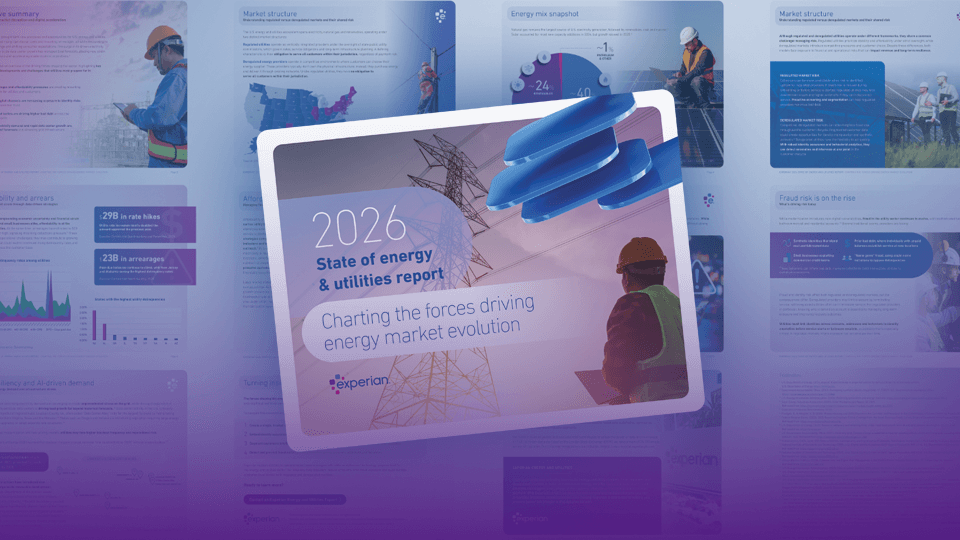
Utilities are managing elevated arrears, expanding digital service channels and shifting grid demand patterns at the same time. These developments are appearing at key points, including service starts, billing and collections. Energy and utilities industry trends for 2026 reflect how these dynamics are surfacing across the customer lifecycle and influencing broader planning decisions. Energy and utilities trends shaping the industry The state of energy and utilities 2026 reflects a sector adapting to financial exposure, fraud risk and demand variability across both regulated and deregulated markets. Rising arrearagesArrearage levels across the utilities sector are estimated at approximately $23 billion. Economic uncertainty may be contributing to a rise in arrearages, often reflected in delayed payments, extended repayment plans or variability in monthly collections. Digital expansion introduces new risk considerationsAs utilities expand digital service channels and self-service tools, identity-based fraud risk may appear during digital service starts and account changes, particularly as more interactions shift online. Fraud behaviors are becoming more sophisticatedMore complex fraud patterns, including synthetic identities, name game fraud and prior bad debt, may span multiple points of the customer journey, making risk more difficult to detect. Grid demand uncertaintyIn certain regions, data center expansion may influence load forecasting and long-term infrastructure planning timelines. Data centers consumed approximately 4.4% of U.S. electricity in 2023 and are projected to account for between 6.7% and 12% by 2028, reflecting the potential scale of demand shifts utilities may be evaluating. What these trends signal for utility planning Together, these energy and utilities industry trends 2026 highlight where risk could first emerge. When risk indicators appear during service start, screening before service starts may help reduce downstream exposure rather than relying only on collections-based controls. As more interactions shift online, identity risk may be harder to identify without stronger verification. When fraud spans from service start through collections, visibility across systems becomes more important. As grid demand grows, planning for reliability may require adjustments to how forecasting and infrastructure decisions are informed. Enabling data-driven utility decisions To navigate these energy sector trends, utilities may benefit from a more connected view of identity, risk and customer behavior. Experian supports providers with data-driven energy and utilities solutions designed to help reduce losses, strengthen customer trust and support utility fraud prevention across the customer lifecycle. For a closer look at how these themes are unfolding across the sector, explore our 2026 State of Energy and Utilities Report, which examines each trend in greater depth through data-driven insights and industry examples. Read our first-ever State of Energy and Utilities Report examining the forces shaping the industry this year. Download now

Across agencies, decisions about digital services, staffing and oversight are often tied together. Public sector trends for 2026 reflect how these considerations are shaping modernization efforts and citizen trust today. At the federal, state and local levels, the public sector outlook 2026 highlights how modernization, program integrity, workforce resilience and citizen trust influence how services are delivered and how resources are prioritized. Four trends shaping the public sector in 2026 Agencies are navigating a set of trends that are influencing both strategic planning and day-to-day execution. Fiscal pressure and program integrityBudget volatility and increased scrutiny may elevate the importance of payment accuracy and operational consistency, particularly as eligibility rules evolve and caseloads remain high. This can surface in areas such as eligibility verifications, benefits recertifications or grant administration, where data inconsistencies may have a broader operational impact. Modernization and technology accelerationAs agencies continue public sector modernization, digital access may expand faster than existing controls can keep pace. This is often most visible in online applications, self-service portals and account management tools, where verification processes may not evolve at the same pace as access. Fraud losses across the U.S. have been estimated at approximately $160 billion, highlighting the extent of identity and payment risks present in digital environments. Decisions about identity assurance and fraud prevention can influence how agencies scale online services. Workforce resilienceStaffing constraints and skill gaps may affect processing timelines, oversight capacity and institutional knowledge, potentially contributing to longer review cycles or greater reliance on manual quality checks. Workforce data shows roughly 200,000 federal positions were reduced in the past year, which may influence how agencies approach automation and oversight. Automation and government data analytics can play a more central role in supporting consistency across programs. Citizen trust and digital experienceAs more interactions move online, citizen trust may be influenced by both security and usability. Public sector fraud prevention approaches that apply friction only when risk indicators are present can help agencies maintain accessibility while managing exposure. What these signal for agencies Together, these trends point to a shift in how agencies evaluate risk and prioritize investment. Choices about modernization, staffing and oversight may increasingly shape one another. Approaches that strengthen government program integrity, improve visibility across digital interactions and support informed decision-making may help agencies sustain service levels while managing evolving risk. For a closer look at how these trends are unfolding across agencies, explore our 2026 Public Sector Trends and Impact Report, which delves into each theme in greater depth through data-driven insights and real-world agency use cases. Read our first-annual 2026 Public Sector Trends & Impact Report to understand the forces reshaping agency operations and trust. Download now

Fraud is evolving faster than ever, driven by digitalization, real-time payments and increasingly sophisticated scams. For Warren Jones and his team at Santander Bank, staying ahead requires more than tools. It requires the right partner. The partnership with Santander Bank began nearly a decade ago, during a period of rapid change in the fraud and banking landscape. Since then, the relationship has grown into a long-term collaboration focused on continuous improvement and innovation. Experian products helped Santander address one of its most pressing operational challenges: a high-volume manual review queue for new account applications. While the vast majority of alerts in the queue were fraudulent and ultimately declined, a small percentage represented legitimate customers whose account openings were delayed. This created inefficiencies for staff and a poor first impression of genuine applicants. We worked alongside Santander to tackle this challenge head-on, transforming how applications were reviewed, how fraud was detected and how legitimate customers were approved. In addition to fraud prevention, implementing Experian's Ascend PlatformTM, with its intuitive user experience and robust data environment, has unlocked additional value across the organization. The platform supports multiple use cases, enabling collaboration between fraud and marketing teams to align strategies based on actionable insights. Learn more about our Ascend Platform

Financial services leaders are dealing with numerous pressures at the same time. These growing challenges for financial services organizations include sophisticated fraud, rapid Artificial Intelligence (AI) adoption without clear regulatory direction, rising customer expectations and the need for compliant, sustainable growth. Businesses are rethinking how they manage risk, growth and customer trust. These financial industry challenges are no longer confined to internal risk teams. They directly impact long-term customer loyalty. How organizations navigate these challenges will determine how effectively they deliver value to their customers. We’ve outlined the six challenges for financial services oranizations that consistently rank highest among industry leaders today. Challenge 1: Fraud is becoming harder to detect and eroding customer trust 72% of business leaders expect AI-generated fraud and deepfakes to be major challenges by 20261 As fraud tactics evolve quickly, driven in part by AI, customers are being targeted through identity-based attacks from account takeovers to synthetic identities and misuse of personal information. When these threats go undetected, or when legitimate activity is incorrectly flagged, the result isn’t just financial loss. It’s a breakdown of trust. Organizations that want to stay ahead must move beyond isolated fraud controls. By embedding identity management and monitoring into the customer experience, organizations can move from reactive fraud response to proactive identity protection. Identity theft protection and monitoring help organizations turn fraud prevention into a visible, trust-building experience for customers — offering early alerts, guidance, and peace of mind when identity risks arise. Challenge 2: AI decisions must be trusted by customers, not just regulators 76% of businesses say implementing responsible AI is one of their biggest challenges2 As AI becomes more embedded in financial services, it shapes the experiences customers see every day. From credit decisions to eligibility outcomes and personalized offers. While AI can drive faster and more inclusive decisions, it also introduces a new expectation: customers want to understand why a decision was made. Responsible AI is no longer just about regulatory compliance. It’s about delivering outcomes that feel fair, consistent and easy to understand. When decisions appear unclear, confidence erodes. When organizations can clearly explain outcomes, not just internally, they build confidence across regulators, partners and customers. This allows AI to scale responsibly while reinforcing trust in every interaction. Financial wellness tools such as credit scores, reports and education help make AI-driven decisions more transparent, giving customers clarity into outcomes and confidence in how their financial health is assessed. Challenge 3: Digital experiences are failing to deliver clarity and confidence 57% of U.S. consumers remain concerned about conducting activities online3 Customer confidence is affected by day-to-day interactions such as onboarding, payments and issue resolution. Inconsistent decisions, unclear outcomes and friction in digital journeys can quickly erode confidence and increase confusion, disengagement and abandonment. Financial services leaders will need to rebuild and strengthen confidence. Improving key decision points with better data and analytics helps ensure customers receive timely insights, understandable outcomes and meaningful guidance, turning everyday interactions into opportunities to build stronger relationships. By delivering ongoing financial wellness insights and education, organizations can replace confusion with clarity — helping consumers better understand their financial standing and stay engaged over time. Challenge 4: Gen Z continues to raise the bar It's no secret that Gen Z stands out for its strong preference for digital financial services and digital interactions, but Gen Z is also pushing the envelope on financial wellness. 48% of Gen Z report that they do not feel financially secure, indicating strong demand for financial support and tools4 Their expectations for instant decisions, seamless digital experiences, transparency and tools that help them manage their financial lives are quickly becoming the baseline. To meet and exceed these expectations, financial institutions will need to support real-time, data-driven decisioning that adapt to individual needs. Delivering modern, app-like financial experiences, without compromising risk management. Increasingly, organizations are meeting Gen Z expectations by offering financial wellness and protection tools through employee benefits, supporting everyday financial confidence beyond traditional compensation. Challenge 5: Limited data limits meaningful consumer engagement 62 million U.S. consumers are thin-file or credit invisible under traditional credit scoring.5 Growth will always be a priority, but it must be responsible and inclusive. Traditional credit data alone often provides an incomplete picture of consumer financial behavior, limiting visibility and making it harder to confidently expand access. By incorporating alternative and expanded data, organizations can gain a more holistic view of consumers. This broader perspective supports smarter decisions, personalized insights and more inclusive engagement, which enables growth while maintaining compliance and managing risk responsibly. Expanded data supports more personalized financial wellness experiences, enabling organizations to provide relevant insights, responsible access and guidance tailored to individual consumer needs. Challenge 6: Disconnected decisions create inconsistent customer experiences Increasingly, fintech leaders are moving toward unified risk and decisioning strategies to deliver more personalized experiences6 While customers interact with a single institution, decisions are often made across disconnected data sources, systems and teams. These silos create inconsistent experiences, slow responses and operational complexities that customers feel directly through conflicting messages and uneven outcomes. Experian helps organizations break down these silos by unifying data, analytics and decisioning across the enterprise. When data incidents occur, integrated experiences enable faster data breach resolution, helping consumers understand what happened, take action, and recover with confidence. Looking ahead These challenges for financial services organizations are not emerging; they’re already here and reshaping how financial institutions engage with consumers. Leaders who proactively address financial industry challenges by connecting data, analytics, and responsible AI are better positioned to deliver trusted, transparent and meaningful experiences. Learn More References:1. https://www.experian.com/blogs/insights/2025-identity-fraud-report2. https://www.techradar.com/pro/businesses-are-struggling-to-implement-responsible-ai-but-it-could-make-all-the-difference3. https://www.experian.com/blogs/insights/2025-identity-fraud-report4. https://www.deloitte.com/global/en/issues/work/genz-millennial-survey.html5. https://www.experian.com/thought-leadership/business/the-roi-of-alternative-data6. https://us-go.experian.com/2025-state-of-fintech-report?cmpid=IM-2025-state-of-fintech-report-livesocial-share

Manual employment and income verification remain a persistent challenge in today’s digital-first financial ecosystem. Despite advances in technology, many organizations still rely on processes that are slow, fragmented, and vulnerable to fraud. These inefficiencies not only strain operational resources but also create friction for consumers seeking timely financial decisions. Why Manual Income and Employment Verification Falls Short Traditional income and employment verification methods often involve back-and-forth communication with employer HR departments, unclear documentation requirements, and delays that can stretch from hours to days. Beyond inconvenience, these processes introduce risks such as: Inaccurate or incomplete data Exposure to fraud through forged documents Coverage gaps for gig workers and the self-employed Operational inefficiency that diverts attention from higher-value tasks As the workforce evolves—particularly with the rise of the gig economy—these shortcomings become even more pronounced. Emerging Solutions: From Consumer Permission Data (CPD) to AI The industry is responding with innovations that prioritize speed, security, and inclusivity: Consumer-Permissioned Data (CPD): This approach allows individuals to securely share payroll data directly from their provider, reducing manual follow-ups and improving trust through consent-driven access. Secure Document Upload: For workers without digital payroll systems, document upload offers a practical alternative. Pay stubs, W-2s, and 1099s can be submitted through secure portals, enabling verification for freelancers and small business owners. AI-Enhanced Verification: Artificial intelligence adds a critical layer of protection and efficiency. Automated scanning detects anomalies, while fraud indicators such as tampered entries are flagged in real time—accelerating review and strengthening accuracy. Why This Matters The gig economy is projected to reach $2.145 trillion by 2033, underscoring the need for verification models that accommodate diverse income streams. By integrating CPD, document upload, and AI document verification, organizations can move beyond the limitations of manual employment verification toward systems that are: Faster and more scalable Resilient against fraud Inclusive of non-traditional employment types Looking Ahead Manual income and employment verification may still have a role for businesses using niche payroll platforms, but the trajectory is clear: the future of employment and income verification is intelligent, consumer-driven, and built to scale. For lenders and verification providers, embracing these tools isn’t just about efficiency—it’s about setting a new standard for transparency and trust.

In our latest Experian fireside chat, Unlocking Alternative Data for Smarter Fintech Decisions, two powerhouse voices in the industry, Ashley Knight, SVP of Product Management at Experian, and Haiyan Huang, Chief Credit Officer at Prosper Marketplace, came together for an exclusive discussion on how alternative data is transforming risk, marketing and growth strategies across the fintech space. Now available to watch on demand, the conversation reveals the data-driven innovations that are empowering fintechs to reach new markets, improve decision-making, and build more inclusive financial experiences. What you'll learn During the session, Ashley and Haiyan explored how fintech leaders are utilizing alternative data to address real-world challenges with smarter, more scalable solutions. Topics include: Identity matching redefined: Discover how Individual Taxpayer Identification Numbers (ITINs), Clarity insights, and device intelligence empower fintechs to gain a competitive edge in verifying and validating identities for thin-file or underserved applicants. Precision credit marketing: Learn how email and phone intelligence help fintechs more accurately connect with qualified consumers, driving better engagement and higher conversion rates. Enhanced risk management with real-time data: Discover how Buy Now, Pay Later (BNPL) data and open banking insights are providing fintechs with a more comprehensive view of consumer financial behavior, beyond what traditional credit scores can reveal. To understand how fintech professionals are approaching alternative data, we asked attendees to weigh in throughout the webinar. Here's what we learned: What the audience had to say Which alternative asset is most important for the underwriting of the insurance? 50% chose open banking. 38% selected behavioral/device intelligence. 12% pointed to asset ownership. Takeaway: Open banking is leading the way, but fintechs are clearly embracing a multi-dimensional data approach. 2. Are you currently using ITINs or planning to in the future? 53% said yes. 47% said no. Takeaway: The adoption of ITINs is gaining momentum, supporting efforts to expand access to underrepresented segments. 3. What’s the most compelling reason to use open banking data? 70% said to better assess risk. 10% said to say yes to more consumers. 10% said to price more effectively. 10% said to improve marketing and personalization. Takeaway: Risk assessment remains the top use case, but marketers and pricing teams are starting to take notice. Why it matters Alternative data isn’t just a trend; it’s a response to the urgent need for smarter, more inclusive lending models. As fintechs continue to grow, the ability to reach new audiences, personalize offers, and manage risk with greater accuracy is no longer a competitive advantage; it’s a requirement. Whether you're already integrating cash flow, open banking, and behavioral insights, or just beginning to explore the possibilities, this webinar offers valuable frameworks and firsthand examples from industry leaders who are putting alternative data into action. Don’t miss this opportunity to catch up on the conversation that's helping define the future of fintech innovation. Watch on-demand webinar

Traditional credit data has long been the end-all-be-all ruling the financial services space. Like the staple black suit or that little black dress in your closet, it's been the quintessential go-to for decades. Sure, the financial industry has some seasonality, but traditional credit has been reigned supreme as the reliable pillar. It's dependedable. And for a long time, it's all there was to the equation. But as with finance, fashion and all things – evolution has occurred. Specifically, how consumers are managing their money has evolved, which calls for deeper insights that are still defensible and disputable. Alternative credit data is the new black. It's increasingly integrated in credit talks for lenders across the country. Much like that LBD, it's become a lending staple - that closet (or portfolio) must-have to - to leverage for better decisioning when determining creditworthiness. What is alternative data? Alternative data expands the traditional credit picture by incorporating additional, compliant insights that help lenders better understand consumer financial behavior. In our data-driven industry, "alternative" data as a whole may best be summed up as FCRA-compliant credit data that isn't typically included in traditional credit reports. For traditional data, think loan and inquiry data on bankcards, auto, mortgage and personal loans; typically trades with a term of 12 months or greater. Types of alternative data Alternative data encompasses a range of non-traditional credit signals that provide broader visibility into how consumers manage their financial lives. Some examples of credit data sources include alternative financial services data, rental payment data, full-file public records and account aggregation. These insights can ultimately improve credit access and decisioning for millions of consumers who may otherwise be overlooked. Common types of alternative data sources include: Financial services data: Information related to short-term or non-bank financial products, such as payday loans or installment loans, which can offer insight into borrowing patterns and repayment behavior Rental payment data: Records of on-time or missed payments that demonstrate payment responsibility for consumers with limited traditional credit history Account-level data: Consumer-permissioned information that offers visibility into cash flow, balances, and transaction activity Expanded public records: Publicly available financial records around a consumer's financial obligations and history How lenders use alternative data Lenders leverage alternative credit to enhance decisioning, improve risk assessment, and responsibly expand access to credit. Alternative or not, every bit of information counts. FCRA-compliant, user permissioned data allows lenders to easily verify assets and income electronically, thereby giving lenders more confidence in their decision allowing consumers to gain access to lower-cost financing. From a risk management perspective, alternative credit data can also help identify riskier consumers by identifying information like the number of payday loans acquired within a year or number of first-payment defaults. Alternative credit data can give supplementals insight, through alternative credit scoring, into a consumer's stability, ability, and willingness to repay that is not available on a traditional credit report that can help lenders avoid risk or price accordingly. How Experian supports lenders Experian helps lenders responsibly incorporate alternative credit data to gain deeper consumer insights while maintaining compliance and confidence in decisioning. From closet finds that refresh your look to that LBD, alternative credit data gives lenders more transparency into their consumers, and gives consumers seeking credit a great foundation to help their case for creditworthiness. It really is this season's - and every season's - must-have. Explore Alternative Credit Data Solutions Explore Data Solutions

Today’s consumers expect more from their banks, credit unions, and financial services providers than just basic transaction services. According to an MX Technologies report, one in three consumers feels providers do not do enough to support their financial needs. At the same time, 50% of banking consumers expect personalized offers for tools, products, and services to help them reach their financial goals.1 The same study found that more than half want financial providers to help them better manage their finances. As customers increasingly turn to their financial institutions for trustworthy information on achieving financial wellness, these institutions have a great opportunity to offer value-added financial services that meet those needs. Adopting a customer-centric approach—one that enables them to provide the specific resources and guidance customers are seeking—is essential for fostering stronger relationships. This, in turn, can be crucial for driving growth, increasing market share, and gaining a competitive edge. What are value-added financial services? Value-added financial services are offerings that go beyond basic financial products, such as bank accounts or loans, to provide additional benefits, convenience or personalized support to customers. These services aim to improve customer satisfaction and set a financial institution apart from competitors, and can include features such as loyalty programs, advanced fraud prevention, data analytics, online access to services and financial planning tools. How value-added financial services can build engagement and trust Savvy financial institutions are adapting to the evolving demands of consumers by offering innovative tools that help their customers make informed financial decisions and enhance their financial literacy. Offering value-added financial services, such as management and planning tools, along with advanced security and fraud protection, provides financial institutions with an essential way to increase customer engagement and foster greater loyalty. By providing deeper insights, better personalization, and reliable financial experiences, institutions can help customers manage their financial health more effectively. Addressing growing concerns over identity threats Fraud and identity theft are top-of-mind concerns for consumers these days as incidence of such attacks are on the rise. A recent Security.org study found that a staggering 60% of U.S. credit card holders have been victims of fraud, with 45% experiencing multiple instances.2 Meanwhile, the U.S. Federal Trade Commission (FTC) received over 1.1 million complaints of identity theft in 2024, resulting in financial losses exceeding $12.7 billion. For financial institutions, this creates an opportunity to address consumer concerns through value-added financial services. Solutions that help detect fraud early and monitor credit health can provide invaluable peace of mind. Institutions that offer services such as credit monitoring, identity alerts, and financial management tools can help customers stay protected while also opening the door to valuable recurring revenue streams. Best-in-class value-added financial services Experian® is uniquely positioned to support financial institutions with best-in-class value-added financial services. By leveraging a complete suite of financial health solutions, institutions can engage, educate and empower customers to be more in control of their financial lives. Our suite of solutions include: Credit monitoring and alert solutions – These advanced tools help increase retention and keep consumers engaged with robust credit monitoring that detects potential fraud and provides alerts, enabling them to respond more quickly. Credit report and score solutions – Provides customers with credit information and guidance to better understand, manage and strengthen their financial well-being. Financial management solutions – With a suite of comprehensive credit and financial management tools, financial institutions can improve a customer’s experience by providing a single platform to link accounts across different institutions and unify financial data. As customers regularly engage with the platform to manage both short and long-term financial goals, institutions can improve longer-term retention. Identity monitoring and alert solutions – This tool helps increase consumer engagement with continuous personal data monitoring and alerts. It empowers consumers to spot potential fraud, assess risks, and respond before they become a victim of identity theft. Identity restoration services – In the face of rising incidence of identity theft, this powerful suite of restoration services helps consumers navigate the complex identity recovery process and mitigate future financial harm. Gaining a competitive advantage As consumers increasingly demand exceptional customer service, offering innovative products and personalized solutions is key to preventing customer churn. When financial institutions deliver value-added financial services, they gain a competitive advantage. Failure to deliver the service, convenience, and personalized products or tools that consumers demand risks losing them to other providers. According to J.D. Powers, up to 54% of consumers will leave their bank in the next year, costing institutions millions. Salesforce reported that 72% of consumers indicated that better deals made them switch to another brand. Financial institutions that offer innovative value-added financial services benefit from continuous engagement that helps build trust and loyalty while generating recurring revenue through subscription-based offerings. Our innovative offerings saw: Credit alert login rates ten times higher than the financial services industry benchmark. Email open rates for alerts more than two times that of the national average for financial services. Top-performing clients with over 25% of their enrolled customers log in to the portal at least once per month. Consumers are opening twice as many credit cards and three times as many savings accounts when using regularly personalized features. Reasons to partner with us When it comes to providing accurate, real-time financial data that can lead to crucial insights for better decision making, Experian is an ideal partner. Our personalized, value-added financial service can be seamlessly integrated and embedded into your existing systems, making it easier for you to meet consumer demands for tools that help them make informed financial choices and improve their financial literacy. Learn more about our value-added financial services 1 https://www.experian.com/content/dam/marketing/na/thought-leadership/business/documents/infographic-fostering-relationships-to-unlock-growth.pdf 2https://www.experian.com/blogs/insights/infographic-stronger-customer-relationships/

Debt collection is rapidly evolving. Traditional methods are becoming increasingly ineffective as consumer preferences shift, regulations tighten and operational inefficiencies lead to bottlenecks.Agencies and debt buyers that rely on outdated strategies are experiencing the consequences: lower recovery rates, increased compliance risks and weaker consumer engagement. However, there’s good news — modern tools, powered by advanced data, analytics and digital platforms, are transforming these challenges into opportunities. Common collections challenges: Real-world scenarios In our latest e-book, we examine four fictional scenarios that illustrate how collections teams are addressing today’s primary challenges by updating their methods. Here’s a preview: Smarter segmentation = Higher recovery: Sally, head of collections at Midwest Debt Solutions, realized her team’s one-size-fits-all approach was costing them. By adopting advanced segmentation powered by data and analytics, she shifted her focus from chasing low-value accounts to targeting those most likely to repay, boosting recovery rates and team morale. Better data in, better decisions out: Jerry, a risk analyst at Bay & Associates, relied on a legacy credit model that overlooked crucial alternative signals. By incorporating trended credit data, utility payments and behavioral signals, his team significantly enhanced their prioritization approach and forecasting accuracy. Modern engagement for the modern consumer: John, a collections agent, was having trouble reaching consumers through traditional methods, such as phone calls and letters. With a digital self-service platform, John’s team gained real-time insight into engagement preferences and was able to connect through the channels consumers use, like SMS and email. Personalization at scale: Rachel, an account manager at Union Collections, knew manual processes were slowing her team down. By implementing personalized communications and multichannel outreach, they enhanced consumer experiences, increased repayment rates and minimized compliance risks — all while saving time. Why it matters These scenarios share a common thread: with the right tools, data and strategy, collections teams can turn today’s pain points into measurable progress. At Experian®, we help agencies: Prioritize accounts more effectively with advanced segmentation. Make smarter predictions using dynamic, modern scoring models. Streamline operations with self-service platforms and automation. Strengthen consumer relationships with personalized outreach. Download the e-book Want to dive deeper into each use case? Access the full e-book to learn how forward-thinking agencies are adapting their collections strategies to recover more, spend less and build stronger consumer relationships. Download the e-book

From innovation to inspiration, Day 2 of Vision 2025 delivered on every front. Attendees experienced a powerful lineup of speakers, engaging breakout sessions and hands-on exploration of technologies shaping the future of finance. Setting the tone: Responsible AI and the future of work The morning opened with an insightful keynote from Sol Rashidi, Chief Strategy Officer of AI & Data at Cyera. With a forward-looking perspective on responsible AI, Sol emphasized the need for data stewardship, workforce readiness and using AI to amplify, not replace, human potential. Her message resonated deeply: Responsible AI means outsourcing tasks, not critical thinking. Challenging convention with Dave Portnoy Next, Dave Portnoy, Founder and Chief of Content at Barstool Sports, brought an energetic conversation on entrepreneurship and disruption in the digital age. His keynote was a reminder that progress is driven by those willing to challenge convention, adapt fast and embrace change with confidence. Exploring the future of financial services After the general session, attendees joined a new wave of breakout sessions exploring the future of financial services. Discussions spanned from how fintech disruptors and embedded finance are reshaping e-commerce and investments to how data and analytics are unlocking new opportunities in housing, lending and fraud prevention. Meanwhile, the Innovation Showcase brought Experian’s cutting-edge capabilities to life, highlighting the power of AI, analytics and modern platforms in driving smarter, faster financial solutions. Closing inspiration: Shaquille O’Neal on reinvention and resilience As the day came to a close, NBA legend Shaquille O’Neal took the stage, captivating the audience with his trademark humor and hard-earned wisdom. He shared stories of his iconic basketball career and business ventures, and his philosophy behind the “business of fun,” leaving us all inspired to think big, act boldly and lead with kindness. A Vision to remember While Vision 2025 has come to a close, the conversations, partnerships and ideas sparked here will continue to shape what’s next in our industry. Thank you for making this year’s event our most inspiring and impactful yet. We can’t wait to see you next year in San Antonio, Texas!

Day 1 of Vision 2025 is in the books – and what a start. From bold keynotes to breakout sessions and networking under the Miami sun, the energy and inspiration were undeniable. A wave of change: Jeff Softley opens Vision 2025 The day kicked off with a powerful keynote from Jeff Softley, Experian North America CEO, who issued a call to action for the industry: to not just adapt to change, but to lead it. “It isn’t a ripple – it’s a tidal wave of technology,” Jeff said. “Together we ride this wave with confidence.” His keynote set the tone for a day centered on innovation and the future of financial services – where technology, insight and trust converge to create lasting impact. Jeff continues this conversation in the latest Experian Exchange episode, where he explores three forces shaping the industry: the rise of AI, the demand for personalized digital experiences and the mission to expand credit access for all. Turning vision into action: Alex Lintner on agentic AI Building on Jeff’s message, Alex Lintner, CEO of Experian Software and Technology, took the stage to show how Experian is turning innovation into measurable results. His keynote explored how agentic and advanced AI capabilities are redefining financial services ROI and powering the next generation of the Ascend Platform™. For a deeper look into how Experian is reshaping the economics of credit and fraud decisioning, read the latest American Banker feature. Unfiltered insights from “Mr. Wonderful” The day’s highlight came from Kevin O’Leary, investor, entrepreneur and the always-candid “Mr. Wonderful.” With his trademark wit and honesty, Kevin shared sharp insights on thriving in a disruptive economy, offering candid advice on leadership, risk and opportunity. He even gave attendees a peek behind the Shark Tank curtain, revealing a few surprises and the mindset that drives his bold business decisions. Breakouts that inspired and informed The conference floor buzzed with energy as attendees joined breakout sessions on fraud defense, AI-driven personalization, regulatory trends and consumer insights. Sessions highlighted how Experian’s unified value proposition is fueling double-digit growth, how to future-proof credit risk strategies and how data and innovation are redefining customer engagement across the lifecycle. Hands-on innovation and connection The Innovation Showcase gave attendees an up-close look at Experian’s latest tools and technologies in action. Meanwhile, friendly competition kept the excitement high through the Vision mobile app leaderboard – with every check-in and connection earning points toward the top spot. Networking beyond the conference hall walls As the sun set, Vision 2025 shifted into high gear with unforgettable networking events across Miami – from golf at the Miller Course to art walks, brewery tours and a scenic cruise through Biscayne Bay. An evening to remember The day closed with the first-ever Vision Awards Dinner, celebrating standout leaders who are shaping the future of financial services. Up Next: Day 2 The momentum continues tomorrow as more keynote speakers take the stage. Stay tuned for more insights, innovation, and inspiration from Vision 2025.

Artificial intelligence (AI) is transforming industries worldwide, and financial services are no exception. One of the most impactful applications is AI credit scoring, a modern approach that uses advanced algorithms to assess consumer creditworthiness with precision, fairness and efficiency.AI credit scoring addresses traditional limitations by introducing more advanced, data-driven techniques. Instead of relying solely on static, historical data points, AI models can process vast amounts of diverse information in real time, spotting patterns and predicting behaviors more accurately. How AI is being used in credit scoring Traditional credit scoring has long relied on structured data such as payment history, credit utilization, and length of credit history. While effective, these models can be limited in capturing a holistic view of an individual’s financial behavior. AI credit scoring expands this view by: Leveraging alternative data: AI models can analyze non-traditional data sources such as rental payments, utility bills, and even digital transaction histories, providing a broader perspective for those with limited credit history. Real-time analysis: Machine learning enables lenders to evaluate applicants faster by instantly processing large amounts of data. Pattern recognition: AI systems identify subtle behavioral and financial patterns that may indicate creditworthiness beyond what traditional models can detect. Continuous learning: Unlike static scoring systems, AI-based models may improve over time as they ingest more data and refine their predictions. Using these methods, AI credit score systems create a richer, more nuanced picture of a borrower’s financial health, making lending more inclusive and predictive. The benefits of AI credit scoring The adoption of AI in credit scoring has created significant benefits for lenders, regulators, and consumers alike: Improved accuracy: AI models draw on a broader range of data, reducing reliance on limited or outdated metrics. Financial inclusion: Millions of consumers globally remain outside the traditional credit system. AI credit scoring allows lenders to evaluate previously overlooked applicants, such as young adults, recent immigrants, or gig economy workers. By factoring in alternative data, lenders can serve historically underserved individuals. Faster and more efficient processes: AI can automate large portions of the decision-making workflow, significantly reducing the time it takes to approve applications. This means faster access to credit for consumers and reduced operational costs for lenders. Fraud detection and risk mitigation: Advanced machine learning models can detect anomalies in borrower behavior that may indicate fraud or identity theft. By flagging these risks earlier, lenders protect both themselves and their customers. Enhanced customer experience: AI-driven insights help lenders design more personalized products and repayment plans. Institutions can better understand customer needs and financial behaviors by offering tailored solutions that improve loyalty and trust. Challenges of AI in credit scoring While the promise of AI is transformative, it also brings new challenges that financial institutions must navigate carefully. Bias and fairness: AI models may inadvertently replicate biases in training data, raising concerns about fairness and equity. Transparency: Complex algorithms can be challenging to explain to regulators, lenders, and consumers, creating a "black box" perception. Data privacy: Using alternative data for credit scoring requires strict compliance with privacy regulations and consumer consent. Regulatory alignment: As AI evolves, credit scoring must comply with evolving financial and consumer protection laws. Why partner with us At Experian®, we understand that trust, accuracy, and transparency are essential in the financial ecosystem. By combining decades of expertise in credit data with AI solutions, we deliver AI credit score solutions that empower lenders to make smarter, fairer, and faster decisions. With us as your trusted partner, you can embrace AI-powered credit solutions confidently and responsibly. Global data expertise: We leverage one of the world’s most comprehensive credit databases, ensuring high-quality insights. Responsible AI: Our solutions are built with fairness, transparency, and regulatory compliance at the forefront. Proven results: We partner with financial institutions worldwide to unlock opportunities for lenders and consumers through AI-driven insights. Commitment to inclusion: Our AI credit scoring tools are designed to expand financial access for underserved communities. The rise of AI credit scoring marks a new era in financial services, where accuracy, speed, and inclusivity converge to benefit lenders and consumers alike. While challenges remain, responsible use of AI ensures that credit scoring becomes more transparent, fair, and effective. Learn more